


A subscriber rarely decides to leave outright. More often, their card gets declined on renewal day, nobody catches it in time, and an account that was fully willing to pay quietly goes dark.
Dunning management for subscriptions closes that gap: catch the decline early, retry it at the right moment, refresh the card data behind it, and reach the customer before the account lapses. According to Baremetrics’ 2026 benchmark, more than $1.24 million in failed payments was recovered.
This guide walks through how the dunning process works step by step, what separates smart recovery from basic retry logic, and when to bring in a specialist for the accounts that automation cannot recover.
What is dunning management?
The word “dun” means to make a persistent request for payment. In subscription billing, dunning management is the system that does this automatically when a recurring charge fails.
It sits at the intersection of three functions: billing, retention, and revenue recovery. When a payment declines, the dunning process for subscriptions kicks in with a coordinated sequence of actions:
- Retry the charge at optimized intervals based on the decline type and timing patterns.
- Notify the customer through email, SMS, or in-app messages that their payment needs attention.
- Prompt a payment update so the subscriber can swap in a new card or fix their billing details before the subscription lapses.
The goal is to resolve the failed payment without the customer ever feeling like they are being chased. That’s why failed payment recovery needs a digital-first strategy built around the customer, not a chase. The subscriber gets a clear message, a simple link to fix the issue, and uninterrupted access to the product they are paying for.
Effective dunning should make payment recovery easier. The best programs give subscribers timely, relevant opportunities to resolve a payment issue while keeping the experience simple.
| Pro tip: Dunning fixes billing issues while customers are active; collections take over when automated recovery fails and balances age. |
Why subscription payments fail in the first place
A failed payment doesn’t always mean a customer stopped paying. Often, something broke between their bank and your billing system, and the fix depends on which type of decline you’re dealing with.
| Decline Type | Common Causes | What Fixes It |
| Soft decline | Insufficient funds, issuer timeouts, gateway errors, velocity limits | A well-timed retry, often close to payday |
| Hard decline | Expired or reissued cards, closed accounts, fraud blocks | Customer action, since retries won’t work |
This split maps to voluntary and involuntary churn: voluntary churn is intentional cancellation, while involuntary churn happens when a failed payment causes a subscription to lapse unnoticed and can be recovered.
The customer still wants the service, and effective failed payment recovery gives them a clear path to fix the issue before the account lapses.
The real cost of failed payments
A single failed payment looks small on a dashboard: one missed renewal from a subscriber who will probably come back. In practice, the cost compounds fast, since a failed renewal doesn’t cost you one month. It costs the subscriber’s entire remaining lifetime.
A $50/month customer with 18 months of expected tenure represents $900 in lifetime value. If the payment fails in month six, that’s $600 gone from someone who never intended to leave.
Multiply that across hundreds of failed payments a month, and three effects compound the drag on MRR:
- Revenue loss stacks permanently. Fifty lost subscribers this month means fifty fewer paying subscribers next month.
- Acquisition cost is wasted, since you already spent to win that customer.
- Reacquisition is nearly as expensive as new acquisition, and many lapsed subscribers never come back at all.
Finance and support teams also absorb hours reconciling failed charges and fielding confused subscribers, which erodes forecast accuracy too.
Even a one-point lift in subscription revenue recovery translates directly into retained MRR. That’s why balances that survive every in-house attempt are still worth recovering rather than writing off, through dedicated debt recovery services built for exactly this stage.
How the dunning management process works
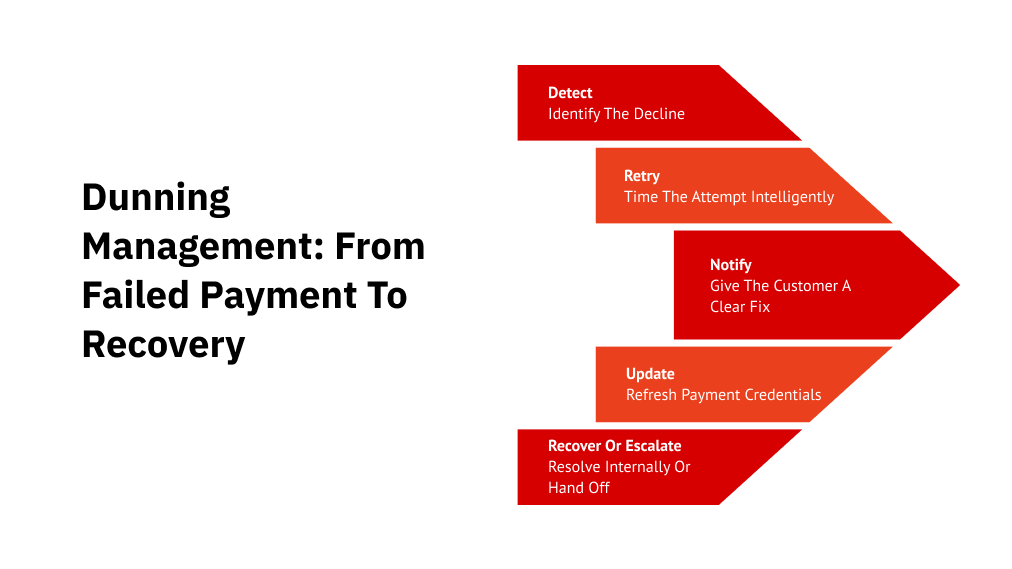
Effective dunning follows a sequence, moving from automated detection through to recovery or escalation.
Step 1: Detect the failed payment
Recovery starts with knowing a payment failed and why. Real-time decline detection captures the response code the moment a charge is rejected.
- Soft decline (insufficient funds, issuer timeout): routes into the retry queue.
- Hard decline (expired card, closed account): skips retries and triggers a customer notification instead.
A 24-hour delay in detection is a 24-hour head start for churn.
Step 2: Retry intelligently
The retry is the highest-leverage step in dunning automation for subscriptions. Smart retry logic times each attempt around:
- Day and time: Payroll cycles and weekday banking hours clear at higher rates.
- Decline type: Insufficient funds benefits from a 48-hour wait; a gateway timeout can be retried within minutes.
- Issuer behavior patterns: Some banks approve more in the morning; others batch-process overnight.
Most successful setups retry three to four times over a one-to-three-week window, with spacing mattering more than the total count.
Step 3: Notify the customer
When retries alone can’t resolve the decline, the subscriber needs a clear, simple path to fix it. Effective notifications:
- Are empathetic, not threatening: “We had trouble processing your payment,” not “Your account is past due.”
- Include a direct, one-tap action link.
- Use the right channel: email for a first notice, SMS for urgency, in-app for subscribers already engaged.
The first notification should go out within 24 hours of a failed retry.
Step 4: Update the payment method
Stale card data is the single biggest silent cause of failed subscription payments.
- Account updaters: Visa and Mastercard refresh card details after replacements.
- Network tokenization: Uses auto-updating network tokens to improve approvals.
- Self-service links: Let customers update payment details when the first two fail.
Step 5: Recover, escalate, or offboard
The process lands in one of three places:
- Recovery: The retry succeeds, or the card refreshes, and the subscription continues uninterrupted.
- Escalation: Automated dunning is exhausted, and the account moves to a specialist team for compliant, targeted outreach.
- Offboard: The subscriber is genuinely gone, and a clean process preserves the door for reactivation later.
Escalation is where most subscription businesses leave money on the table. The accounts that survive every retry, email, and SMS still represent recoverable revenue, which is exactly the stage third-party collections is built to work.
Smart retries vs. basic retry logic
Basic retries fire on a fixed schedule, every 24 to 48 hours, regardless of why the payment failed. Smart retries adjust the timing based on the decline reason, the subscriber’s payment history, and issuer patterns, so the retry actually matches the conditions that are likely to let it succeed.
| Basic Retries | Smart Retries | AI-Optimized | |
| Timing | Same interval always | Adjusted by decline type, day | Scheduled per account |
| Success rate | Lowest ceiling | Measurably higher | Highest at scale |
| Customer impact | Risk of card-network penalties | Fewer unnecessary attempts | Minimal failed attempts |
Retrying the same card at the same time simply recreates the conditions that caused the first failure, which is why basic retries hit a recovery ceiling fast.
The role of account updater and network tokenization
Even the best retry can’t recover a card that’s no longer valid. Account updaters push refreshed credentials from Visa and Mastercard automatically when an issuer reissues a card. Network tokenization keeps a token valid even when the physical card changes and carries higher approval rates.
Together, they’re the backbone of effective recurring billing recovery, closing the largest category of preventable declines: stale card data, before a soft decline ever needs a retry.
Best practices for subscription dunning management
Knowing how dunning works is one thing. Running it well is another, and the gap usually comes down to a few operational decisions.
Lead with prevention
Pre-dunning targets the most predictable failure point: expiring cards. Flag cards expiring within 30 to 60 days, send a friendly one-tap update prompt that reads like a convenience, and run account updater queries before each billing cycle to catch reissued cards early. Every decline prevented is one fewer retry and one fewer subscriber at risk.
Personalize and time your communications
The message determines whether a customer fixes the issue or ignores it. A line like “your subscription is on hold” reassures; “your account is delinquent” creates friction the customer didn’t ask for. Match the channel to the moment: email first, SMS for follow-ups, in-app for active users. Send the first message within 24 hours, space follow-ups three to five days apart, and provide a single, login-free link.
Layer your recovery tactics
No single tactic recovers everything. Account updaters refresh credentials before billing, smart retries handle what fails next based on decline type, and customer notifications catch what retries can’t. Layered together, each step recovers what the one before it missed.
For accounts that survive this entire sequence and still carry an unpaid balance, debt collection outsourcing services are where the remaining revenue sits.
| Pro tip: Set a hard stop on your sequence. Endless retries and emails erode goodwill and can trigger card-network penalties from Visa and Mastercard. |
How to measure if your dunning is working
Four metrics separate a healthy Dunning setup from one that’s just generating activity.
| Metric | What It Measures | Why It Matters |
| Recovery rate | Attempted rate: payments needing real intervention, not first-attempt clears | The honest number; naive rates inflate performance |
| Involuntary churn rate | Subscribers lost monthly to failed payments | Falling rate means dunning catches more before cancellation |
| Revenue recovered | Monthly dollars, and as a share of failed volume | The number finance tracks most closely |
| Time to recover | Days from decline to successful charge | Faster recovery means less service disruption |
The most common mistake is crediting dunning for payments that would have succeeded anyway, which inflates recovery rates and masks whether your actual subscription payment recovery logic is improving. Consistent, transparent portfolio recovery services help distinguish genuine recovery from baseline performance.
When dunning isn’t enough: How First Credit Services recovers what automation misses
Automated dunning recovers a meaningful share of failed payments, but not every account. Aged receivables, high-value B2B subscriptions, and repeat failures often exhaust every retry with no resolution in sight. These are still recoverable revenue; the subscriber may not even know their payment failed, but they need targeted outreach, not another retry.
First Credit Services is a digital-first receivables specialist that picks up exactly where billing tools stop, running omnichannel outreach across SMS, email, chat, and phone with compliance built into every touchpoint, protecting the brand relationship rather than risking it.
Backed by UCEP, the company’s platform that scores each account and routes it to the right channel and timing, the CFO of a chain of low-cost, high-volume health clubs reported recovering up to 70% of monthly failed payments through this subscription payment recovery model, roughly $6,000 a month per club.
| Pro tip: The goal at this stage is recovering revenue and keeping the relationship intact. A subscriber recovered through empathetic outreach is more likely to stay than one who was chased. |
In-house dunning vs. outsourced recovery: How to decide
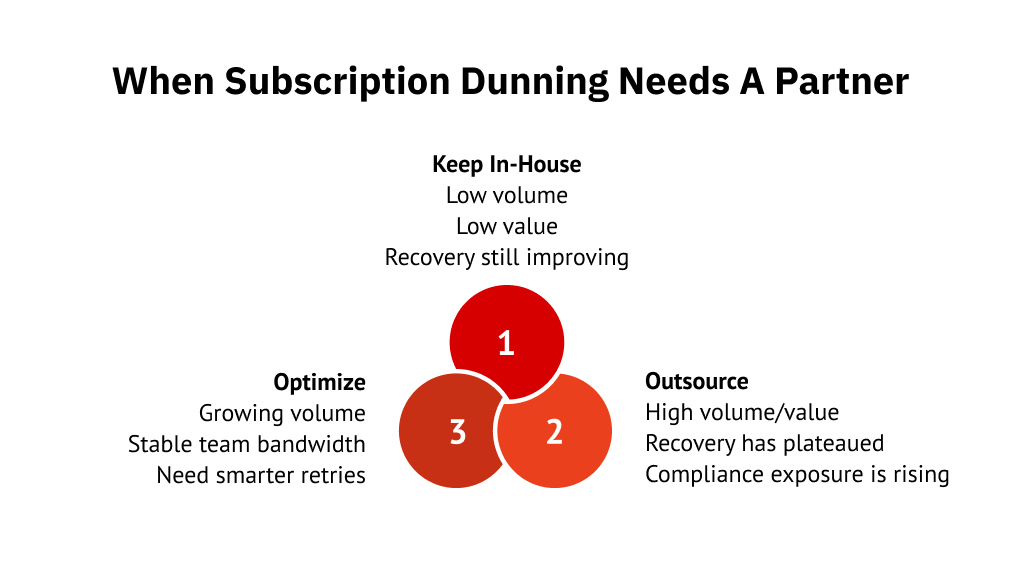
Most subscription businesses start with whatever their billing platform provides; Stripe, Chargebee, Recurly, and similar tools include basic retries and email notifications. That’s often enough early on.
Five signals tell you when your subscription dunning management setup stops being enough:
- Failed-payment volume: Hundreds or thousands of monthly failures hit a recovery ceiling that basic retries can’t clear.
- Team bandwidth: Dunning needs ongoing monitoring; when a team is stretched, recovery rates slip.
- Compliance risk: Outreach around failed payments touches FDCPA and TCPA, and stricter rules apply as balances age.
- Average subscription value: Higher-value accounts justify more specialized recovery effort.
- Recovery-rate ceiling: A plateaued rate despite optimization means the remaining failures need a different approach entirely.
| Scenario | What Works |
| Low volume, low value | Built-in billing platform dunning |
| Growing volume, stable bandwidth | Smarter retry tooling, pre-dunning |
| High volume/value, flat recovery | Outsourced partner for surviving accounts |
| Compliance-sensitive industry | Outsourced recovery with built-in compliance |
Most businesses don’t choose one or the other. They keep the billing platform’s dunning for the automated layer and bring in a partner like First Credit Services for accounts that outgrow it, covering the full spectrum from first decline to aged balance.
Common dunning mistakes to avoid
Even well-intentioned Dunning setups make mistakes that quietly erode recovery rates. All are fixable:
- Fixed-timer retries: insufficient funds on Monday will still be insufficient funds on Tuesday. Time retries to payday and bank processing windows instead.
- Threatening tone: “Action required: your account is past due” creates anxiety, and anxious subscribers cancel faster than they update a card.
- Skipping pre-dunning: a friendly prompt 30 days before a card expires prevents the decline your dunning process would otherwise have to recover.
- No hard stop: Visa and Mastercard monitor retry volume; three to four attempts over two to three weeks is a reasonable ceiling before penalties kick in.
- Treating every decline the same: retrying an expired card wastes cycles that should go straight to a customer notification instead.
- Ignoring account updater services: stale card data drives a large share of preventable declines, and updater queries resolve many silently.
- Never reviewing the sequence: payment patterns shift, so a two-year-old dunning setup rarely matches your current failure profile.
Fixing even two or three of these is usually enough to meaningfully lift recurring billing recovery without touching your core retry logic.
Conclusion
Failed subscription payments are a revenue problem that dunning management for subscriptions is built to solve. A layered process, smart retries, account updaters, timely notifications, and pre-dunning recover the majority of declined charges before subscribers ever notice an issue.
The accounts that slip through automated dunning still represent real revenue. Aged balances, high-value subscriptions, and repeat failures need a different approach: specialist recovery with compliant, multi-channel outreach designed to resolve the situation and keep the relationship intact.
Talk to us at First Credit Services about recovering the subscription revenue your billing tools are leaving behind.
FAQs
1. What does Dunning mean in subscription billing?
Dunning is the automated process of retrying a failed payment and notifying the customer to fix it before the subscription lapses.
2. How many times should you retry a failed subscription payment?
Most setups retry three to four times over one to three weeks, timed to paydays rather than a fixed schedule.
3. What’s the difference between debt management and debt collection?
Dunning handles early, automated recovery while the customer is active; debt collection takes over once attempts fail and the balance ages.
4. Can dunning management reduce involuntary churn?
Yes, since involuntary churn is largely recoverable, layered retries, account updaters, and clear communication recover a meaningful share of it.
5. Do I need dunning software, or is my payment processor enough?
Built-in retries handle some payments, but high-volume or high-value businesses often need smarter tooling or an outsourced partner to lift recovery.
6. When should a subscription business outsource payment recovery?
When failed-payment volume outgrows your team, compliance risk rises, or built-in retries have plateaued while revenue keeps leaking.