


Subscription churn is the rate at which subscribers cancel or fail to renew over a given period. Voluntary cancellations get most of the attention. Payment failures often get overlooked, even though they drive a significant share of total subscriber loss.
The gap is measurable. Most retention strategies address onboarding, engagement, and cancellation flows. Those cover voluntary churn. They do nothing for a subscriber whose card has expired or whose bank has declined a renewal. That subscriber wanted to stay.
This guide covers both sides: where voluntary strategies hit their limit, why payments fail at scale, and how to build a structured recovery program.
What causes subscription churn, and why is the fixable half ignored
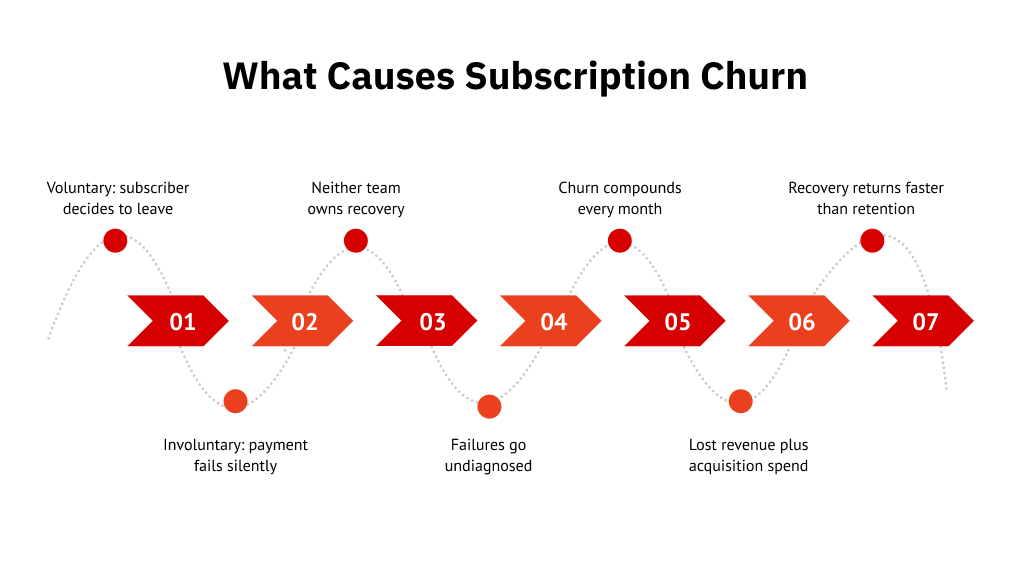
Subscription churn is caused by voluntary cancellations and involuntary payment failures. Voluntary churn happens when a subscriber actively decides to leave. Involuntary churn happens when a payment fails and the subscription lapses on its own. Most retention strategies focus only on the voluntary side.
Voluntary churn vs. involuntary churn
Voluntary churn has clear triggers. Subscribers cancel because of poor onboarding, a perceived value gap, pricing friction, or a stronger competing offer. These are product and experience problems.
Involuntary churn is harder to detect. A card expired, a bank declined the charge, billing details fell out of date, or an authorization failed. The subscription just stopped.
| Churn type | What drives it | What fixes it |
| Voluntary | The subscriber decides to leave | Product, pricing, and experience changes |
| Involuntary | Payment fails silently | Payment recovery infrastructure and operations |
Retention budgets reflect this imbalance. Product teams invest in onboarding sequences and engagement campaigns. Growth teams build cancellation-save flows and run win-back experiments. Payment failures fall between these teams, and neither one owns the recovery process.
| Pro tip Separate voluntary cancellations from payment-driven lapses in your churn reporting. Most billing platforms flag a reason code on every lost subscriber. If your data does not split the two, you cannot allocate retention spend where it will actually recover revenue. |
The compounding cost most retention strategies miss
Churn compounds monthly. A 5 percent monthly churn rate does not mean losing 60 percent of subscribers in a year. Compound 0.95 over 12 months, and you keep just 54 percent of the starting base. The other 46 percent is gone.
Every lost subscriber carries a double cost. You lose the full customer lifetime value you would have collected. You also lose the acquisition spend you already invested to win them.
Involuntary churn reduction carries a faster return. Product changes and customer success programs take months to reduce voluntary churn. Structured payment recovery operations can lift involuntary recovery rates by double digits in weeks.
Where subscription retention strategies hit their ceiling
Subscription retention strategies target conscious cancellation decisions. Pricing adjustments, customer success outreach, and cancellation save flows each give the subscriber a reason to stay. These playbooks work for voluntary churn. They have no mechanism to reduce subscription churn caused by failed payments.
Cancellation flows and save offers
The strongest voluntary intervention happens at the cancellation screen. Effective save flows pair an exit survey with an offer matched to the subscriber’s stated reason. Price concerns trigger a pause or downgrade option. Feature gaps trigger a usage walkthrough or roadmap preview.
| Pro tipMatch your save offer to the cancellation reason. Generic discounts answer a problem the subscriber didn’t name. A subscriber who selected “too expensive” needs a pause option, not 10 percent off a plan they already can’t justify. |
Pricing and customer success
Tiered plans and pause options let subscribers scale down instead of canceling. Both preserve the billing relationship and protect customer lifetime value.
Dedicated customer success teams extend subscriber retention by flagging usage drops and renewal risks early. Without this function, churn prevention relies entirely on the subscriber choosing to speak up. Most don’t.
What no voluntary strategy can recover
Every approach above assumes a conscious decision to leave. Failed payments bypass that decision entirely. The subscriber intended to renew. Their billing relationship broke without their knowledge or input.
Here is where the asymmetry shows. Most subscription businesses invest heavily in voluntary retention playbooks. Their involuntary churn response is a default retry schedule and a single dunning email. The most recoverable share of subscription churn gets the least structured omnichannel recovery strategies.
Why subscription payments fail at scale
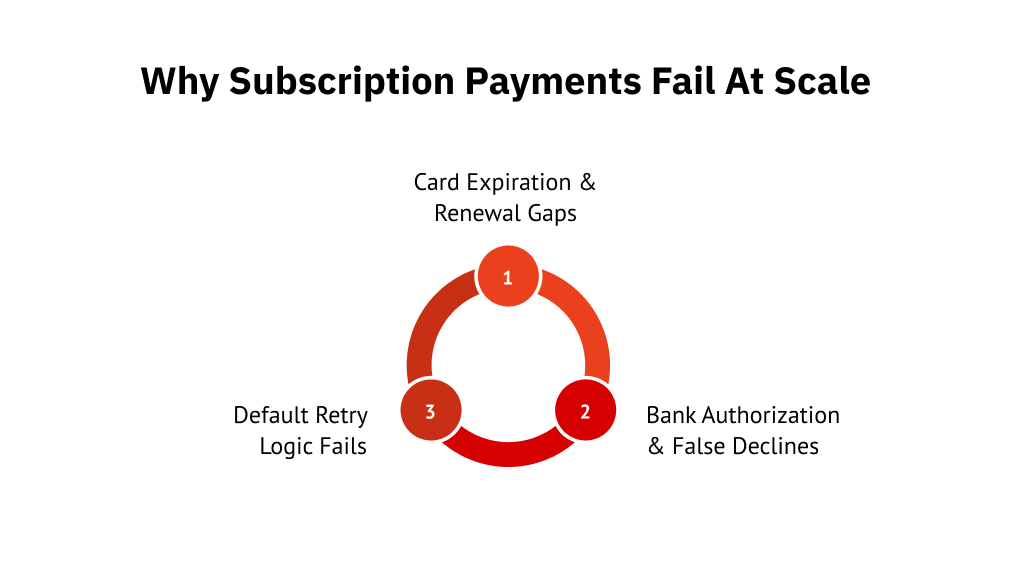
Subscription payments fail at scale because card expiration and bank authorization create failure points that multiply with subscriber volume. Default retry logic, the standard response, cannot keep pace.
Card expiration and renewal gaps
Every credit and debit card has an expiration date. At 1,000 subscribers, a 2 percent monthly expiration rate means 20 failed renewals. At 100,000 subscribers, that same rate produces 2,000 silent cancellations every month.
Card networks offer account updater services that refresh expired card details before a renewal attempt. Most subscription businesses delay adopting them until revenue loss becomes visible.
Bank-side authorization is the least predictable failure point. Banks evaluate each transaction against fraud models, spending patterns, and account limits. A recurring charge can trigger a decline even when the subscriber has sufficient funds.
In fact, 56 percent of U.S. consumers experienced a false payment decline within a 90-day period (PYMNTS Intelligence 2024).
Subscription charges are especially vulnerable. Banks flag repeating transactions from unfamiliar merchant names, particularly after a subscriber receives a replacement card. These failures generate no alert on the subscriber’s end.
Authorization rates shift by time of day and transaction amount. A renewal processed at 2 AM faces different treatment than one at 10 AM. Standard billing systems ignore these patterns entirely.
Why default retry logic fails
Subscription platforms typically retry failed payments on a fixed schedule. The common pattern is three attempts over seven days, using the same time, amount, and card each time. This approach treats every decline identically.
In practice, declines split into two categories that require opposite responses.
| Decline type | Cause | Right response |
| Hard decline | Canceled card, closed account, invalid number | Stop retrying. Contact the subscriber to update payment details. |
| Soft decline | Insufficient funds, bank timeout, temporary fraud hold | Retry with adjusted timing. A single well-timed attempt often resolves it. |
At scale, a blanket retry schedule recovers some soft declines by chance. It misses timing-sensitive failures and ignores hard declines that need direct subscriber outreach.
How to build a subscription payment recovery program
A subscription payment recovery program catches failed payments before they cancel subscribers and recovers them through structured outreach when they do. Building one is the most direct way to reduce subscription churn from payment failures.
Pre-dunning prevention and omnichannel dunning
Recovery starts before the payment fails. Notify subscribers 30 days before their card expires, giving them time to update billing details. This prevents involuntary churn before any charge is declined.
When a payment fails, launch an omnichannel dunning sequence across email, SMS, and in-app messaging. Time the first message to the failure itself. Space follow-ups across several days with escalating clarity and an empathetic tone.
Every message should state the amount due and include a one-click payment update link. Friction in the update process directly lowers recovery rates.
Static dunning sequences treat every failed payment the same way. An AI-driven contact strategy that scores accounts and selects the right channel, message, and timing per subscriber consistently outperforms them. This is where first-party recovery programs gain their edge over basic retry logic.
Account updater and network tokenization
Card networks like Visa, Mastercard, American Express, and Discover offer automated services that update stored card details when cards are reissued. These services prevent payment failures from expired or replaced cards before a charge even processes.
Network tokenization goes further. It replaces card numbers with tokens that persist through card changes, reducing payment disruption at the infrastructure level.
Subscription businesses that skip account updater and tokenization lose subscribers to a problem the card networks have already solved.
When internal recovery reaches its ceiling
Internal billing teams handle day-to-day operations well. Specialized recovery at scale is a different problem.
When failure volumes climb, recovery rates plateau, or compliance requirements add complexity, the internal model runs out of room to improve. A recovery partner with dedicated infrastructure, AI-driven contact optimization, and omnichannel outreach can move rates beyond what default billing tools achieve.
The real question is whether the gap between current performance and achievable performance justifies bringing in third-party recovery services. For most high-volume subscription businesses, that gap represents the difference between acceptable and preventable churn.
How First Credit Services reduces involuntary subscription churn
When internal recovery reaches its ceiling, subscription businesses need a partner with the infrastructure, compliance depth, and contact optimization to move recovery rates beyond what default billing tools achieve. First Credit Services delivers that as a managed service.
The First Credit Services model for recurring revenue recovery
Coverage spans first-party recovery, third-party recovery, and managed service engagements under one program. The same partner handles early billing follow-up and aged account recovery, with no vendor handoff as accounts age.
Subscriber outreach at scale requires compliance controls that most internal billing teams are not built to manage. First Credit Services holds Payment Card Industry Data Security Standard (PCI DSS) Level 1 and Service Organization Control 2 (SOC 2) Type II certifications to protect subscriber payment data. Operations follow the Fair Debt Collection Practices Act (FDCPA) and the Telephone Consumer Protection Act (TCPA), with live call auditing, role-based agent training, and automated monitoring.
That compliance infrastructure supports more than 125 million interactions annually across four global call centers, built over 30-plus years in receivables management.
UCEP (Unified Consumer Engagement Platform)
UCEP is First Credit Services’ proprietary AI-powered engagement and payment platform. First Credit Services operates it entirely on the client’s behalf.
The platform scores accounts using advanced analytics and selects the right message, channel, and timing per subscriber across SMS, email, chat, and phone. Subscribers use the self-service portal to:
- View balances and access AI-driven personalized settlement offers
- Set up customizable payment plans or use promise-to-pay options
- Pay from mobile or tablet through personalized links with no login required
- Schedule a callback to control when and how they engage
For first-party engagements, the portal runs under the client’s brand. Subscribers see the business they signed up for, keeping the experience consistent through recovery.
When First Credit Services fits
First Credit Services fits subscription businesses with meaningful recurring billing volume that lose subscribers to payment failures faster than their internal team can recover them.
The strongest fit is mid-market to enterprise subscription businesses in SaaS, media, financial services, and healthcare. These organizations need managed recovery with compliance and subscriber experience built into the program.
The model works best when payment failure volumes justify a dedicated recovery partner with its own infrastructure, compliance controls, and contact optimization capability.
Reduce subscription churn by recovering what your billing platform misses
Subscription churn is driven by two different problems: voluntary cancellations and involuntary payment failures. Voluntary churn requires better onboarding, engagement, pricing flexibility, and cancellation flows. Involuntary churn requires smarter dunning, card updater tools, and a structured recovery operation.
Most subscription businesses have invested meaningfully in the first. The second is where the most recoverable revenue remains.
Losing subscribers to payment failures that could have been caught isn’t a retention problem. It’s a recovery gap, and it’s one you can close. If your internal recovery rate has plateaued, a portfolio assessment with a recovery partner can show you what revenue is recoverable.
First Credit Services helps subscription businesses recover failed payments and reduce involuntary churn through AI-driven, omnichannel recovery programs. Book a demo to see how a structured recovery approach can protect your recurring revenue.
FAQs
1. How do you calculate subscription churn rate?
Divide the number of subscribers lost during a period by the total number of subscribers at the start of that period. Multiply by 100 to get the percentage. For example, losing 50 subscribers from a base of 1,000 equals a 5 percent monthly churn rate.
2. What is a good churn rate for a subscription business?
Most subscription businesses target a monthly churn rate between 3 and 5 percent. The benchmark varies by industry, pricing model, and contract length. Annual subscriptions typically see lower monthly churn than month-to-month plans.
3. What is the difference between revenue churn and customer churn?
Customer churn measures the percentage of subscribers who cancel. Revenue churn measures the percentage of recurring revenue lost.
A business can lose many low-value subscribers and see high customer churn with low revenue churn. Revenue churn is typically the more actionable metric for financial planning.
4. Does billing frequency affect subscription churn rate?
Yes. Monthly billing creates more failure points because each billing cycle is a potential churn event. Annual billing reduces those failure points and locks in a longer commitment. Businesses that offer both options typically see lower churn rates on annual plans.
5. Can you recover subscribers after involuntary churn?
Yes, but recovery rates drop sharply with time. A subscriber whose payment fails today is far easier to recover than one who churned 30 days ago.
Win-back campaigns using email and SMS within the first 7 to 14 days after cancellation tend to recover the highest percentage of lapsed subscribers.
6. How does offering multiple payment methods reduce subscription churn?
Each additional payment method gives subscribers a fallback when their primary method fails. If a credit card is declined, the subscriber can complete the payment through a bank transfer, digital wallet, or backup card.
Accepting multiple payment types reduces the chance that a single card failure becomes a lost subscriber.