


Right now, about 1 in 20 people in the US carries a debt that has landed in third-party collections. Behind every one of those sits a business that already earned that money and still hasn’t seen it. The longer the balance sits, the harder it gets to pull back.
Debt recovery services turn those stuck balances back into cash without wrecking the customer relationship. If you run finance, billing, or collections and you’re weighing an outside partner, this guide is for you, especially when accounts have stalled in-house or already charged off.
You’ll see what these services actually include, how the process moves stage by stage, what providers charge, which compliance checks matter, what technology to expect, and how to judge a partner on the one number that counts: how much they lift recovery above what you’re already getting.
What debt recovery services actually include
Debt recovery services cover the full arc of turning unpaid balances back into cash: skip tracing, digital-first outreach, payment negotiation, dispute handling, legal escalation, and charged-off portfolio recovery. Most of the real work sits at the third-party stage, where accounts have already resisted every earlier attempt.
By the time an account reaches third-party recovery, it has ignored your reminders, missed its retries, and it has aged past 90 days or charged off outright. A recovery partner takes it over under its own name, tracks down people who have become unresponsive through skip tracing, and works the account toward a payment, a plan, or a settlement. This is the stage that decides how much of your written-off revenue you actually see again.
The strongest recovery partners also work pre-charge-off accounts, managing them quietly under your brand while delinquency is still fresh. This lets one partner carry an account from the first missed payment straight through to final resolution, with no handoff in between. For most businesses, the real challenge is recovering accounts that have already gone quiet and stopped responding.
None of this relies on outbound calling alone. A modern recovery partner starts with a digital-first strategy, prioritizing accounts based on the likelihood of repayment and the most effective way to reach each consumer. Outreach is coordinated across SMS, email, web chat, and self-service payment portals, while live agents focus on the conversations where they can have the greatest impact.
Behavioral scoring decides which accounts to work first and when to reach each person, so the effort lands where it can move the number. Partners still running a single outbound dialer on a fixed schedule leave money on the table by calling the wrong people at the wrong time.
How third-party debt recovery moves stage by stage
Accounts arrive already aged or charged off, so what you’re buying is how well each stage gets worked. Here’s the sequence from handoff to recovered cash.
| Stage | What happens |
| Placement and segmentation | You hand over aged or charged-off accounts. The agency scores each by likelihood to pay and reachability, then works the best bets first. |
| Digital-first outreach | It sequences text, email, chat, and self-service portal messages, adding agent calls only where they move things forward. |
| Resolution | The account moves toward a payment, a plan, or a settlement, with disputes validated and worked rather than stonewalled. |
| Legal escalation | Accounts that justify it go to litigation review and, where warranted, post-judgment enforcement. |
| Reporting and remittance | Recovered funds return on a set cycle, with account-level performance you can see. |
Every account here has already shrugged off reminders and missed its retries, so a friendly payment link won’t cut it. The agencies that recover more don’t push harder. They segment sharper and match channel and timing to each account, while the ones that plateau just dial everyone on the same schedule.
When to Outsource to a Third-Party Debt Recovery Agency?
You’ve reached the point for third-party recovery when your own attempts have stopped moving the number, and the balances are still there. Adding headcount or rewriting scripts rarely fixes it, because the bottleneck isn’t effort. It’s infrastructure. A team working aged accounts from spreadsheets can’t run the segmentation, channel mix, and timing that recovery takes once an account has already gone cold.
Volume is the other common trigger. When charged-off and seriously delinquent accounts pile up faster than anyone can work them, accounts age simply because nobody got to them in time, and every week that passes pulls the recoverable amount lower.
Compliance risk seals the case. As call and message volume climbs, FDCPA, Regulation F, and TCPA exposure grows faster than most internal teams can track, and one mishandled account can cost more than a year of agency fees. A dedicated third-party partner absorbs that exposure with a compliance function built for it.
How Much Do Debt Recovery Services Cost?
Almost every third-party agency works on contingency. You pay a percentage of what it recovers and nothing on what it doesn’t, which lines the agency’s incentive up with yours: it only earns when you get paid. The rate itself tracks the difficulty of the work, so older accounts, smaller balances, and people who’ve gone quiet cost more to work because they take more to close. Aged and charged-off placements sit at the harder end for exactly that reason.
Here’s the part most buyers fixate on: the wrong number. The contingency rate isn’t what decides whether outsourcing pays off. Work out your fully loaded cost to recover a dollar in-house, then compare it against what an agency actually returns on the same accounts, after its fee. A higher rate on balances your team can’t move still beats a lower rate, or a zero rate, on accounts nobody ever works.
That’s the real test: not what the agency charges, but how much it puts back in your account that you weren’t going to see otherwise.
The Compliance Bar Debt Recovery Services Have to Clear
Any debt recovery service you place accounts with is working under the FDCPA, Regulation F, and TCPA, plus state rules in nearly every place it operates. That’s the floor, not a differentiator. If a provider can’t speak fluently to how it stays inside those lines at volume, stop there.
Data security is the second layer. Look for PCI DSS for anything that touches payment data, SOC 2 Type II audits for systems and process integrity, and state licensing everywhere the provider collects, not just where its office sits.
A SOC 2 Type II report covers controls over several months rather than a single point in time, so it says more about how a provider actually operates than a Type I report does. Ask which type they hold and when it was last completed. One mishandled account can cost you more than the recovery was worth, so this isn’t box-ticking.
Past the legal minimum, a few credentials separate debt recovery services that treat compliance as infrastructure from the ones that treat it as a line on a slide: ACA International membership, SOC 2 audit reports you can actually request, and BBB accreditation. Ask for the certificate, not the claim. A provider that runs clean will hand it over without hesitating.
| First Credit Services holds the credentials that matter. RMAI Certified Receivables Business, PCI DSS compliant, AICPA SOC audited, BBB A+ accredited, and an ACA International member, backed by a documented compliance framework built over 30+ years. |
What Technology Debt Recovery Services Should Bring
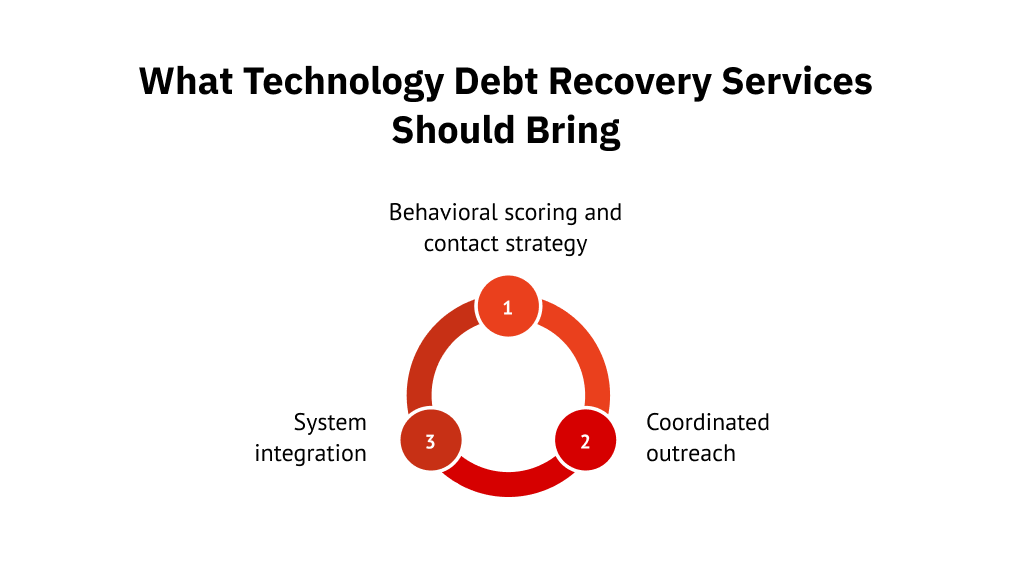
The technology behind a debt recovery service has one job on aged accounts: reach people who’ve stopped responding and make paying effortless once they do. Three things have to be real, not just on capabilities slide:
- Behavioral scoring and contact strategy. The service should decide which accounts to work today and reach each person on the channel and at the time they’re most likely to respond, instead of running everyone through the same fixed dialer schedule. On accounts that have already gone cold, right-time and right-channel is most of the battle.
- Coordinated outreach. Text, email, chat, voice, and a self-service payment portal should move as one sequence, so a person who ignores an email and later opens a text lands in the same conversation, not five disconnected ones. The portal also has to let people pay, set up a plan, or take a settlement on their own, any hour, without waiting for an agent.
- System integration. Every contact, payment, and dispute should post back to your systems automatically, so you’re never reconciling two versions of the same account by hand.
One way to test all of it: ask a provider to show a live payment moving from a person’s click through to a resolved account in real time. If they can only describe it, treat the capability as aspirational, not operational.
How to Vet a Debt Recovery Service’s Technology
You’ve already seen what the tech should do: score accounts, sequence outreach across channels, and let people pay on their own. The harder question is whether a provider’s version of it actually works or just demos well. One test cuts through it: ask them to show a real payment moving from a person’s click through to a resolved, updated account in real time. A provider running this every day can show you live. One that can only describe it is selling you a roadmap, not a capability. The same goes for integration: if updates don’t post back to your systems automatically, your team ends up reconciling accounts by hand, which erases part of what you outsourced to avoid.
How to Choose a Debt Recovery Service
Once you’ve decided to outsource, the choice comes down to proof, not promises. Aged and charged-off accounts are the hardest work in recovery, so the goal is to find a provider who can show they recover on accounts like yours, not one who describes the process well. Six things are worth verifying before you place anything:
- Recovery rates by account age, not a blended average. A single overall number hides how a provider does on the old, charged-off accounts you’re actually placing. Ask for rates broken out by age band, and for results from portfolios that resemble yours. This is the whole recovery-lift question, made concrete.
- A real track record in your kind of accounts. Years spent working the specific type and age of debt you’re handing over beats a logo on an industry page. Ask which portfolios make up most of their recovered dollars, and for how long.
- Account-level reporting you can pull anytime. A live dashboard shows you what’s happening account by account. A monthly PDF asks you to take recovery on faith. Ask exactly what visibility you get and how current it is.
- Complaint history, not just compliance claims. Meeting the legal bar is table stakes. The real tell is a low complaint rate at high volume, which shows a provider recovers without creating problems you’ll have to answer for later.
- Onshore, offshore, or both. Where accounts get worked shapes both cost and customer experience. Ask what a provider offers, what runs where, and how those agents are trained, then get the split in writing instead of accepting “we do both.”
- Contract terms before you sign. Read for placement minimums, exclusivity clauses, and how recall or exit works if performance disappoints. These decide how easily you can walk away, not just how you start.
The right partner won’t flinch at any of these. First Credit Services can put age-banded recovery data, account-level reporting, an onshore and offshore delivery split, and a documented compliance record on the table, so you’re placing accounts on evidence, not a pitch.
What to Expect from Debt Recovery Services on Aged Accounts
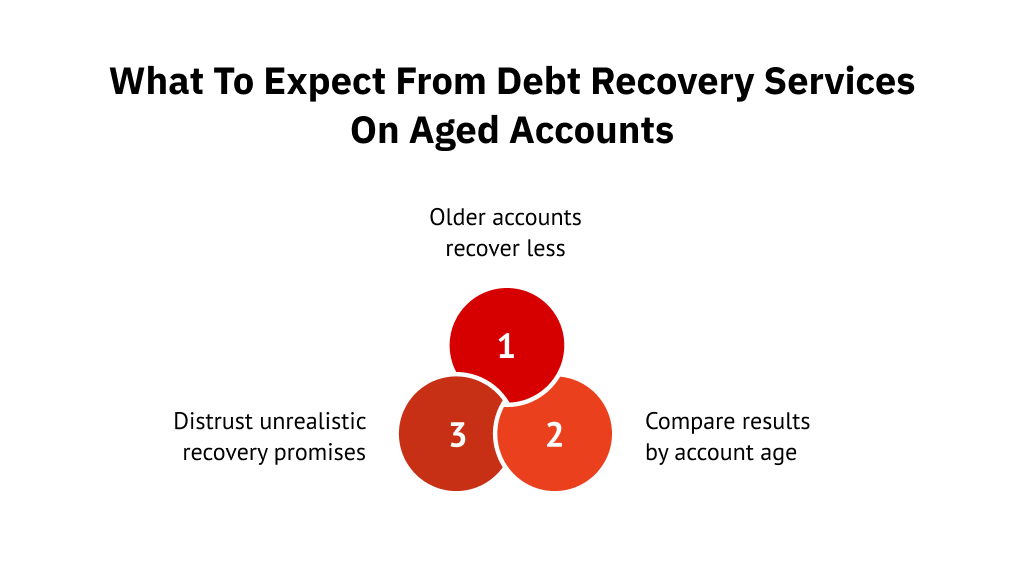
Set expectations against the accounts you’re actually placing. By the time debt reaches a third-party service, it has already aged, gone quiet, or charged off, so recovery rates here run lower than anything you’d see on fresh balances. Working accounts that everyone before had already given up on is hard, which is why the lift a provider adds over your current baseline tells you more than any headline rate.
A few things are worth holding in mind as you compare providers:
- Older accounts recover less, and no provider changes that math. A good service pulls more out of the same hard accounts than you were getting on your own. Judge them on that gap against your baseline and give an absolute recovery number far less weight.
- Ask for results on accounts like yours. A recovery rate only means something next to the age and type of debt it came from. A strong number on fresh accounts leaves you guessing about how a provider handles a charged-off portfolio.
- Be wary of anyone promising big. A provider who quotes recovery rates well above what aged accounts realistically return, or who won’t break results out by account age, is selling confidence. The honest ones tell you what a portfolio like yours tends to yield before they quote anything.
The best debt recovery services earn their keep by recovering from accounts you’d otherwise write off entirely, and by showing you the numbers to prove it.
Conclusion
When you’re placing aged or charged-off accounts, the number that decides everything is how much a service recovers above the baseline you’re already getting. That’s the lens to hold every provider up against, including this one.
First Credit Services is built for late-stage recovery. For a top 10 US credit card issuer, FCS took a stalled late-stage portfolio and tripled the recovery rate against the client’s prior baseline, scaling to 350-plus agents and 85,000 people engaged every month across onshore and offshore operations on a $750M book. The client named FCS its Collections Agency of the Year in 2024 and 2025.
Behind that sits UCEP, the FCS digital engagement platform that scores each person and reaches them on the right channel at the right time, backed by first-party and third-party collections, extended business office, and BPO support, and a compliance record built over 30-plus years.
Place your next batch of aged or charged-off accounts with FCS and measure the lift against your current baseline. Talk to FCS about a third-party recovery program built around your portfolio.
FAQs
1. Will using a debt recovery agency damage customer relationships?
Not if you pick the right partner. The right agency stays respectful and compliant, usually leading with digital, low-friction communication before it escalates to a call. That approach recovers what’s owed while keeping your brand and customer relationships intact.
2. When should a business hire a debt recovery agency?
Hire one when internal recovery has plateaued despite added headcount, when failed-payment churn is eroding recurring revenue, or when compliance risk from in-house outreach is growing faster than your team can manage.
3. What is the difference between first-party and third-party collections?
First-party collections run under your brand and suit early-stage accounts. Third-party collections run under the agency’s own name and suit accounts 60-plus days past due or already charged off.
4. Do recovery agencies handle pre-charge-off and charged-off accounts?
Yes. Full-lifecycle providers handle both: pre-charge-off accounts through first-party or structured outreach, and charged-off accounts through third-party collections and legal escalation when needed.
5. How quickly are recovered funds disbursed back to the creditor?
Most agencies remit recovered funds on a set cycle, often monthly, after deducting their contingency fee. Ask for the exact disbursement schedule and reporting format before signing a placement agreement.
6. Is debt recovery the same as debt settlement?
No. Debt recovery services work on behalf of the creditor to collect what’s owed. Debt settlement companies work on behalf of the consumer to negotiate down what they owe, usually for a fee.