


Auto loan collections is harder than it was five years ago. Not because the economy is worse. Because the loans are.
The 60-day-plus delinquency rate on subprime auto loans hit 6.9% in January 2026, the highest on record since the early 1990s, per Fitch Ratings. The number matters most in context: unemployment sits near 4% today. When delinquency last ran near this level, the country was in the middle of the 2008 financial crisis.
Borrowers aren’t falling behind because the economy collapsed. They’re behind because vehicle payments are high, loan terms are too long, and the pandemic-era financial buffer is gone.
Phone-only outreach is losing traction. Regulation F has capped call frequency. And approaches that worked five years ago are producing flat recovery rates today.
This guide covers where operations are breaking down, what compliance now requires, the strategies that lift recovery rates, and when outsourcing to a specialist makes more sense than scaling in-house.
The State of Auto Loan Collections in 2026
Three factors define the current auto loan collections environment: record origination volumes, a delinquency rate that isn’t normalizing, and a regulatory posture that has raised the cost of compliance gaps.
Auto debt is at an all-time high
The $1.69 trillion in outstanding auto loan balances reflects a structural shift in how Americans are financing vehicles. Average loan terms have stretched well past 60 months, with a significant share of new originations hitting 72 to 84 months.
Longer terms leave borrowers underwater for longer. When income gets disrupted, whether by a job loss or an unexpected bill, payment stress hits immediately. With $182 billion in new originations in Q1 2026 alone, the volume feeding into collections queues is not slowing down.
Auto delinquency is sticky, not improving
The 2.97% flow into serious delinquency in Q1 2026 isn’t normalizing. Mortgages have stabilized; auto hasn’t. Subprime portfolios are absorbing a disproportionate share of the stress, and those accounts carry thinner recovery margins to begin with.
For lenders with any subprime exposure, flat or rising auto loan default rates over consecutive quarters are a signal that current recovery operations are not keeping pace.
The CFPB is paying attention
The CFPB’s October 2024 Supervisory Highlights, Special Edition on Auto Finance made clear that collections practices across the full auto lifecycle are under active regulatory review. The message to lenders and their collections partners is straightforward: compliance posture is now a recovery economics issue.
A single enforcement action can cost more than a year of recovered deficiency balances. The specific findings and their operational implications are covered in the compliance section below.
Signs Your Auto Loan Collections Process Isn’t Working
Most lenders don’t realize their auto loan debt collection process has a structural problem until recovery rates have been declining for multiple quarters. These are the signs worth catching earlier.
- Late-stage focus. If the bulk of your collections effort is concentrated on 60+ DPD accounts, the recovery economics have already shifted against you. Cure rates drop sharply as accounts age, and the cost per dollar recovered rises with them. Early intervention starts at day one, not day thirty.
- Phone-only outreach. Right-party contact rates on outbound calls have been declining for years. Younger borrowers don’t answer numbers they don’t recognize, and Regulation F’s seven-in-seven cap limits how aggressively you can push through that channel anyway.
- Manual segmentation. Treating a 31-day fresh delinquency the same as a 90-day repeat is leaving recovery on the table. A borrower who missed one payment due to a card expiry needs a very different approach than someone with a pattern of late payments and no response to prior outreach.
- Compliance gaps from scaling. Growing call volume without proportional investment in QA, script discipline, and consent tracking is precisely where most CFPB findings begin. Scaling a broken process just scales the risk.
- Disconnected systems. When your CRM, loan servicing, billing, and collections workflows don’t sync in real time, you get duplicated outreach, missed cures, and reporting that’s always a few days behind. Borrowers who have already paid still getting collection calls is both a compliance risk and a customer experience failure.
The Auto Loan Collections Compliance Guardrails You Can’t Skip
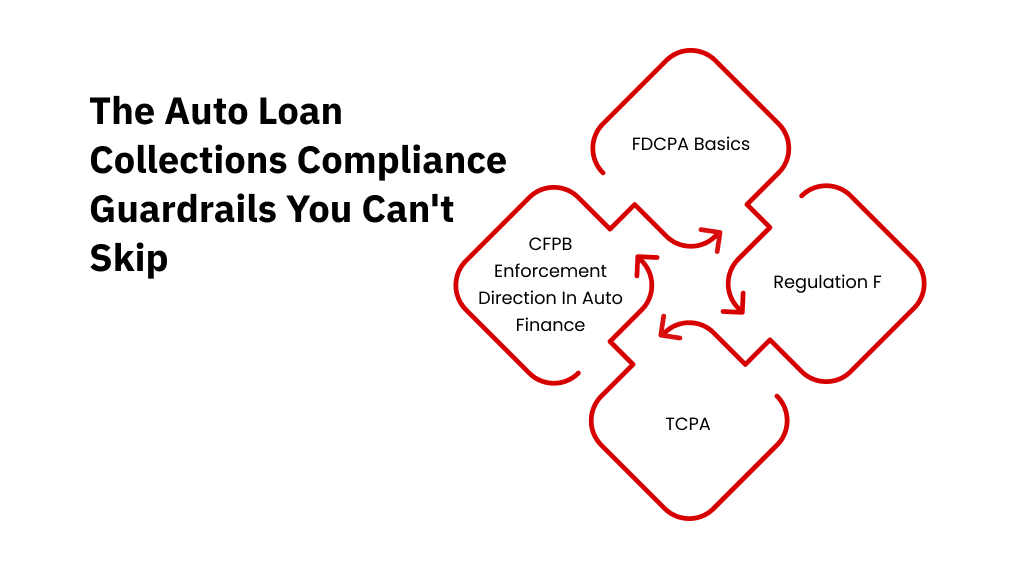
Compliance in auto loan collections isn’t a legal department concern that sits separate from operations. The rules governing how, when, and how often you contact borrowers directly affect your recovery capacity. Getting this wrong doesn’t just create legal exposure. It limits your ability to collect at all.
FDCPA basics
The Fair Debt Collection Practices Act sets the federal floor on debt collection conduct. It applies most directly to third-party collectors, but lenders running first-party operations increasingly model their practices against it because the CFPB has made clear it’s watching the full chain.
Harassment prohibitions, identity disclosure requirements, and dispute handling are where most process gaps surface during audits.
Regulation F
The CFPB’s rule implementing FDCPA introduced the most significant operational constraints for collections teams in decades. The headline item is the seven-in-seven cap: no more than seven calls per debt per consumer in any seven days. It also sets requirements for electronic communications, including opt-out mechanisms for email and SMS, and tightens validation notice rules.
For high-volume portfolios, staying inside those guardrails while maintaining contact frequency requires system-level enforcement, not just agent training.
TCPA
The Telephone Consumer Protection Act governs auto-dialed calls and texts. Consent must be captured, documented, and honored at the account level.
The risk is in the math: statutory damages run per message, meaning a consent documentation failure on a large SMS campaign can generate liability that dwarfs the recoveries the campaign produced.
CFPB enforcement direction in auto finance
The Bureau’s 2024 supervisory work on auto finance flagged four recurring problem areas: add-on product refund administration, payment misapplication, repossession conduct, and FCRA credit furnishing accuracy.
Each of these intersects directly with collections workflows. Repossession conduct and deficiency balance recovery workflows are specifically where the CFPB found gaps; both are high-risk areas during any compliance review. Lenders evaluating outside collections partners should treat compliance infrastructure, licensing, audit history, and documented regulatory workflows as a first-order selection criterion, not something to verify after the contract is signed.
Strategies That Improve Auto Loan Recovery Rates
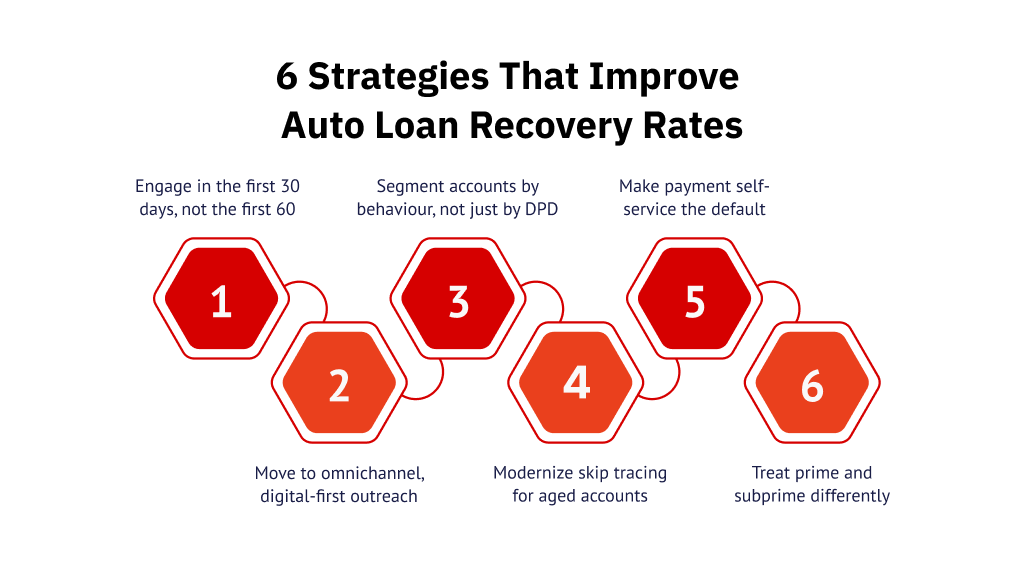
Recovery rate gaps rarely come from a single failure. They compound: outreach starts too late, channels don’t match borrower behavior, segmentation treats different accounts the same. The strategies below address each in sequence.
1. Engage in the First 30 Days to Protect Auto Loan Cure Rates
Recovery probability doesn’t decline gradually. The sharpest drop happens between 30 and 60 DPD, and early-window borrowers are far more likely to resolve with a single touchpoint than those first contacted at 60.
- Set an automated outreach trigger at day 1 to 3, not day 15 or 30. The first missed payment is the highest-probability recovery window.
- Frame early communications as payment reminders, not collection notices. The tone difference affects response rates and protects the customer relationship.
- Include a self-service cure path in the first message, a payment link or balance portal, so borrowers ready to resolve can act without calling.
2. Move to Omnichannel Outreach to Improve Auto Loan Contact Rates
The goal isn’t adding more channels. It’s letting each borrower respond through the one they actually use, with consistent messaging across all of them.
- Lead with SMS for initial contact. It drives faster response for most borrower segments than email or phone.
- Follow with email for documentation-heavy communication: payment links, installment plan details, and settlement options.
- Reserve voice calls for complex cases and negotiation. Calls should follow digital outreach, not precede it.
3. Segment Accounts by Behaviour, Not Just DPD Bucket
Two accounts at the same DPD can need completely different treatment. The data to do this well is usually already in your servicing system. The gap is in how it’s being used.
- Build at minimum three treatment tracks: first-time miss with self-cure history, pattern of late payments, and non-responsive or gone-dark. DPD alone doesn’t tell you which track an account belongs to.
- Factor in channel responsiveness from prior cycles. If a borrower resolved on a call last time but never responded to SMS, that should drive the outreach sequence this cycle.
- Review segmentation logic quarterly against actual cure outcomes. If your highest-outreach segment is producing the lowest cure rates, the segmentation isn’t working.
4. Modernise Skip Tracing for Aged Accounts
Aged accounts often fail because the contact data is cold, not because of the recovery strategy. Modern locator data combines address verification, employment confirmation, and device-level contact intelligence in near real time.
- Run a skip trace refresh on any account that has gone 60+ DPD without a right-party contact. Don’t wait for 90 days.
- Use a locator service that pulls from multiple data sources rather than a single database. A single-source trace misses too much.
- Document every third-party contact attempt during the trace. The FDCPA limits permissible contact with third parties, and an undocumented trace creates compliance exposure.
5. Make Payment Self-Service the Default
Most cures happen outside business hours when a self-service option exists. Borrowers willing to pay but unwilling to call will resolve through a portal when they won’t respond to outbound contact.
- Include a direct payment portal link in every outreach touchpoint, SMS, email, and voicemail. The link should go straight to that borrower’s account, not a generic login page.
- Enable payment plan and settlement options inside the portal. A borrower who can self-serve at 11pm won’t be waiting for a callback window.
- Track portal completion rates by channel source. If email-sourced visits complete at lower rates than SMS-sourced ones, the email CTA or landing experience needs attention.
6. Treat Prime and Subprime Auto Loan Collections Differently
Running both tiers through the same workflow wastes effort on prime and misses recovery opportunity on subprime auto collections. The risk profiles, payment behaviors, and resolution paths are too different for a single cadence to serve both.
- Set different contact cadences from day one. Prime borrowers typically resolve with one or two touchpoints in the first week. Subprime accounts need more frequent contact across a longer window.
- Build flexible arrangements for subprime: smaller installments, longer cure timelines, and settlement offers at realistic thresholds. A prime-style payment plan won’t move a subprime account with real cash flow constraints.
- Track cure rates by tier separately. A healthy blended recovery rate can mask a deteriorating subprime problem until it has already dragged the portfolio numbers down.
When Outsourcing Auto Loan Collections Makes Sense
Outsourcing isn’t the right move for every lender at every stage. But there are specific conditions where continuing to scale in-house stops making financial sense.
Signals it’s time to bring in a partner
- Delinquency volume is outpacing your internal team’s capacity, recovery rates are flat or falling despite added headcount, and internal process changes haven’t moved the numbers.
- Regulation F call caps and SMS consent management are creating compliance complexity your current team isn’t structured to handle at scale.
- You’re expanding into new states and multi-state licensing requirements are slowing down your ability to collect in those markets.
- Aged accounts are accumulating because your internal team is fully occupied with fresher buckets and can’t run a separate aged-debt strategy simultaneously.
What to look for in an auto loan collections partner
When evaluating an auto finance collections agency, the criteria below separate partners built for auto from generalist vendors who have added it to their service list.
- Demonstrated experience in auto finance specifically, across both prime and subprime, and across loan and lease receivables, not just general consumer collections.
- Compliance infrastructure you can actually audit: SOC 2 Type II, PCI DSS, documented Reg F and TCPA workflows, and a compliance team embedded in operations.
- Omnichannel and digital-first capability, not just call centre scale.
- Both first-party and third-party options under one partner, so you’re not managing two vendor relationships across the delinquency lifecycle.
- Contingency-based pricing so recovery cost is directly tied to recovery performance.
- Real-time reporting with account-level visibility, not monthly summary reports.
How FCS Approaches Auto Loan Collections
First Credit Services works with auto lenders managing auto loan delinquency across prime and subprime portfolios, covering both first-party and third-party auto finance debt recovery. The playbooks, agent training, and segmentation logic are built for auto finance specifically, not adapted from a generic collections model.
Both first-party and third-party under one partner
FCS first-party collections operates as a white-labeled extension of the lender’s brand. The consumer never sees the FCS name, and communication style aligns entirely to the lender’s standards.
When accounts escalate to late-stage or post-charge-off, FCS third-party handles recovery under its own identity. One partner across the full lifecycle means integrated reporting, consistent compliance controls, and no lost context between stages.
UCEP, the platform behind the operation
UCEP is FCS’s proprietary Unified Consumer Engagement Platform. It runs an AI-driven contact strategy that determines the best channel and time to reach each account based on behavioral data, not fixed schedules.
Omnichannel orchestration covers SMS, email, voice, and a 24/7 self-service payment portal where borrowers can resolve without agent involvement.
Compliance built into the operating model
Compliance at FCS is built into how the work gets done, not managed as a separate oversight function that reviews it afterward. Reg F and TCPA controls are embedded in the contact cadence system. Consent documentation is tracked at the account level, not reconciled in batch. Call monitoring ties directly to script compliance rather than running as a periodic audit.
Talk to us and see how we can help you.
Conclusion
Auto loan collections in 2026 is not a phone-and-letters operation anymore. The lenders posting better recovery numbers are engaging earlier, communicating across the channels borrowers actually use, building compliance into the workflow from the start, and treating segmentation as a strategy rather than an admin step.
The fundamentals haven’t changed: contact the right borrower, at the right time, through the right channel, with a path to resolution that’s easy to take. What’s changed is how much precision it takes to execute that at scale, and how quickly the compliance environment penalizes getting it wrong.
If your process isn’t delivering on those fundamentals, the gap compounds the longer it stays open.
Want to see how FCS recovers more on your auto loan portfolio without adding headcount? Contact us, and we’ll walk you through UCEP, our compliance setup, and what early-stage recovery could look like for your accounts.
FAQs
1. What is auto loan collections?
Auto loan collections is the process lenders use to recover missed or unpaid payments on financed vehicles. It covers early-stage outreach on fresh delinquencies, late-stage recovery on aged accounts, repossession coordination, and deficiency balance collection after a vehicle has been sold at auction.
2. At what point does an auto loan go to collections?
Most lenders begin internal collections activity between 1 and 15 days past due. Accounts typically move to a third-party agency around 90+ DPD or after charge-off, though many lenders now bring in first-party support much earlier to improve early-stage cure rates.
3. What’s the difference between first-party and third-party auto loan collections?
In first-party collections, the agency operates entirely under the lender’s brand and the borrower never knows a third party is involved. In third-party collections, the agency contacts the borrower under its own name.
4. How does Regulation F affect auto loan collections?
Regulation F caps third-party collectors at seven calls per debt per consumer in any seven-day period, sets rules for electronic communications and opt-outs, and defines validation notice content requirements. Many lenders voluntarily align first-party operations to the same standard to reduce regulatory exposure.
5. Can outsourcing auto loan collections actually improve recovery rates?
Yes, particularly for lenders whose internal teams are stretched across too many buckets or who lack omnichannel capability. Specialist partners bring auto-specific playbooks, multi-state licensing, and contingency pricing, so lenders only pay when accounts actually recover.
6. How are deficiency balances handled after repossession?
After a repossessed vehicle sells at auction, the deficiency balance is what the borrower still owes after subtracting the sale proceeds and allowable fees. Lenders either pursue it directly or place it with a licensed third-party collections agency for recovery.