

Churn does not always come with a cancellation email. Sometimes, it starts with a declined card. The customer may still want the product, but a failed payment can quietly turn an active subscription into lost revenue if the business does not recover it quickly.
According to PYMNTS and FlexPay’s 2023 Decision Guide, declined card payments drive involuntary churn, which accounts for 50% of all customer churn, and 80% of those failures are unrelated to the customer’s intent to pay. The customer wanted to stay, but the card did not go through.
The gap gets closed with a system: catch the decline early, retry it at the right time, refresh the card data behind it, and prompt the customer before the subscription lapses. Where automation stalls, a human recovery step picks up the balances left behind.
This piece breaks down failed payment recovery: why payments fail, how to recover them, and when to escalate.
What is failed payment recovery?
Failed payment recovery is the process of recapturing revenue from a recurring charge that failed, combining retries, updated card data, dunning, and escalation to win it back before the customer churns.
For example, a customer’s card expires mid-cycle, and the payment fails, even though they still want the product and just have the wrong card on file. Recovering failed payments is everything between that failed charge and either a successful payment or a lost customer.
Recovery differs from prevention: prevention stops a decline before it happens, while recovery starts after and wins the payment back before the account lapses.
That recovery work runs on four levers, and each one exists to catch what the lever before it missed:
- Retries: attempting the charge again, timed to the decline reason rather than a fixed schedule
- Card updates: refreshing expired or reissued card data automatically
- Dunning: notifying the customer directly and prompting them to act
- Escalation: handing aging or non-responsive balances to failed payment management, where a specialist takes over the follow-up
| Pro tip: Recovery works as a system. A business that only retries a failed card, without dunning or escalation behind it, recovers the easy wins and writes off the rest. |
Why do recurring payments fail?
Recurring payments fail because of insufficient funds, expired or outdated card details, issuer declines, fraud controls, or technical issues between the payment processor and the bank.
Soft declines vs. hard declines
Soft declines are temporary. They include insufficient funds, velocity limits, and network timeouts that may clear after a well-timed retry. Hard declines point to a payment method that cannot be recovered through another attempt, such as a stolen card or a closed account.
Distinguishing between the two prevents businesses from wasting retries and helps move each account to the right recovery step.
The most common reasons for decline
Recurring payments commonly fail because of:
- Expired or reissued cards
- Insufficient funds at billing
- Issuer risk flags or fraud holds
- Network, gateway, or processor timeouts
These issues often arise before the customer has any reason to notice or update their payment method.
Where in the flow failures happen
A decline can originate with the issuing bank, payment processor, or gateway. The source and decline code should determine the next action.
| Soft decline | Hard decline | |
| Cause | Insufficient funds, velocity limits, timeouts | Stolen card or closed account |
| Recoverable? | Yes, usually | No |
| Right action | Retry using reason-based timing | Request a new payment method |
Failures also occur beyond card payments. ACH transfers may fail because of insufficient funds, closed accounts, or incorrect banking details. Invoices can stall because of approval or billing disputes. A recovery program focused only on card retries will miss these balances.
That is why First Credit Services approaches failed payments as part of a connected revenue recovery services strategy across payment types.
The real cost: Involuntary churn and monthly recurring revenue leakage
Involuntary churn occurs when a customer loses access because a payment fails, even though they never chose to cancel. Unlike voluntary churn, it does not require winning back the customer’s interest. The immediate task is to restore a working payment method before the account lapses.
Even a modest decline rate can erode monthly recurring revenue as the subscriber base grows. Without separate reporting, that loss can disappear inside the overall churn rate and make growth look weaker without revealing the cause.
Why involuntary churn hurts more than voluntary churn
The central problem is that the business loses customers who still want the service.
- It wastes an existing relationship. The customer has already been acquired and has demonstrated product fit.
- It looks like ordinary churn. Combined reporting can hide how much of the loss was recoverable.
- It compounds over time. Each failed renewal removes current revenue and the future value of that customer.
Recovering these accounts is generally more efficient than replacing them because the relationship already exists. Only the payment problem needs to be resolved.
| Pro tip: Report recovered MRR separately from new and expansion MRR. This shows how much recurring revenue the recovery program restores and helps leadership evaluate its impact. |
The failed payment recovery framework
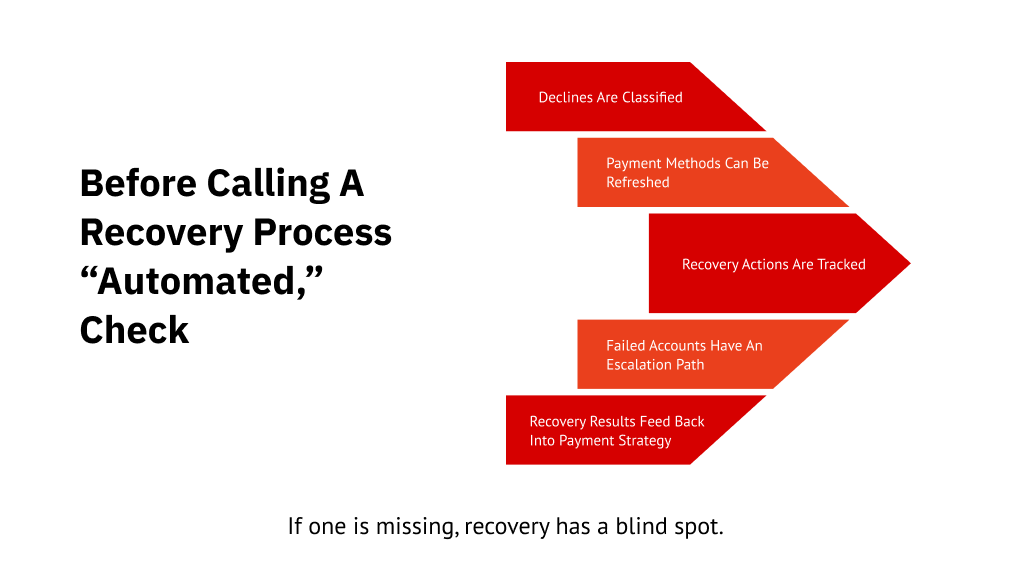
Failed payment recovery works as a sequence. Each layer addresses the balances the previous one could not resolve.
Smart retries
Retry soft declines when the underlying issue is likely to clear. Timing should follow the decline reason instead of a fixed schedule, with hard declines excluded from further attempts.
Card account updater
Services such as Visa Account Updater and Mastercard Automatic Billing Updater can refresh stored credentials after a card expires or is reissued. This may recover the charge without requiring customer action.
Dunning workflows
If retries and card updates fail, dunning prompts the customer to correct the payment method. A structured failed payment recovery program coordinates reminders, payment links, and live follow-up across the recovery window.
Customer-friendly communication
Messages should explain what happened, lead with the required action, and make payment easy. The channel and urgency can escalate as the account ages, but the tone should remain helpful and consistent with the brand.
Together, these layers recover temporary failures first and reserve manual escalation for balances automation cannot resolve.
The smart retry logic: Timing that actually works
The smart retries logic times each reattempt to the decline reason instead of a fixed schedule, which is what separates card decline recovery that actually converts from a system that just keeps guessing.
Static vs. intelligent retries
A static system reattempts every payment at fixed intervals. An intelligent system uses the decline code to determine whether to retry, when to retry, and when to move to another recovery method.
Collections workflow automation applies the same principle more broadly by using account and behavioral signals to select the next action.
| Decline reason | Static schedule | Intelligent retry |
| Insufficient funds | Fixed 24-, 48-, and 72-hour attempts | Times attempts around likely fund availability |
| Network timeout | Follows the standard schedule | Retries quickly because the issue may be temporary |
| Velocity limit | Retries at the next fixed interval | Waits longer for the issuer restriction to clear |
This approach improves recovery while reducing unnecessary attempts that can raise decline ratios or trigger issuer scrutiny.
How many times to retry and when
There is no universal retry count. A practical starting point is:
- Insufficient funds: Make two or three attempts around likely payroll cycles instead of retrying again on the same day.
- Network or processor errors: Reattempt once immediately and, if needed, again within 24 hours.
- Risk flags or velocity limits: Wait 48 to 72 hours before making one more attempt.
- Hard declines: Do not retry. Move directly to an account updater or request a new payment method.
The goal is to capture recoverable soft declines without repeatedly charging accounts that need a different solution. Once the reasonable retry window closes, dunning should take over.
| Pro tip: Review decline codes monthly. Misclassified responses can cause the system to waste attempts and distort recovery-rate reporting. |
Dunning done right: Sequences that recover, not repel
Retries happen in the background. Dunning brings the customer into the recovery process, making cadence, channel, and tone central to the outcome.
Building a dunning sequence
A practical sequence uses four to six touches over 14 to 21 days:
- Start with an immediate, neutral notice and a direct payment link.
- Follow up through the customer’s most responsive channel, adding SMS or an in-app prompt when email goes unanswered.
- Increase urgency as the cancellation date approaches, while reserving live outreach for high-value or non-responsive accounts.
Communicate the grace period clearly so the customer understands when access may pause or end.
The workflow should stop as soon as payment succeeds. It should also suppress messages when an account is disputed, paused, or already assigned for manual follow-up. These controls prevent unnecessary outreach and conflicting customer experiences.
Writing dunning messages
Effective messages make the next step obvious:
- Put the payment link and required action near the top.
- Explain briefly that the charge failed and what happens if it remains unresolved.
- Link directly to the relevant balance or payment-update page.
- Use helpful language instead of aggressive collection phrasing.
Every extra login screen, form field, or unclear instruction creates another opportunity for the customer to abandon the process.
Personalization should remain practical. Referencing the account, failed amount, and service at risk gives the customer enough context without turning a reminder into a lengthy billing notice.
The Dunning sequence checklist
Before launch, confirm that each message has a direct payment path, consistent branding, decline-aware wording, a clear timeline, and a defined escalation point.
Once automated messages stop producing results, move the account forward. An adaptive payment reminder program can add live, first-party follow-up while preserving the customer experience.
When automation isn’t enough: In-house vs. outsourced recovery
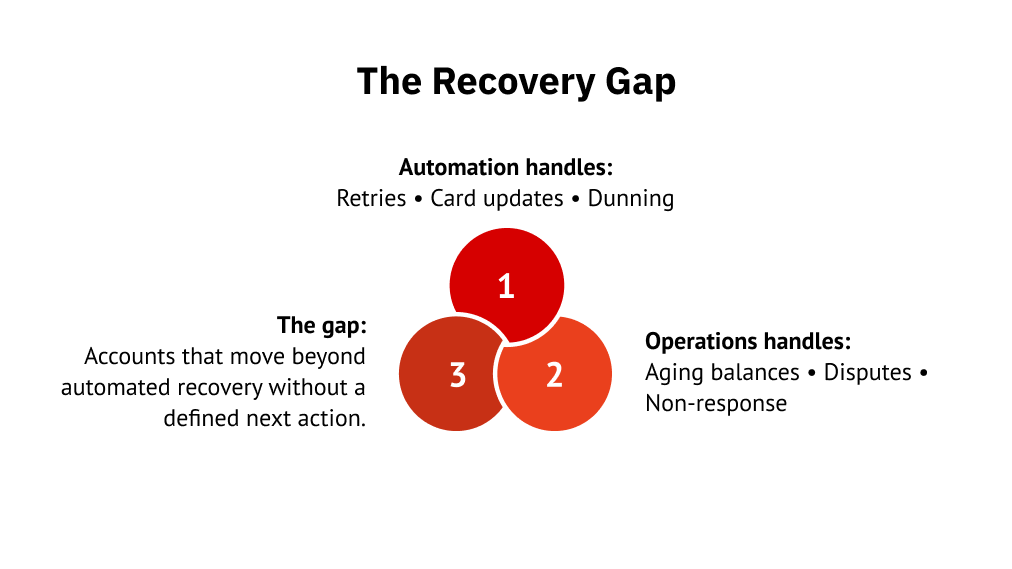
Automation isn’t enough once a balance survives every lever: retried, updater-checked, dunned, still unresolved. At that point, it needs a human decision, not another touchpoint.
What’s left: no updater match, unopened emails, accounts aging past 30 to 90 days is where in-house teams and outsourced partners start to diverge.
The point of diminishing returns
Most dunning programs recover what they are going to recover within the first 14 to 21 days. After that window, each additional automated touchpoint produces a smaller return.
The balance has entered a phase where recovery requires human judgment: identifying why the customer has not responded, choosing the right channel and message, and working the account individually.
This is the point where in-house teams and external recovery partners diverge.
In-house vs. outsourced: a decision framework
The choice depends on four factors. Where you fall on each one points toward the right model.
| Factor | Keep In-House | Bring In a Recovery Partner |
| Volume | Low volume of post-dunning balances that internal staff can absorb | High volume that exceeds what your AR team can work manually |
| Account aging | Most unresolved accounts are under 30 days old | A growing share of accounts are aging past 60 to 90 days |
| Compliance burden | Simple billing model with limited regulatory exposure | Regulated industries where outreach rules are complex |
| Cost per recovery | Internal team cost is sustainable relative to the amounts recovered | The cost of staffing, training, and managing recovery outreach internally exceeds outsourcing |
A layered handoff built around compliance, first-party, and third-party recovery works best when a business treats failed payment recovery and long-term debt recovery as separate problems, routing recent failures to automation and older balances to a dedicated recovery effort.
How outsourced recovery picks up where automation stalls
Once retries, card updates, and dunning have run their course without resolution, the work shifts in three ways:
- The approach changes: a specialist tries a channel or message automation hadn’t.
- The relationship stays intact: outreach continues under the client’s brand in first-party mode.
- The infrastructure changes: a recovery partner absorbs volume that would otherwise mean hiring in-house
For subscription, SaaS, and membership businesses, that combination of continuity, scale, and compliance is usually the deciding factor.
Measuring recovery: The metrics that matter
Recovery metrics should show both how much revenue is returned and which part of the process produced it.
Recovery rate, time-to-recovery, and recovered MRR
Track four core measures:
- Recovery rate: The percentage of failed payments recovered, segmented by retry, updater, dunning, and escalation.
- Time-to-recovery: The average time between the decline and successful payment.
- Recovered MRR: The recurring revenue restored through the recovery program.
- Retry success by decline type: The conversion rate for each decline category.
Together, these metrics show whether performance is improving or whether higher payment volume is masking an unchanged recovery rate.
Segment the results by payment method, decline reason, customer tier, and account age. This reveals problems with retry timing, message performance, outdated credentials, or balances reaching escalation.
What “good” looks like
There is no universal benchmark because recovery varies by industry, transaction value, and billing model. Compare results against your own baseline and track them monthly.
Use the baseline to set realistic targets for each recovery layer. A stronger retry rate should not hide poor dunning performance, and high recovery should not come at the expense of longer resolution times.
In general, faster recovery protects more revenue, reason-based retries outperform fixed schedules, and layered programs recover more than retries alone. A digital-first strategy can support these outcomes by improving timing, channel selection, and visibility across each recovery stage.
Common failed payment recovery mistakes
Several recurring mistakes reduce recovery even when the basic system is in place:
- Retrying hard declines: Closed or stolen cards require a new payment method, not repeated attempts.
- Over-messaging customers: Too many reminders increase frustration and spam complaints without guaranteeing payment.
- Ignoring account updater services: Expired and reissued cards may be recoverable automatically before direct outreach becomes necessary.
- Leaving aging balances without an escalation path: Accounts that remain unresolved after dunning need internal follow-up or external collection credit services.
- Using blended reporting: An overall recovery rate does not reveal whether retries, card updates, dunning, or escalation need improvement.
Review the program regularly so outreach, segmentation, and escalation continue to reflect actual payment behavior.
Conclusion
Failed payment recovery is a layered system. No single lever handles every decline type, and no automation catches every balance.
Smart retries catch soft declines, card updaters prevent expired-card failures, and dunning prompts the customer to act. What’s left needs a defined escalation path, or aging balances quietly drain your recurring revenue.
The businesses that recover the most treat each layer as one connected sequence: segmented by decline reason, measured independently, with a clear read on where automation hits its ceiling.
Ready to close the gap automation leaves behind?
Talk to us at First Credit Services about how omnichannel recovery would run across your failed payment volume once your in-house dunning has reached its limit.
FAQs
1. How do you recover a failed payment?
Identify the decline type, retry recoverable failures, update expired credentials, send payment reminders, and escalate balances that remain unresolved.
2. Why do recurring payments fail even when the customer has money?
Cards may expire, be reissued, hit issuer limits, trigger fraud controls, or encounter network errors despite the customer having sufficient funds.
3. What is the difference between a soft decline and a hard decline?
A soft decline may clear after a well-timed retry. A hard decline requires an updated or entirely new payment method.
4. How many times should you retry a failed payment?
Base the number on the decline reason. Use a limited set of attempts for soft declines and never retry permanent failures.
5. What is dunning in payment recovery?
Dunning is a sequence of reminders that asks customers to update or reauthorize their payment method before the subscription lapses.
6. When should you outsource failed payment recovery?
Consider outsourcing when aging, non-responsive accounts exceed your team’s capacity or require more specialized, compliant outreach than automation can provide.