

Collections workflow automation is software that runs the repetitive steps of recovering past-due balances: segmenting accounts, timing reminders, escalating unresponsive ones, and capturing payment, without a person managing each step by hand. For auto lenders, this shift is no longer optional.
Outstanding auto loan balances reached $1.685 trillion in the first quarter of 2026, according to the Household Debt and Credit Report Q1 2026 from the Federal Reserve Bank of New York. That base keeps growing, teams are stretched thinner, and Regulation F has narrowed the room for error on every contact attempt. The real question isn’t whether to automate. It’s how: build the technology in-house, buy a platform, or partner with a managed provider.
This guide covers what the workflow includes, why manual processes break down, and how to choose your path.
What Collections Workflow Automation Actually Means
Collections workflow automation runs on two types of logic: routing logic, which decides who gets contacted, on which channel, and when. The other is capture logic, which lets a borrower resolve the balance once they respond. Where an account sits in the recovery lifecycle determines how aggressively each one fires, and none of it replaces the judgment calls a hardship case or a dispute still requires.
The Core Workflow It Automates
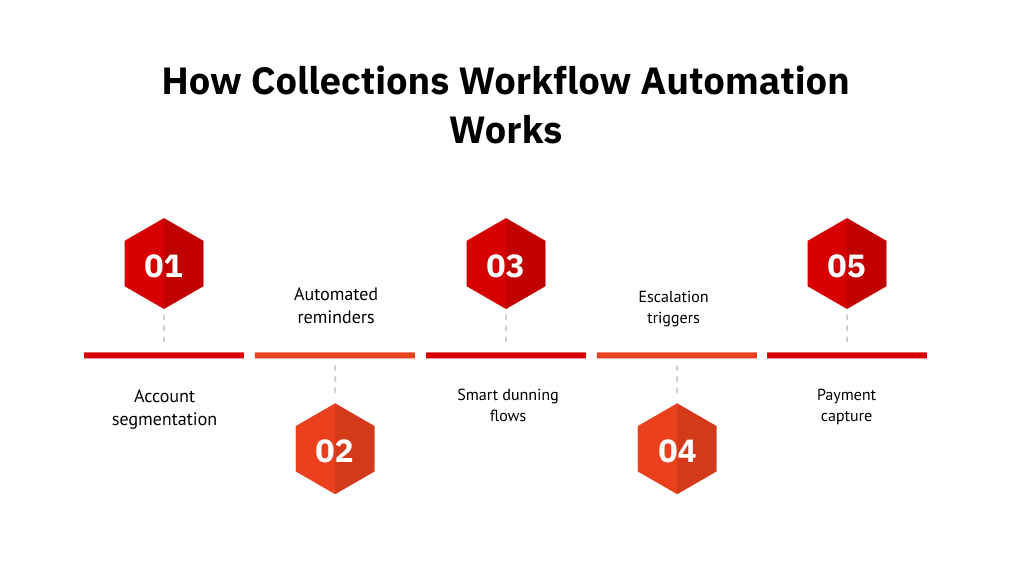
Segmentation, reminders, dunning, escalation, and payment capture make up the core workflow. Each one replaces a specific piece of manual work: sorting a spreadsheet, dialing a number, checking a portal by hand.
- Segmentation: Accounts sort automatically by balance, days past due, risk score, or product type, so the workflow treats a 15-day-past-due auto loan differently than a 90-day-past-due one.
- Reminder cadences: Scheduled touches: a text three days before a due date, an email the day after a missed payment, fired without a person queuing them up manually.
- Dunning steps: A sequenced series of escalating reminders and notices, spaced to match compliance windows and account age, rather than a single generic letter repeated on a loop.
- Escalation triggers: Rules that move an account to a different channel, a human agent, or a later-stage process once a defined condition is met, such as three missed contacts or a broken promise-to-pay.
- Payment capture: Self-service links and portals that let a borrower pay, set up a plan, or accept a settlement offer the moment they’re ready, without waiting on a callback.
Change one of these five and the rest have to adjust with it.
Where It Fits Across the Recovery Lifecycle
It fits differently depending on the stage: light-touch and brand-led early in the lifecycle, more direct and escalation-heavy later on.
Early in the lifecycle, the goal is to catch a missed payment before it becomes a pattern. Automation runs light-touch reminders, mirrors the lender’s own brand and tone, and tries to resolve the balance without the borrower feeling handed off to a collector. This is the territory of first-party collections, where preserving the relationship matters as much as recovering the payment.
Later on, once an account has aged past the point where light reminders work, automation shifts its tone and cadence. Outreach gets more direct, and escalation triggers fire faster. Accounts that stay unresponsive move to third-party collections, where a dedicated recovery process takes over under its own compliance and reporting structure. The workflow engine underneath can be the same one in both cases. What changes is the pacing, the channel mix, and how quickly an account escalates.
What It Does Not Replace
Automation handles volume and consistency, not judgment. Certain situations still need a person who can listen, weigh context, and make a call a rules engine can’t make:
- A borrower who lost a job and needs a modified payment plan.
- A dispute over the loan balance itself.
- A hardship claim tied to a medical event or other crisis.
Automation should route these cases to a human quickly rather than try to resolve them with another scripted message.
Why Manual Collections Break Down at Scale
A collections team can only call as many accounts as it has staff to call. Debt collection workflow automation exists specifically to close that capacity gap, which shows up three ways: accounts sit untouched as volume grows, phone-only tracking creates a compliance blind spot, and inconsistent timing keeps right-party contact rates low.
The Volume and Capacity Gap
Manual outreach scales with headcount, not with account volume, and that mismatch is the whole problem. When delinquency management load rises faster than staffing, someone has to decide which accounts get a phone call and which get skipped.
The accounts that get skipped sit in the middle: not delinquent enough to trigger urgent escalation, not current enough to ignore. They go untouched cycle after cycle, and recovery odds drop with every week that passes. A team stretched across a growing portfolio rarely loses ground on its worst accounts first. It loses ground on the ones in between.
Compliance Risks of Manual-Only Outreach
Phone-only outreach creates a blind spot that’s easy to miss until it surfaces in an audit. Manually tracked channels leave three specific gaps:
- No automated frequency tracker counting calls per debt.
- No shared consent log across phone, email, and SMS.
- No audit trail that holds up cleanly under a CFPB inquiry.
Regulation F sets hard limits on that contact. Under § 1006.14, a collector generally cannot place more than seven calls about a single debt within any seven-day period or call again within seven days of having a phone conversation about that debt. § 1006.34 requires a validation notice within five days of the first contact, giving the consumer the information needed to dispute or verify the debt.
When phone, email, and SMS each run on separate, manual tracking, every channel can look compliant in isolation. Viewed together, the combined contact pattern can still amount to a violation: Regulation F counts contact across the full relationship with the consumer, not per channel.
Inconsistent Outreach and Low Right-Party Contact
Manual timing tanks right-party contact because it runs on staff availability, not borrower behavior. A call placed at 10 a.m. on a weekday reaches an answering machine far more often than a text sent during a lunch break or an email opened that evening.
When outreach timing doesn’t match how a borrower actually engages, the same accounts get worked repeatedly without ever reaching the person who owes the balance.
A workflow that reaches the same borrower on the same channel at the same time every cycle, informed by when they’ve responded before, closes more of that gap. An agent working harder on a fixed schedule can’t match that consistency.
The Building Blocks of an Automated Workflow
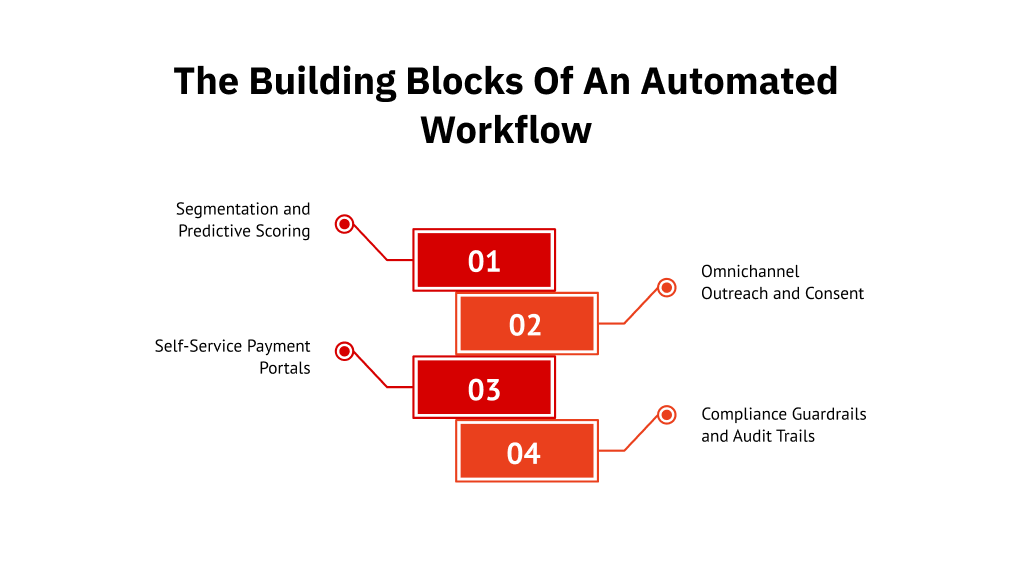
The building blocks of an automated workflow are four components: a scoring engine that decides which accounts get attention first, coordinated outreach across channels, payment options that don’t require a phone call, and guardrails that check the rules before anything goes out.
Segmentation and Predictive Scoring
Segmentation and scoring decide who gets outreach first. Every automated workflow starts with segmentation: grouping accounts by balance, risk, days past due, and propensity to pay.
Predictive scoring layers on top, using account and payment history to separate accounts likely to self-cure from ones that need faster escalation. A borrower who’s paid late twice but always eventually pays deserves patience.
One who’s gone silent after a single missed payment needs faster escalation, something a static rule based only on days past due would miss.
That distinction matters most where early-stage delinquency is largest as a share of the portfolio, which for most auto lenders is the 30- and 60-day-past-due bucket. Accounts that age past those early windows without contact become harder to recover the longer they sit, so a workflow that scores and prioritizes at the earliest stage has the best odds of resolving the balance before it escalates further.
Omnichannel Outreach and Consent
Phone, SMS, email, and a payment portal all pull from the same account record under omnichannel outreach: a text sent Tuesday and a call placed Thursday reflect one contact history, not two separate ones. The platform decides which channel to lead with per account, based on how that account has responded before. It also logs every attempt and every opt-out in one place, so consent status is never channel-specific.
That single record is what makes outreach auditable. Without it, an opt-out on SMS doesn’t stop a call, and consent given by phone doesn’t carry over to email.
Self-Service Payment Portals
A self-service payment portal resolves a balance on the borrower’s own schedule, not the collector’s. Someone who wants to pay but can’t take a call during business hours no longer has to wait for one.
A portal built for this typically lets a borrower view the current balance and payment history, set up a payment plan or accept a settlement offer, and pay in a few taps from any digital message, with no call required.
That shift lifts resolution rates and cuts inbound call volume from borrowers checking a balance or confirming a payment posted.
Compliance Guardrails and Audit Trails
Every automated workflow checks the rules before it acts, not after. Before the system sends a message or dials a number, it verifies:
- Call frequency against the applicable limit.
- Consent status across every channel.
- Time-of-day restrictions for the account’s jurisdiction.
Full logging turns every attempt, every response, and every opt-out into a timestamped record tied to the account. When a dispute or a regulatory inquiry comes in, that log is the answer: what was sent, when, on which channel, and how the consumer responded.
Build vs. Buy vs. Managed Partner
Build vs. buy vs. managed partner comes down to three options for who runs this workflow: build it with your own team, buy a platform and run it yourself, or hand the operation to a managed partner, with speed and control moving in opposite directions across those three choices.
Weighing the Three Paths
Each path answers three questions differently: who builds it, who maintains it, and who owns compliance when the rules change.
Building in-house gives full ownership of the logic and the data. Your team designs, tests, and maintains every rule, and owns every compliance update when Regulation F or a state law changes.
Buying software gets you a working platform faster. Your team still configures it, integrates it with your loan servicing system, and stays accountable for how it’s used.
Partnering with a managed provider hands the operation to a team that already runs it. You trade some control for speed and a lighter internal burden.
| Factor | In-house build | Buy software | Managed partner |
| Speed to deploy | Slow | Moderate | Fast |
| Upfront cost | High | Moderate | Low |
| Ongoing maintenance | You own it | Shared with vendor | The partner owns it |
| Compliance ownership | You | You, with tooling | Partner |
| Staffing burden | High | Moderate | Low |
| Integration lift | Heavy | Moderate | Partner-led |
The right fit depends on how much engineering capacity you have, how fast you need to move, and how much compliance risk your team is equipped to own directly.
How to Choose the Right Collections Automation Solution
Three factors decide the right path: your team’s current capacity, your account volume, and how differentiated your process actually is.
A stretched team with high volume and no dedicated engineering resources gets the most from a managed partner. Standing up a build takes months a team may not have, and buying software still requires someone to own configuration, monitoring, and compliance updates full time. This is the case for most teams facing rising auto loan delinquency volume without spare capacity.
A team with deep in-house engineering and a genuinely differentiated process, one built around a proprietary scoring model or a unique product structure, has more reason to build or buy.
Most teams sit somewhere in between: enough volume to need automation, not enough spare engineering capacity to build and maintain it indefinitely. For that group, the real evaluation question isn’t which platform has the most features. It’s who will still be maintaining this workflow, and keeping it compliant, two years from now.
| Pro tip:Do not automate a broken process. Map your current workflow first, fix the obvious gaps, such as a missing escalation trigger or a channel with no consent tracking, then automate one high-value sequence before scaling to the rest. Automation amplifies whatever you point it at, including the mess. |
How Automated Recovery Works in Practice
An automated recovery workflow works by using behavioral data, not a fixed calendar, to decide the channel, message, and timing for each account. First Credit Services runs this model through its Unified Consumer Experience Platform (UCEP), a proprietary, AI-driven engagement and payment platform.
AI-Driven Contact Strategy in Action
UCEP scores each account with its own analytics and picks the channel, message, and timing most likely to get a response, instead of running every account through the same fixed sequence.
An account that’s opened three emails but never answered a call gets more email and less phone. One that’s responded to a text within the hour gets a text again at that same hour next cycle. A low-risk, early-stage account gets a lighter cadence, while a higher-risk account has faster escalation built into its sequence from day one.
The goal is right-party contact: reaching the actual person who owes the balance, not a voicemail or an unopened email.
Compliance and Omnichannel as Standard
Guardrails and multi-channel outreach run by default here, not as features a team switches on later. Rules enforced at the point of contact, rather than in a weekly compliance review, keep an account within Regulation F and FDCPA limits automatically as it moves through the workflow.
The handoff between stages benefits most from this setup. When first-party collections and third-party collections run under one partner instead of two separate vendors, an account’s full contact history, consent record, and prior outreach attempts travel with it. Nothing resets when an account escalates to a later stage, and reporting stays intact instead of fragmenting across systems that don’t talk to each other.
Conclusion
Auto portfolios keep growing, and Regulation F keeps tightening the margin on every contact attempt. An automated collections workflow isn’t really the open question anymore. The real decision is which execution path (build, buy, or partner) fits your team’s volume, staffing, and risk tolerance.
Start by mapping your current workflow and pinpointing where accounts actually stall: an understaffed follow-up step, a missing escalation trigger, no self-service option. That gap tells you what you’re solving for. Build if you have the engineering capacity and a process worth owning end to end. Buy if your team is ready to configure and maintain a platform itself. Partner if you’d rather not build, staff, and supervise this software in-house while tracking every rule change.
See the partner path against your own numbers. Book a demo and First Credit Services will map your current escalation and compliance gaps against its Unified Consumer Experience Platform, using your actual account volume and delinquency mix.
FAQs
1. What systems does collections workflow automation need to integrate with?
Most connect to your loan servicing system, CRM, and payment gateway through an API, SFTP feed, or direct sync. First Credit Services, for example, updates account status and payment records across all three in real time, without manual reconciliation.
2. How much does collections workflow automation cost?
Cost follows the delivery model, not a flat number. Building in-house means absorbing engineering and infrastructure spend directly. Buying software usually means a license or per-account fee. A managed partner like First Credit Services typically prices on contingency, collecting a percentage of what’s recovered rather than charging upfront.
3. How long does it take to implement collections workflow automation?
Timeline follows the path you choose. An in-house build usually takes months to design, test, and launch. A software purchase can go live in weeks once it’s configured and integrated. A managed partner is typically fastest, since the platform and staffing already exist.
4. What should you ask a collections workflow automation vendor before signing?
Ask whether the platform is licensed alone or bundled with staffing, how compliance updates get applied, what integration methods it supports, and whether pricing is contingency-based or a flat license fee. The answers show whether you’re buying software or a service.
5. Are there state-level rules beyond Regulation F that collections workflow automation must follow?
Yes. States layer their own contact-frequency, licensing, and disclosure rules on top of Regulation F, and they don’t always match the federal standard. A compliant workflow needs state-specific logic built in, not just the federal 7-in-7 limit.
6. Does collections workflow automation make sense at a low account volume?
It depends on the math, not a fixed cutoff. At low volume, the fixed overhead of building or licensing a platform often costs more than a managed partner’s contingency fee. At high volume, in-house economics start to compete as cost per account managed drops.