

Collection credit services are third-party services that recover what your customers owe on credit-based accounts. The work runs from the first missed payment through charged-off balances. Businesses use them to recover more revenue, lower days sales outstanding (DSO), and stay compliant while keeping customer relationships intact.
US household debt reached $18.8 trillion at the end of 2025, with 4.8% of all balances in some stage of delinquency, the highest share since early 2020, according to the New York Fed Household Debt and Credit Report Q4 2025. Every overdue account ties up working capital, lifts your DSO, and moves closer to a write-off.
Every overdue account ties up working capital, lifts your DSO, and moves closer to a write-off.
If you searched “collection credit services,” you are likely doing one of two things. You are either looking up the company Credit Collection Services (CCS), or you are weighing the service category to decide whether to keep recovery in-house or outsource it. This guide is for the second group.
It covers what these services are, why businesses outsource, the risks, how to evaluate a partner, pricing, and the compliance checks you cannot skip.
What are collection credit services?
Collection credit services are outsourced recovery for the money your customers owe on credit-based accounts. The work covers accounts receivable (AR) aging oversight, outreach across the stages of delinquency, dispute handling, and recovery on charged-off balances. It spans the account from the first missed payment through final resolution, rather than only the unpaid invoices at the end. Many providers package this as credit collection services within a wider receivables program.
The category serves any business that lets customers pay over time. That includes financial institutions for loan and card portfolios, healthcare providers for patient balances, fitness and subscription businesses for lapsed memberships and failed payments, and retailers, utilities, insurers, and auto-finance lenders. If you carry a receivables ledger and some of it ages, you are a candidate.
How are collection credit services different from a collections agency?
A basic collections agency takes a batch of delinquent accounts and works them. Collection credit services run recovery as an ongoing, managed program across the full delinquency lifecycle, with first-party, third-party, and digital recovery handled by one partner.
| Dimension | Basic collections agency | Collection credit services |
| Scope | Recovery on placed accounts | Recovery across the full delinquency lifecycle |
| When it engages | After accounts go delinquent | From early missed payments through charged-off balances |
| Recovery modes | Usually one mode | First-party, third-party, and digital under one roof |
| How you use it | Hand over a batch, get back what is collected | Ongoing managed recovery, with handoffs between modes inside one partner |
| Best fit | One-off recovery of bad debt | Managing recovery end-to-end as receivables age |
In practice, most businesses run both kinds of effort at once. The internal AR team handles current invoices and routine reminders, while an external partner takes on the delinquent and aged accounts that need specialist attention. The real question is which accounts stay in-house and which move out, and at what point in the account’s life the handoff happens.
| Pro tip: Place the handoff earlier than instinct says. Recovery odds are highest in the first 30 to 60 days, so escalate before an account is deep into aging, not after the balance has already hardened. |
What forms do collection credit services take?
Two distinctions decide how a provider engages with your customers and what results you should expect.
The first is first-party versus third-party. First-party collections operate as an extension of your own AR team. The outreach goes out under your brand, usually early in the cycle, and the customer often does not realize a partner is involved.
Third-party collections engage later, typically after charge-off, under the provider’s own name and identity. First-party protects the relationship; third-party applies more formal recovery pressure once the relationship has already frayed.
The second is pre-charge-off versus post-charge-off. The severity stage drives everything downstream: the tone of outreach, the channels used, the recovery rate you can expect, and the pricing model the vendor proposes. A 20-day failed card payment, and a 200-day charged-off balance are different problems, even when the same provider handles both.
Why do businesses outsource collections?
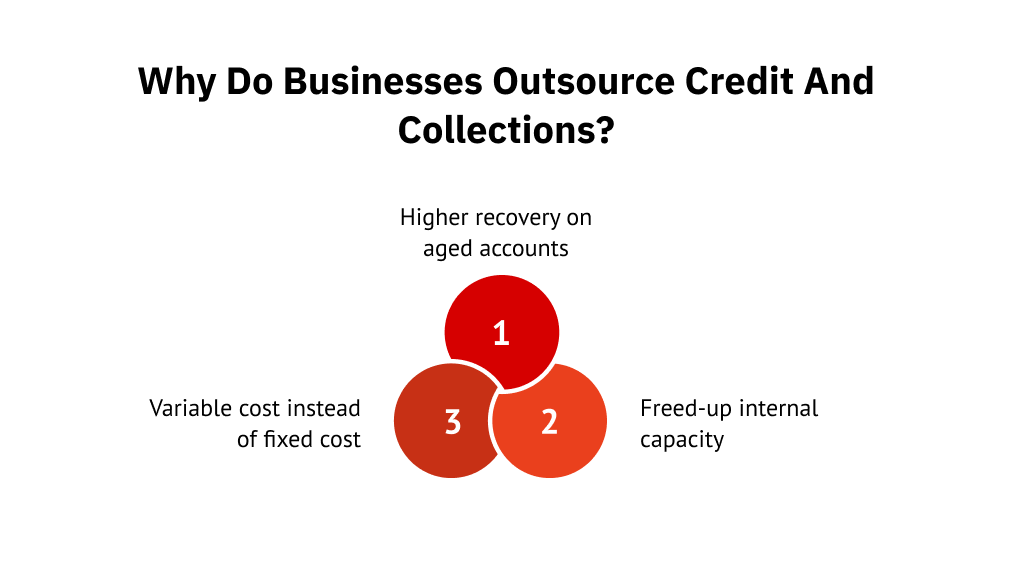
Businesses outsource recovery when in-house efforts stop keeping pace with the receivables. The case usually comes down to a few clear gains:
- Higher recovery on aged accounts. A specialist has the contact data, the channel mix, and a day-by-day workflow built for recovery. It pulls back more than an internal team juggling collections alongside everything else.
- Variable cost instead of fixed. You pay in proportion to what gets recovered, rather than carrying headcount, software, and training overhead whether or not accounts go delinquent.
- Freed-up internal capacity. When a partner absorbs the volume, your AR team stops resending reminders and logging payment promises. It can refocus on current receivables and the strategic accounts that need a human relationship.
Outsourcing does not make sense for everyone. If your DSO is already low, your debtor volume is small, and a strong in-house team keeps aging under control, a third party adds cost without adding much recovery. The same goes for strategic accounts where the relationship is worth more than the balance at risk, and you would not want any third party touching the customer. Be honest about which accounts those are before you sign anything.
What risks come with credit collections outsourcing?
Handing accounts to an outside partner moves work off your plate. It does not move the liability with it. Four risks deserve a hard look:
- Compliance liability. If a vendor mishandles outreach, your business can still be exposed. You chose the partner, and the debt is yours.
- Customer-relationship risk. Aggressive or clumsy tactics damage retention. The damage is worse with recurring-revenue accounts, where one bad collections experience can end a subscription that would have paid for years.
- Commercial risk. Contingency fees dilute net recovery. A high headline collection rate can still leave you with less than expected once the fee comes out, and no vendor guarantees an outcome.
- Data security risk. You are sharing customer financial data with a third party. Their controls become your exposure. Vetting their security posture is not optional, especially in healthcare and financial services.
None of these risks argues for keeping everything in-house. They argue for choosing your partner carefully, which is what the next section walks through.
How do you choose the right collections partner?
Work the decision in sequence. Evaluate provider fit first, screen for red flags, negotiate pricing, then verify compliance. Jumping to price before checking fit and compliance is how businesses end up cheap and exposed.
A useful starting point is comparing what you keep in-house against what you move out, so you know exactly what you are buying.
| Factor | In-house AR | Outsourced collection credit services |
| Cost model | Fixed (salaries, software, training) | Variable (contingency or per-account) |
| Best stage | Current and early-stage invoices | Aged, delinquent, post-charge-off accounts |
| Recovery on aged debt | Lower, not the team’s core focus | Higher, specialist workflows and data |
| Customer relationship | Full control | Depends on the first-party vs third-party model |
| Compliance burden | Yours to build and maintain | Shared, but liability stays with you |
| Scalability | Limited by headcount | Absorbs volume spikes |
Treat the table as a starting frame. The right split depends on your DSO, your volume, and how sensitive your accounts are. Use it to decide which buckets to keep and which to place.
How do you evaluate a credit collections agency?
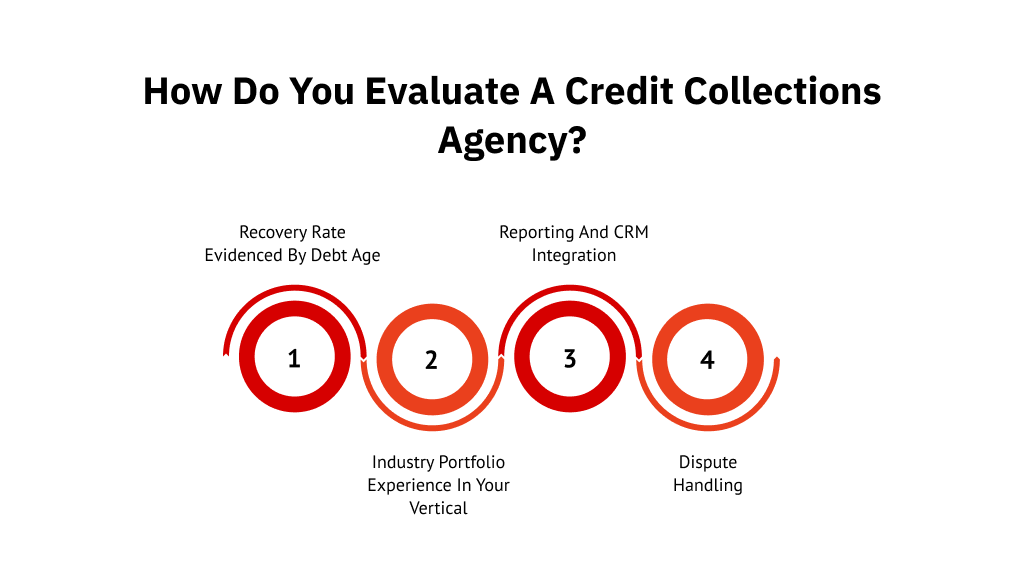
Push past the sales deck and ask for specifics. The questions that separate a real partner from a generic one:
- Recovery rate evidenced by debt age. Ask for results broken out by days past due. A single blended rate hides whether they are good at the aged accounts you actually need help with.
- Industry portfolio experience in your vertical. Healthcare, fintech, fitness, and utilities each carry different compliance rules and customer behavior. Experience in someone else’s vertical does not transfer cleanly.
- Reporting and CRM integration. Can they receive account files and return outcome data through your systems, by application programming interface (API), secure file transfer protocol (SFTP), or direct sync, without manual reconciliation?
- Dispute handling. What happens when a customer disputes a balance? A real partner walks you through a workflow with steps and owners, not a one-line policy.
- Compliance and licensing posture. Ask for proof of a documented compliance program and active licensing in every state where your debtors live. Their misstep becomes your liability, so confirm it before you place accounts.
It helps to go in with realistic benchmarks. As a directional rule, recovery is strongest at 0 to 30 days past due, when a clear reminder and an easy payment path resolve most accounts. It falls through the 60 to 90 day window, drops more sharply from 90 to 180 days, and is lowest at 180+ days, where balances are often a fraction of face value. Treat any vendor’s by-bucket numbers against that curve, and be skeptical of rates that look flat across age bands.
A compliance-led, transparent partner shows you the by-bucket data, names the verticals it actually works, and explains its escalation path rather than promising a number it cannot defend. First Credit Services fits that bar, covering automotive finance, fintech, healthcare, credit card, health and fitness, insurance, utilities, and government, so accounts do not get rebuilt from scratch when they move between recovery stages.
| Match the partner to your book First Credit Services runs first-party, third-party, and digital recovery as one managed program. See how it fits your portfolio: talk to the team. |
What are the red flags when evaluating a collections vendor?
Six signals should give you pause. Each one maps to a cost or a risk you would carry.
- No documented compliance program. Without it, every contact the vendor makes is a potential liability that lands on you.
- Vague or unverifiable recovery rates. A number they cannot break down or substantiate is a marketing figure. You will discover the real one only after you have placed accounts.
- No client references in your industry. No proof they understand your vertical’s rules means you are paying them to learn on your portfolio.
- Opaque fee structure. If you cannot model net recovery before signing, you cannot tell whether the engagement is worth it.
- Refusal to share licensing or insurance proof. This often signals gaps in coverage that become your exposure if something goes wrong.
- No visibility in reporting. If you only see dollars collected, and not activity, disputes, and outcomes by account, you cannot manage the program or catch a problem early.
None of these is a dealbreaker in isolation. Two or three together usually mean the relationship will cost you more than the recovery is worth.
What pricing models do collection credit services use?
How you pay should match your debt profile. A good vendor builds the model around your account mix rather than defaulting to whatever suits them.
- Contingency. A percentage of the amount recovered, commonly 20 to 50%, rising with debt age and difficulty. Best for delinquent or aged accounts, where you only pay when money comes back.
- Flat fee per account. A set fee regardless of outcome. Works for high-volume, low-balance portfolios where contingency math does not justify the effort per account.
- Hybrid. A lower contingency rate plus a modest flat fee. Increasingly common for mid-market creditors who want shared incentives without paying top-end contingency on everything.
- Subscription or managed service. A recurring fee for an ongoing, managed recovery program across the receivables lifecycle, suited to businesses outsourcing recovery end-to-end rather than a one-off batch of bad accounts.
The buyer’s question that cuts through it: which model does the vendor recommend for your debt profile, and why? A partner who pushes the same structure regardless of your account mix is optimizing for their own margin over your net recovery.
First Credit Services works on contingency, so you pay when it collects. Ask any vendor which model they recommend for your debt profile, and make them show the math on net recovery before you sign.
What compliance requirements should you verify?
Vendor missteps become your liability, so verify compliance directly rather than taking it on trust.
The primary framework is the Fair Debt Collection Practices Act (FDCPA) and Regulation F, enforced by the Consumer Financial Protection Bureau (CFPB) and the Federal Trade Commission (FTC). Together, they govern contact rules, disclosures, harassment limits, debt validation, and unfair or deceptive practices.
Push past a vendor that simply says it is FDCPA compliant. Regulation F sets concrete limits a partner has to honor. It caps call attempts at seven per account within seven days, requires clear opt-out paths for email and text, and requires a validation notice before the account moves further. Ask how the workflow enforces these, and what happens when a customer disputes a balance or asks the vendor to stop.
Licensing adds another layer, and it varies from state to state. Confirm the vendor is licensed in every state where your debtors live, not only where it is headquartered. A partner that treats debt collection compliance as core infrastructure, with audit trails and call monitoring, protects your business as much as its own. First Credit Services is HIPAA, PCI DSS Level 1, and SOC 2 Type II compliant, operates within FDCPA and TCPA frameworks, and subjects every call to live and recorded auditing.
Make the Collection Credit Services Decision With Confidence
Choosing collection credit services works as a sequence of decisions. Define the category and where it fits your recovery lifecycle. Weigh the compliance, relationship, commercial, and data risks. Evaluate provider fit on real by-bucket evidence. Screen for red flags. Match pricing to your debt profile. Then verify compliance and state licensing before you place a single account.
The takeaway: the best partner recovers revenue while protecting the customer relationship and shielding you from regulatory exposure. The highest headline recovery rate rarely tells you who that is.
Ready to scope a recovery program? Talk to First Credit Services about a compliance-led approach that covers first-party, third-party, and digital recovery across healthcare, fintech, fitness, insurance, and utilities.
FAQs
1. What recovery rate should businesses realistically expect by debt age?
Recovery is highest at 0 to 30 days past due and falls as accounts age, dropping sharply past 90 days and reaching its lowest beyond 180 days. Exact rates vary by industry, balance size, and contact quality, so ask vendors for by-bucket data.
2. What does $100K recovered look like across contingency, flat fee, and hybrid pricing?
On 30% contingency, you net about $70K. A flat fee per account is fixed regardless of amount, so the net depends on account count. Hybrid blends a lower contingency with a small flat fee. Contingency is usually negotiable on volume and debt age.
3. At what AR volume or DSO threshold does outsourcing start to make sense?
There is no universal number. Outsourcing tends to pay off when delinquent volume exceeds what your team can work well, when DSO is rising despite internal effort, or when aged accounts are being written off that a specialist could still recover.
4. Can we run a hybrid model where in-house handles 0 to 60 days, and an agency takes over after that?
Yes, and it is common. Keep early, brand-sensitive outreach in-house or with a first-party partner, then escalate unresolved accounts to third-party recovery. The key is a clean data handoff, so context is not rebuilt at each stage.
5. When should an overdue account be escalated to legal action instead of staying with a collections vendor?
Legal action usually fits larger balances where the debtor has assets or income to pursue, and standard recovery has failed. It is slow and costly, so exhaust first-party and third-party recovery first, then weigh expected net against legal cost.