

A late account is not a loss yet. But the longer it stays unresolved, the harder it becomes to bring back.
That is where pre-charge-off collections becomes critical. Accounts that could be cured at 15 or 30 days past due often become harder to recover by 90 or 120 days. Customers stop responding, balances lose value, and internal teams fall behind. Then, what started as a missed payment becomes a write-off risk.
The cost of waiting is already visible. According to FRED’s Q1 2026 data, the credit card charge-off rate at all commercial banks reached 3.84%.
The fix is earlier, smarter recovery. This guide explains how pre-charge-off recovery works, how delinquency buckets shape strategy, what metrics to track, and when first-party support can help reduce roll rates before charge-off.
What Is Pre-Charge-Off Collections?
Pre-charge-off collections is the recovery work that happens before an account is formally written off as a loss. In most consumer credit portfolios, this window includes accounts that are 1 to 180 days past due, often shortened as DPD.
At this stage, the account still belongs to the original creditor and remains on the balance sheet. It may still be recoverable through brand-safe outreach, payment reminders, payment plans, or hardship support.
Once an account is charged off, the creditor may place it with a third-party agency, sell it to a debt buyer, or move it into a separate recovery workflow. At that point, recovery options narrow.
You may also see this stage called:
- Early-out collections.
- Early-stage collections.
- Pre-collection services.
- Pre-write-off recovery.
- First-party pre-charge-off collections.
The terms overlap, but the goal is the same: resolve accounts earlier, reduce write-offs, and protect the customer relationship while it is still active.
The Pre-Charge-Off Window: How Delinquency Buckets Work
Pre-charge-off collections works best when teams understand delinquency buckets. These buckets show how far past due an account is and how much risk it carries.
| Bucket | DPD | Typical consequences | Recovery difficulty |
| Early delinquency | 1 to 29 DPD | Missed payment, reminder outreach, possible late fee. | Low to moderate |
| 30-day bucket | 30 to 59 DPD | Stronger follow-up, possible credit impact, higher roll risk. | Moderate |
| 60-day bucket | 60 to 89 DPD | More resistance, more disputes, lower cure odds. | Higher |
| 90-day bucket | 90 to 119 DPD | Serious delinquency and greater compliance sensitivity. | High |
| Late pre-charge-off | 120 to 180 DPD | Charge-off risk and escalation planning. | Very high |
A 15 DPD account and a 150 DPD account are both pre-charge-off, but they need different treatment. One may need a simple reminder and payment link, while the other may need a payment plan, settlement option, or human escalation.
That is why delinquency buckets help teams move from generic follow-up to stage-based recovery.
When does pre-charge-off become post-charge-off?
The handoff point depends on the account type and the creditor’s policy.
For open-end credit, such as credit cards, federal retail credit guidance generally requires charge-off when the account reaches 180 days past due. The Federal Reserve’s retail credit classification policy states that open-end retail loans should be charged off at 180 cumulative days past due, while closed-end retail loans generally move to charge-off at 120 days.
Once a charge-off happens, the brand-safe outreach window narrows. Third-party collections, portfolio recovery, or debt-sale workflows often begin from there.
For AR leaders, the lesson is clear. Charge-off prevention should start much earlier, while the account still has a realistic path back to current.
Why Pre-Charge-Off Recovery Matters More Than Most Lenders Treat It
Many organizations treat pre-charge-off recovery as a routine follow-up. That is where the problem starts.
The closer an account is to 0 DPD, the lower the cost per recovered dollar and the higher the chance of curing the account. As the account ages, teams are no longer just chasing a missed payment. They are fighting roll risk, customer disengagement, disputes, and write-off exposure.
The broader debt environment adds pressure. The New York Fed’s Q1 2026 Household Debt and Credit report found that total U.S. household debt reached $18.8 trillion. In that environment, early intervention becomes a protective strategy.
Every dollar that reaches charge-off becomes harder to recover. In many cases, it returns only a small fraction of the principal through third-party recovery or debt sale.
What happens to the account value as it ages
Account value declines in two ways. The probability of payment drops as the account rolls forward. At the same time, the cost of recovery rises because outreach, documentation, disputes, and escalation become more complex.
| Acting at 30 DPD | Acting at 120 DPD |
| The customer may see it as a missed payment. | The customer may already feel disconnected. |
| A reminder or payment link may be enough. | Negotiation or escalation may be needed. |
| The relationship is easier to preserve. | The relationship may already be strained. |
| Cost per recovered dollar is usually lower. | Recovery effort is usually higher. |
| Cure rate is usually stronger. | Charge-off prevention becomes harder. |
That is why early-out collections needs its own playbook. The goal is not to bring late-stage pressure forward but to stop recoverable accounts from becoming late-stage problems at all.
The Three Biggest Challenges in Pre-Charge-Off Collections
Pre-charge-off recovery looks simple from the outside. The account is late, so the business follows up. In reality, the window is short, the relationship is still active, and every outreach decision matters.
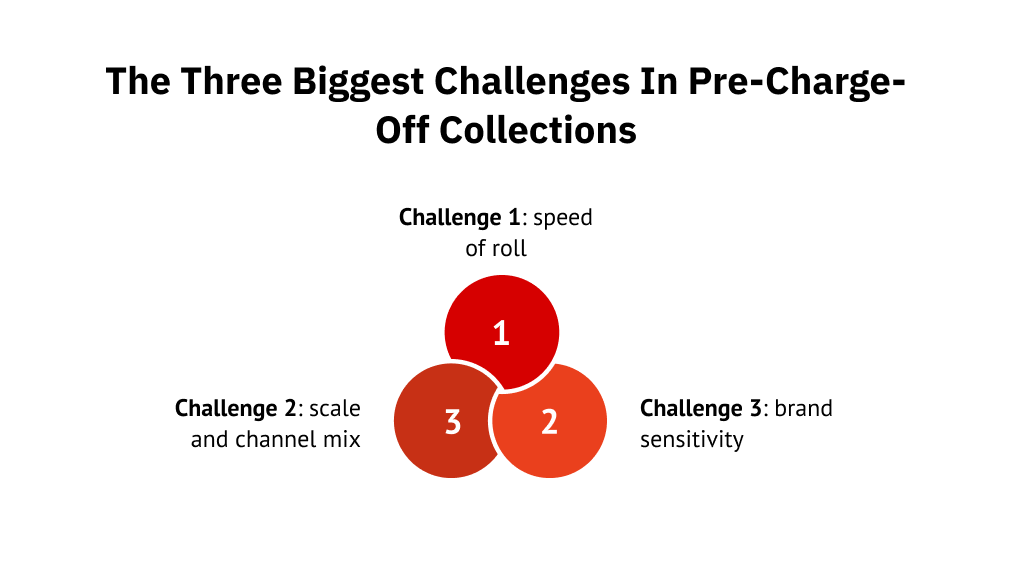
Teams must balance recovery, compliance, channel preference, and brand reputation. The pressure usually shows up in three areas:
Challenge 1: speed of roll
Delinquency moves faster than many workflows can handle. An account can move from 30 to 60 DPD before the first meaningful follow-up happens. That delay creates avoidable risk.
The customer may have missed the first reminder. They may need a different channel or may also be willing to pay, but not through the path provided.
That is why pre-charge-off programs need fast first contact, consistent cadence, and treatment changes before the next bucket begins.
Challenge 2: scale and channel mix
Internal AR teams can often manage low-volume delinquency. The problem appears when account volume rises.
At scale, manual follow-up becomes inconsistent. Agents focus on accounts they can reach by phone. Meanwhile, customers who would respond to SMS, email, chat, or self-service links may never receive the right prompt.
A stronger program layers outreach across:
- SMS for quick action.
- Email for details and documentation.
- Self-service portals for payment resolution.
- Chat for questions and disputes.
- Phone for complex conversations.
The aim here is not to remove human contact but to use it where it adds the most value.
Challenge 3: brand sensitivity
Pre-charge-off outreach happens while the customer relationship is still intact. That makes tone, timing, and identity important.
For example, a harsh message may recover one payment, but it can damage future value. Similarly, a confusing message may delay payment and create a dispute. In the same way, a vendor-branded message may make the customer feel that escalation is happening too early.
This is why first-party framing matters. In the pre-charge-off window, outreach should feel like it comes from the creditor, provider, lender, or business the customer already knows.
Key Metrics Every Pre-Charge-Off Program Should Track
A pre-charge-off program cannot be managed only by total dollars recovered. That number matters, but it does not show whether accounts are moving in the right direction.
Track these metrics every month:
- Roll rate: The percentage of accounts moving from one DPD bucket to the next.
- Early cure rate: The percentage of accounts that return to current status before charge-off.
- Days to first contact: The time between delinquency and first meaningful outreach.
- Promise-to-pay completion rate: The percentage of payment arrangements that are fulfilled.
- Cost per recovered dollar: The operating cost required to recover each dollar.
- Escalation rate: The percentage of accounts that move toward third-party collections, charge-off, or write-off.
These metrics are most useful when segmented by bucket, channel, account type, and customer group. Otherwise, a strong portfolio-level cure rate can hide weak performance in specific delinquency stages.
Compliance Rules That Apply in the Pre-Charge-Off Window
Pre-charge-off collections may feel less regulated than post-charge-off collections, but that assumption creates risk. The rules depend on who contacts the customer, whose name is used, which channel is used, and what type of debt is involved.
1. First-party vs. third-party compliance exposure
First-party outreach generally means the creditor collects its own accounts under its own name. In many cases, this falls outside the FDCPA’s third-party debt collector rules.
However, that does not eliminate all compliance obligations. The CFPB’s Regulation F page explains that Regulation F implements the FDCPA and governs debt collectors as defined under the rule.
TCPA rules still apply when teams use SMS, prerecorded calls, or certain automated outreach. That means consent must be documented, opt-outs must be honored, and outreach records should be easy to audit. State rules, licensing requirements, and UDAAP standards may also apply.
2. What Regulation F changes and does not change for pre-charge-off
Regulation F primarily governs third-party debt collectors. It does not automatically apply to every first-party creditor program.
Still, outsourced pre-charge-off programs must be structured carefully. If the partner operates under the creditor’s brand, the program should preserve first-party identity, documentation, and role clarity.
Industry context also matters, such as:
- Healthcare adds HIPAA obligations.
- Auto finance programs must consider credit reporting and FCRA-related workflows.
- Consumer lending programs need strong documentation around consent, hardship, disputes, and payment arrangements.
| Pro tip: Build compliance into the outreach design before launch. If legal review happens after messages, channels, and cadence are already built, the program may need expensive rework. |
What A Strong Pre-Charge-Off Collections Program Looks Like
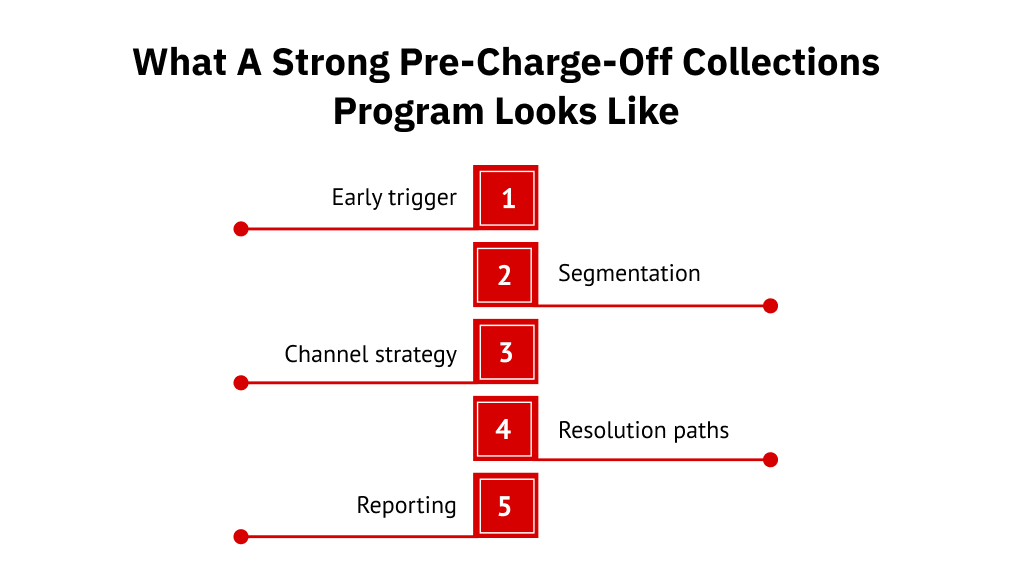
A strong program intervenes early, segments accounts intelligently, and gives customers more than one way to resolve the balance.
The best programs begin within the first 1 to 15 days, when the account may still be easy to cure. They also avoid using one message for every customer.
Here is how each layer should work inside a pre-charge-off program:
| Program layer | What it should do |
| Early trigger | Start outreach before the account rolls forward. |
| Segmentation | Group accounts by risk, behavior, history, amount, and response pattern. |
| Channel strategy | Use SMS, email, portal, chat, and phone based on behavior. |
| Resolution paths | Offer pay-in-full, payment plans, hardship support, or callback options. |
| Reporting | Track roll rate, cure rate, engagement, promise-to-pay, and escalation. |
What omnichannel actually means in this window
Omnichannel is not repeating one message across every channel. It means adjusting the next step based on customer behavior.
Someone who opens an SMS link but does not pay needs a different follow-up than someone who never responds. Self-service then gives customers a 24/7 path to view the balance, choose an option, and resolve it without calling an agent.
The strongest pre-charge-off programs lead with digital channels and use human support only where it adds value.
When To Keep It In-House Vs. Outsource Pre-Charge-Off Collections
Not every organization needs an outsourced partner. If delinquency is stable, account volume is manageable, and your team can maintain fast, compliant follow-up, in-house may work well.
However, the decision changes when roll rates rise or internal teams start falling behind. Here is the decisive framework:
| Situation | Best-fit Model |
| Low delinquency, stable roll rates, and manageable volume. | Keep the program in-house. |
| Higher volume but simple reminder needs. | Keep in-house with automation support. |
| Rising roll rates, inconsistent outreach, or channel gaps. | Consider first-party pre-charge-off support. |
| Compliance reviews consume too much internal time. | Consider an outsourced partner with documented controls. |
| Accounts frequently move into charge-off or third-party recovery. | Use a full-lifecycle partner that can support both stages. |
The broader objective is to protect the recovery window before accounts lose value.
What to look for in a pre-charge-off collections partner
Once outsourcing becomes a serious option, evaluate execution, not promises.
Look for these capabilities:
- First-party capability: Outreach should run under your brand during the pre-charge-off window.
- Omnichannel sequencing: The partner should offer coordinated omnichannel collections, not disconnected SMS, email, and phone campaigns.
- Self-service payment options: Customers should be able to resolve balances through secure digital paths without agent dependency.
- Compliance infrastructure: Ask about consent management, opt-out handling, audit trails, scripts, call policies, and documentation. You should also review the partner’s broader debt collection compliance approach.
- Full-lifecycle escalation: If accounts do not cure, the partner should have a clear path into post-charge-off recovery.
Looking for a pre-charge-off recovery partner that can support early-stage and third-party recovery under one roof? See how FCS enables first-party collections for brand-sensitive recovery.
How First Credit Services Supports Pre-Charge-Off Recovery
First Credit Services helps stop recoverable accounts from becoming write-offs through managed first-party programs built for early intervention, brand-safe outreach, and digital-first resolution.
In the pre-charge-off window, the experience stays white-labeled. Thus, customers see a familiar name, while the account remains easier to resolve.
FCS’s model supports:
- First-party pre-charge-off collections: Outreach can run under the client’s brand, helping teams engage accounts before charge-off.
- Managed digital engagement: Consumer outreach runs through UCEP, the Unified Consumer Engagement Platform. FCS manages the platform for the client rather than handing it over as software to operate.
- Omnichannel sequencing: UCEP supports workflows for SMS, email, chat, phone, and the self-service portal. The outreach sequence can adapt based on consumer behavior and response patterns.
- Self-service resolution: Consumers can view balances, make payments, set up payment plans, schedule callbacks, or start chats through a secure portal.
- Full-lifecycle support: Accounts that do not resolve in the pre-charge-off window can transition into FCS’s third-party collections program without rebuilding vendor context.
This creates one connected recovery path. Early-stage accounts receive brand-safe engagement, older accounts have a clear escalation route, and internal teams get reporting visibility without operating the technology themselves.
Protect More Accounts Before They Become Write-Offs
Pre-charge-off collections is the last point where recovery, customer experience, and account value are still easier to protect together. Once accounts keep rolling forward, the work becomes more expensive, the cure rate weakens, and the path back to the current status gets harder.
The stronger move is to act before that happens. Start earlier, segment smarter, and use the channels customers actually respond to. It gives them a clear way to resolve the balance before charge-off becomes the next step.
If rising roll rates or stretched internal teams are pushing more accounts toward write-off, FCS can help you build a first-party recovery program that protects both revenue and relationships.
See how much of your pre-charge-off portfolio is still recoverable.
FAQs
1. Is pre-charge-off collections the same as first-party collections?
Not always. Pre-charge-off describes the timing before write-off. First-party collections describes the identity of the outreach. Many pre-charge-off programs are first-party because the creditor’s brand is still used during early recovery.
2. How does charge-off affect the balance a lender can recover?
Charge-off does not erase the debt, but it changes how the account is handled. The balance often moves into third-party recovery, portfolio recovery, or debt sale, where recovery value is usually lower.
3. What is a healthy roll rate for a pre-charge-off portfolio?
There is no single healthy roll rate for every portfolio. It depends on product type, customer segment, risk tier, seasonality, and account age. The key is to benchmark roll rates by bucket.
4. Does Regulation F apply to pre-charge-off outreach?
Regulation F generally applies to third-party debt collectors, not standard first-party creditor outreach. However, outsourced programs must be structured carefully. TCPA, state laws, UDAAP expectations, and internal policies may still apply.
5. When should a lender switch from early-stage to third-party collections?
The switch usually happens when accounts pass the creditor’s pre-charge-off window or write-off policy. For many open-end credit accounts, that point is around 180 days past due, though timelines vary.
6. Can pre-charge-off collections help with customer retention?
Yes. When outreach is clear, respectful, and brand-safe, pre-charge-off collections can help customers resolve missed payments before the relationship breaks down. The goal is recovery without pushing the customer away.