

One misleading message or poorly timed call can turn a routine recovery effort into a compliance problem. For creditors, the risk can extend across communication channels, account data, disclosures, and collection-partner workflows.
As regulatory requirements become more detailed, even small gaps in these areas can create bigger risks. The Fair Debt Collection Practices Act (FDCPA) governs third-party consumer debt collection and prohibits abusive, deceptive, and unfair practices.
The Consumer Financial Protection Bureau’s Regulation F adds detailed requirements for calls, digital communications, and validation notices. Consequently, FDCPA debt collection demands coordinated compliance across channels, disputes, disclosures, and consumer interactions.
However, outdated workflows can create gaps when systems and practices fail to reflect current requirements. Effective recovery therefore depends on understanding the legal boundaries and their operational impact.
This guide explains how these requirements shape compliant recovery and where operational risks can undermine collection programs.
What is FDCPA debt collection and why does it matter in 2026?
FDCPA debt collection is the federal framework governing how covered debt collectors pursue consumer debts. In practice, these requirements directly affect collection-partner selection and oversight.
The Fair Debt Collection Practices Act (FDCPA) was enacted in 1977. The law generally applies to third-party debt collectors collecting debts owed to another party. Original creditors collecting under their own names are generally outside its “debt collector” definition.
However, specific exceptions can change that analysis. Coverage also depends on the debt’s purpose. The FDCPA covers obligations primarily incurred for personal, family, or household purposes.
Examples include credit cards, medical bills, student loans, auto loans, and mortgages. Commercial and business debts fall outside this federal consumer debt collection law.
The Consumer Financial Protection Bureau (CFPB) has rulemaking, supervision, and enforcement authority within its jurisdiction. The Federal Trade Commission also retains enforcement authority.
The law remains operationally relevant in 2026. ACA International reported 396 FDCPA lawsuits in January 2026. It compares with 313 lawsuits in January 2025, representing a 26.5% year-over-year increase.
Consequently, this activity reinforces the importance of collection-partner oversight. Outsourcing recovery does not eliminate risks associated with poor collection practices.
| Pro tip: Individual FDCPA actions can include up to $1,000 in additional damages. Class-action damages can reach $500,000 or 1% of net worth, whichever is lower. Successful actions may also result in reasonable attorney’s fees and costs. |
Who the FDCPA covers and the exceptions most guides get wrong
FDCPA coverage depends on who collects the debt, who owns it, and how the collector presents itself. These distinctions determine which federal debt collector rules apply.
The framework involves three parties:
- Consumers receive protections for covered personal, family, or household debts.
- Debt collectors are generally third parties collecting debts owed to another party.
- Creditors are generally excluded when collecting their own debts under their own names.
In a third-party collections model, an external collection partner pursues accounts placed by the creditor.
Covered debt collectors can include collection agencies and attorneys who regularly collect consumer debts. Certain debt servicers may also qualify, depending on their role and when they obtained the debt.
An original creditor’s in-house accounts receivable team is generally excluded when collecting under the creditor’s own name. However, the statutory definition contains exceptions that require closer review.
When first-party creditors cross into FDCPA territory
A creditor can fall within the FDCPA definition when collecting its own debts under a different name. The key question is whether that name suggests a third party is collecting the debt.
This exception makes collection identity important when creditors structure internal or outsourced recovery workflows. Therefore, teams should confirm which entity communicates with consumers and under whose name.
Even when the FDCPA does not apply, other federal and state obligations can remain relevant. Section 5 of the Federal Trade Commission Act prohibits unfair or deceptive acts or practices.
Accordingly, each collection relationship should be classified before workflows are designed. Collection identity, servicing status, and applicable state law can change the requirements.
Prohibited debt collection practices under the FDCPA: What crosses the line
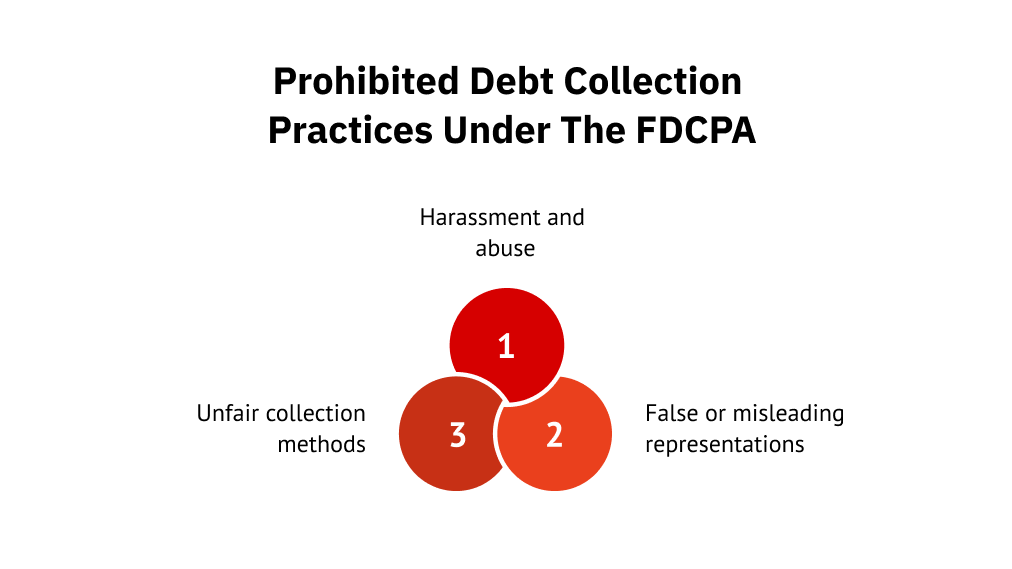
The FDCPA prohibits harassment or abuse, false or misleading representations, and unfair collection practices. These restrictions shape how covered collectors communicate and pursue debts.
In practice, compliance requires controls over agent behavior, account data, communications, and collection actions.
Harassment and abuse
Under § 1692d, collectors cannot engage in conduct whose natural consequence is harassment, oppression, or abuse.
Examples include threats of violence, obscene language, and publishing lists of consumers who allegedly refuse to pay debts. Repeated telephone calls can also violate the law when intended to annoy, abuse, or harass.
Regulation F adds call-frequency presumptions to this standard. Those presumptions consider calls involving a particular person and particular debt.
Exceeding the applicable frequency thresholds can create a presumption of violation. Remaining within them can create a presumption of compliance. However, surrounding circumstances can still affect whether conduct is considered harassing.
In response, partner oversight should cover call governance, agent conduct, and escalation procedures. These controls translate statutory restrictions into repeatable operating practices.
False or misleading representations
Section 1692e prohibits false, deceptive, or misleading representations used to collect a debt. Collectors cannot misrepresent a debt’s amount, character, or legal status. They also cannot falsely claim government affiliation or misrepresent someone as an attorney.
Threatening action that cannot legally occur, or is not actually intended, is prohibited. The statute also prohibits falsely implying that a consumer committed a crime.
Documents cannot imitate court or government papers or misrepresent their source.
Inaccurate placement data can create downstream compliance risk before consumer contact begins. Likewise, poorly governed communication templates can create similar problems.
Partner reviews should assess account validation processes and controls over approved communications before outreach begins.
Unfair collection methods
Section 1692f addresses unfair or unconscionable collection methods. Collectors cannot add interest, fees, or other charges unless an agreement or applicable law permits them.
Other prohibited practices include:
- Depositing or threatening to deposit a postdated payment instrument before its stated date.
- Taking certain nonjudicial property action without a present legal right or intention.
- Communicating with a consumer about a debt by postcard.
These restrictions make accurate account terms and authorized charges essential during placement. Workflows also need controls around payments, property actions, and communication methods.
Together, these categories show why debt collection compliance cannot depend only on agent judgment. Policies, account data, approved communications, and workflow controls must align before consumer contact begins.
How Regulation F reshaped FDCPA debt collection for digital channels
Regulation F made FDCPA requirements more operationally specific for telephone and digital communications.
Effective November 30, 2021, it implements the FDCPA without replacing the statute. Specifically, it addresses call frequency, electronic communications, and validation information.
The 7-in-7 call frequency rule: How it actually works
Regulation F establishes rebuttable presumptions for telephone-call frequency involving a particular person and particular debt.
Generally, a collector is presumed compliant when neither applicable frequency threshold is exceeded. To retain that presumption, call activity must remain within the applicable limits. The calls must concern a particular debt. The collector also should not call within seven days after a telephone conversation concerning that debt.
Exceeding either threshold creates a presumption of violation. However, Regulation F identifies certain calls that are excluded from the frequency calculations.
The presumptions generally operate by particular debt. Certain student loans receive specific treatment under the regulation.
Therefore, multiple debts can create separate frequency calculations involving the same consumer.
Creditors should also consider applicable state requirements and internal policies when evaluating contact strategies. Aggregate communication patterns can still matter when assessing harassment.
Regulation F permits collection communications through email, text, and private social media messages when applicable requirements are satisfied. Electronic outreach must include a clear and simple method for opting out from further messages to that address or number.
Public social media communications about a debt are prohibited when visible to the public or the consumer’s contacts.
Email and text outreach also requires procedures designed to reduce prohibited third-party disclosures. Regulation F specifies circumstances for using email addresses and telephone numbers.
The general inconvenient-time rule also applies across communication media. Without contrary knowledge, communications before 8 a.m. or after 9 p.m. at the consumer’s location are considered inconvenient.
As a result, digital collections require more than adding communication channels. Permissions, opt-outs, timing, and contact information must remain coordinated throughout collection workflows.
Those controls should also inform collection-partner evaluation. Organizations need visibility into how vendors govern digital outreach across channels.
Standardized validation notices: Model Form B-1
Regulation F also standardized how collectors can present validation information. Model Form B-1 provides a safe harbor for specified information and form requirements when properly used.
Required validation information includes:
- The current creditor’s name.
- The debt amount and required itemization.
- Information identifying the debt.
- The consumer’s dispute rights and validation-period end date.
Validation information must generally accompany the initial communication or be sent within five days afterward. Alternatively, the notice may be electronic. Electronic disclosures must follow applicable Regulation F delivery requirements.
The initial communication must state that the collector is attempting to collect a debt. It must explain that obtained information will be used for that purpose. Subsequent communications require disclosure that the communication is from a debt collector.
These rules make accurate source data critical when creditors place accounts with collection partners. Debt balances, creditor identities, itemization data, and contact details directly shape compliant notices.
Incomplete placement data can therefore create compliance problems before a collector sends the first message.
FDCPA vs. state debt collection laws: Which rules actually apply?
The FDCPA establishes federal protections, while applicable state and local laws can provide greater protections. Federal compliance therefore does not automatically satisfy every jurisdiction.
Under FDCPA rules governing state laws, state requirements remain effective unless they conflict with federal law. A state law is not inconsistent simply because it provides consumers greater protection.
For example, California shows why jurisdiction matters. The Rosenthal Fair Debt Collection Practices Act defines “debt collector” more broadly than the federal FDCPA. Its definition includes certain persons who regularly collect covered debts on their own behalf or for others.
Additionally, local requirements can create another compliance layer. New York City regulates communications, disclosures, disputes, verification, and other collection activities.
Its SHIELD Rule takes effect January 1, 2027. The rule adds protections for covered New York City consumer accounts.
Across multiple states, these differences create a jurisdiction-mapping challenge. Workflows must identify applicable requirements before configuring outreach and disclosures.
| FDCPA (1977) | Regulation F (2021) | State and local laws | |
| Scope | Primarily covered debt collectors | Implements FDCPA requirements | Varies; some laws cover original creditors |
| Call frequency | Prohibits harassment | Establishes call-frequency presumptions | May impose different requirements |
| Digital channels | Provides underlying communication restrictions | Addresses email, text, and social media | May add communication requirements |
| Validation notices | Establishes validation requirements | Adds detailed content and Model Form B-1 | May require additional disclosures |
| Liability | Provides federal remedies | Operates within the FDCPA framework | Varies by applicable law |
Ultimately, the operational challenge extends beyond checking one federal standard. Controls must identify applicable jurisdictions before collection workflows are configured.
Where FDCPA compliance breaks down and how First Credit Services strengthens controls
FDCPA compliance often breaks down when collection channels, account data, and operating controls function separately. In response, we coordinate managed workflows, technology, compliance oversight, and documented operating practices.
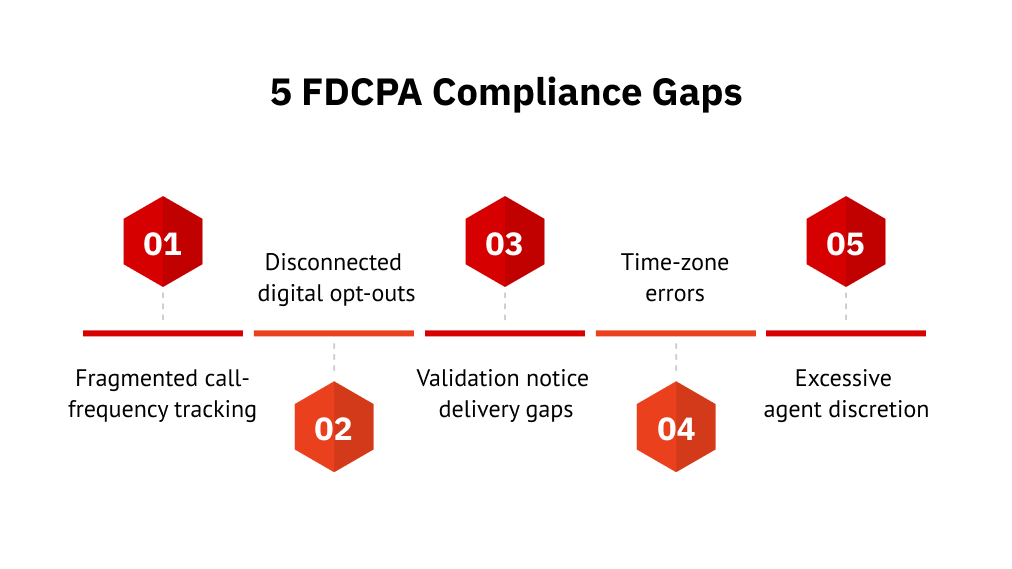
Within that framework, five operational gaps deserve particular attention:
- Fragmented call-frequency tracking. Regulation F measures presumptions using a particular person and particular debt. Multiple debts can still create problematic aggregate contact patterns.
- Disconnected digital opt-outs. Fragmented systems can make it harder to manage consumer communication preferences consistently across channels.
- Validation notice delivery gaps. Collection workflows must support required sending procedures, timing, and documentation.
- Time-zone errors. Contact timing depends on the consumer’s location. Incorrect location data can cause outreach during presumptively inconvenient hours.
- Excessive agent discretion. Compliance becomes harder when agents independently determine contact timing, channel selection, or outreach sequencing.
At First Credit Services, we combine managed third-party recovery operations with our proprietary Unified Consumer Engagement Platform (UCEP).
Our approach brings several elements together:
- Managed platform execution: We operate UCEP on our clients’ behalf, coordinating the technology within the broader recovery program.
- Coordinated engagement: The platform supports email, SMS, chat, and phone within managed recovery workflows.
- Engagement analytics: Analytics help us adapt contact methods and timing based on consumer engagement patterns.
- Compliance oversight: Role-based training, call auditing, automated monitoring, and ongoing oversight support recovery operations.
- Human involvement: Our teams remain involved when consumer circumstances require conversation, negotiation, or resolution.
Together, these capabilities reduce reliance on disconnected tools and individual judgment. They also centralize recovery execution without requiring clients to administer the underlying platform.
| Pro tip: Ask how a collection partner tracks call frequency by person and particular debt. Also review how it manages digital opt-outs, interaction records, and compliance oversight across channels. |
Strengthen recovery with FDCPA compliance built into operations
Recovery performance can suffer when compliance is treated as a final checkpoint instead of an operational requirement. Effective programs build compliance into communications, account data, documentation, and partner workflows.
Ultimately, strong recovery depends on consistent execution across every consumer interaction. The right collection partner should support revenue goals while maintaining disciplined compliance and respectful engagement.
Ready to strengthen compliant third-party recovery across overdue consumer accounts? See how First Credit Services supports compliant debt recovery for your organization.
FAQs
1. Who is responsible for FDCPA compliance when a creditor hires a collection agency?
A collection agency covered by the FDCPA is responsible for complying with its requirements when collecting covered debts. Creditors should still evaluate partner controls and ongoing compliance practices.
2. What happens if a consumer disputes a debt during the validation period?
A timely written dispute generally requires the debt collector to pause collection until required verification is provided. Creditors should maintain accurate records that support timely verification.
3. What records should creditors provide to a debt collection agency for FDCPA compliance?
Creditors should provide complete and accurate account information needed for compliant collection activity. Relevant records can include balances, creditor information, itemization data, and supporting account documentation.
4. What should creditors review when evaluating a collection agency for FDCPA compliance?
Creditors should review compliance governance, training, monitoring, complaint handling, communication controls, and documentation practices. They should also assess how the agency manages Regulation F and applicable state requirements.
5. Does FDCPA compliance replace FCRA or TCPA compliance?
No. FDCPA compliance does not replace obligations under other applicable laws. Collection activities may also implicate the FCRA, TCPA, state laws, and other requirements depending on the activity involved.
6. How often should creditors review a collection agency’s FDCPA compliance?
Creditors should review compliance before engagement and periodically throughout the relationship. Additional reviews may be appropriate when regulations, collection practices, communication channels, or identified compliance risks change.