
Failed payment dunning services recover recurring revenue lost to declined charges, expired cards, and lapsed payment methods through automated retries, card updates, dunning emails, and outsourced agent-led outreach.
Every month, a share of your recurring subscription drafts fail. Your billing system retries a few times. Your team flags the rest. First-week follow-ups happen. By week three, those accounts go quiet. Members who never knew their payment failed leave, and involuntary churn happens without a single conversation.
The gap is predictable. Automated dunning catches card-level failures well. It does nothing for the member who ignores every email and never clicks the update link. That member needs a phone call, a text, or a message that feels like it came from your business.
This post covers why subscription payments fail and go unrecovered, what the revenue leakage looks like at scale, how automated dunning management tools and outsourced payment recovery services compare, and what to look for in a recovery partner.
What do failed payment dunning services actually cover
Failed payment dunning services combine automated retries, card updates, and dunning emails with outsourced agent-led outreach to recover recurring revenue that your billing platform cannot recover on its own.
Why subscription payments fail: soft declines, hard declines, and systemic causes
Soft declines (insufficient funds, temporary holds, network timeouts) clear when retried at the right time. Hard declines (cancelled card, stolen flag, closed account) require the member to provide a new payment method. No retry will resolve them.
Most billing platforms do not distinguish between the two. They retry every decline on the same fixed schedule and send the same dunning email. That burns attempts on cards that will never clear and misses the timing window on cards that would.
The larger problem sits past both decline types. Your dunning email goes out. The member never opens it. A second email follows. It gets ignored. Across 40 locations processing thousands of monthly drafts, these unresponsive accounts stack up fast. Each one is a member who did not choose to cancel and would stay if someone reached out to them directly.
Your billing coordinator knows these accounts need a phone call. In the first week, some calls happen. By week three, membership sales, check-ins, disputes, and daily operations take over. The follow-up list grows untouched, and the members who needed a second or third contact leave without a conversation.
The involuntary churn math: what unrecovered payments actually cost
Involuntary churn from failed recurring payments costs more than the missed charge. Every unrecovered decline removes a member’s full remaining lifetime value and adds recovery work your team was not hired to do. The cost compounds monthly across every location.
Recurring revenue leakage at scale
The recurring payment recovery math is straightforward. If your organization processes $500,000 in monthly subscription drafts and 10% of payments fail, $50,000 is at risk every month. Without a structured recovery program, most of that revenue walks out.
At higher volumes, the leakage scales proportionally. A multi-location membership organization processing $2 million in monthly drafts faces $200,000 in monthly exposure at the same failure rate.
| Monthly Recurring Drafts | 10% Failure Rate | Annual Revenue at Risk |
| $500,000 | $50,000/month | $600,000 |
| $1,000,000 | $100,000/month | $1,200,000 |
| $2,000,000 | $200,000/month | $2,400,000 |
These figures capture only the immediate loss. Each failed payment also removes every future payment that the member would have made.
For example, at a $49/month membership with 14-month average retention, losing 200 members per month to unrecovered declines erases $137,200 in future revenue beyond the missed drafts. The recovered charge is the smallest part of what you keep.
Staff bandwidth and the internal recovery trap
Consider a 40-location fitness chain processing 25,000 monthly drafts at a 10% failure rate. That generates 2,500 declined accounts every billing cycle. Each one needs follow-up.
Your billing team handles what it can in the first week. The straightforward recoveries are clear. However, the backlog grows faster than your staff can work it. The next billing cycle delivers another 2,500 declined accounts before the previous batch is resolved.
This compounds quickly:
- Month one: 2,500 open accounts
- Month two: 2,500 new declines plus unresolved accounts from the previous cycle
- Month three: your team manages three months of open recovery alongside their primary responsibilities
Each month, the oldest accounts receive the least attention. These are the members who needed the most outreach: a phone call after ignoring the dunning email, or a text after missing a callback. Instead, they receive nothing, and their memberships quietly expire.
Adding a dedicated recovery headcount addresses the capacity problem. However, a full-time recovery specialist requires salary, benefits, training, and ongoing management. For a multi-location organization, scaling that role across every location adds a fixed cost regardless of how many payments you actually recover.
That is the internal recovery trap. Doing nothing costs you members and their lifetime revenue. Staffing up costs fixed overhead that does not flex with your declining volume.
Smart payment retries vs. outsourced failed payment recovery services
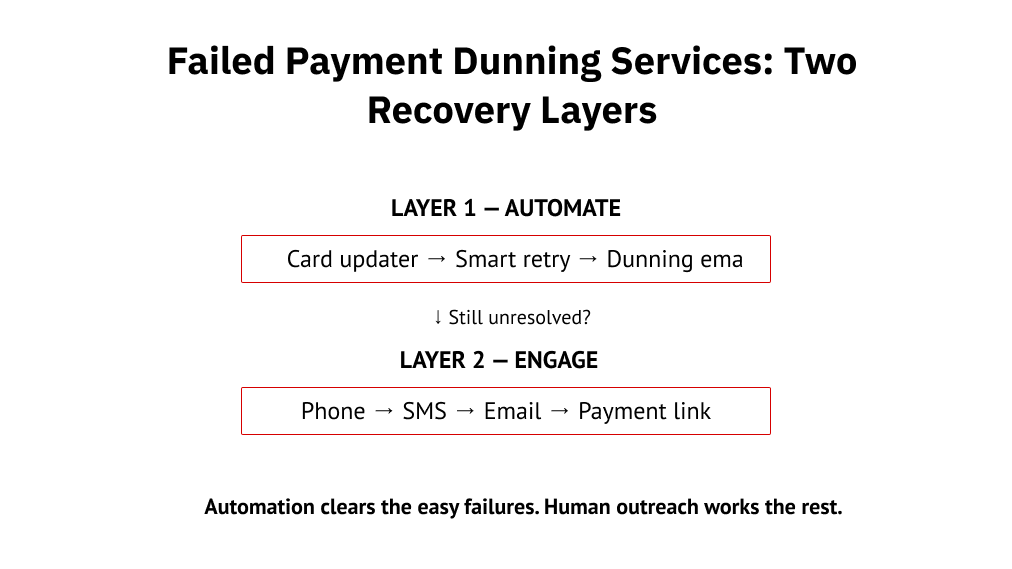
Failed payment dunning services fall into two categories: automated tools that retry and update at the card level, and outsourced recovery programs that contact members directly. Payment retry services handle card-level failures. Outsourced failed payment recovery services handle unresponsive members. Most high-volume billing operations layer both.
Where automated dunning management tools fit
Card updater integrations pull refreshed credentials from the issuing network before your next charge date. When a card is reissued or expires, the updated details clear the payment without member action.
Smart payment retries add timing optimization. Payment retry logic sends each reattempt during windows where approval is likely: post-payday, post-card-refresh, or after a temporary hold is released. The timing difference between retrying on the 28th and retrying on the 1st often separates a decline from a cleared charge.
Dunning email sequences run alongside retries. They notify the member, link to a self-service portal for updating payment details, and escalate through a timed cadence.
This stack handles the recoverable failures well:
- Expired or reissued cards (card updater)
- Soft declines from temporary holds or insufficient funds (smart retries)
- Network timeouts and payment processor errors (automatic reattempt)
The gap appears with members who never open the dunning email, see the notification, and do nothing. No number of retries or automated messages will recover that payment. Those accounts need direct contact.
Where outsourced human-led subscription payment recovery fits
Outsourced subscription billing recovery works as a managed service. A dedicated team of agents contacts declined members by phone, email, and text under your brand name. The member experience stays consistent with your business.
This recovery model fits when:
- The decline volume exceeds what your billing team can follow up on consistently
- Members respond to a personal call or text but ignore system-generated dunning emails
- You need a structured, multi-week follow-up cadence across your full decline population
- You want first-party, brand-compliant outreach where the member relationship stays intact
The outsourced partner runs the program, reports results, and adjusts outreach strategy across the recovery cadence. Your organization adds no headcount.
What it does not cover: card-level automation. Outsourced recovery teams do not run card updaters or payment gateway retries. They work on the accounts that automation could not resolve.
When businesses use both
Automated subscription dunning services handle the first pass. The moment a recurring payment fails, card updaters refresh credentials, smart retries fire at optimized windows, and dunning emails go out. This clears card-level failures within the first few days.
Members not recovered by automation flow into the second pass. Recovery agents begin direct outreach through a structured cadence that runs for several weeks. Each contact goes out under your brand, through the channel the member is most likely to respond on.
Automated tools handle fast recoveries. Your outsourced team works on the accounts that need a conversation. This structure covers the full recurring payment recovery cycle without duplicating effort.
| Dimension | Automated dunning tools | Outsourced recovery services |
| How it works | Software retries charges and sends automated messages | Trained agents contact members directly |
| Member engagement | No human intervention | First-party, brand-compliant phone, email, text |
| Best for | Card-level failures (expired, soft declines, network errors) | Members who do not respond to automated outreach |
| Speed | Immediate, 24/7 | Structured cadence over weeks |
| Limitation | Cannot reach unresponsive members | No card-level automation |
| Staffing impact | No internal staff needed | No internal staff needed (outsourced) |
| Pro Tip:Ask any recovery partner for their recovery rate broken out by decline reason. A blended number can mask weak performance on harder accounts. It could mean the partner only recovers the soft declines your existing retry tools would have caught anyway. |
How First Credit Services recovers failed payments
First Credit Services delivers the outsourced recovery side of the model above as a fully managed service. The company runs the entire failed payment recovery program on your behalf, under your brand, with no headcount added to your team.
First-party outreach through UCEP
Every contact a declined member receives looks and sounds like it came from your business. First Credit Services agents work from scripts, messaging, and talking points your team approves. The member never knows a recovery partner is involved.
The engine behind this outreach is the Unified Consumer Engagement Platform (UCEP), First Credit Services’ proprietary engagement and payment platform. UCEP scores each declined account and selects the right channel, message, and timing per member. First Credit Services operates UCEP entirely on your behalf. Your team never touches the platform.
Members receive a personalized, mobile-first payment link. They can view their balance, set up a payment plan, update their payment method, or schedule a callback. No login or account number entry is required. Most resolutions happen through this self-service portal without an agent conversation.
First Credit Services connects with your existing billing and club management systems through custom API integration. Payment updates flow into your records as accounts recover.
The structured omnichannel recovery process
First Credit Services runs a multi-week recovery cadence coordinating phone, SMS, and email. Each channel informs the next. A member who opens an email but does not pay gets a follow-up text. A member who misses a call gets a voicemail and an SMS with a payment link.
This process picks up where your automated dunning tools left off. The cadence runs long enough to reach members who need a second, third, or fourth contact before they update their payment method.
First Credit Services manages outreach scheduling, agent staffing, compliance monitoring, and reporting. Your team receives recovery updates without running the day-to-day operation.
Recovery benchmarks
A coffee subscription company VP reported recovering over 70% of failed payments each month through First Credit Services’ failed payment recovery program.
This model fits recurring-payment businesses processing high draft volumes: health clubs, membership organizations, and subscription services that need managed, brand-compliant recurring payment recovery without adding headcount. If automated subscription dunning services handle your decline volume alone, you are better served staying in-house.
How to choose the right failed payment recovery approach
Automated dunning management tools recover card-level failures fast. Outsourced failed payment recovery services reach the members who ignore every email and never click the update link. The right approach depends on your decline volume, how your members respond to outreach, and whether your internal team can follow up consistently past the first week.
For most high-volume billing operations, the strongest recurring payment recovery program layers both. Automation clears the recoverable declines immediately. Outsourced agents work the rest through direct contact over a structured cadence.
Expanding your billing team or adding another automated tool is a valid starting point. The question is whether either delivers consistent results at your current scale.
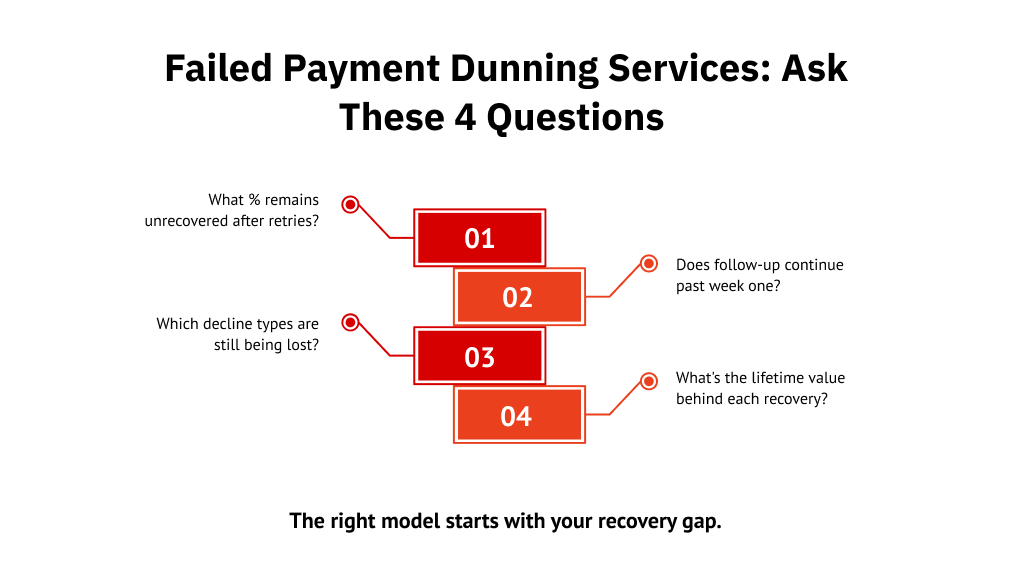
Before choosing a recovery partner, ask yourself:
- What share of your failed payments go unrecovered after automated retries?
- Does your internal team follow up consistently past week one?
- Can you quantify the lifetime value of each member you lose to a declined payment?
Contact First Credit Services for a portfolio assessment of your current failed payment recovery program.
FAQs
1. What is the difference between dunning and debt collection?
Dunning is the process of recovering failed payments on active accounts before they are written off. It includes automated retries, payment update requests, and outreach to resolve declined charges. Debt collection begins after an account has been formally written off and placed with a collection agency. Dunning keeps the customer relationship intact. Collections works on accounts that have already left.
2. How long should a dunning process run before canceling a subscription?
Most dunning sequences run 14 to 30 days after the initial failed payment. The right window depends on your billing cycle, average customer lifetime value, and how your members respond to outreach. Ending too early loses recoverable accounts. Running too long delays revenue recognition on accounts that will never resolve. High-value memberships with longer retention histories justify a longer recovery window.
3. What recovery rate should a business expect from dunning services?
Recovery rates vary by decline type, account age, and recovery model. Automated retries recover a higher share of soft declines within the first few days. Outsourced recovery teams focused on unresponsive members reach accounts that automation cannot resolve. Ask any recovery partner for their rate broken out by decline reason, because a blended number can mask weak performance on harder accounts.
4. Do I still need outsourced recovery if I already use smart payment retries?
Smart retries and card updaters handle card-level failures: expired cards, soft declines, and network errors. They do not reach members who ignore every automated email and never update their payment method. If a meaningful share of your declined accounts go unrecovered after automated retries, outsourced recovery fills that gap through direct phone, email, and text outreach.
5. What percentage of subscription churn comes from failed payments?
A PYMNTS/FlexPay study found that failed card payments cause 50% of all subscription churn, with 80% of those failures happening without any action from the customer. Most of these members did not choose to cancel.
6. Does Dunning work for annual billing or only monthly subscriptions?
Dunning applies to any recurring payment that can fail, including annual charges. Annual billing makes each failed payment higher-stakes because you lose a full year of revenue in a single decline. The recovery approach is the same: automated retries, card updates, and direct outreach. The urgency and follow-up cadence may need to be more aggressive given the larger amount at risk.