


Recovering unpaid patient balances often requires more than standard collections expertise.
A medical bill collection agency combines healthcare-specific recovery processes with the insurance, privacy, and compliance requirements that govern patient accounts, making the choice of collection partner an important business decision for hospitals, health systems, and other providers.
Hospital finance leaders are weighing more than recovery speed. They need a partner that protects compliance and the patient relationship while getting the balance paid.
That pressure keeps building. An American Hospital Association report found that bad debt and charity care per calendar day rose 16% year over year through May 2026.
Patient balances involve insurance adjudication, explanations of benefits, financial-assistance eligibility, and protected health information. Each factor is governed by its own rules, so healthcare collections cannot run on the same playbook as ordinary consumer debt.
This guide covers how a medical bill collection agency works, first-party versus third-party models, compliance requirements, typical costs, and how to choose the right partner.
How does a medical bill collection agency work?
Knowing the recovery sequence helps you judge whether a prospective partner is actually built for healthcare accounts, rather than adapting a general process to fit.
- Account placement and data validation: The agency verifies the patient’s identity, account number, and billing history before any outreach begins. This step also flags accounts that still need insurance follow-up or billing correction. Contacting a patient about a balance the insurer should have paid damages trust fast.
- Compliant patient outreach: Outreach runs across phone, email, SMS, chat, and self-service channels, sequenced to reach the right party through the channel most likely to get a response. Healthcare-specific compliance rules govern the timing, frequency, and content of every message.
- Financial-assistance screening: Before pursuing a balance, the agency checks whether the patient may qualify for charity care or another assistance program. Screening first protects the provider from pursuing money a patient was never actually responsible for.
- Payment resolution and reporting: Accounts resolve through payment in full, a payment plan, or a documented dispute. The agency reports every outcome back to the provider, so finance and revenue-cycle teams keep a current view of recovery performance.
First Credit Services runs this entire sequence on an omnichannel debt collection model, coordinating compliant outreach and digital engagement across every channel. This is done so providers get one consistent process instead of a patchwork of manual steps.
First-party vs. third-party medical debt recovery: which model fits your organization?
Providers generally choose between two recovery models for unpaid patient balances. First-party recovery keeps the account on the provider’s own books. Third-party recovery, which accounts for much of hospital bad debt collection, transfers eligible accounts to an agency after the provider’s internal collection efforts have been exhausted.
The right model depends on account age, the patient relationship at stake, and how much recovery infrastructure the organization wants to build internally.
Here is how each model actually functions, starting with the option that keeps the account under the provider’s own name.
First-party recovery (early-out and EBO)
In first-party recovery, the account never technically leaves the provider. Outreach goes out under the provider’s own name, so the experience feels like ongoing billing rather than collections.
This model covers early-out follow-up on self-pay balances and Extended Business Office (EBO) support. EBO support handles insurance follow-up and denial management before a balance becomes true patient responsibility.
Once internal efforts on early-out and EBO accounts are exhausted, the balance typically escalates to a different model entirely, one where the account leaves the provider’s own name for good.
Third-party recovery
Third-party recovery applies once an account is aged, escalated, or exhausted through internal collection efforts. At that point, the provider places the balance with an agency, which contacts the patient under its own name rather than the provider’s.
This shift is usually reserved for accounts that internal teams have already worked without success.
| Comparison Factor | First-Party Recovery | Third-Party Recovery |
| Who owns the account | The provider | The agency, acting on the provider’s behalf |
| Whose name the patient sees | The provider’s own brand | The agency’s own brand |
| How the collector is paid | Fee-for-service or contingency, depending on setup | Typically contingency |
Whichever model applies, the account stays inside one connected recovery process rather than moving to an unrelated vendor.
FCS offers first-party and third-party collections, EBO, and broader healthcare revenue-cycle services under one partner. One hospital billing director, an EBO partner for over five years, pointed to significant drops in dispute resolution times and bad debt sent to collections.
What compliance rules must a medical bill collection agency follow?
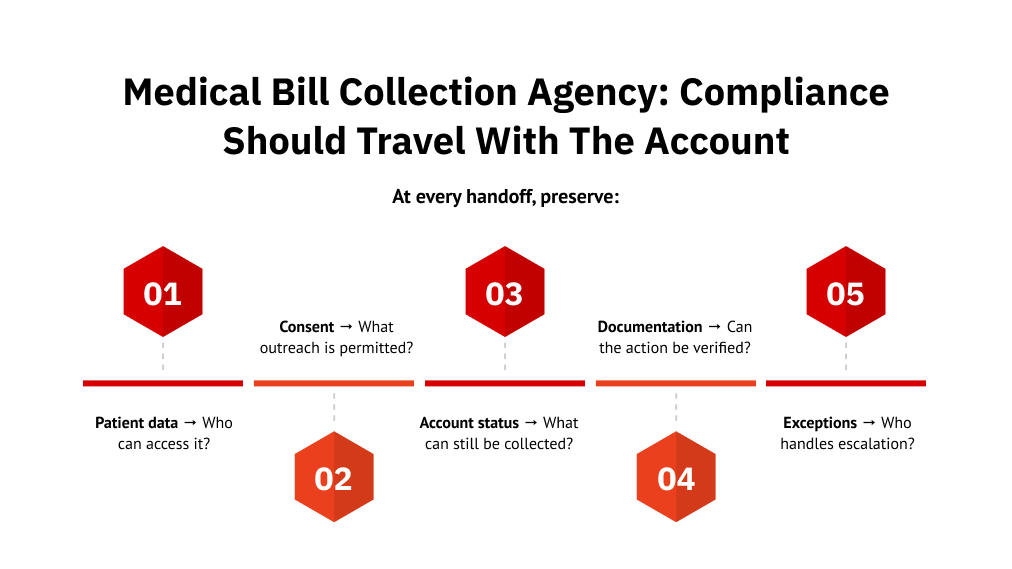
A medical bill collection agency operates under more regulatory overlap than almost any other collections vertical. This is why a patient balance collection agency needs to prove its compliance posture before a provider signs. Understanding each layer matters before you sign a contract.
HIPAA and protected health information safeguards
The Health Insurance Portability and Accountability Act (HIPAA) governs how an agency handles protected health information (PHI). Any agency working with patient accounts must sign a Business Associate Agreement (BAA) and apply the minimum-necessary standard when accessing records. It must also encrypt PHI in transit and at rest, as per the HHS HIPAA for Professionals.
FCS, for example, maintains HIPAA compliance, PCI DSS Level 1, and SOC 2 Type II certification, giving providers a documented, checkable standard to compare other agencies against.
Once you’ve confirmed the agency’s compliance requirements, ask for its most recent SOC 2 Type II report before sharing account data. Confirm that a signed BAA is already in place.
FDCPA and Regulation F
The Fair Debt Collection Practices Act (FDCPA) and its implementing rule, Regulation F, set fair-practice standards for contacting a patient. These rules govern call frequency, required disclosures, and prohibited threats or misrepresentations, as per the FTC, the Fair Debt Collection Practices Act, and the CFPB, Debt Collection Practices Regulation F.
TCPA
The Telephone Consumer Protection Act (TCPA) restricts automated calls and text messages, including consent requirements for autodialed outreach. A medical bill collection agency needs documented consent before texting or robocalling a patient about a balance, as per the FCC, Telemarketing and Robocalls.
No Surprises Act
The No Surprises Act limits certain out-of-network balance billing, which matters directly to collections. An agency should confirm an account does not involve a protected surprise-billing scenario before pursuing it, as per the CMS No Surprises Act.
The CFPB medical debt rule
The Consumer Financial Protection Bureau (CFPB) finalized a rule barring medical debt from consumer credit reports on January 7, 2025. A federal court vacated that rule on July 11, 2025, and it is not currently in force, as per the CFPB.
With the federal rule no longer in force, providers can continue placing accounts with a collection agency. State-level reporting laws and each agency’s own credit-bureau practices still vary, so confirm current requirements with your compliance team.
| Compliance Snapshot: Medical receivables may involve HIPAA (PHI and BAA requirements), FDCPA and Regulation F (covered collection practices), TCPA (certain call and text consent requirements), and the No Surprises Act (balance-billing protections). The CFPB medical debt rule is currently vacated. FCS supports its compliance framework with HIPAA, PCI DSS Level 1, and SOC 2 Type II credentials. |
How much does a medical bill collection agency cost?
Pricing for a medical bill collection agency generally falls into two models. Which one applies often depends on where the account sits in its lifecycle, and whether you’re evaluating it as a patient balance collection agency for early-stage accounts or as a bad-debt recovery partner for aged ones.
Contingency fee model
Contingency pricing is the standard model for third-party collections. The agency earns a percentage of whatever it actually recovers and charges nothing on accounts that never pay. This aligns the agency’s incentive with the provider’s outcome, since payment only happens after money changes hands.
Flat-fee pre-collection programs
Flat-fee programs typically apply earlier, before an account reaches contingency-based recovery. The provider pays a fixed cost per account for letter-based or other early outreach, regardless of whether the balance resolves. This model suits high-volume, low-balance accounts, where a percentage fee would not cover the outreach cost.
| Fee Model | When It Applies | Who Bears the Risk |
| Contingency | Third-party or bad-debt recovery | The agency, since payment depends on results |
| Flat-fee pre-collection | Early, letter-based outreach before contingency recovery | The provider, since the fee applies regardless of outcome |
| Pro tip: Ask any agency for netback, not gross recovery. Netback is what actually reaches you after fees, so the highest gross recovery rate does not always mean the highest return. |
Medical bill collection agency vs. in-house billing vs. full RCM outsourcing
Providers can keep everything in-house, bring in a specialized medical bill collection agency for hospitals, or outsource the entire revenue cycle management (RCM) function. Each option fits a different point in the account lifecycle and a different level of internal capacity.
The point of diminishing returns
Internal billing teams typically recover the easiest accounts first, meaning patients who respond to an early statement or a single phone call. Recovery rates drop sharply as accounts age, become disputed, or need insurance follow-up that competes with a team’s daily workload.
At that point, a specialized partner often outperforms continued in-house effort. The question then becomes which factors actually point you toward that decision.
A framework for the decision
The right choice depends on several factors working together, starting with how many accounts you place and how fast that volume is growing.
Consider these factors when deciding which approach fits your operation:
- Account volume and growth rate
- Average account age at the point of escalation
- Complexity, including insurance disputes and financial-assistance flags
- Internal team’s compliance burden
- Internal capacity and bandwidth for account-level follow-up
- Integration requirements with your billing or CRM system
| Approach | Best For |
| Keep in-house | Low volume, early-stage, straightforward self-pay balances |
| Specialized medical bill collection agency | Aged or complex accounts once internal recovery slows |
| Full RCM outsourcing | Organizations handing off the entire revenue cycle function, not just collections |
FCS works as a flexible outsourcing partner, supporting first-party collections, third-party collections, EBO, and broader patient financial services outsourcing without requiring a full RCM arrangement.
How to choose the right medical bill collection agency
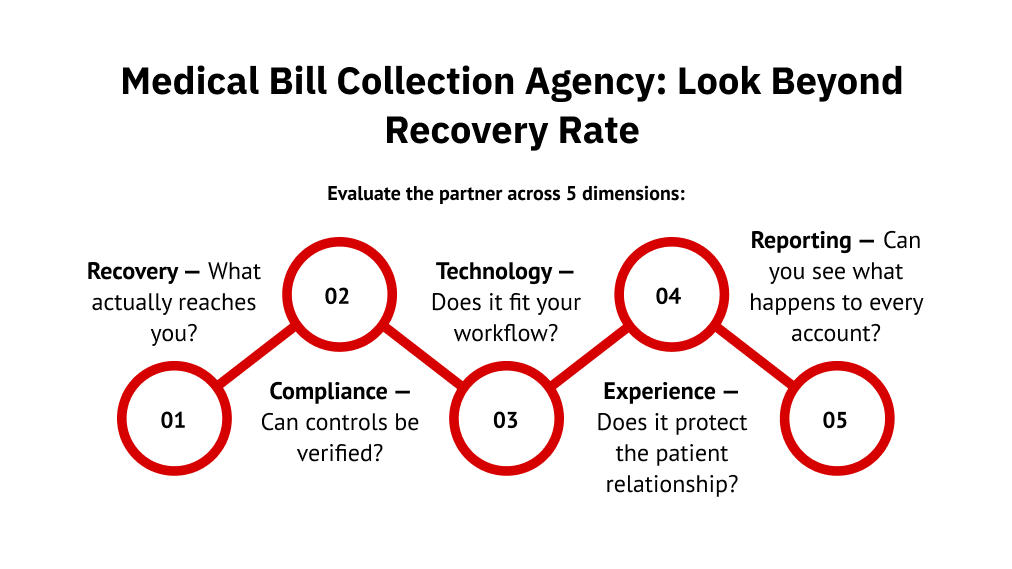
Selecting a medical bill collection agency for hospitals comes down to more than a quoted recovery rate.
Look for these signals before you sign:
- Proven healthcare specialization, not a general collections background applied to medical accounts
- Documented HIPAA, SOC 2, and PCI DSS credentials you can verify independently
- Electronic health record (EHR) integration that fits your existing healthcare revenue-cycle systems
- Transparent netback reporting, not just gross recovery figures
- A defined process for financial-assistance and charity-care screening
- Digital-first outreach across phone, email, SMS, and chat
- Clear, documented compliance procedures for every applicable framework
- Current state licensing in every state where your patients live
Ask each vendor to walk through this list item by item rather than accepting a general pitch deck. A partner that hesitates on any single point is worth a closer look before you move forward.
Some warning signs are just as telling as the checklist above.
Red flags to watch for
- Talks about gross recovery instead of netback
- Cannot explain how financial-assistance screening actually works
- Treats every account stage the same way, regardless of age or complexity
- Cannot confirm current state licensing
- Makes broad compliance claims without offering documentation
The strongest medical bill collection agency partners perform well across recovery, compliance, patient experience, reporting, technology, and netback, not just one metric in isolation.
Conclusion
Choosing a medical bill collection agency is a layered decision, not a single comparison point. Understanding the model, whether first-party, third-party, or a blend of both, comes first. From there, compliance credentials, true cost through netback, and how the agency handles financial-assistance screening all shape the outcome as much as any advertised recovery rate.
The right partner should function as an extension of your revenue cycle, not simply a vendor pursuing unpaid balances.
Ready to choose a medical bill collection agency that prioritizes recovery, compliance, and patient experience? Discuss with the FCS team to explore its healthcare EBO and medical bill collection services.
FAQs
1. What does a medical bill collection agency do?
It contacts patients on a provider’s behalf to resolve unpaid balances, screens accounts for financial-assistance or charity-care eligibility, sets up payment plans, and reports outcomes back to the provider, all while following healthcare and debt-collection compliance requirements specific to patient accounts.
2. How much does a medical bill collection agency charge?
Most agencies operate on contingency, taking a percentage of the amount recovered and charging nothing if the account never pays. Some also offer flat-fee, letter-only pre-collection programs for early-stage outreach before an account moves into full contingency-based recovery.
3. How does the CFPB’s vacated medical debt rule affect how we place accounts?
The rule was vacated by a federal court in July 2025 and is not currently in force. Providers can continue placing accounts with a collection agency, subject to other applicable requirements. Confirm current rules with your compliance or legal team and agency partner.
4. What’s the difference between first-party and third-party medical debt collection?
First-party collection happens while the account is still on the provider’s books, with outreach going out under the provider’s own name. Third-party collection generally begins when an aged or escalated account is placed with an external agency, often after internal recovery efforts are exhausted.
5. Does a medical bill collection agency need to be HIPAA compliant?
Yes. Agencies handling protected health information on behalf of covered entities generally operate as business associates and must maintain appropriate HIPAA safeguards along with a signed Business Associate Agreement before any patient data changes hands or account details are shared.
6. How do I choose the right medical bill collection agency?
Look for proven healthcare specialization, documented compliance credentials such as HIPAA, SOC 2, and PCI DSS, EHR integration, transparent netback reporting, and financial-assistance handling. Avoid choosing based on a headline recovery rate alone, since that number rarely tells the full story.