


A patient balance becomes harder to resolve when the bill starts competing with rent, groceries, utilities, and other everyday costs.
That pressure is now affecting millions of households. According to the West Health 2026 report, about one in three U.S. adults made at least one daily life trade-off in the past year to pay for healthcare expenses.
For providers, this changes the role of patient financial services. The work is no longer just about sending statements or following up on overdue balances. It is about giving patients clearer payment paths before accounts age further.
This guide explains what patient financial services outsourcing covers, when to consider early-out or EBO support, what compliance requirements matter, and how to choose the right partner.
What does patient financial services outsourcing actually cover?
Patient financial services outsourcing covers the patient-facing financial work that happens after care is delivered and a balance needs action.
That may include patient billing support, early-out outreach, self-pay recovery, payment plan coordination, EBO support, dispute routing, and collections handoff. The goal is not to chase every balance harder but to move accounts toward resolution with the right timing, channel, and tone.
Most providers outsource three layers.
| Layer | What it covers | Best fit |
| Early-out self-pay recovery | Follow-up on newer balances, often 0 to 90 days. | High-volume balances that need faster outreach. |
| Extended Business Office | Added AR and billing support for backlogs or staffing gaps. | Teams that need capacity without replacing internal staff. |
| First-party and third-party collections | Escalation for accounts that move beyond the EBO window. | Aged accounts that need a documented recovery path. |
Early-out should still feel like billing support, not collections. At this stage, patients may need a clearer balance explanation, financial assistance guidance, or a simple path to set up payment.
When the account needs more structured support, an Extended Business Office can go further. For example, First Credit Services’ extended business office model can support patient outreach, denied claim follow-up, and AR resolution while working as an extension of the provider’s team.
If the account still does not resolve, collections becomes the next step. Based on the provider’s internal policy, unresolved balances may move into a first-party or third-party recovery workflow.
| Key takeaway: Patient financial outsourcing works best when each account stage has a clear role. Early balances need support. Aging accounts need structure. Bad debt needs a compliant recovery process. |
Where patient financial outsourcing ends and full RCM begins
Patient financial services outsourcing and full revenue cycle management are often discussed together, but they solve different problems.
PFS outsourcing focuses on patient-facing financial resolution. It supports billing communication, patient balance follow-up, self-pay outreach, payment support, and escalation when accounts need the next step.
Full RCM has a wider scope. It can cover coding, charge capture, claims submission, denial management, payer follow-up, contract underpayment analysis, and revenue integrity.
That difference matters during vendor selection. If denied claims are the main issue, a patient billing support partner may not solve the root problem. But if self-pay balances are aging because patients are not engaging, a full RCM vendor may be more than the organization needs.
Defining the scope early keeps the project focused. It also helps avoid mismatched pricing, unclear handoffs, and disappointing results after launch.
What signals tell you it is time to outsource patient financial services?
Outsourcing usually becomes relevant before the problem appears as bad debt. The signs show up in aging reports, staffing gaps, and delayed patient engagement.
Before choosing a model, look at where the revenue cycle is slowing down.
1. AR aging and self-pay growth
Self-pay AR is often the clearest signal that patient financial workflows are falling behind. When more balances move into the 60- to 120-day bucket, the recovery window is already narrowing.
However, delayed payment does not always mean patients are refusing to pay. Some patients may not understand the bill, while others may need a payment plan. They may also miss phone-based outreach or prefer a digital link that lets them resolve the balance without calling the billing office.
Watch for these patterns:
- Self-pay AR is rising faster than patient volume.
- More accounts are crossing 90 days.
- Days in AR are increasing quarter over quarter.
- Payment plan adoption is low.
- Bad debt placements are rising.
- Staff spends more time answering balance questions than resolving accounts.
When these patterns repeat, the issue is usually not effort. It is capacity and process design.
2. Staffing gaps and compliance load
A single vacancy in billing or AR can quickly turn into a revenue cycle problem. As open accounts pile up, follow-ups become less consistent, disputes take longer to resolve, and payment conversations lose the structure patients need.
Meanwhile, compliance expectations keep adding pressure to already stretched teams. Patient financial services now have to account for HIPAA, TCPA, Regulation F, No Surprises Act disclosure expectations, internal financial assistance policies, and state-level collection rules.
This is why many providers look for partners that combine operational support with compliance-ready workflows. A digital-first partner can also reduce call dependence by using channels such as SMS, email, chat, and branded self-service portals. FCS covers this through its digital collections platform, which supports coordinated patient engagement across multiple channels.
Which outsourcing model fits your revenue cycle stage?
Once the warning signs are clear, the next step is to match the model to the account stage. Early-out, EBO, and collections are connected, but they solve different problems.
When early-out self-pay recovery is enough
Early-out self-pay recovery fits newer balances where the main issue is communication volume.
At this stage, the patient relationship is still active, so outreach should feel like a continuation of billing support rather than a collections handoff. The goal is to clarify the balance, offer practical payment options, route disputes quickly, and resolve accounts before avoidable aging sets in.
Early-out works well when:
- Balances are fresh.
- Account volume is high.
- Staff cannot follow up consistently.
- Patients need clearer payment options.
- The provider wants to reduce bad debt before write-off.
It is less effective when accounts are already deeply aged or when the real issue is unresolved claims, coding errors, or missing insurance updates.
When an EBO is the right fit
An EBO adds operating capacity without replacing the internal team.
This model fits providers facing a defined backlog, chronic staffing pressure, payer-specific AR issues, or post-EHR migration cleanup. It can also help when accounts in the 60- to 90-day range are moving toward write-off faster than staff can work them.
A strong EBO program needs clear ownership. The provider should define which accounts go to the partner, which remain internal, how disputes return, and when unresolved balances move to the next stage.
| Implementation tip: Before launching an EBO, define the return path for disputed accounts. If the partner cannot resolve the issue, the account should move back to the right internal team without delay. |
When to escalate beyond EBO
Some accounts will not resolve during early-out or EBO work. That is why escalation should be planned before the program starts.
Accounts that age beyond 120 to 180 days may move into first-party or third-party collections, depending on provider policy.
The handoff matters. Account notes, outreach history, dispute status, payment attempts, and patient preferences should move with the account. If that history disappears, patients repeat themselves and internal teams lose context.
A complete lifecycle model helps reduce that break. It gives the provider one connected path from patient billing support to formal recovery.
Why patient experience should shape the outsourcing decision
Patient financial services outsourcing touches the relationship after care. That makes experience a revenue issue, not a soft metric.
When a bill is confusing, payment can slow down even if the patient is willing to resolve it. Poorly timed outreach can create frustration, and a hard-to-use portal can stop patients from completing the payment process.
Thus, the provider should decide what the patient will see before any account is placed.
Brand visibility matters
In a white-labeled model, patients see the provider’s brand. The partner works behind the scenes, and the experience feels like a continuation of the billing office.
In a standard third-party model, patients may see the agency’s name. That can make sense for older accounts, but providers should decide when that shift happens and how it will affect the patient relationship.
Ask these questions before signing:
- Will patients see our brand or the partner’s name?
- Does that change by account age?
- Can the payment portal be white-labeled?
- Who handles chat and phone conversations?
- How are complaints routed?
- Can scripts match our communication standards?
These details decide whether outsourcing feels supportive or disruptive.
Omnichannel support improves resolution access
Phone-only outreach leaves too much to chance because many patients do not answer unknown calls. However, they may respond to a secure text, email, portal link, or scheduled callback when the next step is clear.
A stronger PFS model gives patients more ways to resolve their balance on their own terms. They should be able to view the amount due, choose a payment plan, ask a question, or pay without waiting on hold.
That is where omnichannel engagement becomes useful. It does not replace human support; it removes unnecessary friction before a patient needs to speak with someone.
What compliance requirements must your patient financial services partner meet?
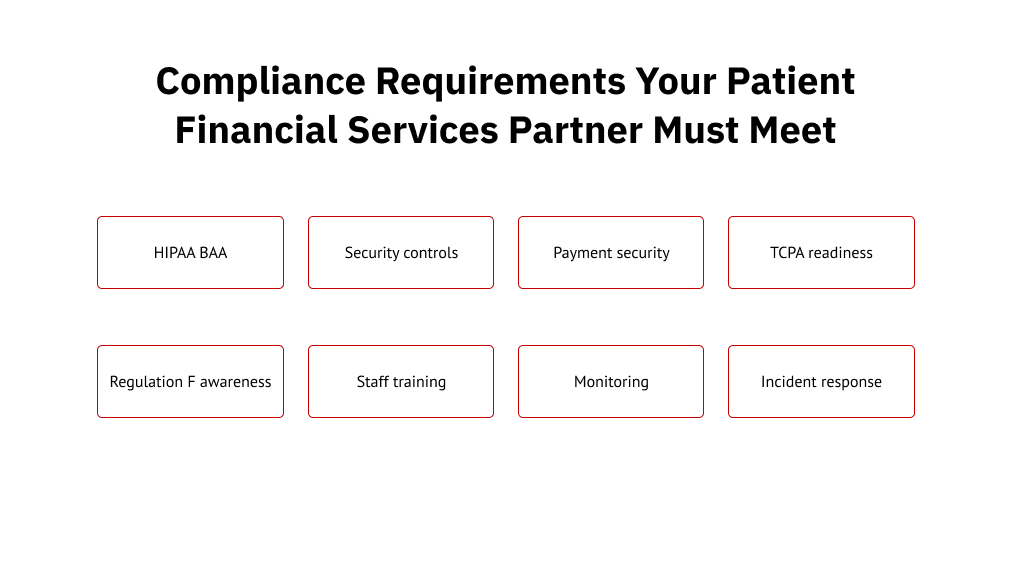
Patient financial services outsourcing involves PHI, payment data, contact rules, and sensitive financial conversations. Hence, compliance should be tested before any data is exchanged.
The first requirement is a HIPAA Business Associate Agreement. A BAA should define permitted data use, safeguards, breach notification obligations, and responsibilities on both sides.
The stakes are real. According to the HIPAA Guide, HHS civil monetary penalties for HIPAA violations now range from $145 to $2,190,294 per violation. That makes vendor due diligence more than a procurement step.
Use this checklist during evaluation:
| Requirement | What to confirm |
| HIPAA BAA | Signed before PHI transfer. |
| Security controls | SOC 2 Type II, HITRUST, or equivalent safeguards. |
| Payment security | PCI DSS controls for card payments. |
| TCPA readiness | Consent documentation for calls and SMS. |
| Regulation F awareness | Contact rules, disclosures, and digital communication controls. |
| Staff training | Role-based training records. |
| Monitoring | Call review, QA, escalation rules, and audit trails. |
| Incident response | Written process for security or compliance events. |
In addition to these, ask how the partner handles financial assistance workflows, disputed balances, deceased accounts, bankruptcy flags, and patient complaints.
How do you evaluate and onboard a patient financial services partner?
A good vendor conversation should make the operating model clearer. If it creates more uncertainty, slow down.
Before signing, ask five questions.
| Question | Why it matters |
| How will data move between systems? | Confirms API, SFTP, direct access, file fields, and update frequency. |
| Which stages do you support? | Prevents gaps between early-out, EBO, and collections. |
| What will patients see? | Clarifies brand visibility and patient experience. |
| What reporting will we receive? | Shows whether you get dashboards, netback, status, and dispute tracking. |
| How is pricing structured? | Clarifies contingency, flat-fee, hybrid, and seat-based costs. |
Red flags include vague integration language, no BAA before data discussion, no escalation protocol, weak TCPA or Regulation F documentation, and reports that show gross recovery without netback.
| Selection tip: Ask the vendor to walk through one sample account from placement to resolution. This reveals more than a capabilities deck because it shows data flow, patient contact, dispute handling, payment options, and reporting. |
How does patient financial services outsourcing work with First Credit Services?
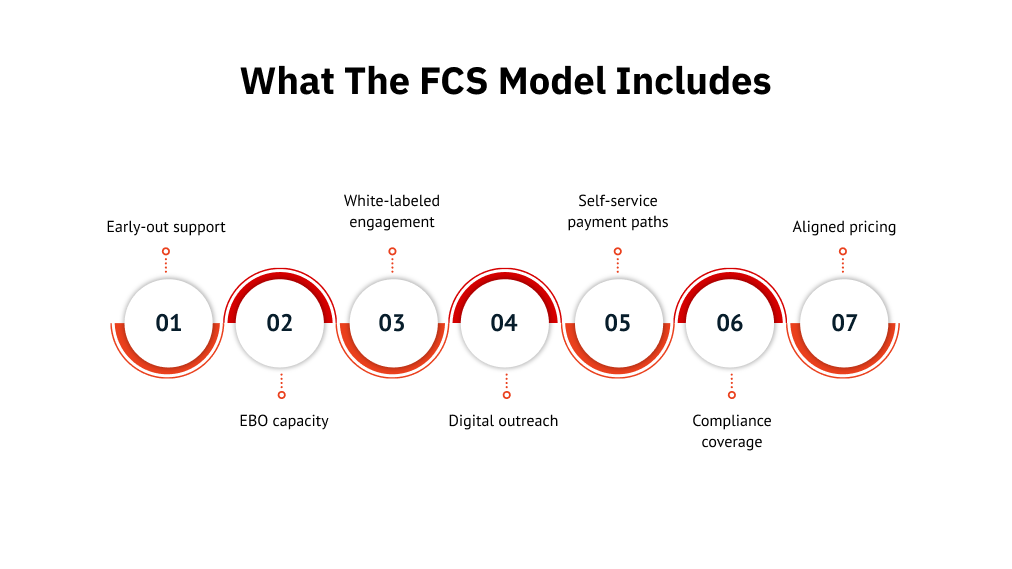
First Credit Services supports healthcare organizations with managed patient engagement, EBO support, and compliant recovery workflows.
FCS can manage the full patient financial lifecycle across early-out, EBO, first-party recovery, and third-party collections. The model is operated by FCS, so providers do not need to run a new collections platform internally. They receive reporting, visibility, and performance updates while FCS manages the workflow behind the scenes.
What the FCS model includes
- Early-out support: Patient balances can receive earlier outreach before they age deeper into AR.
- EBO capacity: FCS can support patient billing workflows, self-pay outreach, and AR projects alongside internal teams.
- White-labeled engagement: In brand-aligned programs, patients see the provider’s brand rather than FCS.
- Digital outreach: SMS, email, chat, phone, and portal workflows are coordinated through a managed model.
- Self-service payment paths: Patients can view balances, pay, select plans, and request help through branded digital experiences.
- Compliance coverage: FCS supports HIPAA, PCI DSS Level 1, SOC 2 Type II, Regulation F, TCPA, and FDCPA controls.
- Aligned pricing: The model can support contingency-based recovery, with first-party call center support scoped separately where needed.
The practical value is continuity. Accounts do not have to move from one disconnected vendor to another as they age. The same partner can support patient engagement early, and collections later, with account history, documentation, and compliance controls carried forward.
Is patient financial services outsourcing the right move for your revenue cycle?
Patient financial services outsourcing works when the internal team is outpaced, not when it is underperforming. It is a capacity decision, an experience decision, and a risk decision.
It may be time to evaluate a partner if:
- Self-pay balances are aging faster than staff can work them.
- Billing turnover is creating gaps.
- EBO backlogs are growing.
- Patients need better payment options.
- Compliance documentation is becoming harder to manage.
- Bad debt is increasing despite stable patient volume.
- Internal teams need relief without adding permanent headcount.
The right partner should help patients understand what they owe, offer easier ways to resolve balances, document each step, and escalate accounts only when the stage calls for it.
Ready to evaluate a patient financial services partner? FCS manages early-out recovery, EBO, and collections as a single HIPAA-compliant, white-labeled engagement, under your brand, not ours.
FAQs
1. What is the difference between early-out and EBO in healthcare?
Early-out focuses on newer patient balances before they become bad debt. EBO is broader business office support for self-pay follow-up, billing questions, backlog projects, and AR recovery work.
2. Is patient financial services outsourcing HIPAA-compliant?
It can be, but the partner must have the right safeguards. Providers should require a signed BAA, secure data exchange, access controls, staff training, and clear PHI handling rules.
3. How long does it take to go live with an outsourced PFS partner?
Timelines depend on data access, integration needs, scripting, reporting, compliance review, and account volume. A focused early-out program may move faster than a full lifecycle recovery program.
4. Does outsourcing patient billing hurt patient satisfaction?
It should not if the partner uses clear scripts, respectful outreach, digital payment options, dispute routing, and brand-aligned communication. Patient experience standards should be defined before launch.
5. What happens to accounts that do not resolve during EBO?
They may return to the provider, stay in specialized follow-up, or move into first-party or third-party collections. The handoff should be documented before the program starts.
6. Can providers keep their brand identity when outsourcing PFS?
Yes. Many PFS outsourcing models can be white-labeled, so patients see the provider’s brand in messages, payment portals, and outreach. Providers should confirm where the partner’s name appears.