


Hospitals are delivering care, closing claims, and still fighting to get paid.
That is the pressure sitting inside healthcare revenue cycle collections. According to the American Hospital Association’s 2026 Costs of Caring report, hospitals spent $43 billion last year trying to collect payments insurers owed for care already delivered.
Now add rising patient responsibility, slower self-pay recovery, and aging AR. The collections stage is no longer just a back-office function but also a margin-protection issue. For RCM leaders, the question is not whether accounts need follow-up. It is which accounts need payer resolution, which need patient engagement, which should stay pre-write-off, and which are ready for third-party recovery.
This guide breaks down how to manage that handoff without losing recoverable revenue or damaging the patient relationship.
What Is Revenue Cycle Collections in Healthcare?
Revenue cycle collections is the back-end stage of healthcare RCM where providers work to resolve balances that remain after care is delivered, claims are submitted, and payers adjudicate the bill.
It is different from coding, billing, and claims submission. Those stages create and send the bill. Collections focuses on what remains unpaid.
In practice, healthcare collections RCM includes:
- Self-pay accounts.
- Post-insurance patient responsibility.
- Denied, delayed, or underpaid insurance AR.
- Balances nearing write-off.
- Aged accounts have already been placed with a third party for recovery.
However, ownership varies by organization. It may sit with a collections manager, the director of RCM, the VP of patient financial services, the AR manager, or the CFO.
The key point is simple: healthcare revenue cycle collections is not one generic queue. It includes different account types, timelines, rules, and outreach needs.
Where Does Collections Fit in the Revenue Cycle?
Collections begins after the front-end and middle-stage revenue cycle work is complete. By then, the provider has captured the visit, coded the encounter, submitted the claim, received payer action, and identified what remains unpaid.
That handoff determines the next move. A denied claim needs payer follow-up. A patient balance needs clear communication and easy payment options. A late-stage account may need third-party recovery.
The stages that precede collections
Before collections begins, several steps have already shaped the account. The typical path looks like this:
- Patient registration and demographic capture.
- Insurance verification and eligibility checks.
- Charge capture and coding.
- Claim submission.
- Payer adjudication.
- Remittance posting.
- Patient balance identification.
- AR follow-up or patient collections.
Collections usually start when payer adjudication leaves a remaining patient balance, or when an unpaid insurance claim stays unresolved beyond the normal follow-up window.
From there, leakage builds quickly. A clean claim can still turn into old AR if follow-up stalls. An accurate patient bill can still go unpaid if outreach is unclear or delayed. And a balance that could have been resolved at 30 days can become much harder to recover by 120 days.
The two types of AR collections teams manage
Once accounts enter collections, the first job is to separate insurance AR from patient AR. Many providers still treat both as one aging queue. That creates operational noise.
| AR type | Trigger | Typical age at handoff |
| Insurance AR | Denied, delayed, or underpaid claim remains after payer follow-up. | Often 45 to 90+ days from remit, depending on payer and policy. |
| Patient AR | Self-pay or post-insurance balance remains after statements and initial outreach. | Often 30 to 120 days before write-off. |
Insurance AR is a documentation and payer-resolution problem. Patient collections in the revenue cycle is an engagement and affordability problem.
That distinction changes the work. Insurance AR needs denial codes, appeal timelines, contract terms, and documentation. On the other hand, patient AR needs clear balance explanations, flexible payment paths, SMS or email reminders, and self-service options.
When both sit in the same queue, teams often work the loudest account instead of the most recoverable one.
Why Most Providers Are Losing Revenue at the Collections Stage
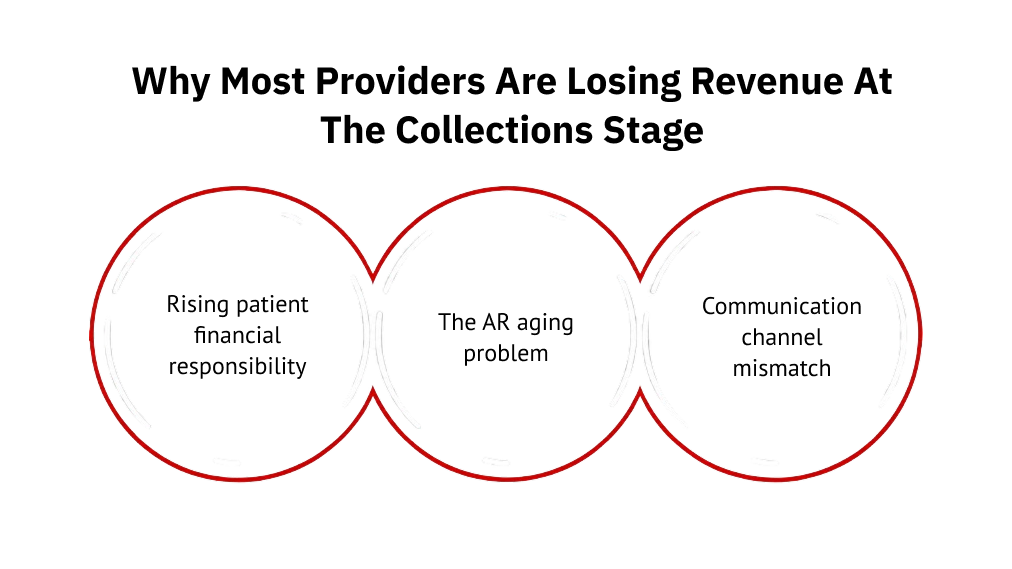
Most collection leakage does not start with one big failure. It comes from delays, channel mismatch, limited staff capacity, and compliance checks that happen too late. By the time the issue shows up in monthly AR reports, the best recovery window may already be gone. Some of the common reasons for this include:
1. Rising patient financial responsibility
Patient balances are harder to collect than payer balances because the patient is not a payer department. They may not understand the bill. They may disagree with the amount or may be willing to pay, but not all at once.
That changes the role of revenue cycle recovery. The goal is not to send more statements but to make the resolution easier while the balance is still fresh.
2. The AR aging problem
Collections is time-sensitive. A 30-day balance and a 120-day balance may look similar in a report, but they behave very differently.
The 30 to 60-day window is usually the highest-yield period for outreach. The patient still remembers the encounter, the bill is still recent, and the provider relationship is still active. Once an account is 90 days or more past due, the patient may have ignored several notices, lost context, or mentally moved on.
Common warning signs include:
- AR days are rising across patient responsibility accounts.
- Self-pay liquidation is slowing.
- More accounts are moving past 120 days.
- Staff is spending more time on low-yield follow-up.
- More disputes stem from unclear statements or insurance confusion.
An account at 90 days is meaningfully less recoverable than an account at 30 days. That is why RCM collections should be managed as a timed recovery process rather than a back-office backlog.
3. Communication channel mismatch
Patients are used to resolving bills digitally. They check balances on mobile devices. They click email links. They respond to texts. They expect payment options that do not require calling during business hours.
That gap is especially visible with younger patients. According to PYMNTS Intelligence’s 2026 healthcare payments report, 68% of Gen Z patients faced at least one payment barrier during their last healthcare payment experience. The same report found that 29% of Gen Z patients want digital or mobile payment options in the year ahead.
That is why the collections stage needs more than persistence. It needs clear messaging, the right timing, and a channel mix that matches how patients actually respond.
Pre-Write-Off vs Post-Write-Off: Why the Distinction Matters
Not every unresolved balance belongs in third-party collections. The stage of the account should shape the recovery model. Pre-write-off is the AR management window. On the contrary, post-write-off is the collections window. Confusing the two can damage patient experience, reduce recoveries, and create compliance risk.
How EBO services cover the pre-write-off window
Extended Business Office, or EBO, support is designed for the pre-write-off stage. This usually covers accounts in the 30- to 120-day window, though timing depends on the provider’s policy.
In this stage, the partner operates under the provider’s brand. Patients see the hospital, health system, or physician group name, not a third-party collections identity.
That matters because the relationship is still active. The patient may need help understanding insurance, setting up a payment plan, or resolving a denied claim. A familiar brand can reduce friction.
A strong EBO model can support:
- Patient outreach on newer balances.
- Denied claim follow-up.
- Balance clarification.
- Payment plan setup.
- Documentation inside the provider’s system.
- AR resolution before write-off.
First Credit Services’ extended business office model supports pre-write-off outreach, denied claim follow-up, and AR resolution under the client’s brand.
When third-party collections begin
Third-party collections typically begin after accounts age past the provider’s internal write-off threshold. Many organizations use 120 to 180 days, but policies vary.
At this point, the partner operates under its own identity. The account is older, and recovery rates are usually lower. However, that does not mean that third-party collections is low value. On large portfolios, even modest recovery can return meaningful revenue that would otherwise be written off.
The two models work best together:
- EBO for early-stage, brand-sensitive AR.
- Third-party collections for aged, post-write-off accounts.
- Reporting across both to identify where accounts leak.
For many health systems, the right model is hybrid.
Compliance Requirements at the Collections Stage
Healthcare revenue cycle collections operate at the intersection of patient privacy, consumer finance, and communication law. Compliance cannot be a final procurement checkbox.
The partner must know how to recover balances while protecting PHI, honoring consent, documenting outreach, and following rules that change by account stage.
1. Health Insurance Portability and Accountability Act (HIPAA): the privacy baseline
Any partner handling patient balances may receive, maintain, or transmit protected health information. Under guidance from the U.S. Department of Health and Human Services, a business associate is an entity that performs functions involving PHI on behalf of a covered entity.
That means a business associate agreement should be in place before PHI is shared.
HIPAA can touch:
- Patient statements.
- SMS and email workflows.
- Agent notes.
- Payment portals.
- Call recordings.
- Denial follow-up documentation.
- Reporting dashboards.
Providers remain accountable for choosing the right partner. Hence, the due diligence should cover security controls, access management, audit logs, training, breach response, and subcontractor handling.
2. Regulation F and Telephone Consumer Protection Act (TCPA)
Regulation F applies to third-party debt collectors and updates how the FDCPA works in modern collections. The CFPB’s debt collection rule FAQs cover communication rules, inconvenient times and places, validation notices, and call frequency.
TCPA matters when programs use texts, prerecorded calls, or automated dialing. The FCC’s 2024 order confirms that the TCPA restricts robocalls and robotexts without prior express consent or a recognized exemption. That is why consent must be documented, honored, and revocable.
These rules are often overlooked when providers evaluate recovery partners. That creates exposure for the provider, not only the vendor.
In-House, Outsource, or Hybrid: How to Decide
Outsourcing is not always the right answer. Some providers have strong internal RCM teams, stable AR days, and enough volume per FTE to manage collections internally.
The decision changes when backlog, aging, self-pay complexity, or compliance requirements outpace internal capacity. Here is how to decide:
| Situation | Recommended approach |
| AR days are rising, but accounts are still pre-write-off. | Add EBO or first-party support to work accounts earlier. |
| Self-pay recovery is declining and staff rely mainly on statements or calls. | Add digital-first outreach, SMS, email, and self-service payment workflows. |
| Accounts are aging past 120 days with low internal touch rates. | Use third-party collections for post-write-off accounts. |
| EHR transition, staffing gap, denial spike, or volume surge creates a backlog. | Use outsourced support to protect recovery windows. |
In most cases, the hybrid model works best for mid- to large-scale providers. Internal staff can focus on high-complexity accounts and payer work, while EBO support handles early-stage patient outreach and AR resolution. Then, once accounts move past the pre-write-off window, third-party recovery can work on older portfolios.
That structure keeps each account in the right lane.
What To Look For In A Revenue Cycle Collections Partner
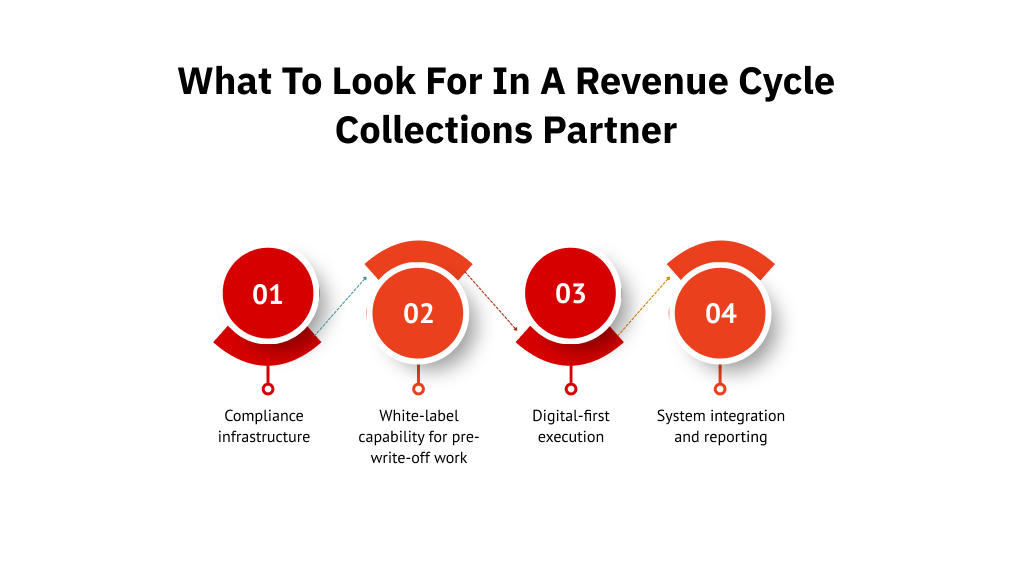
A collections partner should reduce friction, not create another vendor-management problem. The right partner understands healthcare operations, patient sensitivity, payer complexity, and compliance.
Start with the areas that determine whether the relationship will actually work:
- Compliance infrastructure: Before evaluating scripts or recovery projections, ask for the partner’s BAA process, HIPAA controls, Regulation F workflows, TCPA consent documentation, and audit practices.
- White-label capability for pre-write-off work: In the EBO window, the provider’s brand should stay on all patient-facing outreach. That includes messages, payment links, portals, and agent-assisted resolution.
- Digital-first execution: Strong omnichannel collections should include SMS, email, chat, self-service payment portals, and phone support. The phone should help resolve complex cases. It should not be the default strategy for every account.
- System integration and reporting: The partner should connect with your billing system or system of record. They should also provide clear visibility into AR aging, recovery rate, channel engagement, payment plan activity, dispute reasons, and account status by stage.
A monthly liquidation summary is not enough. RCM leaders need operational data to improve recovery, staffing, and account routing decisions.
How FCS Supports Healthcare Revenue Cycle Collections
FCS supports healthcare providers with managed healthcare revenue cycle management support across the collections lifecycle. It works as a revenue recovery and customer engagement partner, handling outreach strategy, integration, messaging, payment support, and reporting.
Its model gives healthcare teams:
- Early-stage recovery support: FCS can support pre-write-off accounts through first-party collections, helping providers resolve balances while the patient relationship is still active.
- Post-write-off recovery: For older accounts, FCS offers third-party collections under its own identity, helping providers recover revenue that may otherwise be written off.
- Managed digital outreach: Patient engagement runs through UCEP, the Unified Consumer Engagement Platform. It supports SMS, email, chat, phone, and self-service portal workflows.
- System-connected recovery: UCEP is not a CRM and does not replace the provider’s billing system. It connects to the provider’s system and supports coordinated outreach around patient balances.
- White-labeled patient experience: For pre-write-off accounts, patients see the provider’s brand across messages, payment links, portal flows, callbacks, and chat.
- Compliance-led operations: FCS builds considerations for HIPAA, PCI DSS Level 1, SOC 2 Type II, Regulation F, and TCPA into onboarding and program execution.
Client-facing dashboards show AR aging, recovery rates, and outreach engagement, while the UCEP administrative interface is managed by FCS.
Is Your Collections Stage Costing You Revenue You Have Already Earned?
Most providers do not lose revenue because one bill was wrong. They lose it because recoverable accounts age past the best outreach window, or the patient communication does not match patient behavior. The risk grows further when compliance is added after the workflow is already built.
That is why healthcare revenue cycle collections needs structure from the start. Every stage should have a clear owner, every account type should have the right workflow, and every patient should have a simple path to resolution.
If your AR is growing, your self-pay recovery is slowing, or too many accounts are crossing into write-off, FCS can help you identify what is still recoverable and build a compliant recovery strategy around it.
Talk to the FCS team about improving healthcare revenue-cycle collections across pre- and post-write-off accounts.
FAQs
1. How can providers improve collections without hurting patient experience?
Use clear balance explanations, digital outreach, flexible payment options, and self-service payment paths. The goal is to make resolution easier, not more aggressive. Patients are more likely to respond when the process feels simple and respectful.
2. What causes patient AR to become harder to collect?
Patient AR becomes harder to collect when outreach is delayed, statements are unclear, payment options are limited, or accounts age past the early recovery window. The longer the balance sits, the harder it becomes to resolve.
3. Should healthcare providers outsource all revenue cycle collections?
Not always. Providers with stable AR days, strong internal teams, and enough staff may keep more work in-house. Outsourcing makes more sense when volume, aging accounts, self-pay balances, or compliance needs exceed internal capacity.
4. What should RCM leaders ask before choosing a collections partner?
Ask how the partner handles HIPAA, BAAs, TCPA consent, Regulation F workflows, white-label outreach, system integration, reporting, payment plans, patient disputes, and account segmentation across pre-write-off and post-write-off stages.
5. Why is digital outreach important in healthcare collections?
Digital outreach helps patients respond through channels they already use, such as SMS, email, chat, and self-service portals. It reduces friction and gives patients a faster path to review balances, ask questions, and make payments.
6. What collections metrics should be reviewed every month?
Review AR aging, recovery by account age, self-pay recovery, payment plan completion, channel response rates, dispute trends, write-off volume, and movement from pre-write-off to post-write-off. These metrics show where revenue is leaking.