


Receivables pressure builds quietly through small delays that your team keeps absorbing.
A reminder goes out late, a dispute waits another day, and a payment comes in, but reconciliation falls behind. Over time, those gaps show up in cash flow, DSO, and forecasting accuracy. As per Deloitte’s CFO Signals 2026 report, 49% of CFOs cite automating processes to free employees for higher-value work as their top finance talent priority. Another 50% rank digital transformation of finance as their top 2026 priority.
That is where AR outsourcing services create value. They reduce manual follow-up, improve visibility, and move receivables from billed to paid with fewer internal bottlenecks.
In this guide, we will explore what AR outsourcing includes, how it differs from collections, and what to look for in a compliant, tech-enabled partner.
What Are AR Outsourcing Services?
AR outsourcing services involve hiring a third-party provider to manage part or all of your accounts receivable operations. This can include invoicing, payment follow-up, early-stage account engagement, dispute resolution, cash application, payment reconciliation, reporting, and recovery support.
The scope can be broad or narrow. Some providers manage the full order-to-cash cycle. Others focus on the receivables management layer, where balances are overdue, and internal teams are stretched.
Generally, accounts receivable outsourcing covers:
- Invoicing and billing: Creating, sending, and tracking invoices.
- Payment reminders: Following up before and after due dates.
- Pre-write-off AR management: Engaging customers while the account is still under your brand.
- Post-write-off collections: Moving aged accounts into formal recovery.
- Cash application: Matching incoming payments to open invoices.
- Dispute resolution: Handling billing questions, short pays, and documentation gaps.
- DSO reporting: Tracking aging, cash flow, and recovery performance.
However, not every provider covers the full spectrum. For example, one vendor may only send basic reminders, while another may run structured omnichannel follow-up with compliance controls, payment plans, and escalation paths.
How Is AR Outsourcing Different From Traditional Debt Collections?
AR outsourcing covers a wider part of the invoice-to-cash cycle. On the other hand, traditional debt collections refers to the downstream recovery of delinquent or written-off accounts.
Understanding this difference is important because many teams use the terms interchangeably. Yet the capabilities are not the same. An invoice-processing provider may not manage recovery, while a collections agency may not handle billing, cash application, or ERP reconciliation.
A better way to view AR is as a spectrum. Early-stage engagement covers accounts 30 to 60 days past due, while post-write-off collections sits further down the line and usually requires third-party recovery.
The table below compares full-cycle AR outsourcing with collections-specialist AR outsourcing.
| Basis of difference | Full-cycle AR outsourcing | Collections-specialist AR outsourcing |
| Scope | Invoicing through cash application | Early-stage recovery through third-party collections |
| Primary outcome | O2C efficiency and billing accuracy | DSO reduction and payment recovery |
| Customer touchpoints | Billing, statements, disputes, payments | Follow-up, settlement, payment plans, escalation |
| Compliance focus | SOX, GAAP, audit controls, internal policies | FDCPA, Regulation F, TCPA, state rules |
| Best fit | High invoice volume and complex billing | Delinquent AR, aged accounts, recovery-heavy operations |
If invoices are inaccurate, full-cycle support may be the priority. If balances are aging due to inconsistent follow-up, outsourced AR services with a strong recovery layer may be a better fit.
What Do Managed AR Outsourcing Services Actually Cover?
Managed AR services are connected workflows that move accounts from billed to paid, or from overdue to resolved. The strongest programs combine people, process, technology, and reporting. They create a consistent rhythm for invoice follow-up, credit control, payment resolution, and visibility in the following ways:
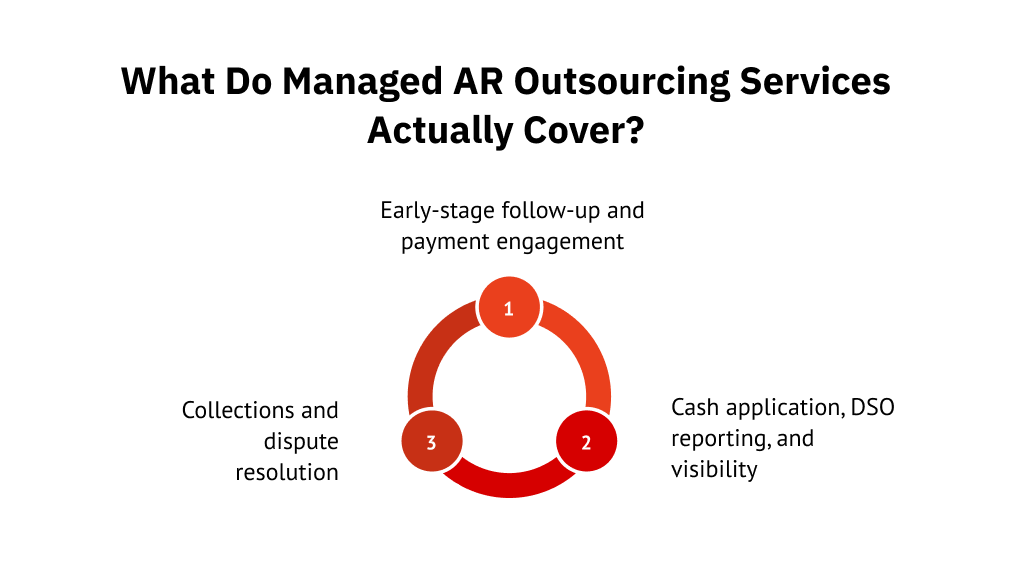
1. Early-stage follow-up and payment engagement
Early-stage payment engagement happens before an account becomes a formal collections matter. It usually starts when invoices are 30 days past due and internal reminders are no longer enough.
This is the pre-write-off AR management stage. The account is still tied to your brand, so the tone should feel like customer support rather than escalation.
A managed provider may handle:
- Email and SMS reminders where permitted.
- Portal-based payment links.
- Payment plan offers.
- Callback scheduling.
- Account status updates.
- Documentation of contact attempts.
The goal is retention as much as recovery. A customer who missed an invoice may still be valuable. They may need a corrected invoice, a payment link, a plan, or a clear explanation of the balance.
2. Collections and dispute resolution
As accounts age, the process becomes more formal. Documentation, compliance, and escalation controls matter more, especially when an account moves from first-party recovery to third-party collections.
Both stages can sit within receivables outsourcing services, but they need different handling. Pre-write-off AR management keeps active customer relationships on track, while post-write-off collections focuses on balances that have moved beyond standard follow-up.
Disputes often sit in the middle. Many accounts age because a blocker remains unresolved, such as a missing statement, a corrected invoice, a contract copy, or a payment confirmation.
That is why a managed provider should identify whether the issue is non-payment or process friction. That helps resolve more balances before they move deeper into collections.
3. Cash application, DSO reporting, and visibility
Cash application is the process of matching incoming payments to open invoices. It sounds simple, but it becomes difficult at scale.
Payments do not always arrive cleanly. They may be missing invoice numbers, bundled across several invoices, partially paid, or tied to deductions, credits, and disputes. When matching is manual, reconciliation backlogs build quickly.
That backlog can create problems that customers notice. A paid account may still receive an overdue notice, and aging reports may show balances that are already resolved. Teams may also follow up twice because the payment status was not updated.
Strong managed AR services support:
- Cash application and payment reconciliation.
- Aging reports by customer, segment, or balance.
- DSO trend tracking.
- Recovery rates by delinquency stage.
- Dispute aging.
- Contact and response analytics.
Reliable reporting depends on clean data flow. Your AR outsourcing partner should connect with your ERP, CRM, billing system, or payment processor so that account status stays current and reporting does not lag reality.
What Are The Signs Your AR Process Needs Outsourcing?
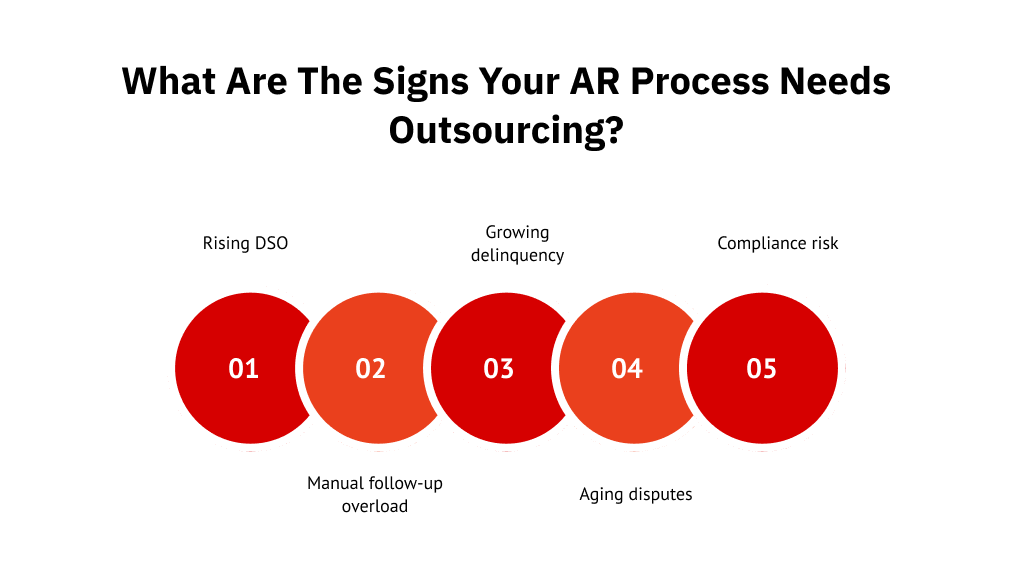
AR problems usually build through small delays: an unanswered invoice, an unresolved dispute, or a payment that has not been applied. Over time, the aging report grows, and the team is always catching up.
The PYMNTS 2024 report states that 43% of organizations face too many late or delinquent payments, while 46% struggle to reduce DSO. It also found that 59% of U.S. businesses link poor cash flow and forecasting to outdated manual AR methods.
If similar issues are emerging in your AR workflow, these signs can help you decide whether outsourcing is an option.
- Rising DSO: When invoice follow-up depends on whoever has time, aging accelerates, and overdue accounts lose momentum.
- Manual follow-up overload: If AR managers are buried in reminders, they lose time for cash forecasting, credit control, and dispute prevention.
- Growing delinquency: When new overdue accounts enter the queue before existing ones are worked, the backlog compounds.
- Aging disputes: The customer may be ready to pay, but a missing invoice, unclear documentation, or unapplied payment keeps the balance open.
- Compliance risk: As outreach volume grows, so does the risk of improper cadence, weak documentation, missed opt-outs, or inconsistent dispute handling.
If these signs are starting to show up, full outsourcing may not be the ideal move. A stronger early-stage recovery process can keep accounts from aging further.
First Credit Services helps mid-to-large organizations manage brand-aligned first-party collections and payment engagement before balances become harder to recover.
What Should You Look For In An AR Outsourcing Partner?
The right partner helps resolve balances faster without creating friction for your customers. The wrong one can add extra handoffs, slow down resolution, and increase compliance risk.
That is why price should not be the only deciding factor. You also need to assess how the partner manages compliance, outreach, system integrations, reporting, and escalation. The following factors should play the decisive role:
1. Compliance controls and regulatory alignment
Any partner touching the collections layer of AR needs documented compliance controls. This is non-negotiable in healthcare, financial services, fintech, auto finance, subscriptions, and consumer lending.
For post-write-off collections, ask about FDCPA, Regulation F, TCPA, and state-specific requirements. For first-party AR management, ask how the partner handles state consumer protection rules, consent, contact preferences, privacy, and alignment with internal policies.
According to the CFPB’s 2025 FDCPA report, debt collection generated about 207,800 complaints in 2024, representing 7% of all complaints submitted that year. That makes compliance controls a practical requirement, not a box to check during vendor review.
Ask every provider for:
- Licensing coverage.
- Contact cadence controls.
- Opt-out and preference management.
- Dispute and validation workflows.
- Call monitoring and QA.
- Account-level audit trails.
- Data security controls.
Partners like First Credit Services build industry-specific compliance into contact protocols, documentation, and escalation paths. Thus, compliance becomes a part of every consumer interaction, not a final review step.
2. Digital-first, omnichannel engagement capabilities
A single-channel follow-up process can leave money on the table because consumers do not all respond the same way. Some may ignore calls but respond to text, while others prefer email or want to resolve the balance privately through a portal.
That is why modern AR process outsourcing should support coordinated outreach across digital and human channels. Look for:
- SMS and email wherever permitted.
- Self-service payment portals.
- Chat and callback options.
- Payment links and payment plans.
- Client-approved settlement options.
- Human escalation when needed.
The goal is better engagement that helps consumers understand the balance, choose a resolution path, and act without unnecessary friction.
3. Integration with your existing billing and ERP systems
AR outsourcing fails when the partner works in a silo.
If payment status, dispute notes, customer updates, and account changes do not flow between systems, your team can lose control. As a result, customers may be contacted after payment, disputed accounts may continue to receive reminders, and payment plans may not appear in the billing system.
To avoid such issues, ask these questions when evaluating the partner:
- Will data move through API, SFTP, CRM sync, or batch upload?
- How often will the account data refresh?
- How are payment updates sent back?
- Can dispute notes sync with your system?
- Who owns field mapping and data validation?
- How are recalls, holds, and exclusions handled?
Your ERP or billing system should remain the source of truth. The outsourcing partner should connect to it rather than create a competing version of the account status.
4. Reporting visibility and DSO tracking
Reporting should help you manage AR, not just review past activity.
You should expect visibility into placement volume, aging by segment, response rates, payment plan enrollment, dispute aging, recovery by stage, DSO trends, cash application status, and remittance timing.
However, monthly reports alone are not enough. Finance leaders also need dashboards that turn activity into decisions. A static summary shows what happened, but a stronger reporting model shows where accounts are slowing down and what action may improve recovery.
| Example: If 90-day accounts are recovering poorly, the issue may be late placement rather than poor outreach. If disputes are concentrated in one product line, the billing process may need correction. If payment plans keep breaking after the first installment, the team may need clearer terms, better reminders, or more flexible payment options. This is why reporting matters. It helps finance teams move from reactive follow-up to proactive receivables management, where decisions are based on account behavior, aging patterns, and recovery performance. |
How First Credit Services Handles The Collections Layer Of AR Outsourcing
Once you know where AR is breaking down, the next step is deciding which layer needs support. Some teams need help with billing or cash applications, whereas others need stronger recovery before overdue accounts age into harder-to-collect balances.
FCS focuses on the recovery and customer-engagement layers of AR outsourcing. Here is how:
1. UCEP connects outreach, payments, and account workflows
FCS relies on the Unified Consumer Engagement Platform (UCEP) to integrate digital outreach, self-service payments, and account data into a single managed recovery workflow.
UCEP integrates with your existing systems, so outreach, payment options, and reporting are powered by your current account data. Since FCS operates it on your behalf, your team does not have to manage campaigns, workflows, or software administration.
The platform supports:
- Omnichannel engagement: SMS, email, chat, phone, and self-service portals work together rather than operating as disconnected touchpoints.
- White-labeled first-party outreach: Consumers can engage under the client’s brand, helping preserve trust during early-stage recovery.
- Self-service resolution: Personalized links let consumers view balances, pay, choose a plan, accept approved offers, schedule callbacks, or start a chat.
- Connected reporting: Account activity, payment progress, and outreach performance stay tied to the client’s receivables workflow.
This gives consumers an easier path to resolve balances while giving finance teams better visibility into recovery progress.
2. AI-enabled workflows help personalize recovery
Many recovery programs still use fixed sequences. Every account gets the same reminders, in the same order, at the same pace. That approach is easy to manage, but it ignores consumer behavior.
FCS uses AI-enabled omnichannel workflows to help determine the right channel, message, and timing for each account. It helps make engagement more relevant and reduce unnecessary escalation.
That can support:
- Higher response rates.
- Faster payment resolution.
- Fewer manual follow-ups.
- Better routing to agents when help is needed.
- Clearer visibility into account-level progress.
Choosing an AR Partner That Protects Cash Flow
AR outsourcing services work only when they solve the bottleneck holding cash back.
If billing accuracy is the issue, full-cycle support may help. But if aging receivables, inconsistent follow-up, and rising DSO are the real pressure points, you need a partner with deeper expertise in receivables management and collections.
The right partner should recover revenue, resolve balances, protect customer relationships, and give finance leaders clear visibility into cash flow.
If your team needs stronger recovery without adding headcount, talk to FCS about a digital-first AR recovery model. It is built around digital-first engagement, compliance, and measurable resolution.
FAQs
1. Can AR outsourcing support failed recurring payments?
Yes. Outsourced AR services can support failed payments by sending reminders, payment links, card update prompts, and follow-up workflows. This is useful for subscriptions, memberships, healthcare balances, and recurring service models.
2. What data should you prepare before outsourcing AR?
Prepare customer details, invoice history, payment records, dispute notes, contract terms, contact preferences, account status, and exclusion rules. Cleaner data helps the provider segment accounts, avoid errors, and resolve balances faster.
3. Can you outsource only part of the AR process?
Yes. Many organizations outsource only the recovery, follow-up, dispute, or cash application layer. Partial outsourcing works well when the internal team wants to keep billing control but needs support with overdue accounts.
4. Who owns the customer relationship in an outsourced AR program?
The client still owns the customer relationship. In first-party programs, the provider works as an extension of the client’s brand. The setup should define tone, approval rules, escalation paths, and customer experience standards.
5. What KPIs should be included in an AR outsourcing agreement?
Useful KPIs include DSO trend, recovery rate by aging bucket, dispute resolution time, payment plan completion, contact response rate, cash application accuracy, complaint volume, and remittance timing.
6. Can AR outsourcing help during seasonal volume spikes?
Yes. Outsourcing can add capacity during seasonal billing cycles, enrollment periods, benefit changes, renewals, or portfolio spikes. The key is to set clear expectations for onboarding, data transfer, staffing, and reporting before volume increases.