


Customers rarely leave because of one dramatic failure. More often, trust breaks quietly through repeated moments of friction.
It could be a delayed support response, confusing billing interaction, inconsistent communication across channels, or a difficult payment experience. Individually, these moments seem minor. But together they define how customers remember your brand.
That’s why customer experience strategy is no longer just a support initiative. It has become a competitive advantage. According to the Forrester 2024 report, organizations that prioritize customer experience reported 41% faster revenue growth and 51% higher customer retention than those that did not.
Yet many businesses still approach CX as disconnected initiatives instead of a connected lifecycle strategy. They optimize onboarding and support while overlooking critical touchpoints like billing, payment communication, and recovery workflows.
This guide breaks down what an effective CX strategy framework looks like, how to build one step by step, and why the payment and recovery experience deserves a bigger place in your customer journey.
What is a Customer Experience Strategy?
A customer experience strategy is a structured plan for how a business manages every interaction a customer has with its brand. It covers the full customer lifecycle across all channels, from awareness and onboarding to billing, payments, and renewal.
However, customer experience is often confused with customer service. Customer service focuses on specific support interactions, whereas customer experience shapes how customers perceive your brand across the entire relationship.
The confusion does not stop there. Many businesses also mistake CX tactics for CX strategy. NPS surveys, chatbots, and loyalty programs can support a strategy, but they are not the strategy itself. Businesses that confuse tools with strategy often create disconnected experiences and inconsistent customer journeys.
A working customer experience strategy has five core components:
- Customer journey mapping across the full lifecycle
- Omnichannel consistency across every channel
- Voice of the customer and feedback loops
- Personalization and data-driven engagement
- Cross-functional alignment across every department
One thing worth saying plainly: CX strategy is not a department. It is a company-wide operating principle. Marketing, sales, product, billing, and collections all play a role. If any of those teams are operating in isolation, the strategy has a gap.
| For a closer look at how customer engagement fits into this model, explore FCS’s BPO and customer engagement services. |
Why Customer Experience Strategy Matters More Than Ever
Customer expectations are rising faster than most businesses can adapt. Customers now expect connected, personalized, and friction-free experiences across every interaction, whether they are speaking with support, resolving a billing issue, or updating payment information.
As a result, customer experience strategy has shifted from a support function to a direct business growth priority.
The Business Case for Getting CX Right
Customers are increasingly willing to pay more for businesses that make interactions feel easier, faster, and more personalized. The Qualtrics 2025 report mentions that 68% of consumers are willing to pay more for better customer service experiences.
That matters because retaining existing customers is significantly more cost-effective than constantly acquiring new ones. A strong customer experience strategy improves retention by making every interaction feel seamless across the customer lifecycle.
The opposite is equally true.
One unresolved interaction can weaken trust, damage loyalty, and make customers far more likely to switch brands.
In a world shaped by online reviews and instant feedback, negative experiences spread fast and influence far more than a single customer relationship. That’s why CX is no longer just about customer satisfaction. It directly influences retention, loyalty, referrals, and long-term revenue growth.
Why Most CX Strategies Still Fall Short
Despite heavy investment in CX initiatives, many experiences still feel fragmented because the operational workflows behind them remain disconnected.
The most common problems include:
- Siloed teams and systems
- Inconsistent communication across channels
- Reactive support instead of proactive engagement
- Limited visibility across the customer lifecycle
- Rising interaction volumes without scalable workflows
This becomes especially visible in high-volume environments where businesses manage support requests, billing disputes, payment reminders, and follow-ups across multiple channels simultaneously.
However, the biggest blind spot usually appears after the sale.
Most businesses optimize marketing, onboarding, and support while overlooking billing communication, payment resolution, and recovery workflows. Yet these moments often define customer trust.
That is why modern CX improvement strategy must extend beyond acquisition and support. Companies like First Credit Services consider billing communication, payment resolution, and revenue recovery as critical moments in the customer journey, not back-office operational tasks.
Core Components of an Effective CX Strategy Framework
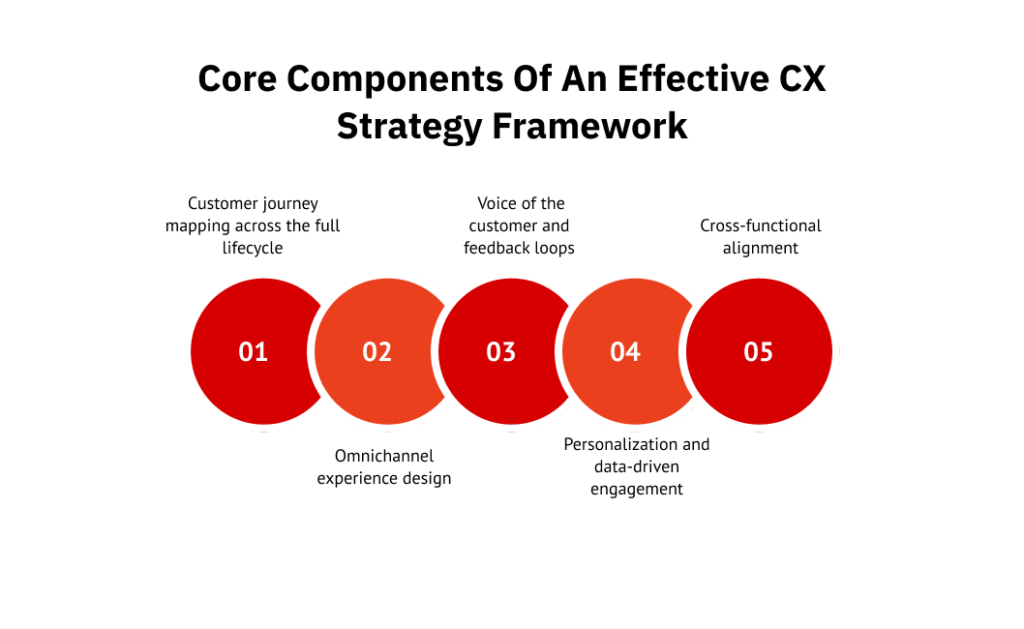
A strong customer experience management strategy does not depend on any one channel, team, or customer interaction. It works because every part of the experience is designed to feel connected, consistent, and intentional across the full customer lifecycle.
That requires a CX strategy framework built around visibility, coordination, hyper-personalization, and continuous improvement.
1. Customer Journey Mapping Across the Full Lifecycle
Customer journey mapping helps businesses visualize every interaction a customer has with the brand, from awareness and onboarding to billing, payment resolution, and renewal.
The reason it matters is simple: you cannot fix what you cannot see.
Most journey maps stop at “purchase” or “onboarding.” However, some of the most important customer moments happen after the sale, especially during billing issues, failed payments, or recovery outreach.
| A complete journey map often looks like this:Awareness → Purchase → Onboarding → Support → Billing → Payment reminder → Resolution → Renewal or recovery |
Each stage affects the next. A smooth onboarding experience quickly loses value if the billing experience later feels disconnected or difficult to navigate.
That is why companies should include early-stage collections and payment resolution in their CX journey maps. Clear first-party outreach, digital payment options, and brand-consistent communication help resolve issues earlier without making the customer experience feel like a hard collections handoff.
2. Omnichannel Experience Design
Customers no longer interact through a single channel. They move constantly between phone, email, SMS, chat, and self-service portals.
A strong CX strategy ensures those interactions stay connected.
This is where many businesses confuse multichannel with omnichannel. Multichannel means being present across platforms. Omnichannel means those platforms work together to provide a consistent experience.
For example, if a customer starts a conversation through SMS and later calls support, the agent should already have the conversation history available. The customer should not have to repeat the issue from the beginning.
Without connected workflows, communication quickly becomes repetitive, inconsistent, and frustrating.
3. Voice of the Customer and Feedback Loops
Most companies collect customer feedback. Far fewer know how to act on it effectively.
Feedback can come from:
- NPS surveys
- CSAT scores
- Customer interviews
- Social listening
- Support ticket analysis
- Online reviews
Strong CX organizations treat feedback as a continuous operational loop:
Collect → Analyze → Act → Measure → Improve
For example, repeated complaints about delayed billing responses or confusing payment reminders should trigger workflow improvements, not just another internal report.
4. Personalization and Data-Driven Engagement
Generic communication no longer works because customers expect businesses to understand context. According to Contentful’s 2025 research, 76% of customers are frustrated when personalization is absent.
That level of customized experience depends on data such as purchase history, communication preferences, engagement behavior, and payment patterns.
Modern CX platforms increasingly use AI to determine:
- The best time to contact a customer
- The most effective communication channel
- The right tone or message format
This becomes especially important in payment communication and recovery workflows. A customer-specific SMS reminder sent at the right time creates a very different experience than a generic collections notice.
5. Cross-Functional Alignment
Customer experience breaks the moment teams stop coordinating.
That is why CX cannot belong to a single department. Sales, marketing, product, billing, finance, operations, and collections teams all shape how customers experience the brand.
However, many organizations still operate through disconnected systems and siloed workflows. Customer data often sits across disconnected platforms, teams work toward different goals, and communication becomes inconsistent as customers move between departments.
Strong CX strategies eliminate those gaps by aligning people, systems, and communication around one shared customer experience vision.
How to Build a Customer Experience Strategy Step by Step
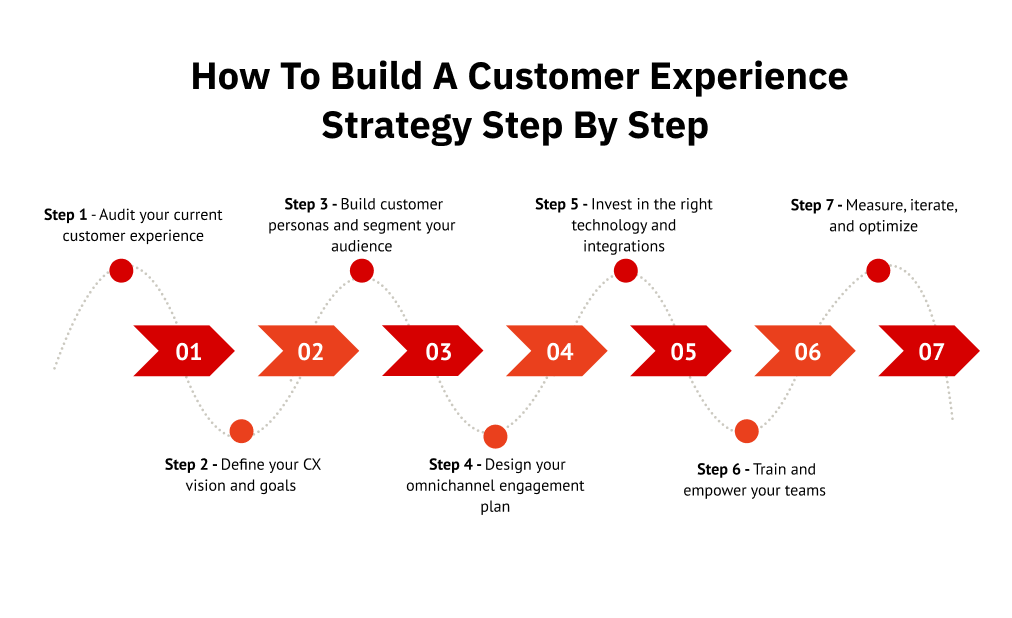
A strong CX strategy is built intentionally across every stage of the customer journey, from onboarding and support to billing and payment resolution.
The key is to approach CX as an operational system, not just a customer service initiative. Here’s how:
Step 1: Audit Your Current Customer Experience
Start with a simple question: What does the customer experience actually look like today?
Map every touchpoint across the customer lifecycle. Review support tickets, customer complaints, churn reasons, survey responses, and frontline feedback.
Pay special attention to the touchpoint optimization areas most companies overlook, such as billing disputes, failed payments, overdue communication, and account resolution workflows.
Step 2: Define Your CX Vision and Goals
Once the gaps become clear, define what a strong customer experience should look like for your business.
The most effective CX goals connect directly to business outcomes, including:
- Customer retention
- NPS and CSAT scores
- Customer lifetime value
- Churn reduction
- Revenue recovery performance
Your CX vision should also be simple enough for every team to understand and act on consistently.
Step 3: Build Customer Personas and Segment Your Audience
Not all customers behave the same way, which means the experience cannot be the same for everyone.
Segment customers based on:
- Behavior
- Lifecycle stage
- Communication preferences
- Engagement patterns
- Payment behavior
The purpose is to create personas that guide operational decisions, not just marketing presentations.
| An example:A subscription business may segment customers into active engaged users, at-risk quiet users and lapsed users with payment issues. Each group requires a completely different communication strategy, channel mix, and outreach timing. |
Step 4: Design Your Omnichannel Engagement Plan
Once customer segments are defined, map the right communication channels to each stage of the customer lifecycle. Most modern CX strategies prioritize digital-first engagement through SMS, email, chat, and self-service portals. Phone support still matters, but it works best for high-touch or complex interactions that require human resolution.
Most importantly, every channel must stay coordinated. Customers should never receive conflicting messages, duplicate reminders, or disconnected follow-ups across different communication methods.
Step 5: Invest in the Right Technology and Integrations
Technology shapes whether customer experiences feel connected or fragmented.
Core CX infrastructure often includes:
- CRM platforms
- Customer data platforms
- Communication tools
- Analytics systems
- Workflow automation platforms
However, the real value comes from integration. If systems cannot share data in real time, the customer experience quickly feels disconnected.
Self-service capabilities have also become increasingly important. Customers expect to resolve issues, update payment details, manage disputes, or complete payments on their own terms, 24/7.
Connected engagement platforms help unify communication, payment resolution, and recovery workflows into one experience.
Step 6: Train and Empower Your Teams
Technology alone does not create strong customer experiences. The people delivering the experience still matter most.
That means training teams beyond scripts and workflows. Employees need guidance on empathy, tone, clarity of communication, and problem resolution.
This becomes especially important during sensitive interactions like billing disputes or payment recovery. In those moments, tone often determines whether the customer relationship strengthens or breaks. Strong CX organizations empower frontline teams to solve problems quickly rather than forcing customers to navigate disconnected escalation paths.
Step 7: Measure, Iterate, and Optimize
Customer experience strategy is never finished. Expectations, behaviors, and communication preferences constantly evolve. That is why continuous measurement matters.
Ideally, track metrics such as:
- NPS
- CSAT
- CES
- Churn rate
- Retention rate
- Recovery rate
Then build a consistent review process around those insights.
The goal is not just reporting but refinement. Strong CX teams continuously optimize outreach timing, communication channels, messaging, workflows, and segmentation based on real customer behavior.
Customer Experience Strategy Examples Across Industries
The fundamentals of customer experience stay consistent across industries: customers want communication that feels clear, connected, and easy to navigate.
However, the moments where friction appears can look very different depending on the business model, regulatory environment, and customer relationship.
Healthcare
In healthcare, trust, empathy, and compliance are non-negotiable. Patient communication must remain HIPAA-aware and easy to understand.
However, one of the biggest sources of frustration often happens after care delivery. Confusing insurance statements, delayed billing follow-ups, and fragmented payment workflows can quickly damage the overall patient experience.
That is why healthcare CX strategy cannot stop at patient care alone. Post-visit billing often shapes patient trust just as much as the care experience itself. Healthcare revenue cycle management and medical bill collections services help create a smoother, more connected financial experience for patients.
Subscription and Recurring Revenue Businesses
For subscription businesses, failed payments are often a silent CX problem.
Expired cards, declined transactions, or outdated payment details create involuntary churn long before customers actively cancel. Yet many companies still treat failed payment recovery as a back-office workflow instead of a customer experience issue.
A stronger CX strategy includes personalized payment reminders, self-service billing updates, flexible resolution paths, and communication that feels helpful rather than transactional.
To put this into action, companies like FCS approach payment recovery and first-party collections as part of the broader customer engagement journey.
The CX Touchpoint Most Companies Overlook (Payment and Recovery Experience)
Most CX strategies focus heavily on marketing, onboarding, and support. Very few address what happens when a payment fails, an invoice goes unpaid, or a customer falls behind.
Yet these moments often define the relationship.
Payment experiences strongly influence customer trust. A confusing invoice, disconnected reminder, or difficult payment process can quickly damage the customer relationship.
Modern CX strategies now prioritize:
- Digital-first communication
- Omnichannel engagement
- Self-service payment options
- Flexible resolution paths
The focus shifts from collection to resolution. Companies that treat recovery as a customer experience challenge, not just a finance problem, often see stronger retention, better engagement, and improved recovery outcomes.
That’s why companies like FCS provide omnichannel debt collection services to help businesses maintain continuity across billing, payment resolution, and recovery interactions.
How to Measure If Your CX Strategy is Working
A customer experience strategy only works if it improves real customer outcomes. That is why measurement matters.
The goal is not to track more metrics. It’s to understand whether the customer experience is actually becoming easier, faster, and more consistent over time.
Key CX Metrics to Track
Strong CX programs typically monitor a mix of customer sentiment, operational performance, and retention metrics.
Key metrics include:
- Net Promoter Score (NPS): Measures whether customers would recommend your brand
- Customer Satisfaction Score (CSAT): Measures satisfaction with specific interactions
- Customer Effort Score (CES): Measures how easy it is for customers to complete tasks or resolve issues
- Churn rate: Measures how many customers leave
- Retention rate: Measures how many customers stay over time
- Recovery rate: Measures payment recovery performance
- Payment completion rate: Measures how effectively payment-related workflows are resolved
Together, these metrics help businesses identify where friction exists across the customer journey.
Turning Data Into Action
Metrics only matter if they drive decisions.
Strong CX organizations build a regular cadence of review, optimization, and operational improvement around customer data.
When a metric drops, the goal is to identify why quickly. When performance improves, the goal is to understand what worked and scale it consistently.
This helps businesses continuously improve communication, workflows, and customer segmentation over time.
Build a CX Strategy Customers Actually Remember
A customer experience strategy does not stop at marketing, onboarding, or customer support. It defines every interaction across the customer lifecycle, especially the moments where trust is easiest to lose, like billing communication, payment resolution, and recovery.
The companies that deliver the strongest customer experiences are not necessarily the ones with the biggest budgets. They are the ones that reduce friction consistently across the moments customers care about most. Increasingly, those moments include the payment and recovery experience.
If that part of your CX strategy still feels disconnected, FCS helps businesses create more connected, customer-friendly engagement and recovery workflows.
Book a demo today to improve the customer experience beyond the point of sale.
FAQs
1. What is the difference between customer experience and customer service?
Customer service is one touchpoint, whereas customer experience is the sum of every interaction a customer has with your brand.
2. How long does it take to see results from a CX strategy?
Smaller improvements, such as better communication workflows, can yield results within weeks. However, full CX transformation efforts typically take 6–12 months.
3. Do small businesses need a CX strategy?
Yes. Even simple improvements like journey mapping, clearer communication, and customer feedback loops can significantly improve retention and loyalty.
4. How does AI fit into a CX strategy?
AI helps personalize communication, predict customer behavior, optimize outreach timing, and automate routine interactions. It is a tool, not a strategy by itself.
5. What role does the payment experience play in CX?
AI helps personalize communication, predict customer behavior, optimize outreach timing, and automate repetitive tasks. However, AI supports the strategy, it does not replace it.