

Banking BPO solutions help banks move defined operational work to external specialists while retaining governance, risk ownership, and strategic control. The key decision is which processes can move outside the institution without weakening customer experience, compliance, or accountability.
Customer engagement, back-office support, collections, and recovery may all be candidates, but each requires a different control model. Volume, process complexity, regulatory sensitivity, and internal expertise can influence where outsourcing creates operational value. Banks also need clear ownership of workflows, exceptions, performance, and escalation before transferring execution to a provider.
Provider selection then comes down to operating fit. Banks need to assess whether a partner can support the required processes, controls, scale, and governance model.
This guide explains what to outsource, what to retain, how to assess third-party risk, and how to compare providers.
Which banking processes can be outsourced?
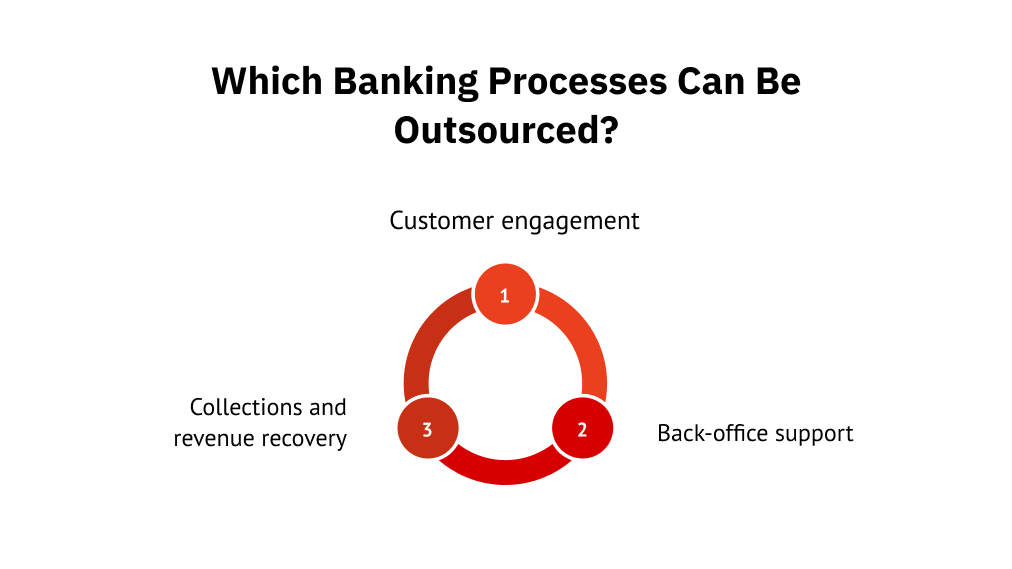
Banks can outsource repeatable processes in which specialized execution or additional capacity improves coverage without transferring institutional accountability. The strongest candidates generally fall into three groups: customer engagement, back-office administration, and collections or recovery.
Customer service and customer engagement
Customer-facing outsourcing can support voice and digital services, routine communications, account inquiries, and continuity during demand fluctuations. For banks, the operational value comes from extending coverage while maintaining defined service standards and escalation paths. However, providers should be evaluated for the specific channels, workflows, training, and customer populations they can support.
For higher-volume programs, buyers should also confirm staffing resilience, quality controls, escalation coverage, and how service levels are maintained when demand changes unexpectedly.
Back-office and administrative support
Accounting, bookkeeping, data handling, and other administrative workflows may suit outsourcing when processes are repeatable, and responsibilities are clearly documented. Broader banking BPO categories can include Know Your Customer and Anti-Money Laundering (KYC/AML) processing, underwriting, and loan processing. Banks should verify these capabilities rather than assume every provider supports regulated or specialized workflows.
Collections and revenue recovery
Recovery outsourcing depends heavily on the account stage. Active receivables and early-stage first-party collections typically require workflows aligned with the bank’s brand, policies, and customer relationships. Late-stage third-party collections involve a separate recovery model and different consumer-facing branding.
Accordingly, banks should evaluate handoffs, account treatment, communication rules, escalation paths, and reporting before assigning recovery work externally.
| Process | Why outsource it | What buyers should verify |
| Customer engagement | Extend service capacity and channel coverage | Supported channels, training, escalation, service standards |
| Back-office support | Add capacity for repeatable administrative work | Process expertise, controls, data handling, scope |
| Collections and recovery | Add specialized engagement and recovery capacity | Account stage, branding model, workflows, compliance controls |
Banks should also confirm whether seasonal demand materially changes staffing or escalation requirements.
Ultimately, the suitability of outsourcing depends on volume, customer impact, regulatory exposure, process complexity, and available internal expertise.
When does banking business process outsourcing make sense?
Banking business process outsourcing makes sense when a bank has a defined operating constraint that external support can address without weakening oversight. Common triggers include capacity gaps, volume spikes, rising servicing demands, recovery workloads, or functions that no longer justify permanent internal headcount.
Capacity and operational coverage
External capacity can help banks absorb variable workloads, extend coverage, or support repeatable processes without rebuilding internal teams for every demand cycle. A structured business process outsourcing model can also shift execution outside the organization while the bank retains policy, governance, and performance accountability.
The business case should still reflect the portfolio and process involved. High-volume, standardized work may benefit from scalable support, while complex or highly sensitive workflows may require more internal expertise and tighter controls.
Customer engagement and recovery needs
Outsourcing can also make sense when internal teams cannot consistently support the required mix of digital and human engagement. Coordinated channels can expand contact opportunities, make payment access easier, and route unresolved issues to people when additional support is needed.
However, the value depends on more than available capacity. Banks should consider customer expectations, account characteristics, channel preferences, escalation needs, and the provider’s ability to support the intended workflow.
Those constraints should be measurable enough to evaluate outcomes. These factors help determine whether outsourcing addresses the underlying operating constraint or merely transfers the same workload to an external delivery team.
What should banks keep in-house vs. outsource?
Banks should keep strategic, high-risk, and judgment-heavy responsibilities in-house while outsourcing processes that are repeatable, scalable, and supported by clear controls. The decision should be made on a per-process basis because operational value and risk can vary significantly within the same banking function.
Strong candidates for outsourcing
Workflows are stronger outsourcing candidates when they are standardized, volume-driven, and supported by documented rules. Additional capacity can be useful when banks face fluctuating demand, repetitive administrative work, or specialized execution needs that do not require continuous internal ownership.
However, suitability should still reflect customer impact, regulatory sensitivity, process complexity, and available internal expertise. A workflow that is easy to standardize may still require tighter oversight if it affects critical customer outcomes or sensitive data.
Responsibilities that require strong internal control
Banks should retain ownership of policies, compliance accountability, major risk decisions, third-party governance, and critical exception handling. Even when execution is outsourced, internal teams remain responsible for setting expectations, monitoring performance, and addressing material issues.
A practical framework is to separate execution from accountability:
| Process | Outsourcing suitability | Internal responsibility that remains |
| Repeatable operational work | Often suitable | Policy, standards, oversight |
| Specialized support workflows | Suitable when expertise is verified | Governance, exceptions, risk decisions |
| High-risk or strategic activities | Limited or selective | Accountability, control, final decisions |
Documented decision rights reduce confusion when unusual cases require review. This separation clarifies which execution responsibilities can move outside the institution.
How should banks evaluate compliance and third-party risk?
Third-party risk evaluation belongs at the center of any banking BPO decision because outsourcing does not transfer compliance or risk-management responsibility. Due diligence therefore needs to examine the provider’s controls, data practices, operating model, escalation procedures, continuity planning, and termination readiness.
Data security and process-specific compliance
The review should begin with the data and activities involved in the outsourced workflow. Customer information, payment data, credit reporting, and collections each introduce different control requirements.
Due diligence should also identify material subcontractors, access privileges, incident-response responsibilities, and dependencies affecting service continuity. This helps internal teams understand where risk extends beyond the primary provider.
For banks, information-security due diligence should reflect applicable Gramm-Leach-Bliley Act safeguards and the expectations of the institution’s banking regulator.
Similarly, Fair Credit Reporting Act (FCRA) obligations may apply when a workflow involves consumer reporting. Payment Card Industry Data Security Standard requirements may apply when payment card data is handled. Bank Secrecy Act and Anti-Money Laundering requirements should be assessed only where the specific process makes them applicable.
For collections-related workflows, banks should also evaluate communication controls, documentation, and debt collection compliance requirements relevant to the account stage and operating model.
Ongoing third-party oversight
Risk management continues after contracting. The Interagency Third-Party Risk Management Guidance treats third-party relationships as a lifecycle requiring ongoing oversight. Meanwhile, the Consumer Financial Protection Bureau (CFPB) FCRA resources provide process-specific guidance for credit-reporting obligations.
| A practical banking BPO due-diligence checklist should confirm:Defined scope and responsibility ownership;Contractual controls and service expectations;Information-security and access safeguards;Monitoring, reporting, and audit rights;Escalation and business-continuity procedures; andTermination, transition, and data-disposition planning. |
Contracts should define notification expectations when security, service, or control issues occur. Together, these controls help banks evaluate whether a provider can support the outsourced process while remaining subject to appropriate institutional oversight.
How should banks compare banking BPO solutions and providers?
Effective provider comparison starts by testing claims against the exact processes, portfolios, account stages, volumes, and customer-contact models the bank needs supported. Operating fit, proof, and governance deserve as much scrutiny as commercial terms.
Match expertise to the process and portfolio
A provider may have broad banking experience but not be equally strong in every workflow. Buyers should verify experience with the specific process being outsourced, including customer service, back-office support, active receivables, first-party collections, and late-stage recovery.
That process fit also needs to reflect the characteristics of the portfolio itself. Account stage, volume, channel mix, exception frequency, and customer profile can affect staffing, workflow design, and oversight requirements. Evidence from comparable operating conditions is more useful than generalized capability statements.
Evaluate the operating and technology model
Technology claims need to be evaluated in the context of how the service actually runs. Buyers need clarity on system ownership, data movement, channel coordination, and the path for unresolved issues.
Reporting needs to provide visibility into service levels, exceptions, customer-impacting issues, and outcomes. When moving from category evaluation to provider-specific capability, review the scope of banking BPO services against the institution’s requirements.
Verify proof, governance, and commercial terms
Relevant proof needs to match the proposed workflow and operating scale. Buyers can then compare implementation ownership, staffing plans, escalation procedures, reporting cadence, governance responsibilities, and pricing structure.
Commercial terms also need to be assessed alongside delivery responsibilities so buyers understand what the proposed model actually includes.
| Criterion | What to verify | Why it matters |
| Process expertise | Exact workflow and account-stage experience | Reduces mismatch between claims and execution |
| Operating model | Staffing, channels, technology ownership, exception handling | Shows how work will be delivered |
| Reporting and governance | Measures, reviews, escalation paths, accountability | Supports ongoing oversight |
| Proof | Results or references for comparable work | Tests capability beyond marketing claims |
| Commercial terms | Pricing structure, cost per contact where applicable, included services, implementation responsibilities | Clarifies total operating commitment |
Buyers also need to confirm that proposed staffing and governance can scale with expected volume changes. A disciplined comparison reveals whether the provider’s delivery model, controls, proof, and commercial structure align with the bank’s requirements.
What does banking BPO implementation require?
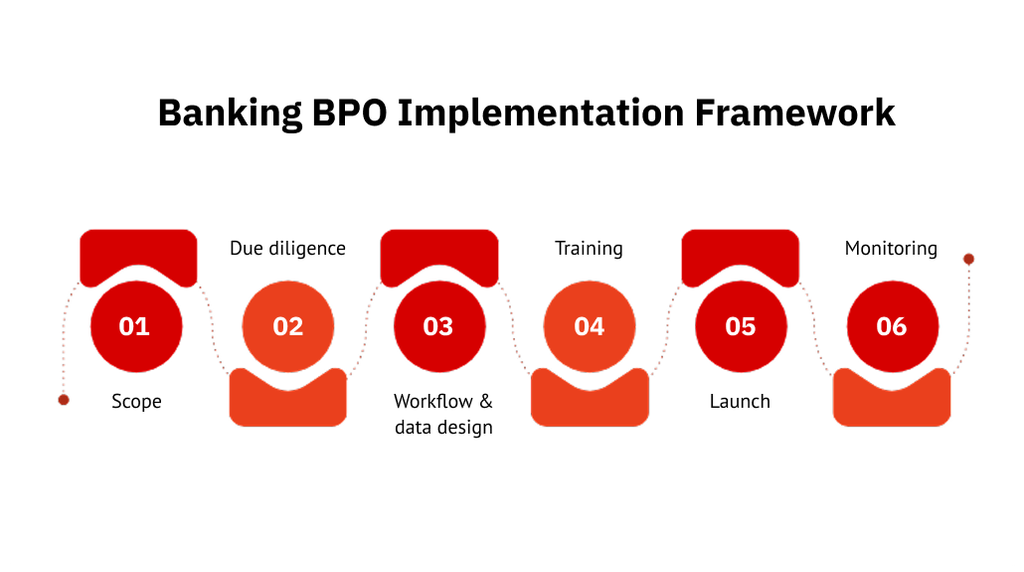
Banking BPO implementation requires a controlled transition that defines scope, data movement, workflow ownership, staffing, training, reporting, escalation, and governance before launch. As a result, banks should manage the transition as an operating-model change with clearly assigned responsibilities.
Scope, data, and workflow design
The first step is to define exactly what the provider will execute and what the bank will retain. That includes data requirements, system dependencies, approval points, exception paths, service expectations, and ownership of customer-impacting decisions.
For customer-facing workflows, customer service outsourcing should align with existing channels, policies, and escalation rules. This mapping helps the provider maintain continuity across customer interactions.
Connectivity also needs to be verified against the bank’s infrastructure and the provider’s actual capabilities. Training and testing should confirm that documented workflows work under realistic operating conditions. Banks should confirm how data will move, which systems are involved, what access controls apply, and where manual intervention remains necessary.
Reporting, governance, and optimization
After launch, governance should make performance and exceptions visible. Banks should establish reporting cadence, service measures, issue escalation, operational reviews, and approval requirements for material changes.
Unclear ownership is one of the biggest implementation risks because exceptions can stall when teams do not know who decides, approves, or resolves them. Change control matters for the same reason, especially when workflows, volumes, or system dependencies evolve.
| Banking BPO Implementation Framework: Scope → Due Diligence → Workflow & Data Design → Training → Launch → Monitoring |
Each stage should confirm responsibilities before the next begins, reducing gaps that could otherwise weaken service quality, oversight, or operational control. This sequencing also gives internal teams clear checkpoints for readiness decisions and launch documentation.
How First Credit Services supports banking BPO and revenue recovery
At First Credit Services, we support banking organizations as a revenue recovery and customer engagement partner. Our managed services combine operational support, technology, collections, and compliance expertise while keeping responsibilities and oversight clearly defined.
Customer engagement and recovery across account stages
Active receivables may remain within the bank’s existing servicing workflow before early-stage delinquency moves into first-party collections. When configured, our first-party programs can operate under the client’s brand to support continuity.
Our late-stage third-party programs operate under the First Credit Services brand. Keeping these stages distinct helps banks align account treatment, workflows, escalation paths, and handoffs.
Managed technology and integration
We operate UCEP (Unified Consumer Engagement Platform) on the client’s behalf to coordinate digital and voice engagement.
Depending on implementation design, data movement may use an application programming interface (API), Secure File Transfer Protocol (SFTP), or direct customer relationship management (CRM) sync.
Because integration varies by implementation, banks should evaluate data requirements, routing, reporting, workflow ownership, and connectivity assumptions during onboarding.
Verified banking fit
We manage more than 125 million interactions annually across our customer engagement and recovery operations. This company-wide figure should not be interpreted as a banking-specific performance result.
Our model generally fits medium-to-large and enterprise financial institutions with meaningful account or placement volumes. These organizations may need managed support across customer engagement, receivables, recovery, or broader business process outsourcing workflows.
Choose a banking BPO model that supports scale and control
Choosing the right banking BPO model requires more than matching a provider to a process. Banks should weigh process fit, retained control, compliance requirements, and implementation readiness. They should also verify that the provider can support the intended workflow at the required scale.
A well-structured outsourcing model should extend operational capacity while preserving visibility into customer experience, exceptions, performance, and risk. That means defining responsibilities clearly and confirming how the operating model works in practice. Banks should also select a partner whose capabilities align with portfolio and governance expectations.
For decision-makers, the strongest model is the one that addresses a specific operating need while maintaining the oversight required for banking functions.
Ready to strengthen customer engagement, receivables, recovery, or BPO operations? Discuss your banking BPO requirements with our team to evaluate whether managed support fits your institution’s needs.
FAQs
1. How are banking BPO solutions typically priced?
Banking BPO solutions may use pricing based on staffing, transaction volume, service scope, or other commercial models. Banks should compare included services, implementation costs, volume assumptions, and performance responsibilities before evaluating total cost.
2. How long do banking BPO solutions take to implement?
Implementation timelines vary because there is no standard timeframe for banking BPO programs. Banks should request a process-specific transition plan with defined milestones, dependencies, readiness criteria, and responsibilities before agreeing to a launch schedule.
3. Can banks use different BPO providers for customer service and collections?
Yes. Banks can use separate providers when responsibilities, data flows, handoffs, escalation paths, reporting, and governance are clearly defined. The bank should retain visibility across providers so operational gaps do not develop between functions.
4. What is the difference between onshore, nearshore, and offshore banking BPO?
Onshore, nearshore, and offshore describe where outsourced work is delivered relative to the bank’s primary market. The appropriate model depends on process requirements, operating coverage, staffing needs, customer expectations, risk controls, and governance requirements.
5. How is banking BPO different from staff augmentation?
Banking BPO assigns defined process responsibilities to an external provider, while staff augmentation adds personnel to a function the bank continues to manage. Buyers should clarify who owns supervision, workflows, controls, service levels, and performance outcomes.
6. How should banks measure banking BPO performance?
Banks should measure BPO performance against metrics tied to the specific outsourced function. A customer-service program, back-office workflow, and recovery program may require different service levels, quality measures, exception thresholds, and outcome indicators.