

After paying collection agency fees, how much of each recovered dollar makes it back to your business? When your recovery team is stretched, an unclear fee structure makes cash flow harder to predict. That uncertainty complicates collection budgets and partner selection.
The scale of overdue household debt reinforces the need for pricing clarity. The New York Fed’s Q2 2026 report recorded $18.8 trillion in debt, 4.7% delinquent, or roughly $880 billion.
Although those balances are not necessarily agency placements, they show why creditors must weigh collection costs against recovered revenue.
For your own portfolio, quoted agency fees depend on account age, balance, volume, and service needs. Different pricing models can change how much financial risk your business carries.
This guide helps you compare agency quotes by net recovery and spot contract terms that could reduce your returns.
Collection Agency Pricing Structure
Collection agency fees are the amounts creditors pay to outside agencies to recover overdue consumer accounts.
While contingency pricing is common, some agencies charge a fixed amount per account or combine models. Regardless of structure, your quote reflects account characteristics, recovery stage, service scope, and contract terms.
Agencies weigh recovery effort against the likelihood of payment. Recent accounts with usable contact details and placement volume may receive lower quotes.
By contrast, older, low-balance accounts may require more outreach for each recovered dollar, pushing fees higher. Compare quotes for comparable account mixes; otherwise, the lower percentage may hide greater collection difficulty.
| Did you know? Under contingency agreements, agencies generally deduct their percentage as payments arrive, including installments. Check your agreement’s timing and remittance terms. |
Collection agency pricing models compared
Collection agencies generally price recovery through contingency, flat-fee, hybrid, or seat-based arrangements. Each shifts payment obligations and financial risk differently, and not every agency offers all four. Third-party programs typically use contingency pricing, while dedicated first-party staffing can use seat-based fees.
| Pricing model | How you pay | Who carries the risk | Best fit | Watch-outs |
| Contingency | Percentage of recovered funds | Agency risks unpaid work; creditor risks uncollected debt | Uncertain third-party recoveries | Unwritten age or balance tiers |
| Flat fee per account | Fixed charge per placement | Your business pays regardless of recovery | High-volume, low-balance early-stage accounts | Limited outreach or follow-up |
| Hybrid | Upfront charge plus reduced recovery percentage | Risk is shared | Portfolios with mixed account ages | Overlapping charges |
| Seat-based (full-time equivalent) | Fixed cost per dedicated agent | Your business funds capacity | Branded first-party programs | Idle capacity when volume drops |
Contingency fees
With contingency fees, the agency earns payment only when it recovers funds, subject to agreed extras. Rates may change by account age or balance, so request a written tier table when evaluating a contingency collection agency. The tier table should also state whether rates change after placement.
Flat fees per account
Flat fees make costs more predictable, although the services included can vary considerably. For example, some arrangements cover letters only, while others include calls, follow-ups, or disputes.
| Pro tip: Ask which letters, calls, and channels are included. Confirm what happens to unresolved accounts once the covered work ends. |
Hybrid pricing
Hybrid contracts combine an upfront charge with a lower contingency rate. To avoid duplicate billing, specify what the upfront fee covers and when recovery-based charges begin.
Seat-based pricing for first-party programs
Seat-based arrangements fund dedicated agents working early-stage accounts under your brand, where configured. Costs continue while agents are assigned, making workload forecasts important when placement volumes fluctuate.
At First Credit Services, our third-party collection programs follow a contingency-based pricing model, where clients pay a fee only when we recover funds. For first-party programs, pricing depends on the service model: digital-only programs can be contingency-based, while dedicated live-agent programs are typically priced per seat.
Legal escalation costs
Litigation can add attorney fees, filing charges, and other court expenses beyond agency pricing. Because these costs reduce net recovery, your agreement should state who advances them and require written approval before litigation.
Collection rates by recovery stage: how agency fees change
Agency fees generally rise as overdue accounts move from early-stage recovery into repeated third-party placements. Older accounts can require more work per recovered dollar, although each provider prices its own portfolio.
| Stage | Typical pricing model | Common fee direction | Why it can change |
| First-party / early-out | Contingency, flat fee, or seat-based | Often lower | Fresher contacts and early opportunities to resolve |
| Primary third-party placement | Contingency | Moderate | Internal follow-up has stalled, but some consumers remain reachable |
| Secondary/tertiary placement | Contingency | Often higher | Earlier efforts may have resolved more collectible accounts |
| Legal escalation | Contingency plus approved legal costs | Potentially highest total cost | Attorney work, filing fees, and enforcement expenses |
As accounts move between recovery stages, the responsibility for customer outreach can also change. First-party programs can support early outreach under your brand, while third-party collections involve an external agency recovering debt on your behalf, subject to applicable identification and disclosure requirements.
| Pro tip: Set a written handoff point based on account age and earlier outreach results. Review the timing before accounts enter charged-off debt collection, when previous attempts may complicate recovery. |
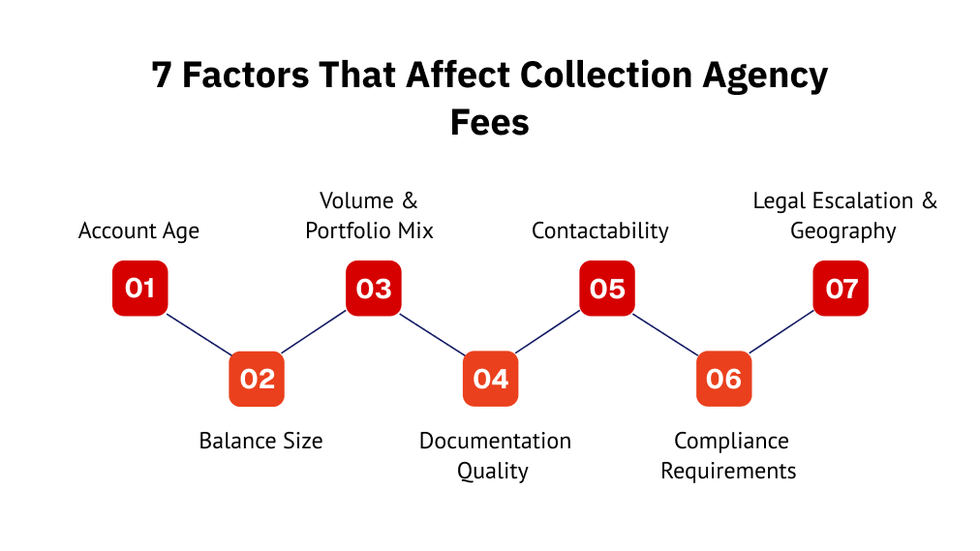
7 factors that affect collection agency fees
Collection agency fees depend on account age, balance, volume, documentation, contractability, compliance requirements, and geography. Here’s how those factors shape the work involved and the fees agencies may quote.
1. Account age
Older accounts can have outdated contact details and a longer history of unsuccessful outreach. Agencies may factor that effort into pricing, although debt type and records also influence recoverability.
2. Balance size
Small balances can require the same verification as larger accounts. Because verification requires staff time regardless of balance, agencies may quote higher percentages on smaller accounts.
3. Volume and portfolio mix
Predictable placement volumes help agencies plan workloads and capacity. Segmenting placements by age, balance, and product type can also support negotiated pricing tiers.
4. Documentation quality
Missing agreements, statements, payment histories, or dispute notes create extra verification work. Keeping those records complete helps resolve questions and avoid delays during recovery.
5. Contactability and channel mix
Unreachable customers require more work, encouraging coordinated SMS, email, and phone outreach where permitted.
At First Credit Services, we use UCEP (Unified Consumer Engagement Platform) to adapt channels and timing based on responses. Our configured self-service payment plans let consumers resolve balances independently, reducing routine agent follow-up.
6. Compliance requirements
Under Regulation F, presumed compliance requires no more than seven calls in seven days and a seven-day post-conversation pause. The pause follows a debt-related phone conversation, and both limits concern a particular person and debt. These limits have exceptions, and meeting them does not automatically rule out harassment.
Beyond communication rules, state licensing requirements may add operational controls. Healthcare collections involving protected health information may also require Health Insurance Portability and Accountability Act (HIPAA) safeguards. Because applicability depends on the entities and information involved, distinguish required compliance work from optional charges.
7. Legal escalation and geography
Multi-state portfolios can increase licensing oversight, administrative requirements, and legal coordination. Confirm that the agency’s quoted scope covers your portfolio’s jurisdictions.
Who pays collection agency fees?
Businesses typically pay agencies for recovery services. Customers can face added collection charges only when authorized by contract or law.
Your business pays the agency’s fee
Under contingency agreements, agencies commonly deduct their percentage from recovered funds before remitting the balance. Flat-fee arrangements charge your business regardless of recovery.
Placement alone does not automatically increase a customer’s balance, since additional charges need a separate legal or contractual basis. To reconcile those amounts, review remittance statements for recovered funds, agency compensation, and any permitted customer-paid charges.
When a collection fee can be added to a customer’s balance
The Fair Debt Collection Practices Act’s fee provision limits additional charges collected by covered debt collectors. The original debt agreement must expressly authorize those amounts, or applicable law must permit them.
For example, Western Kentucky University’s pre-collections policy permits agency fees up to 33.3% on overdue student debt. This limit reflects its own policy, rather than a universal cap other businesses can apply.
Before transferring collection costs to consumers, check the underlying agreements and applicable state requirements.
| Did you know? The university’s policy lists reasonable attorney fees and court costs separately from agency fees, alongside other lawful charges. |
How to calculate your effective collection cost
Calculate your effective collection cost by dividing total recovery fees and approved expenses by the dollars recovered. Unlike an agency’s quoted rate, this measures the share of collected revenue spent across your portfolio.
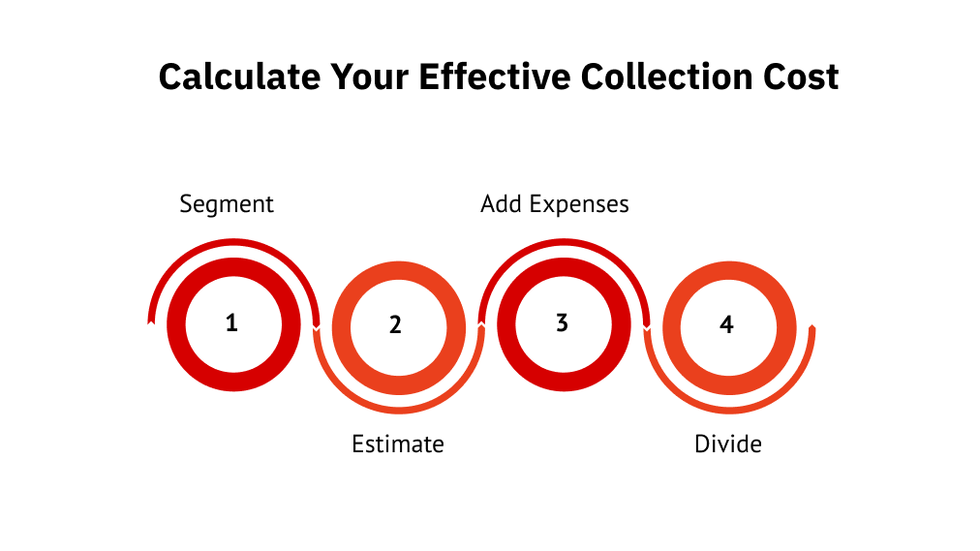
To compare proposals using your own account mix:
- Segment accounts by recovery stage so each placement group is priced accurately.
- Estimate recoveries for each group, then apply its quoted fee rate to those amounts.
- Add approved expenses, including any setup, legal, or payment-processing charges.
- Divide total costs by total recovered to calculate your effective collection fee rate.
The rates below (15%, 30%, and 40%) are assumptions for illustration, not industry benchmarks. This example excludes setup, legal, and payment-processing costs.
| Stage | Placed | Recovered | Fee rate | Fee | Net to your business |
| First-party recovery program (digital) | $200,000 | $80,000 | 15% | $12,000 | $68,000 |
| Primary third-party | $250,000 | $37,500 | 30% | $11,250 | $26,250 |
| Secondary placement | $50,000 | $3,000 | 40% | $1,200 | $1,800 |
| Total | $500,000 | $120,500 | 20.3% effective fee rate | $24,450 | $96,050 |
The portfolio incurs $24,450 in fees on $120,500 recovered, leaving $96,050 for your business.
Its effective rate is 20.3% ($24,450 ÷ $120,500), distinct from the percentage of placed balances recovered. This blended rate falls below both third-party rates because most recovered dollars came from first-party accounts.
| Pro tip: Recalculate every quote using your portfolio’s stage mix and expected recoveries. Compare expected net receipts for each quote, then weigh the benefits of outsourcing collections against your internal recovery costs. |
How to review a collection agency fee schedule
Review a collection agency fee schedule by checking written rates, charge triggers, service scope, and approval requirements before signing. A quoted percentage has limited value unless your agreement also explains additional expenses and payments received directly.
Use this checklist to identify charges that could reduce net recovery.
| Line item | What a clear schedule states | Red flag |
| Contingency tiers | Rates by account age or balance, including changes after placement | Rates adjustable without defined triggers |
| Flat-fee scope | Covered letters, calls, digital messages, and disputes | Contingency charged for the same work |
| Skip tracing and data | Included searches or price per search | Undefined research charges |
| Credit bureau reporting | Whether reporting occurs, responsible party, and procedures | Reporting promised without a defined process |
| Legal and court costs | Who advances costs; written approval before filing | Filing authority without your consent |
| Direct customer payments | Fees owed when customers pay you after placement | No direct-payment clause |
| Setup fees and minimums | Onboarding charges, monthly minimums, and waiver terms | Minimums unrelated to placement volume |
For the credit-reporting entry, confirm who furnishes account data and handles disputes. The Consumer Financial Protection Bureau’s Regulation F provision specifies steps covered collectors must take before reporting debts. The Fair Credit Reporting Act (FCRA) also governs reporting practices where applicable.
| Pro tip: Request the fee schedule as a signed contract exhibit rather than relying on a sales sheet. Include this check when you hire a debt collection agency. |
Ways to negotiate fees without losing recovery
Negotiate from documented placement volumes and account segments, so discounts reflect the work agencies can reasonably forecast.
- Offer consistent placement volumes and define when better pricing tiers activate.
- Request separate rates for account age, balance, and recovery stage.
- Ask whether digital-first treatment could reduce costs for low-balance accounts without limiting necessary follow-up.
- Review recovered dollars, total fees, and net receipts quarterly before changing terms.
Any discount should preserve the outreach and reporting needed to assess results.
How First Credit Services supports recovery-cost evaluation
At First Credit Services, we establish outreach scope, staffing arrangements, and reporting expectations during program planning. Those decisions guide how we coordinate digital engagement and live-agent support, including routing established during onboarding.
Because we operate the technology ourselves, clients can review relevant reports without managing the outreach platform. We tailor that reporting to available data and each program’s needs.
Across our operations, we handle more than 125 million interactions annually. For enterprise creditors, these defined responsibilities support clearer comparisons of coverage, costs, and recovery performance.
Protect recovered revenue with enforceable fee terms
The first remittance statement can reveal fee problems that were easy to miss when the agreement was signed. To avoid surprises, each agency deduction should match an agreed fee term and a supporting payment record. Otherwise, even successful recoveries can leave your finance team untangling disputed charges.
Reliable reporting should show each payment, applicable fee, and amount due back to your business. When a discrepancy appears, clear records help your team resolve it before unresolved questions accumulate.
As you evaluate partners, look for the same accountability after placement that you expect during contract negotiations. Ask how quickly unresolved deductions can be identified, explained, and corrected once payments begin. Predictable costs depend on consistent oversight throughout the relationship.
Ready to make your recovery costs more predictable? Discuss your portfolio with us
FAQs
1. Are collection agency fees tax deductible?
Collection agency fees may qualify as deductible business expenses when they are ordinary and necessary for recovery. Bad-debt deductions follow separate rules, including whether the unpaid amount was previously reported as income. Your tax adviser can confirm how both apply to your business.
2. How often do collection agencies send recovered payments to creditors?
Collection agencies may remit recovered funds daily, weekly, or monthly, depending on their contracts and applicable rules. Funds may also take time to clear before remittance. Before placing accounts, agree on the schedule, statement format, and handling of returned or reversed payments.
3. How are contingency fees calculated when a debt is settled?
Contingency fees are generally calculated on the amount actually recovered through a settlement, subject to the agreement. A lower settlement usually reduces the dollar fee when the agreed percentage remains unchanged. Require creditor approval when proposed settlements fall below your agreed threshold.
4. Can a business use more than one collection agency?
Yes, businesses can assign separate account groups to different collection agencies, subject to their contract terms. Avoid simultaneous placements of the same account, which can create conflicting customer outreach. Compare net recoveries across similar portfolios and timeframes for a fair assessment.
5. What information does a collection agency need to quote fees?
Collection agencies typically need account counts, balance ranges, delinquency age, debt type, and expected placement volume to quote fees. Include whether accounts are pre- or post-charge-off and any relevant history of prior collection attempts. Share portfolio information securely and identify specialized servicing requirements.
6. Can a business recall accounts from a collection agency?
Recall rights depend on your collection agency contract, including notice and exclusivity provisions. Check when collection stops, how account records return, and whether payments after recall still trigger fees. Clear handoff instructions reduce the risk of duplicate outreach when you change partners.