


Who on your team owns an account after it charges off?
For many creditors, the honest answer is no one. The moment it is written off, the account drops out of the reports your team checks every week. Over time, charged off debt collection becomes nobody’s job, even though the customer still owes the balance. Every month the account sits untouched, it gets harder to recover.
Every dollar recovered after write-off reduces your losses. Recovery, then, needs an owner, a plan, and the right partner. Done well, it can also win the customer back, because how you collect affects whether they return.
This guide explains what happens after charge-off, when to place accounts with an agency, and how post-charge-off collections work. It also covers the compliance rules that apply and the KPIs that show whether your strategy is paying off.
What is a charged-off debt collection?
Charged-off debt collection is the recovery of balances a creditor has formally written off as uncollectible. Charge-off timing depends on the type of account and applicable regulatory requirements. For example, credit card issuers generally charge off accounts at 180 days past due under federal banking guidance, while other types of consumer credit may follow different timelines.
A charge-off is an accounting entry that moves the balance off active receivables and records it as a loss. However, the customer still owes it. The original creditor or a third-party agency can keep pursuing it through regulated outreach, payment plans, and legal remedies.
Many internal teams treat charge-off as a signal to stop. Meanwhile, the account remains legally collectible until the statute of limitations expires. Under charged off debt collection laws, the window is typically three to six years, depending on the state.
| Pro Tip: Make the charge-off date an automatic trigger for a recovery review. That way, every newly charged-off account moves toward a clear recovery path. |
Three terms often get confused at this stage:
- Charged off refers to the accounting event itself. The creditor has recognized the loss on its financial statements.
- Written off describes the same event using different terminology. In most contexts, the two are interchangeable.
- Sent to collections means the account has been placed with an internal recovery team or an outside agency. This can happen after charge-off or much earlier, through early-out collections.
Understanding these distinctions shapes how you build a recovery strategy. For example, a charged-off account that has never been placed with an agency carries stronger recovery potential. By contrast, an account that has already passed through two vendors usually needs deeper data work first.
With these terms clear, the next step is to see what happens after a creditor charges off an account.
What happens after a creditor charges off an account?
Once an account crosses the charge-off threshold, the window for pre-charge-off collections has closed. From here, the creditor faces a decision with direct financial consequences. The path you choose determines how much of that balance comes back, how quickly, and at what cost.
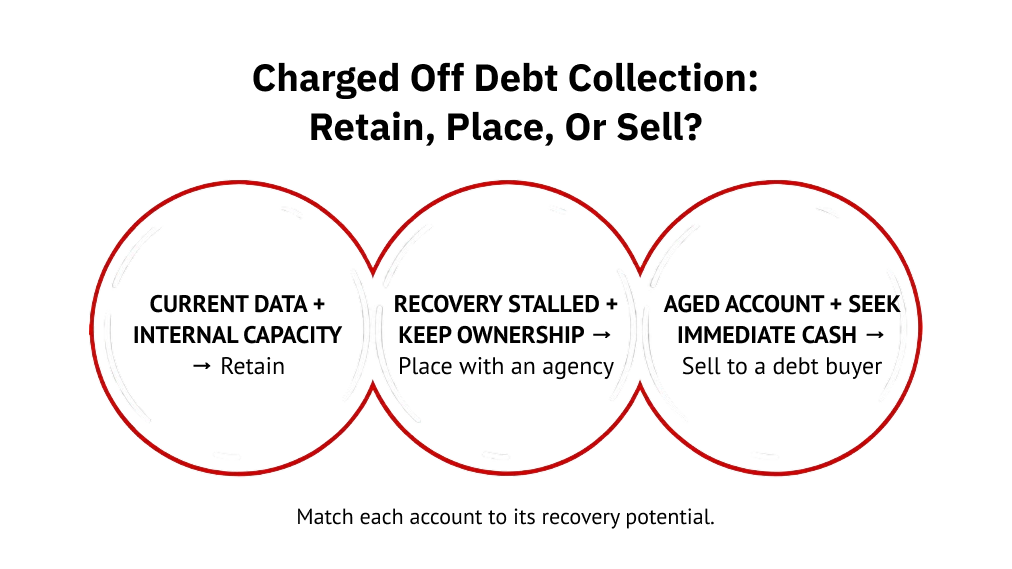
Before weighing timing, it helps to see the three options side by side.
The three post-charge-off paths
Each path balances control, cost, and recovery potential in its own way.
- Retain and collect internally: Your team keeps working the account, an approach best suited to fresh contact data and spare capacity. The catch is fixed overhead, which pushes the cost per dollar collected up as accounts age past 90 days.
- Place with a third-party collection agency: A licensed agency collects on your behalf, typically on a contingency basis, with fees determined by factors such as account type, age, balance, placement volume, and the terms of the agreement. You keep ownership and control of the customer experience while gaining specialized outreach and compliance support.
- Sell to a debt buyer: You sell the account outright, typically for four to eight cents per dollar on aged portfolios. The cash arrives fast, but you give up control over customer treatment and any future recovery.
At First Credit Services, we offer both first-party collections under your brand and third-party recovery for stalled accounts. Either way, we work on contingency, so you pay only when we collect.
Whichever path you choose, timing determines how much each one returns.
Why timing matters for post-charge-off recovery
Charged off debt recovery gets harder with every month an account sits untouched. The following three factors drive that decline:
- Contact data decays: Phone numbers change, emails go inactive, and customers move, increasing skip-tracing needs.
- Circumstances change: Early outreach reaches customers before new income goes toward newer obligations.
- Other creditors compete: Customers with multiple charged-off accounts may respond to whoever reaches them first with a reasonable offer.
On a broader scale, the Federal Reserve’s Charge-Off and Delinquency Rates data release shows this pressure. It puts the consumer loan charge-off rate at 2.66 percent, down from 2.88 percent in Q3 2025. Although the rate has eased, it still feeds a steady flow of accounts into post-write-off queues. Many internal teams cannot work that volume alone.
Fortunately, upstream recovery programs can shrink that flow before accounts reach write-off. For accounts already past that point, the next question is when to place them with a collection agency.
When should creditors place charged-off accounts with a collection agency?
Place too early, and you may pay fees on accounts your team could resolve. Wait too long, and collectibility may drop past the point of return. Therefore, the collection of charged off accounts hinges on two decisions: when to place and which accounts to place.
Placement timing and the recovery curve
Earlier placement after charge-off tends to produce higher recovery rates. Each 30-day delay chips away at collectibility as contact data ages and customer attention drifts. As a result, accounts placed within 30 to 60 days usually outperform those held six months or longer.
Beyond 180 days, skip tracing costs rise, outreach cycles lengthen, and customers engage less. Consequently, cost per dollar collected climbs while liquidation rates fall. For this reason, we recommend placing accounts within 30 to 60 days of charge-off, especially once internal efforts have stalled.
Account segmentation for post-charge-off portfolios
Once timing is set, the next decision is which accounts deserve agency placement at all. Treating every charged-off account the same wastes resources. A $200 gym membership balance and a $15,000 credit card balance need different approaches. Each one also carries its own cost structure and level of effort.
In addition, three inputs should shape how you segment your portfolio before placement:
- Balance tier: Higher balances justify more intensive recovery effort. A contingency fee on a $12,000 balance covers several outreach cycles. That same effort on a $300 balance may not pay for itself.
- Age since charge-off: Fresh charge-offs carry current contact data and recent engagement history. Accounts aged 12 months or more need skip tracing, updated addresses, and often a new outreach strategy.
- Customer engagement history: Prior payments, disputes, and past responses to outreach signal how likely the customer is to engage again. An account with partial payments before going silent is more recoverable than one with no prior response.
Moreover, segmentation determines which path each account takes. High-balance, recently charged-off accounts with engagement history are strong candidates for debt collection outsourcing. Low-balance, aged accounts with no prior response may suit a portfolio sale better.
Decision framework: retain, place, or sell?
To bring these inputs together, the table below maps each path to the accounts where it performs best.
| Path | Best when |
| Retain internally | The balance is high, contact data is current, the customer has paid before, and your team has capacity. |
| Place with an agency | Internal efforts have stalled, and the account is 30 to 180 days post-charge-off. You also want to keep ownership and control of the customer experience. |
| Sell to a debt buyer. | The account is 12+ months post-charge-off with no recovery activity. Contact data is thin, and you need immediate balance-sheet relief. |
No single path fits every account. The creditors who recover the most apply all three paths with care. They match each account to the path that promises the strongest return relative to cost.
After placement, the real work begins with a clean data handoff.
| Did You Know: The New York Fed’s Liberty Street Economics 2026 analysis counts over 23 million Americans still carrying charged-off card balances. That backlog shows how much charged-off debt stays outstanding long after write-off. |
How post-charge-off collections work: from placement to recovery
Debt collection after charge off follows a clear sequence, from placement to payment. Each stage builds on the one before it. Because of this, a weak link at any stage reduces what comes back downstream. The sequence starts with the data you hand over at placement.
Data handoff and account validation
Your placement file shapes how fast the agency makes first contact. It also shapes how accurately the agency reaches the right person. A complete placement file includes:
- Customer name, address, phone number, and email
- Account number and full balance breakdown, including principal, interest, and fees
- Last payment date and payment history
- Dispute history and any prior resolution attempts
- A copy of the signed credit agreement
Upon receipt, the agency scrubs each account for bankruptcy filings, deceased records, and known disputes. It also checks active-duty military status under the Servicemembers Civil Relief Act (SCRA). Skip tracing then refreshes outdated addresses and phone numbers.
Unfortunately, this step is where many recoveries stall. Incomplete files send the agency chasing basic contact details before real outreach can begin. On the bright side, data quality is one recovery factor you fully control.
In turn, clean data sets up the next step: reaching customers through the right channels.
Omnichannel outreach for charged-off accounts
Customers who ignored six months of calls rarely respond to the same approach from a new caller. Accordingly, effective post-charge-off outreach leads with digital channels. Email and SMS let customers respond on their own time. Self-service portals go further, letting them resolve accounts without a live call.
From a compliance standpoint, Regulation F permits email and text outreach.
These channels can make it easier to reach customers and provide timely payment information. But businesses still need to follow the communication rules that apply to debt collection.
The Fair Debt Collection Practices Act (FDCPA) requires every message to offer a clear opt-out.
Equally important is the order of outreach. A strong program layers channels in three steps:
- Digital first: Email and SMS go out in the first week after placement, at the lowest cost per contact.
- Self-service portal: A payment link gives customers 24/7 access to balances, settlement offers, and installment plans.
- Phone and letter follow-up: Traditional channels step in for customers who stay silent after a set window, such as 14 to 21 days.
On top of that, AI-driven contact sequencing predicts the best channel and time slot for each customer. It then adjusts the sequence as real response patterns emerge.
At FCS, our agents run this sequence through our Unified Consumer Engagement Platform (UCEP). The platform scores each account and selects the channel, timing, and offer most likely to work. Behind the scenes, we manage strategy, sequencing, and reporting, so your team never has to run campaigns.
Ultimately, the offer itself decides whether an engaged customer pays.
Payment plans and settlement structures
Many customers with charged-off balances cannot pay in full. Nevertheless, many will engage when an arrangement fits their budget.
Settlement offers range from 30 to 70% of the balance, depending on account age and the customer’s finances. Generally, older accounts with thinner data settle at steeper discounts.
For balances above $1,000, structured installment plans often recover more than lump-sum settlements, even allowing for some mid-plan defaults.
Choice matters just as much as the math. To that end, the strongest programs offer several options through one self-service experience:
- Lump-sum settlement at a defined discount
- Short-term installment plan of three to six months
- Extended payment arrangement of six to twelve months
- Promise-to-pay commitment with a scheduled follow-up
| Pro Tip: Set the first payment date as close to the promise-to-pay commitment as possible. The longer the gap, the more room other bills have to take priority. |
Offering choice tends to lift both engagement and resolution rates. Conversely, a single take-it-or-leave-it offer risks losing customers who would pay on different terms. Across all three stages, every touchpoint also carries compliance obligations.
Compliance rules that apply to charged-off debt collection
Several rules change once third-party collections after charge off begin. Regulators also expect you to oversee your collection vendors, so their conduct reflects on you. Our debt collection compliance guide covers each law in depth.
This section focuses on what shifts after charge-off.
- FDCPA and Regulation F: Both apply in full once an agency collects on your behalf. The agency must send a validation notice within five days of first contact. Regulation F also limits calls to seven attempts in seven days per debt. A seven-day pause then follows any phone conversation about that debt.
- FCRA: A charged-off account can stay on a credit report for about seven years from first delinquency. Both you and the agency must report it accurately and update it after any payment or settlement.
- TCPA: Autodialed or prerecorded calls and texts to mobile numbers require prior express consent. Because numbers get reassigned, verify each one before launching automated outreach.
- State laws and time-barred debt: Some states add licensing, disclosure, or contact rules beyond federal law. Notably, Regulation F bars suing or threatening to sue on time-barred debt. Several states also require written notice that a debt is too old for a lawsuit.
- Form 1099-C: Applicable financial entities, such as banks and credit unions, must report canceled debt of $600 or more. Partial settlements can trigger this filing.
Above all, vet a collection partner’s compliance controls as closely as its recovery results. Against that backdrop, here is how we handle recovery and compliance together at First Credit Services.
5 KPIs to measure post-charge-off recovery performance
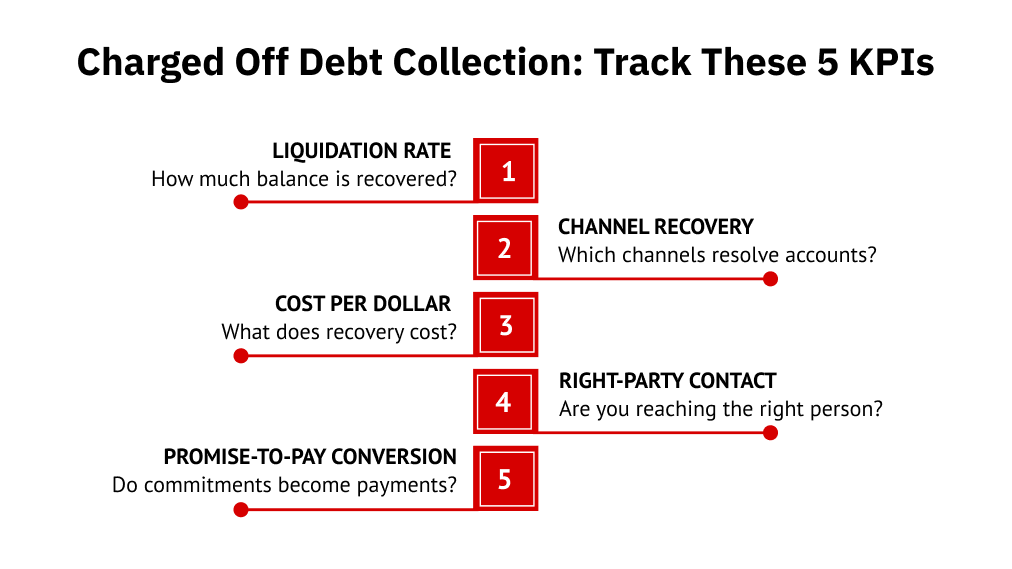
Placement is only the first step. Five KPIs show whether your charged off account collection strategy is paying off.
- Liquidation rate: It measures the share of placed balances your agency recovers. Track it by account age cohort, since fresh and aged accounts perform very differently.
- Recovery rate by channel: This metric reveals which channels, from email to phone, produce the most resolutions. Use it to shift budget toward the channels that deliver.
- Cost per dollar collected: Here, total collection cost is divided by total dollars recovered. Read it alongside liquidation rate, since strong recovery at a high cost can still underperform.
- Right-party contact rate: It tracks the share of attempts that reach the correct customer. As a leading indicator, a low rate often exposes weak placement data or thin skip tracing.
- Promise-to-pay conversion rate: The last KPI measures how many payment commitments become completed payments. Low conversion usually points to a hard payment process or slow follow-up.
| Pro Tip: Group recovery results by placement month or quarter. This separates new and older accounts and shows whether each cohort resolves faster or slower. |
Recover more from charged-off accounts with the right collection strategy
In short, a charge-off changes your books, yet the customer still owes the balance. To begin, match each account to the right path, then place accounts within 30 to 60 days.
During recovery, clean data, digital-first outreach, and flexible payment options drive results. Along the way, stay compliant and track KPIs by placement cohort. Every month of delay narrows the window for post charge off collections.
Is your team sitting on a growing backlog of charged-off accounts? Discuss with FCS about recovering the balances you have already written off.
FAQs
1. How long does it take to see results after placing charged-off accounts?
Early payments often arrive within the first 30 to 60 days, especially on accounts with current contact data. Full portfolio performance usually becomes clear over six to twelve months, as aged accounts take longer to resolve.
2. Can a creditor keep collecting after filing a 1099-C?
Generally, yes. IRS rules treat Form 1099-C as an information return. Many courts also hold that filing it does not cancel the debt. Still, confirm with legal counsel before resuming collection.
3. How should creditors report a settled charged-off account?
Update the tradeline to show the account as settled with a zero balance. The charge-off itself stays on the report for about seven years from first delinquency. Accurate updates also reduce FCRA dispute risk.
4. What happens to charged-off accounts an agency cannot recover?
You can recall them for secondary placement with another agency. Alternatively, charge off debt sold to a collection agency or debt buyer brings immediate cash but ends your recovery upside. Account age and limitations periods shape the choice.
5. When does first-party collection make sense after charge-off?
First-party collection, under your brand, suits recently charged-off accounts with strong relationship value. Third-party collection suits stalled accounts that need a fresh voice, skip tracing, and a dedicated compliance program.
6. Can creditors place charged-off accounts with more than one agency?
Yes. Some creditors run a champion-challenger model, splitting comparable accounts between two agencies. Comparing results by placement cohort then shows which partner recovers more at a lower cost.