


Choosing a debt collection agency can have a lasting impact on your recovery rates, customer relationships, and brand reputation. The right debt recovery partner should do more than collect outstanding balances. It should have the processes, technology, and compliance practices to recover debt responsibly while protecting your business.
Before choosing a debt collection agency, make sure it has a clear process for verifying account balances and resolving customer disputes. Ask how these checks are carried out and request evidence before placing accounts with the agency.
This guide walks you through seven steps, from defining your portfolio and evaluating collection proposals to setting measurable service expectations and transitioning accounts in phases.
How to hire a debt collection agency: the full sequence
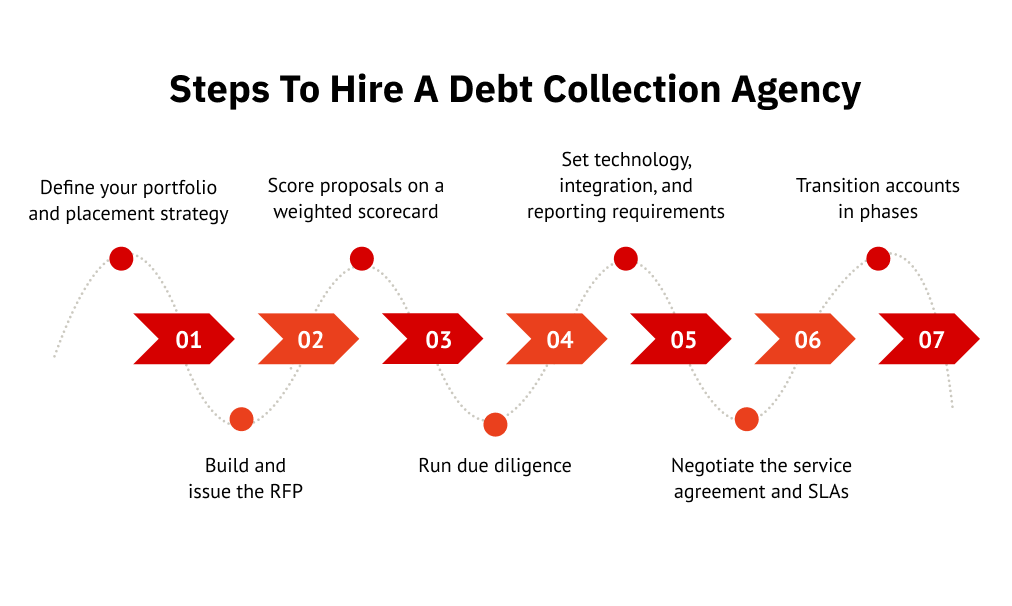
Follow these seven steps to compare agencies on evidence and establish clear responsibilities for managing your portfolio.
- Define your portfolio and placement strategy
- Build and issue the RFP
- Score proposals on a weighted scorecard
- Run due diligence
- Set technology, integration, and reporting requirements
- Negotiate the service agreement and SLAs
- Transition accounts in phases
Each step builds on the one before it. Hence, skipping ahead means placing accounts with an agency you have not fully evaluated.
Define your portfolio before you go to market
Portfolio analysis comes before vendor outreach. The accounts you plan to place determine which agencies qualify, how pricing works, and what compliance requirements apply.
Signs it is time to bring in an agency
Internal follow-up has stalled, accounts keep aging past your handoff point, or collection work is pulling staff off core billing. If these patterns persist for two or more quarters, outsourcing may cost less than keeping recovery in-house.
Consumer vs commercial receivables
Agency selection also depends on the type of receivables you hold. Consumer debt collection is subject to requirements under the Fair Debt Collection Practices Act (FDCPA) and Regulation F. However, commercial agencies operate under different rules.
Therefore, placing consumer accounts with a commercial-focused agency can create compliance gaps that regulators may trace back to you.
To establish the requirements upfront, your RFP should specify whether the portfolio is consumer or commercial. For consumer accounts, look for agencies with the required state licenses, call-monitoring programs, and agent training on validation notice requirements.
Portfolio placement strategy
Segment accounts by debt age, balance, and type before you go to market, since agencies price each segment differently. Early-stage accounts also need different outreach than charged-off balances.
- Debt age buckets: group by 30-day, 60-day, 90-day, and post-charge-off bands.
- Balance ranges: separate high-balance and low-balance accounts. The cost to collect on a $200 balance differs from a $5,000 balance.
- Account type: distinguish first-party (pre-write-off) from third-party (post-write-off) placements.
Based on these segments, decide between a single partner and a primary/secondary split. Then record baseline metrics, such as current liquidation rate, internal cost to collect, and average days to resolve. Every proposal needs a number to beat.
How to write a debt collection agency RFP
A well-built RFP shapes every proposal you receive. It defines the scope, sets compliance expectations, and structures responses for direct comparison.
What to include in the RFP
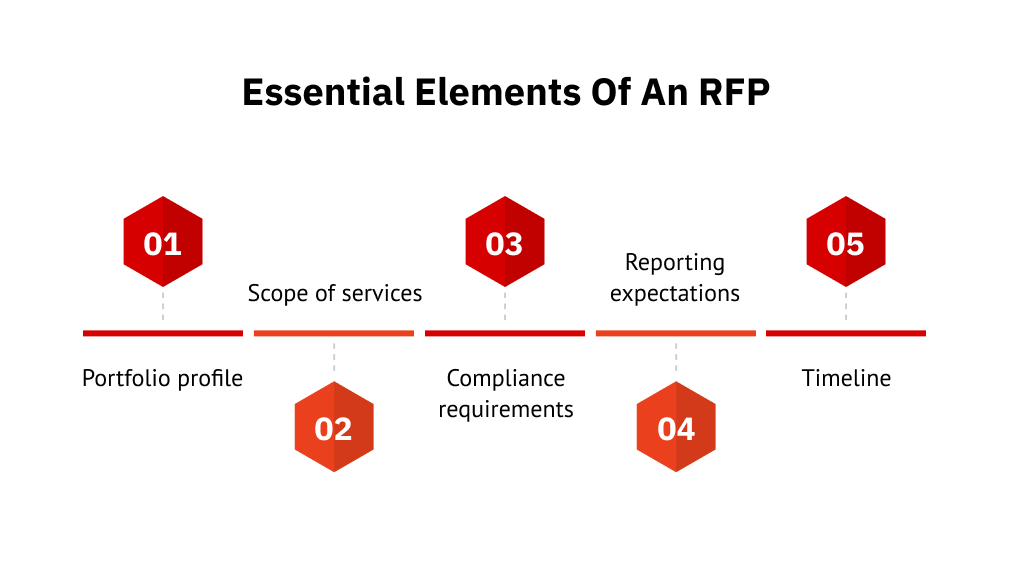
A strong RFP tells agencies what you need and structures their responses for side-by-side comparison. It includes:
- Portfolio profile: volume, balance ranges, age buckets, and industry.
- Scope of services: first-party, third-party, or both. Include dispute handling and credit bureau furnishing if applicable.
- Compliance requirements: FDCPA, Regulation F, state licensing, and industry-specific rules such as the Health Insurance Portability and Accountability Act (HIPAA).
- Reporting expectations: reports, cadence, and format.
- Timeline: proposal due date, award date, and planned placement date.
What public-sector RFPs ask agencies to prove
Public-sector buyers publish their RFPs, and their criteria are worth borrowing. For example, the City of Thomson, GA scores experience, methodology, fees, references, compliance, and reporting.
Similarly, the City of Lodi asks for System and Organization Controls (SOC) audit results, personally identifiable information protection, and disaster recovery plans. To structure its evaluation, EBMUD scores each criterion on a weighted zero-to-five scale.
If a municipality requires SOC controls and disaster recovery proof for utility accounts, your consumer portfolio deserves at least that standard.
Proposal requirements that separate strong agencies
Ask for materials that reveal how the agency operates in practice, such as:
- Sample reports, redacted letter templates, and call scripts.
- A compliance management system overview with named processes.
- A named account team with defined escalation paths.
| Pro tip: Send every agency the same anonymized sample file of 500 to 1,000 accounts and ask for a projected recovery curve by age bucket. You will compare real projections instead of marketing claims. |
Collection agency evaluation criteria: a weighted scorecard
A weighted scorecard forces you to rank priorities before reading proposals. Without weights, evaluators score on instinct, and the agency with the best slide deck wins. Use the suggested weights below as a starting point, adjusting them to your portfolio’s risks and recovery goals.
| Criterion | Suggested weight | Evidence to request |
| Compliance and licensing | 25% | Licenses, audit results, compliance |
| Recovery performance by debt age | 25% | Liquidation curves on comparable portfolios |
| Pricing and net recovery | 15% | Fee schedule applied to your sample file |
| Data security and technology | 15% | SOC 2 Type II report, portal demo, integration specs |
| Reporting and client service | 10% | Sample reports, account team structure |
| Consumer experience and complaints | 10% | Complaint ratio, dispute handling process |
Adjust weights by industry. For example, healthcare organizations may give greater weight to Health Insurance Portability and Accountability Act (HIPAA) compliance and patient experience, while fintech businesses may prioritize digital collection and integration capability.
Pay close attention to pricing as well. Contingency-based fee structures vary by debt age and balance size. Compare net recovery after fees, because a lower fee rate means little if the agency recovers less.
| Did you know? Some public buyers shortlist agencies on written scores, then invite finalists to present before running reference checks. The City of Lodi’s RFP follows this sequence. |
Collection agency due diligence: what to verify before you sign
Proposals show what an agency claims it can do. Due diligence shows what it can prove. This step separates credentialed agencies from those running on reputation alone. Here’s what to evaluate:
1. Licensing, bonding, and insurance
An agency needs a license and bond in every state where your consumers live. Many states process licensing through the Nationwide Multistate Licensing System (NMLS). Verify each license directly.
Also confirm current certificates for errors and omissions insurance and cyber liability coverage. A data breach or wrongful collection claim generates costs that a small bond will not cover.
2. Compliance management and complaint history
Request the agency’s compliance policies, agent training records, quality assurance call-monitoring results, and internal audit findings. A credible agency shares these readily.
Since the CFPB stopped publishing individual complaint narratives in August 2026, public data is harder to compare. Hence, ask each agency for its own complaint log, root-cause notes, and resolutions. You can use CFPB Compliance Bulletin 2016-02 as a benchmark for what your oversight should cover.
3. Data security and funds handling
Review the following standards and controls to assess how the agency protects sensitive data and safeguards collected funds:
- SOC 2 Type II: covers internal controls over a sustained period.
- Payment Card Industry Data Security Standard (PCI DSS): required for card payments.
- HIPAA compliance: required for patient account data.
- Trust account: collected funds belong in a separate trust account.
The IBM Cost of a Data Breach Report 2025 put the average U.S. breach at $10.22 million. Your agency’s security controls therefore deserve close scrutiny, since weaknesses can increase your own risk exposure.
| Pro tip: Treat these as red flags: vague “proprietary methods,” no SOC 2 report, reluctance to share call recordings, or complaint counts the agency cannot explain. |
Technology, integration, and reporting requirements
Technology determines how data moves between your systems and the agency’s platform. Errors in this layer cause bad placements, missed payments, and consumer complaints.
Collection agency integration and data transfer
The placement file is the first thing an agency works from. A wrong balance or mismatched account number can lead to contacting consumers about debts they do not owe.
To prevent these errors, define file formats for placement, updates, payments, and recalls. Then decide whether data moves by Secure File Transfer Protocol (SFTP) or API. Once done, set the file frequency and assign reconciliation ownership. Clean placement data protects consumers and reduces disputes.
Collection agency reporting requirements
To monitor performance, standard reports should cover liquidation by placement month, right-party contact rate, disputes, complaints, and remittance reconciliation. Review these reports through a live client portal demo.
Consumer-facing channels
An agency that reaches consumers through their preferred channels can resolve more balances and generate fewer complaints. Look for:
- Omnichannel outreach: SMS, email, letters, and calls working as a sequenced workflow.
- Self-service payment portals: consumers can view balances, set up plans, and pay without an agent.
- Consent and preference tracking: Regulation F governs contact frequency and channel preference. The agency should honor opt-outs at the account level.
Collection agency service agreement and SLA: terms to negotiate
The service agreement formalizes the agency’s commitments and gives you a basis for holding it accountable. Clear obligations help resolve disagreements over fees, responsibilities, and performance.
Core contract terms
Use the following clauses to set approval limits, preserve oversight rights, and establish what happens when the relationship ends:
- Scope and fee schedule: account types covered, contingency rate by age band, and volume thresholds.
- Settlement authority: the floor below which the agency can accept a settlement without your approval.
- Legal action: require written consent before the agency files suit.
- Compliance and indemnification: the agency indemnifies you for violations caused by its conduct.
- Audit rights: access to call recordings, quality assurance scorecards, complaint logs, and training records.
- Data return: all account data and documentation returned within a defined window at termination.
- Credit bureau furnishing: whether the agency reports, and under what Fair Credit Reporting Act (FCRA) accuracy rules.
SLAs and performance metrics to write in
SLAs turn expectations into enforceable commitments. Without them, “prompt account loading” means whatever the agency decides.
| SLA area | What to define | Why it matters |
| Account load time | Days from placement to active | Stops accounts aging in limbo |
| First contact attempt | Window after load | Early outreach drives recovery |
| Dispute and validation response | Days to acknowledge and resolve | Core FDCPA and Regulation F exposure |
| Complaint escalation | Hours to notify you | You hear it before the regulator does |
| Remittance frequency | Weekly or monthly, with reconciliation | Protects cash flow |
| Report delivery | Cadence and format | Keeps oversight consistent |
| Recall processing | Days to stop activity and return data | Makes switching agencies clean |
Tie metrics to quarterly reviews. If an agency misses its first-contact or dispute-response SLA for two consecutive quarters, your contract should allow account recall without penalty.
A signed agreement is the starting point. From there, the transition plan determines whether accounts move cleanly.
The collection agency transition process: a 90-day plan
Switching agencies is where accounts fall through the cracks. A structured 90-day transition protects open accounts and in-flight payment arrangements.
- Days 1 to 30: Map data fields between systems. Run test files. Review every outbound letter, SMS, and call script for compliance with FDCPA, Regulation F, and state rules. Set up portal access.
- Days 31 to 60: Place a pilot segment and measure against your baseline. This is proof of concept before committing the full portfolio.
- Days 61 to 90: Scale placements. Recall from the incumbent. Reconcile balances and carry over all payment plans and open disputes.
Freeze a list of every active payment arrangement and open dispute before recall. These accounts generate the most complaints during a handoff.
Common mistakes when hiring a collection agency
Even a structured evaluation has failure points. These mistakes appear across industries, and each one is avoidable with the right contract language and oversight plan.
- Choosing on commission rate alone: A 15% fee with a 2% liquidation rate recovers less than a 25% fee with a 5% rate. Net recovery after fees is the number that matters.
- Skipping a pilot: Placing your full portfolio on day one gives you no baseline and no way to course-correct.
- Signing without defined SLAs: A contract without measurable commitments gives you no leverage when performance slips.
- Treating oversight as finished at signing: Quarterly reviews, call audits, and complaint monitoring should run for the life of the contract.
Pre-signing checklist
Use this checklist to resolve any outstanding gaps before placing accounts:
- State licenses, bonds, and insurance verified
- Scorecard completed for every finalist
- Recovery projections compared on your sample file
- Compliance evidence and complaint log reviewed
- SOC 2, PCI DSS, HIPAA, and trust account confirmed
- SLAs set with targets and measurement methods
- Audit and recall rights written into the contract
- Pilot-first transition plan agreed
What First Credit Services brings to your shortlist
A strong shortlist candidate proves its value with evidence. First Credit Services brings an extensive experience of over 30 years in compliant collections and the operational depth buyers look for in an RFP.
That depth shows in the numbers. We manage over 125 million consumer interactions annually across three global call centers. Every placement runs under PCI DSS Level 1, AICPA SOC 2 Type II, and HIPAA standards. We are also RMAI Certified and BBB A+ accredited, with licensing, bonding, and insurance current in every required state.
On the technology side, our in-house Unified Consumer Engagement Platform (UCEP) uses behavioral data to select the right channel, message, and timing for each consumer. A self-service payment portal then lets consumers view balances, set up plans, and pay without speaking to an agent.
Hire a debt collection agency that protects your recovery and your name
The agencies worth shortlisting can prove their results, show their compliance controls, and commit to SLAs you can measure. Score every finalist on that evidence, start with a pilot, and keep oversight running after go-live.
Putting together your shortlist? Request a portfolio assessment and see how recovery results compare against your current baseline.
FAQs
1. How many collection agencies should we invite to an RFP?
Invite three to five agencies to compare pricing and recovery approaches without overloading your review team. Inviting fewer than three limits comparison. Pre-screen for licensing and relevant industry experience before sending invitations.
2. Should we use a first-party or third-party collection agency?
First-party agencies collect under your brand, usually on early-stage accounts. Third-party agencies collect under their own name, typically on older or charged-off balances. Many creditors use both and hand accounts off at a defined delinquency point.
3. Do we need separate agencies for early-stage and late-stage accounts?
In many cases, no. Early-stage recovery depends on digital outreach and a lighter touch. Late-stage accounts need persistence and careful dispute handling. Some agencies handle both under one contract. If you split them, define the handoff point and data transfer clearly.
4. Who should sit on the agency selection committee?
Include finance or accounts receivable leadership, compliance or legal counsel, IT or security, and someone who owns customer experience. A mixed committee catches risks one team alone would miss, such as weak data controls or aggressive letter language.
5. Will hiring a collection agency affect our customers’ credit reports?
It can, depending on whether the collection agency or another responsible party reports the account to credit bureaus. Before hiring an agency, clarify who handles credit reporting and how the process complies with the Fair Credit Reporting Act (FCRA), including requirements for accurate information and dispute handling. For medical debt, the three nationwide credit bureaus generally exclude paid medical collections and medical collections with an initial balance under $500 from credit reports. These policies do not apply to all types of debt.
6. What is the difference between hiring a collection agency and selling debt?
When you hire a collection agency, you typically retain ownership of the accounts and pay the agency a fee based on the amount recovered. When you sell debt to a debt buyer, ownership transfers to the buyer in exchange for an upfront payment, usually below the outstanding balance. Selling debt also means giving up direct control over future collection decisions, so it’s important to evaluate the buyer’s practices and reputation before completing the sale.