


Are unpaid customer accounts piling up faster than your finance team can collect them?
The benefits of outsourcing collections lie in handing that recovery work to a specialist who recovers more for less.
In-house recovery ties up skilled staff, carries compliance risk, and often returns less than it costs. Outsourcing changes that equation. As a result, recovery rates climb, compliance risk shifts to the partner, and your staff returns to revenue-generating work.
This guide covers the financial case, the compliance risk transfer, the technology advantages, and the scenarios with the strongest results.
What is collections outsourcing?
Collections outsourcing means hiring a specialized partner to recover past-due consumer accounts on your behalf. The partner manages outreach, payment negotiation, compliance, and reporting, while your team stays focused on core operations.
Outsourced collections can take several forms. In general, the scope depends on how early you involve the partner:
- First-party recovery: The partner works under your brand, so your customers never see a third-party name. This model fits early-stage delinquency and failed payment recovery.
- Third-party recovery: The partner operates under its own name and handles later-stage and charged-off accounts.
- Accounts receivable (AR) follow-up: Proactive outreach reaches customers with aging balances before those accounts move to formal placement. Therefore, this work sits upstream of traditional collections.
- Digital recovery: Automated outreach runs through SMS, email, chat, and self-service portals. It suits high-volume, low-balance portfolios where phone calls cost more than they recover.
One variation matters before you compare these options. AR management is proactive because it covers balances your business still expects to collect.
By contrast, collections is reactive and starts after an account is written off or formally placed. Many businesses outsource both stages. For example, they often place accounts once they pass 60 to 90 days past due.
With the model defined, the real question is what your business gains from it.
The core benefits of outsourcing collections at a glance
The benefits of outsourcing debt collection fall into eight areas. Each area gets a deeper look later in this guide, so treat this list as your quick summary.
- Higher recovery rates: A specialized partner works more accounts with better data, which lifts the share of balances resolved.
- Lower cost per dollar recovered: Contingency pricing ties your cost to results, while an in-house team carries fixed overhead.
- Compliance risk transfer: The partner manages daily compliance with the Fair Debt Collection Practices Act (FDCPA) and state rules.
- Collections technology access: AI-driven account scoring, omnichannel outreach, and self-service payment portals come without a capital build.
- Scalability: Seasonal spikes, portfolio acquisitions, and charge-off waves no longer require new hires or ramp-up time.
- Faster resolution cycles: Earlier and more consistent outreach shortens the time between delinquency and payment.
- Preserved customer relationships: White-labeled, digital-first outreach protects your brand while customers resolve their balances.
- Reduced turnover in your finance team: Your staff spends less time on repetitive follow-up calls, which eases burnout.
Taken together, these gains build on each other as your account volume grows.
| Pro tip: The benefit that surprises most finance leaders is compliance risk transfer. A licensed, audited partner takes over the daily regulatory work your team once carried. |
Of these eight, cost and net recovery usually decide the business case, so the numbers come first.
Financial benefits: lower cost and higher net recovery
The financial case for outsourcing collection services rests on one comparison: what each model costs against what it recovers. That comparison starts with the cost side.
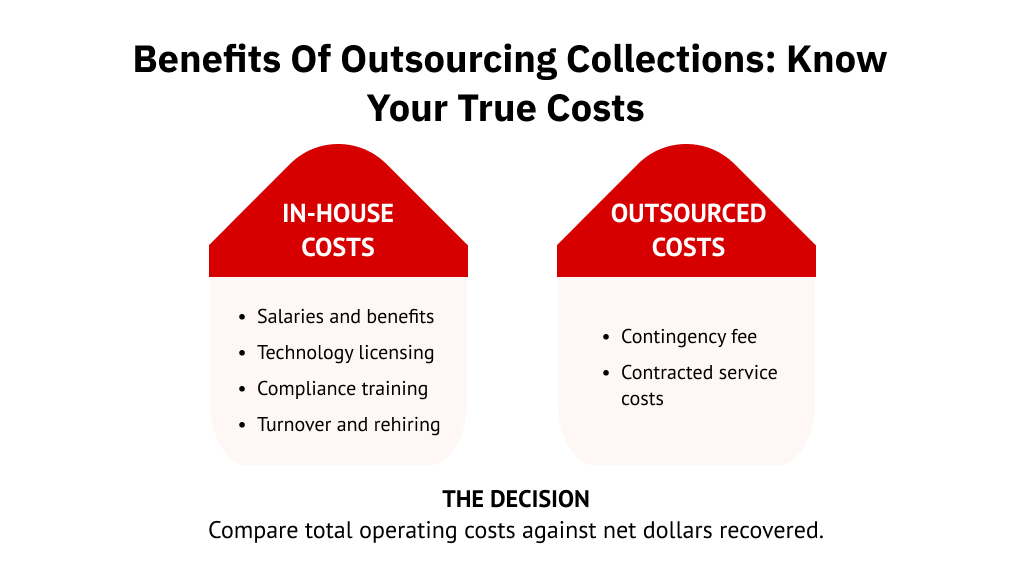
What outsourcing actually costs vs. what in-house costs
Contingency-based agencies commonly charge 25% to 50% of recovered dollars. If the agency recovers nothing, you pay nothing.
However, in-house teams carry fixed costs whether accounts pay or stay unresolved:
- Salaries and benefits: Collector pay stays the same in strong and weak recovery months.
- Technology licensing: Dialers, payment portals, and skip-tracing tools carry recurring fees.
- Compliance training: Federal and state rules change often, so your staff needs regular retraining.
- Turnover and rehiring: Each departure means recruiting and training a replacement before recovery work resumes.
Once you see both cost structures, the common mistake in the math becomes easier to spot.
The net recovery math finance leaders miss
Most finance leaders compare an agency’s contingency fee against zero, as if in-house recovery carries no cost. A fairer formula is net recovery, which equals gross dollars recovered minus the fully loaded cost.
For example, take $500,000 in past-due accounts placed for recovery:
- In-house: A 15% recovery rate brings in $75,000. After $60,000 in salary, technology, training, and compliance costs, net recovery is $15,000.
- Outsourced: A 30% recovery rate brings in $150,000. After a 30% contingency fee of $45,000, net recovery is $105,000.
These figures are illustrative and should not be read as benchmarks. Moreover, the difference grows with time, because recovery rates fall as accounts age while salaries stay fixed.
| Pro tip: Include turnover, licensing, and compliance costs in your in-house figure before you present the comparison to leadership. Leaving them out makes the in-house model look cheaper than it is. |
Net recovery is one half of the financial picture, and timing is the other.
Cash flow acceleration
Faster resolution cycles shorten your days sales outstanding (DSO). When a specialized partner contacts accounts within days of placement, payments arrive sooner. That allows your business to free working capital and rely less on short-term borrowing.
At First Credit Services, our portfolio recovery services run on success-aligned pricing. Your cost moves with the dollars we recover, whatever the size of the team behind them.
Lower cost and faster cash are only part of the return, since outsourcing also reshapes your team’s workday.
Operational benefits: scale, speed, and reclaimed bandwidth
Cost savings get the most attention when leaders weigh the benefits of a collection agency. In addition, outsourcing changes how your operation handles volume, staff time, and coverage hours. Volume comes first, because it puts the most pressure on an in-house team.
Scalability without hiring
Account volume shifts with seasonal billing cycles, portfolio acquisitions, and charge-off waves. Your in-house team cannot absorb those spikes without new hires, and each hire needs recruiting and training time. A recovery partner absorbs the same spikes right away because its staff and systems are already in place.
Charge-off waves show the difference most clearly, since many accounts reach write-off in the same quarter. Without a partner, your team falls behind or pulls staff away from other functions.
Extra capacity also protects the time of the people you already employ.
Bandwidth reclaimed for revenue work
Every hour spent on follow-up calls is an hour taken from higher-value work. Outsourcing moves repetitive recovery tasks to the partner. In turn, your finance and customer experience teams regain time for work such as:
- Cash application: Payments get posted and reconciled without delay.
- Forecasting: Leaders receive cash projections built on current data.
- Dispute resolution: Customers with billing questions get faster answers.
Reclaimed hours matter during the workday, but recovery also needs to continue after it ends.
24/7 recovery cycles vs. business-hours in-house teams
An in-house team works accounts only during business hours. Meanwhile, a partner’s self-service payment portals stay open around the clock, so customers can resolve balances at any hour. Agent calls still follow legally permitted contact hours. This extended coverage brings cash in sooner.
Wider coverage also means more customer contact, and every contact carries regulatory obligations.
Compliance benefits: FDCPA, Regulation F, and risk transfer
Among debt collection outsourcing benefits, compliance is the one finance leaders underestimate most. The Fair Debt Collection Practices Act (FDCPA) and Regulation F set the federal standard for consumer contact. Both apply mainly to third-party collectors, so in-house teams often assume they face no rules.
That assumption creates three common gaps:
- State collection laws: Several states extend FDCPA-style rules to creditors that collect their own accounts.
- Call and text consent: The Telephone Consumer Protection Act (TCPA) covers automated calls and texts from any business.
- Contact frequency: Regulation F treats more than seven calls in seven days as presumed harassment by a collector. Few in-house teams track attempts with that precision.
| Did you know? The CFPB received approximately 207,800 debt collection complaints in 2024, according to its 2025 FDCPA annual report. The most common issue was a debt the consumer said was not owed. |
Specialized agencies build compliance into daily operations through agent training, contact caps, and documented audit trails. Even so, you keep oversight responsibility, because regulators expect creditors to monitor their vendors.
At FCS, we maintain state-by-state licensing and a compliance program that most in-house teams cannot replicate.
Additionally, each industry adds rules on top of federal law:
- Healthcare: The Health Insurance Portability and Accountability Act (HIPAA) protects patient data, alongside state medical debt and surprise billing rules.
- Financial services: The FDCPA, Regulation F, and state lender licensing create obligations that differ by jurisdiction.
- Utilities and telecom: Shutoff protections and state utility commission rules govern when you can pursue past-due accounts.
Staying compliant across that many rules depends on systems as much as people.
Technology benefits: AI, omnichannel, and analytics
Compliance protects your business, while technology decides how many accounts you recover and at what cost. Access to that technology is a major reason companies choose accounts receivable collection outsourcing. The value starts with what the tools do on each account.
What modern collections technology actually does
Specialized agencies invest in tools that most internal teams cannot justify buying. The core stack includes:
- Predictive scoring: Machine learning models rank accounts by likelihood to pay, so effort goes where it converts.
- Skip tracing: Automated data enrichment locates customers who changed phone numbers, emails, or addresses after falling behind.
- Payment prediction: Behavioral models identify the best time, channel, and offer for each account.
Building this stack yourself means licensing, integrating, and maintaining several platforms. Debt collection outsourcing services give you the same output without the cost of owning the infrastructure.
Scoring tells a partner whom to contact, and channel strategy determines how.
Omnichannel outreach and analytics
Traditional in-house recovery leans on phone calls, which misses the many customers who prefer digital contact. A capable partner runs SMS, email, chat, self-service portals, and phone as one coordinated sequence. Specifically, each channel’s result shapes the next message. For instance, tomorrow’s SMS changes based on whether the customer opened today’s email.
That coordination also produces data your team can use. A strong partner reports contact rate, payment conversion, dispute status, and channel performance without any dashboard work on your side.
Better technology also changes how each interaction feels to the customer on the other end.
Customer experience benefits: recovering revenue without losing the customer
The way you treat customers during recovery decides whether they stay afterward. Well-run outsourced collections protect that relationship, and the old image of confrontational phone calls no longer applies. In fact, modern agents follow your tone guides and escalation rules, and their training centers on empathy.
Likewise, a white-label first-party model keeps your brand on every message, so customers never see a third party. Recovery then feels like a continuation of your own service.
Effective partners also replace rigid payment demands with choices:
- Payment plans: Installments match what the customer can afford over time.
- Settlement offers: A reduced lump sum resolves the balance for customers who can pay at once.
- Hardship pathways: Customers with documented financial difficulty stay on a resolution track and avoid write-off.
- Dispute handling: Agents log and resolve billing disputes quickly, before frustration ends the relationship.
Ultimately, each option turns a non-paying customer into a paying one and keeps the relationship intact.
These benefits apply broadly, but some businesses feel them far more than others.
Business scenarios where outsourcing collections delivers the most value
Some businesses can wait on outsourcing collection services, while others gain from them right away. Four conditions make the return much stronger, and portfolio size is the first.
Some businesses can wait on outsourcing collection services, while others gain from them right away. Three conditions make the return much stronger, and portfolio shape is the first.
Portfolio size and account balance
The economics of outsourcing improve as your volume of past-due accounts grows. Each added hire raises fixed cost, while contingency fees rise only with recovered dollars. Small balances add to the problem, because each in-house call can cost more than it returns.
Digital-first agencies use automated outreach, which keeps the cost per attempt low. The same approach supports subscription payment recovery after card retries fail.
Portfolio shape is one trigger, and regulation is another.
Regulated industries with high compliance risk
Healthcare, financial services, utilities, and telecom carry sector rules on top of federal law. In particular, the compliance workload alone can justify outsourcing, regardless of your recovery performance.
The final scenario comes down to pace.
Businesses growing faster than their collections function
Past-due accounts pile up when revenue grows faster than you can hire and train staff. Outsourcing absorbs that volume, so you avoid building a permanent team for a temporary surge.
Here is how the economics compare across three of these profiles:
| Business profile | In-house economics | Outsourced economics |
| Regulated provider (healthcare, lending, utilities) | Compliance staff and training add fixed costs. | Compliance infrastructure is included in the fee. |
| High-volume, low-balance portfolio | Cost per contact often exceeds the balance. | Automated outreach keeps cost per attempt low. |
| Fast-growing business | Hiring lags behind account volume. | Capacity scales with each placement. |
Whichever profile fits your business, the decision should rest on numbers you can measure.
How to measure the ROI of outsourced collections
You can only prove debt collection outsourcing benefits through consistent measurement. Start tracking on the day you place your first accounts and compare every result with your in-house baseline.
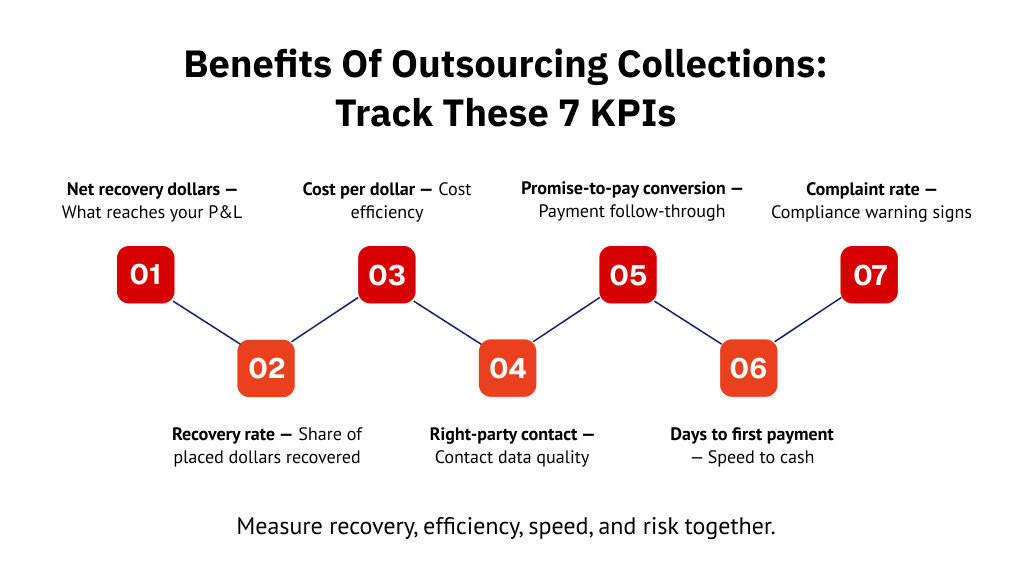
These seven metrics cover both weekly activity and monthly financial results:
- Net recovery dollars: Gross recovered minus fees gives the number that reaches your P&L.
- Recovery rate: This figure shows dollars recovered as a percentage of dollars placed.
- Cost per dollar recovered: Total outsourcing spend is divided by dollars recovered.
- Right-party contact rate: A low figure signals bad data or weak skip tracing.
- Promise-to-pay conversion: This metric tracks how many payment commitments became real payments.
- Days to first payment: Shorter timelines mean faster cash flow and a lower DSO.
- Complaint rate: Complaints per 1,000 accounts worked act as your compliance early warning.
Accordingly, your contract should require monthly reporting, a defined format, and escalation steps for missed targets. Otherwise, vague terms in the agreement become vague reporting later.
At First Credit Services, our Unified Consumer Engagement Platform (UCEP) surfaces these metrics for clients in real time.
Clear metrics also help you answer the doubts that often delay an outsourcing decision.
Common misconceptions about outsourcing collections
Four assumptions often stop finance teams from weighing the benefits of a collection agency fairly:
- “It’s more expensive than doing it in-house.” In reality, salaries, technology, training, and turnover give in-house recovery a fully loaded cost.
- “It damages customer relationships.” White-label first-party models keep your brand, tone, and escalation rules in every conversation.
- “Our accounts are too small for an agency.” Today, digital-first partners work low-balance accounts through automated outreach at a low cost per attempt.
- “We lose control of the process.” Your contract binds the partner to your scripts, tone guidelines, reporting SLAs, and escalation rules.
With these doubts answered, the overall case becomes easier to judge.
Turn the benefits of outsourcing collections into recovered revenue
The benefits of outsourcing collections extend well beyond recovered dollars. You also gain compliance infrastructure, proven technology, flexible capacity, and a customer experience that protects relationships.
Simply put, outsourced collections are an operational upgrade that many finance teams underuse. The useful next step is to measure what your current approach recovers.
Do you want to see how much more your portfolio could recover? Request a portfolio review from FCS today. We will benchmark your current recovery numbers and show where a partner can add value.
FAQs
1. Is outsourcing collections cheaper than hiring an in-house collections team?
Outsourcing is cheaper in most cases because contingency agencies charge only on recovered dollars. In-house teams carry fixed costs for salaries, technology, and compliance every month.
2. How long does it take to see results after outsourcing collections?
Recovery activity usually begins within the first few weeks of placement, and cash flow impact builds over the following months. Accounts placed early in delinquency recover at higher rates than older accounts.
3. Can I outsource only a portion of my collections?
Yes, partial outsourcing is common and often delivers the highest return. Many businesses keep accounts under 30 days past due in-house and outsource everything past 60 days.
4. What industries benefit most from outsourcing collection services?
Healthcare, financial services, utilities, telecom, subscription businesses, and higher education see the strongest returns. Any consumer-facing industry with high account volume or regulated collection rules tends to benefit.
5. Does outsourcing collections affect my company’s reputation?
Reputation impact depends on the agency’s approach. In white-label first-party models, customers interact with your brand alone. Reputable agencies also use compliant, respectful communication that protects the relationship.
6. What should I look for in a collections outsourcing contract before signing?
Look for a written fee schedule, reporting SLAs, compliance certifications, and data security terms. The contract should also cover dispute handling, exit terms, and a named account manager.