

Flexible payment plans cannot help customers who never see them. For your recovery team, that creates two jobs: encouraging engagement and making payment straightforward.
A self-serve debtor portal handles the payment experience. Customers can review balances and choose available plans without an agent. Meanwhile, AI debt recovery platforms can guide outreach timing and channel selection, helping bring customers to those options.
However, reaching customers is only part of the challenge. The Federal Reserve’s 2025 household well-being report found that 28% of U.S. adults struggled to pay bills in the prior month. Among adults who missed or struggled with non-credit-card bills, 16% negotiated a lower payment or more time to pay.
The right setup therefore depends on where your recovery process needs support. This guide compares both approaches, explains which operating model fits your portfolio, and shows how to evaluate vendors using evidence.
AI debt recovery platforms vs self-serve debtor portals: the short answer
A self-serve debtor portal handles payments and plan setup. An AI debt recovery platform guides account prioritization, outreach, and follow-up.
Together, they connect engagement with a way to resolve balances. Shared account data helps coordinate messages with portal activity, including abandoned payments. Your buying decision depends on whether your portfolio needs a better payment experience, stronger engagement, or both.
What is a self-serve debtor portal?
A self-serve debtor portal is a secure web page where customers can view and resolve past-due balances independently. For creditors, it reduces routine payment calls and supports after-hours payments. Its value depends on how easily customers find and use it.
Core portal features
A functional portal handles the following four jobs.
- Balance and account visibility: Shows your customers their outstanding balance, the creditor name, and any legally required disclosures.
- Self-service payments: Lets customers pay in full, enroll in a payment plan, or accept a settlement offer without speaking to an agent.
- Dispute and validation handling: Lets customers request debt validation documents or file a dispute online, which reduces inbound calls to your team.
- Secure payment processing: Accepts Automated Clearing House (ACH) transfers, cards, and digital wallets, with processing that meets the Payment Card Industry Data Security Standard (PCI DSS).
Where portals perform well
Portals are useful in three scenarios:
- Willing-to-pay accounts: Customers can resolve balances without scheduling a call or mailing a check
- Small balances: Self-service reduces agent handling on low-value accounts
- After-hours payments: Customers can pay outside staffed hours, including nights and weekends
Where portals fall short
Portals have clear limits, and those limits tend to appear in the same places.
- No outreach capability: A portal does not generate its own traffic. Unless emails, texts, or letters send customers to it, the page sits empty. Recovery depends on whatever outreach system feeds the portal.
- Static offers: Most portals present the same payment plan options and settlement percentages to every account. A customer with a $200 balance sees the same terms as one with $12,000, which leaves money on the table.
- No follow-up on drop-offs: Basic portals do not act when a customer leaves without paying or misses a plan payment. The moment of intent passes, and no system recaptures it.
What is an AI debt recovery platform?
An AI debt recovery platform uses account data to prioritize accounts and tailor outreach to customer behavior. It automates scoring and sequencing, while trained collectors handle exceptions.
What the platform decides
The platform makes four decisions on every account in your portfolio.
- Who to contact first: It scores accounts by likelihood to pay and identifies which are likely to resolve on their own. Your team’s time goes to accounts where outreach changes the outcome.
- How and when to reach out: The platform selects the channel, send time, and message for each customer based on response patterns and account data.
- What to offer: It presents payment plans or settlement options within limits you approve, adjusted to the account’s balance, age, and history.
- When to escalate: Stalled accounts, dispute language, and hardship signals trigger a handoff to a live collector.
Where AI platforms perform well
AI-driven recovery supports portfolios where manual prioritization and standard reminders struggle to scale:
- High account volumes: Scores and sequences large portfolios without requiring individual manual review
- Varied customer profiles: Adjusts outreach to differences in payment behavior, channel preference, and balance size
- Regulated outreach environments: Regulation F’s call-frequency limits cap how often a collector can phone the same customer. Programs that rely heavily on calls struggle to scale under these rules. AI platforms shift volume to SMS, email, and chat, which keeps engagement active without exceeding the limits.
Where AI platforms fall short
Its effectiveness still depends on the surrounding recovery process.
- Data dependency: Scoring is only as accurate as the account data behind it. Incomplete records, outdated contacts, or missing payment history weaken every decision the platform makes.
- No payment completion path: A customer who responds to an AI-driven message still needs a simple way to pay. Without a portal or payment link, the interaction often ends at a promise with no transaction.
- Limited handling of exceptions: AI conversations need a clear route to a trained collector for disputes, hardship claims, and regulatory complaints. Automation that cannot hand off cleanly creates the dead ends regulators flag.
| Did you know? The Consumer Financial Protection Bureau (CFPB) flagged “doom loops” in its issue spotlight on chatbots in consumer finance. These loops leave customers with no way to reach a human. The CFPB also notes that a business stays responsible for compliance even when its technology fails. |
AI collections platform vs debtor portal: side-by-side comparison
The table below compares what each tool handles across the dimensions businesses weigh most. Use it to identify which functions your current setup covers and where a gap exists.
| Dimension | Self-serve debtor portal | AI debt recovery platform | What it means for your business |
| Automation | Automates payment capture, plan setup, and receipts once a customer arrives | Automates account prioritization, outreach timing, and follow-up before payment | A portal saves agent time on payments; AI saves time on deciding which accounts to work |
| AI decisioning | Rule-based or none; same options for every account | Scores likelihood to pay and selects channel, time, and offer per account | Decisioning drives most of the gain in engagement |
| Self-service | Core function: view balance, pay, set up a plan, accept a settlement | Relies on a portal or payment link to complete the payment | AI without self-service often stalls at agreement with no way to complete the transaction |
| Outreach | None; depends on letters, emails, or texts from another system | Runs outreach across SMS, email, voice, and chat | Portal traffic depends on the quality of the outreach behind it |
| Integrations | Payment processor and system of record | System of record, messaging, dialer, payment data, and portal activity | Data must flow both ways between the two tools |
| Payment workflows | Plans, settlements, recurring payments, and receipts | Plan reminders, failed-payment follow-up, and offer adjustments | Active follow-up after enrollment keeps plans on track |
| Compliance controls | Disclosures, secure payment processing, dispute and validation requests | Contact frequency, time-of-day, opt-out, and consent rules across channels | Each tool covers a different set of regulatory obligations |
| Human escalation | Contact or callback request | Detects dispute and hardship language and routes accounts to collectors | Confirm who handles exceptions before you sign |
| Pricing | Typically per transaction or by license | By license, usage, or contingency, depending on the provider | Total cost to collect matters more than the sticker price |
| Best fit | Customers already willing to pay | Large, mixed portfolios with low response to reminders | Many programs benefit from both |
| Pro tip: Ask both vendors to trace one account that has gone unresponsive for 30 days. Request every message, offer, and decision in that account’s history. The answer shows which tool is actually doing the recovery work. |
How First Credit Services combines AI and self-service recovery
At First Credit Services, we connect AI-driven outreach and self-service payments through our Unified Consumer Engagement Platform (UCEP). We operate it on your behalf:
- AI-guided outreach: UCEP uses account analytics and customer behavior to select messaging, timing, and channels across SMS, email, chat, and phone
- Self-service payments: Customers follow personalized links to review balances, accept available settlements, or arrange payment plans without an agent
- Adaptive follow-up: UCEP adjusts outreach as customers respond or remain inactive
- Managed execution: We handle integration, campaign operations, and compliance controls, with reporting for your team’s oversight
Portal only, AI added, or integrated? Choosing the right buying model
The right setup depends on where recovery slows down and how much your team can manage in-house. Start with your main bottleneck, then assess which model addresses it.
1. Portal only
If your outreach already brings customers to the payment stage, a portal-only model may be enough. In this case, the priority is removing payment friction. For example, subscription and membership businesses recovering single missed payments may benefit from a straightforward way for customers to pay independently.
2. AI platform added to an existing portal
However, if your portal converts well but too few customers reach it, the outreach strategy needs attention. Adding an AI platform can support account scoring, contact strategy, and follow-up. This lets your team strengthen engagement while keeping the payment page that already works.
3. Integrated platform or managed service
When the challenge extends across outreach, payments, follow-up, and escalation, an integrated platform can connect those workflows through shared account data.
If your team also needs help running the process, consider a managed service. For first-party programs, lenders, healthcare providers, and fintechs can work with a first-party recovery partner that manages outreach and payment tools on their behalf.
Use the table below to match your portfolio to the right model.
| Portfolio factor | Portal only | AI platform + existing portal | Integrated platform or managed service |
| Account volume | Low | Medium to high | High, across several stages |
| Delinquency stage | Early, single missed payment | Early to mid stage | Early through late stage |
| Current outreach | Already drives portal traffic | Exists, poorly targeted | Fragmented or limited |
| Portal performance | Converts well | Converts well, low traffic | Traffic and conversion both underperform |
| Customer digital readiness | High | Mixed | Mixed |
| In-house capacity | Runs outreach and follow-up | Can manage one more tool | Limited, or growth without new hires |
| Compliance resources | Covers payment and disclosure rules | Can add cross-channel contact rules | Prefers provider-managed controls |
How AI and self-service work together
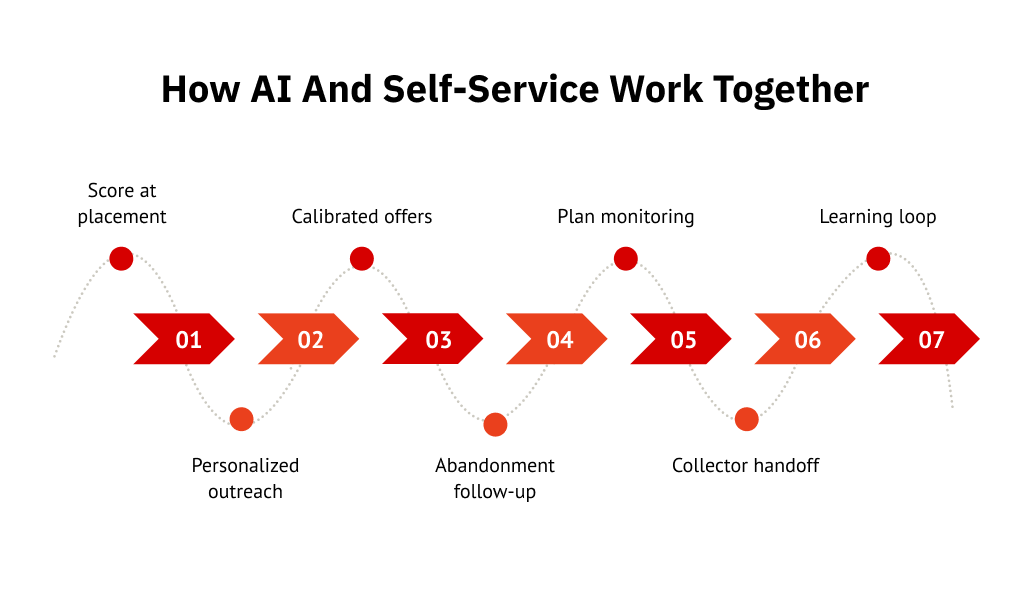
The real value appears when both tools run from shared account data. These seven steps follow one account through a combined recovery flow.
- Score at placement: The AI ranks the account by likelihood to pay and likelihood to resolve without contact.
- Personalized outreach: The customer receives a message with a portal link on their preferred channel. Under Regulation F, every collection email and text must include a clear opt-out.
- Calibrated offers: The portal shows plan or settlement options matched to the account, within limits the creditor approves.
- Abandonment follow-up: If the customer leaves without paying, a follow-up message goes out on a different channel or at a different time.
- Plan monitoring: A failed payment triggers outreach before the plan breaks down.
- Collector handoff: Dispute or hardship language pauses automation and routes the account to a trained collector.
- Learning loop: Each outcome feeds back into scoring, so the next account benefits from what this one taught the model.
Providers that manage AI-driven outreach and compliance across channels can run this entire flow from one set of account data. When the same provider handles first-party and third-party stages, the account history carries across without a handoff gap.
How to score portal and AI platform vendors
Use the scorecard below when evaluating debt collection software vendors. Each row pairs a question with the evidence you should request before signing.
| Criterion | Question to ask | Evidence to request |
| Outreach and decisioning | How are channel, timing, and offer chosen per account? Do portal events change the next step? | Live demo of one account’s 30-day contact path |
| Portal and payment experience | How do customers reach the portal? What happens when they leave without paying or miss a plan payment? | Mobile walkthrough from text link to completed plan, plus follow-up rules |
| Integration and data sync | Do payments, plans, disputes, and portal activity sync both ways with your system of record? Who owns the data at exit? | Integration documentation, sample data export, and written exit terms |
| Compliance and auditability | How are Regulation F limits and opt-outs applied across all channels? | Sample audit log for one account, with consent and opt-out records |
| Escalation and exceptions | How are disputes and hardship cases routed to people? | Escalation workflow and the collector’s handoff screen |
| Total cost and implementation | What does setup require from your team? Which fees sit outside the quoted price? | Implementation plan, full fee schedule, and results from similar portfolios |
| Pro tip: Score vendors only on evidence you have seen. If a criterion has no demo or document behind it, score it a zero. |
How to measure the portal-to-payment funnel
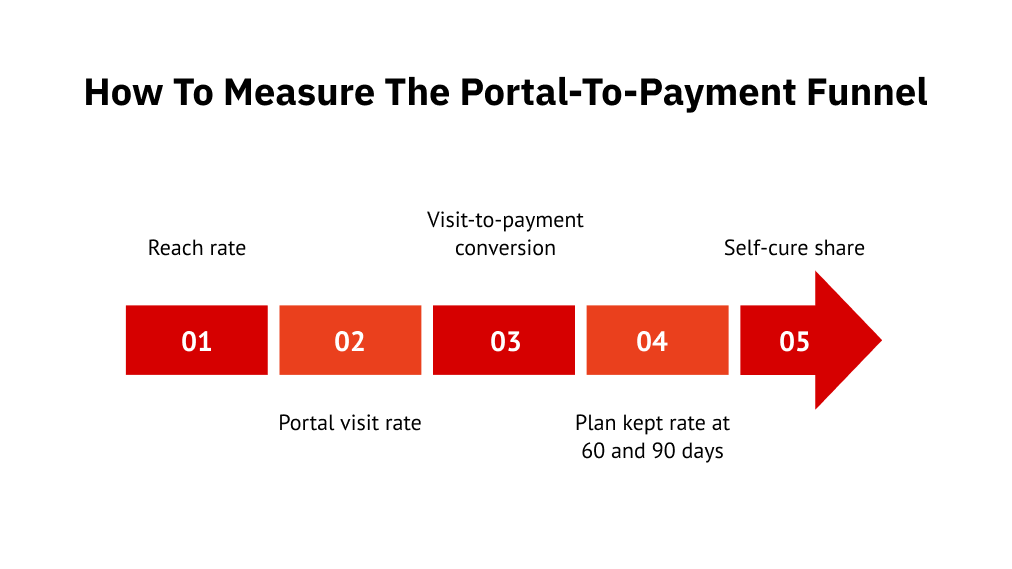
Track these five metrics as one connected funnel. The step with the biggest drop shows which tool needs attention.
- Reach rate: Messages delivered ÷ messages sent.
- Portal visit rate: Portal visits ÷ messages delivered. Shows whether outreach creates traffic.
- Visit-to-payment conversion: Paying sessions ÷ portal visits. Shows whether offers match the account.
- Plan kept rate at 60 and 90 days: Plans still active ÷ plans created.
- Self-cure share: Accounts resolved without an agent ÷ total accounts resolved.
Combine these metrics into one dashboard. Separate portal and outreach reports hide the weakest step.
Common mistakes when adding a portal or an AI platform
Avoid these four rollout errors that hold back recovery results.
- Leaving old notices unchanged: Letters and scripts that still say “call us” steer customers away from the portal.
- Leaving collectors out of the rollout: Agents should send portal links during calls so customers can pay right away.
- Sending text links to a desktop-first portal: Customers who tap a link in a text land on a phone screen. A portal built for desktop loses them at the first step.
- Running overlapping tools: Adding an AI platform with its own portal while keeping the old one splits account data and confuses customers.
A clear debt collection strategy accounts for these risks before launch.
Turn customer engagement into completed payments
The real test comes after a customer clicks: can they resolve the balance and maintain the payment arrangement?
Choose your model around where accounts stall. Address outreach when engagement is weak, payment friction when customers abandon the portal, or shared data when both need attention.
Then ask vendors for results on comparable accounts. Measure completed payments and kept arrangements, while tracking self-cure separately.
Talk to our experts about the right recovery setup for your portfolio.
FAQs
1. Should our debtor portal require a login or use a one-time secure link?
A one-time secure link with a light identity check, such as date of birth, keeps access simple and data protected. Full logins suit customers on long payment plans. Either way, confirm identity before showing account details.
2. Do debtor portals need to meet accessibility standards?
Government creditors typically must meet Web Content Accessibility Guidelines (WCAG) 2.1 Level AA under the ADA Title II rule. Compliance deadlines vary by entity size. For private creditors, WCAG 2.1 Level AA is the widely adopted benchmark.
Under Regulation E, recurring electronic debits require written or electronic authorization from the consumer. Your portal must capture that consent and provide the consumer a copy before the first debit.
4. What happens to a portal payment plan when an account moves to a third-party agency?
The agency is a debt collector under Regulation F and must issue its own validation notice. Unless the creditor and agency share account data, the customer may need to set up a new plan. One provider for both stages avoids this gap.
5. Can healthcare providers use AI outreach and debtor portals for patient balances?
Yes, with safeguards. A vendor handling patient data is typically a HIPAA business associate, so sign a business associate agreement first. Messages and portal screens should share only the minimum health information needed to collect.
6. Should we offer our debtor portal in Spanish or other languages?
It can widen your reach. Regulation F allows debt collectors to send translated validation notices alongside an English version. If a consumer requests a Spanish notice, the collector must provide a complete and accurate translation.