

Every aging report doubles as a forecast of next quarter’s write-offs. The accounts sliding from 60 days toward 90 are the likeliest to land there. Well-built debt collection strategies decide whether that forecast comes true by changing how and when those accounts get worked.
Fortunately, structure solves most of this problem without adding headcount. Segmenting accounts, matching outreach to each stage, and setting escalation points create a repeatable recovery system.
This guide covers the framework behind effective debt collection strategies. It moves from segmentation and outreach to escalation and the metrics that prove results. To begin, consider what a debt collection strategy includes.
What is a debt collection strategy?
A debt collection strategy is the structured process a business follows to recover overdue payments. It defines which accounts to prioritize and how and when to contact them. It also sets the payment options to offer and when to escalate beyond internal efforts.
Effective recovery requires a balance across four priorities:
- Recovery performance: The share of each overdue balance your team brings back.
- Regulatory compliance: Adherence to the laws and contract terms that govern each client account.
- Operational efficiency: The cost and staff time behind every dollar recovered.
- Client relationships: The goodwill that keeps a client buying after the balance is resolved.
Moreover, these priorities shift as account volumes, delinquency patterns, and communication expectations change. For that reason, modern debt collection strategies adapt to each account’s risk, stage, and likelihood of resolution. The right recovery model can also vary by account, with businesses using first-party and third-party collections to support different recovery needs.
A simple comparison makes the distinction clear. Sending a reminder is a tactic; deciding which accounts get reminders, calls, or escalation, and when, is the strategy.
In turn, that strategic layer shapes the outcomes that matter most to your business.
Why a deliberate strategy matters more than ad hoc follow-up
A collection strategy shapes three outcomes: cash flow, bad-debt write-offs, and ongoing client relationships.
- Cash flow: Without priority logic, staff time gets spread evenly across accounts with different recovery odds. In effect, the accounts most likely to pay wait in the same queue as the rest.
- Write-offs: Recovery odds drop as accounts age. Over time, unworked accounts pass the point where recovery is realistic, and the balance becomes a write-off.
- Client relationships: Poorly timed or aggressive outreach strains the relationship. By contrast, a structured approach adjusts tone and channel to each account’s stage.
Ultimately, the common thread is timing. Businesses without defined debt recovery strategies often notice the gap only after collection rates decline.
Catching it earlier depends on a framework built around three operating decisions.
The core framework for a debt collection strategy
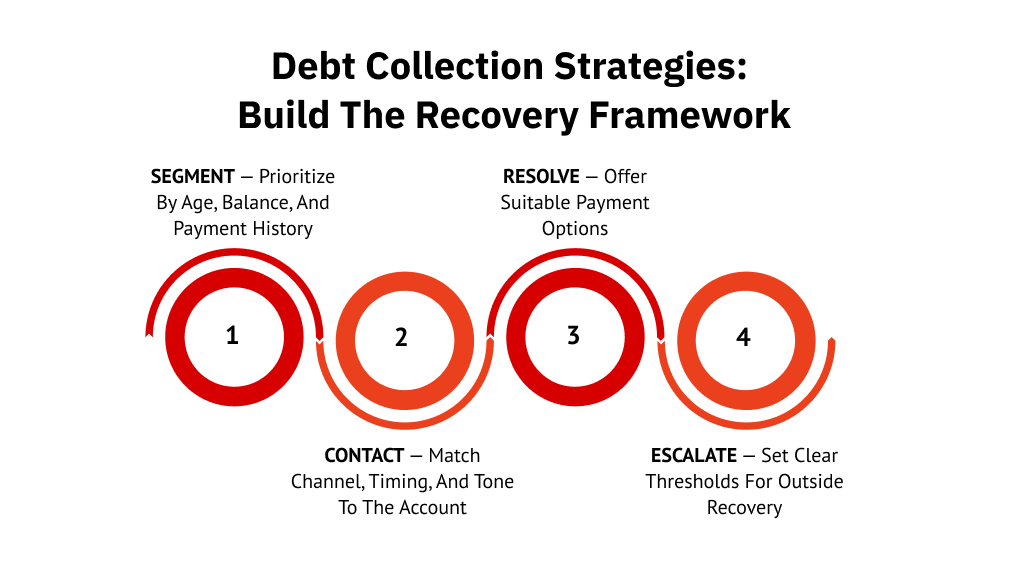
A working debt collection strategy rests on three operating decisions. Your team must decide who to prioritize, how to reach them, and what to offer. Each decision shapes recovery outcomes on its own. Together, they form the system that most debt collection best practices build on.
Start with segmentation, which determines how you prioritize accounts and apply the right recovery approach.
Segmenting accounts by risk, balance, and relationship value
Without segmentation, every account gets the same outreach at the same cadence, regardless of how likely it is to pay. Four criteria typically drive segmentation:
- Account age: Days past due are one of the clearest signals of recovery likelihood. Accounts at 1-30 days respond to lighter outreach, while those past 90 days need direct contact or escalation.
- Balance size: Higher balances justify more resource-intensive outreach. Accordingly, a $500 balance and a $50,000 balance should follow different recovery paths.
- Payment history: A client with two years of on-time payments and one missed invoice needs a lighter approach. On the other hand, a client with repeated late payments needs closer follow-up.
- Relationship value: Some accounts carry long-term revenue beyond the overdue balance. Segmentation should weigh the cost of losing that relationship against the cost of a write-off.
Blended, one-size-fits-all outreach underperforms segmented outreach at scale because it ignores these differences. Specifically, it spends equal effort on a low-balance, low-likelihood account and a high-balance, high-likelihood one.
| Pro tip: Track recovery rate by account age band instead of one blended number. A declining trend usually shows up in the 60-90 day band weeks before it appears in total recovery volume. |
After segmentation, the focus shifts to how your team reaches each group.
Matching channel, timing, and tone to the account
Channel, timing, and tone should all shift based on where an account sits in the recovery lifecycle.
- 1-30 days past due: These accounts usually respond to lighter digital outreach. An email reminder or text with a payment link often resolves the balance before a call is needed.
- 30-60 days past due: The mix typically combines email with a direct phone call.
- 60-90+ days past due: These accounts need personal contact, structured follow-up, and clear communication about next steps.
Similarly, tone shifts alongside the channel. For example, a pre-due reminder reads differently than a 90-day escalation notice, even for the same account type. At the same time, early outreach works best as a courtesy, since oversight often causes the delay. As the account ages, later outreach should be clear and firm without turning aggressive.
An omnichannel debt collection approach blends digital and personal outreach into one coordinated sequence. That coordination helps recover the balance while protecting the business relationship.
Once contact is made, the offer determines whether the account resolves or stalls.
Structuring payment options and terms
Payment flexibility shapes how quickly an account resolves. Three options belong in most strategies:
- Payment plans: Splitting a balance into installments helps accounts where the full amount is a barrier.
- Partial payment acceptance: For aged accounts, accepting part of the balance can recover more than extended follow-up on the full amount.
- Self-service portals: Online access to view balances, choose a plan, and pay removes friction. As a result, straightforward accounts often resolve faster than they would through agent-driven outreach.
Negotiated settlement terms work best as a last resort for accounts where a plan or self-service has failed. Otherwise, offering settlement too early can train clients to wait for a discount.
Even with all three decisions working together, some accounts will outgrow what an internal team can resolve.
When in-house effort should escalate to an outside partner
Most businesses start by collecting internally and consider outsourcing invoice collection only when that effort stalls. Three signals typically mark that point:
- Account volume outpaces staff capacity: When overdue accounts grow faster than your team can work them, outreach becomes inconsistent. Follow-up intervals stretch, and accounts slip past the window where recovery is most likely.
- Recovery rates decline in the 60-90 day band: A drop in this band is usually the first sign of strain. Accounts age without adequate attention, and your team loses ground before late-stage escalation begins.
- No infrastructure for staged outreach: Without tools for sequenced, multichannel follow-up, every touchpoint becomes manual. Inevitably, that approach breaks down as volume scales.
Ideally, account recovery strategies define these signals in advance, so escalation happens on schedule.
When these signals appear, escalation follows one of two models. A first-party partner works accounts under your name while they remain in accounts receivable. A third-party agency takes over after write-off or placement. In other words, that handoff marks the line between receivables and collections.
Whichever model you choose, the numbers you track reveal whether escalation is paying off.
Metrics that prove a strategy is working and the mistakes that undermine them
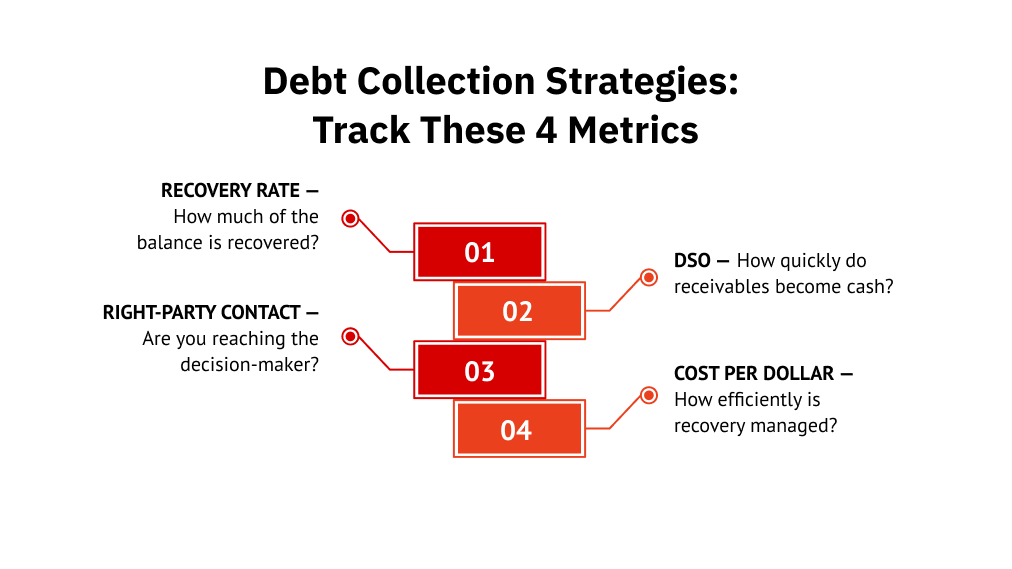
Measuring a debt collection strategy requires the right metrics at the right level of detail. Four metrics give the clearest picture of performance:
- Recovery rate against amount owed: This measures how much of the outstanding balance your team recovers. Notably, it is the most direct indicator of strategy effectiveness.
- Days Sales Outstanding (DSO): DSO measures the average number of days it takes to convert a receivable into cash. A rising DSO signals slower resolution, even when total recovery volume appears stable.
- Right-party contact rate: This tracks how often outreach reaches the intended decision-maker. Conversely, a low rate means effort lands on wrong numbers, outdated contacts, or unused channels.
- Cost per dollar collected: This shows how efficiently recovery resources are deployed. A high figure often points to excess effort on low-recovery accounts.
Beyond internal use, these metrics also form a scorecard when you set collection strategies for agencies handling your placed accounts.
At the same time, three common mistakes can undermine these metrics:
- Treating every account the same regardless of segment: Skipping segmentation distorts both recovery rate and cost per dollar collected.
- Optimizing for contact volume over resolution: High outreach volume looks productive on paper while resolution stays flat.
- Tracking one blended recovery number: A steady aggregate rate can mask a sharp decline in one age band.
| Did you know? According to the Credit Research Foundation’s National Summary of Domestic Trade Receivables 2026, surveyed businesses reported a 37.50-day median DSO. That Q2 figure fell from 40.12 days in the prior quarter. |
Avoiding these mistakes at scale often depends on how well technology supports the strategy.
Where technology and automation fit in
Automation dominates most conversations about effective debt collection strategies. Still, its value depends on where you apply it and which outcome it serves. Applied carelessly, automation makes a flawed strategy run faster. If segmentation is off, automated outreach reaches the wrong accounts more efficiently.
The first principle concerns where automation sits in your operation.
Keep automation at the strategy level
Automation delivers the most value in the decisions that shape outreach. The following operational changes deserve priority:
- Account prioritization: Automated scoring assigns each account a treatment path based on age, payment history, and past response. That way, every account enters the right workflow from day one.
- Channel consistency: Coordinated sequencing keeps email, text, and phone outreach aligned across your portfolio. Likewise, messaging stays consistent regardless of which channel carries it.
- Self-service routing: Accounts with low balances and prior digital engagement route directly to online payment portals. This frees agent capacity for accounts that need a conversation.
Well-applied automated debt collection handles prioritization and routing at scale, so your team can focus where judgment matters.
With automation in the right layer, its success still needs the right yardstick.
Focus automation on resolution outcomes
Activity metrics, such as messages sent and calls attempted, can increase without improving recovery outcomes. In contrast, resolution metrics such as right-party contact and payment arrangement rates show whether the strategy is actually working. Most importantly, avoid automation that increases contact volume without improving right-party contact or resolution.
Before adopting any automation, test it against three questions:
- Does it help you reach the right decision-maker sooner?
- Does it remove friction from the payment path?
- Does it flag accounts that need escalation before they age further?
If a tool fails all three, it likely adds noise to your operation.
FCS’ first-party collections use its proprietary Unified Customer Engagement Platform (UCEP) and report ROIs exceeding 600%. Agents work under your brand while the platform handles contact timing and channel choice.
When paired with sound segmentation and escalation rules, that balance turns a strategy into daily operations.
Putting your debt collection strategy into action
Structured debt collection strategies turn overdue receivables into recovered revenue while protecting the client relationships behind future growth.
To recap, the strongest approaches segment accounts, match channel and payment options to each stage, and define when to escalate. From there, they track results by account age band and apply automation where it improves resolution.
To evaluate your own approach, confirm it has segmentation, an escalation threshold, age-band tracking, and clear compliance ownership. Wherever one is missing, recovery is likely leaking at that point.
Building or reworking a debt collection strategy for your business? Reach out to FCS to map where your recovery process is losing ground.
FAQs
1. Who should own compliance within a business’s debt collection strategy?
Assign a named owner, usually in finance or legal, to oversee compliance at each account stage. That owner reviews outreach scripts and contract terms. When accounts move to an outside partner, the agreement should define which party handles each compliance task.
2. How often should a business revisit its debt collection strategy?
Review it at least once a year, and sooner if the recovery rate or DSO shifts noticeably. A strategy built for last year’s account mix may no longer fit the current portfolio. You should also revisit it when your business changes, such as when you start serving new client segments.
3. What changes operationally when a business moves from in-house collection to an outside partner?
Day-to-day outreach, reporting cadence, and contact infrastructure shift to the partner. Your business typically keeps strategic oversight and sets escalation rules. First-party agents work under your brand, while third-party outreach runs under the agency’s name, and the agency manages late-stage recovery.
4. How long does it take to see results from a new debt collection strategy?
Timelines vary with account volume and age mix. Typically, leading indicators such as right-party contact rate respond first, since outreach changes take effect right away. Recovery rate and DSO move more slowly, because they reflect accounts working through every age band.
5. Does adopting a new debt collection strategy require replacing existing billing or CRM systems?
A new strategy rarely requires a platform change. Segmentation, escalation rules, and outreach sequences usually run within your existing billing and CRM systems. For example, outsourced services can integrate with existing systems. What changes is how accounts are prioritized, contacted, and escalated.
6. What is early intervention in a debt collection strategy?
Early intervention is first-party outreach that resolves overdue accounts early in delinquency. It usually covers accounts 1 to 90 days past due. Timely reminders and payment options help clients settle balances before escalation. Throughout this stage, the original creditor keeps the client relationship.