


A missed payment creates a critical window before delinquency becomes harder to manage and recovery options begin to narrow.
An early-stage collections agency helps creditors act during that window with structured outreach and clear resolution pathways. Early intervention can improve contactability, reduce avoidable escalation, and protect customer relationships before accounts move further past due.
Maintaining early contact becomes harder as delinquent volumes rise, especially when outreach and payment discussions happen across separate teams. Bringing those activities into one workflow helps creditors maintain consistent follow-up and compliance controls.
For creditors evaluating this approach, the key question is how the model works in practice at scale. This guide explains early-stage recovery mechanics and the capabilities needed to support an effective strategy before charge-off.
What is an early-stage collections agency?
An early-stage collections agency supports creditors during initial delinquency, before accounts require late-stage recovery. The focus is pre-charge-off recovery, where creditors still have more flexibility to resolve past-due accounts.
Understanding early-stage collections and pre-charge-off recovery
Early-stage collections address accounts that have missed payments but have not yet reached charge-off. Recovery efforts aim to resolve delinquency while the account remains within the creditor’s active recovery process.
In many programs, this work aligns with first-party collections. The recovery partner may communicate under the creditor’s brand, where configured, using approved workflows and messaging.
Under this arrangement, the original creditor continues to own the account while the partner follows the agreed program design. Recovery can therefore remain within a first-party model before any third-party placement occurs.
As accounts progress through delinquency, late-stage collections may become appropriate for older or written-off balances. Clear stage definitions help teams determine when a different recovery model is needed.
| Recovery stage | Primary goal |
| Early-stage | Resolve delinquency before escalation |
| Late-stage | Recover aged or charged-off accounts |
When creditors typically use early-stage collections
Creditors often use early-stage recovery when missed payments create a growing follow-up burden. It can also help when internal teams cannot maintain consistent outreach across a large account volume.
However, growing backlogs do not determine the right starting point by themselves. Program timing also depends on creditor policy, account type, delinquency stage, and internal responsibilities.
Defined escalation criteria help teams decide when early-stage treatment should end and another recovery approach should begin.
How early-stage collections agencies recover delinquent accounts
Early-stage collections agencies recover delinquent accounts through structured account review, coordinated outreach, accessible payment options, and ongoing monitoring. The workflow helps creditors manage early delinquency before accounts require a different recovery approach.
Account review and outreach strategy
The process begins by identifying accounts that have entered delinquency and reviewing their current status. Creditors and recovery partners then apply agreed treatment rules based on account stage and program design.
Once account status is clear, timing becomes the next operational decision. Repeated contact without a plan can create friction, so workflows should specify channels, review points, and contact timing.
Those rules should also distinguish newly overdue accounts from accounts with prior outreach. Records should show completed actions and unresolved questions.
Each sequence should reflect documented account information rather than assumptions about how consumers will respond.
Omnichannel communication and self-service options
Once outreach begins, agencies may coordinate short message service (SMS), email, chat, and phone across one recovery workflow. Channel coordination reduces disconnected outreach because a digital response may change whether another contact attempt is appropriate.
Alongside these channels, self-service options give consumers a way to respond without waiting for a live conversation. Depending on program design, digital experiences may support balance review, payment access, callback scheduling, or chat initiation.
For creditors, the operational value comes from reducing friction while keeping outreach organized and measurable. Reporting can then show which accounts are engaging and which require another action.
Payment arrangements and resolution pathways
Outreach has greater operational value when consumers have clear ways to resolve the account. Depending on the program, options may include full payment, configured payment plans, or promise-to-pay arrangements.
Payment arrangements should follow the creditor’s approved terms and recovery strategy. Clear resolution pathways also help teams distinguish active engagement from accounts that need further review.
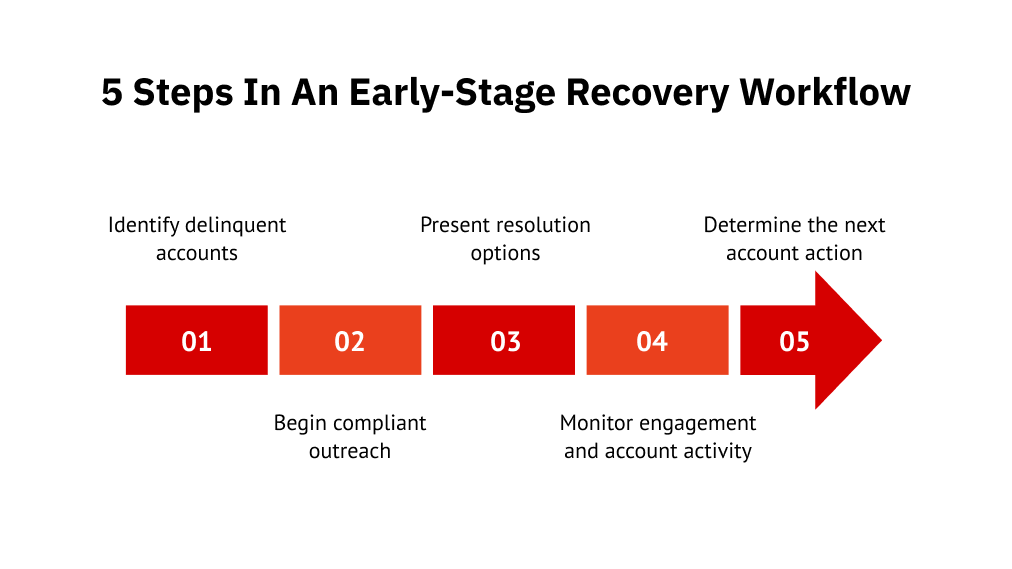
A practical early-stage workflow can follow five steps:
- Identify delinquent accounts.
- Begin compliant outreach.
- Present available resolution options.
- Monitor engagement and account activity.
- Determine the next account action.
Ongoing monitoring connects outreach results with the next account treatment decision. A response, payment commitment, completed payment, or continued nonresponse can change the next operational step.
Creditors therefore gain a clearer view of account movement and where further intervention remains necessary.
Why early intervention matters in recovery strategy
Early intervention gives creditors more options before delinquent accounts move into complex recovery stages. It also preserves more time to apply structured outreach before account treatment becomes more constrained.
As balances age, accounts may require different workflows, stronger escalation rules, or a late-stage recovery model. Early action gives teams more room to pursue resolution while maintaining communication continuity.
Early contact can also support customer relationships when clear payment choices remain available. Yet growing account volumes can expose missed follow-ups and unclear ownership.
Compliance requirements further complicate outreach across channels. If initial contact fails, teams need enough visibility to reassess their approach before moving an account forward.
A structured early-stage program can help recovery teams:
- establish consistent contact timing;
- preserve defined resolution pathways;
- identify follow-up gaps earlier; and
- maintain clearer ownership of active accounts.
Tracking missed contacts and unresolved commitments helps managers identify which workflows need adjustment. With that visibility, they can act before more accounts require late-stage treatment.
Early-stage collections vs third-party collections: understanding the difference
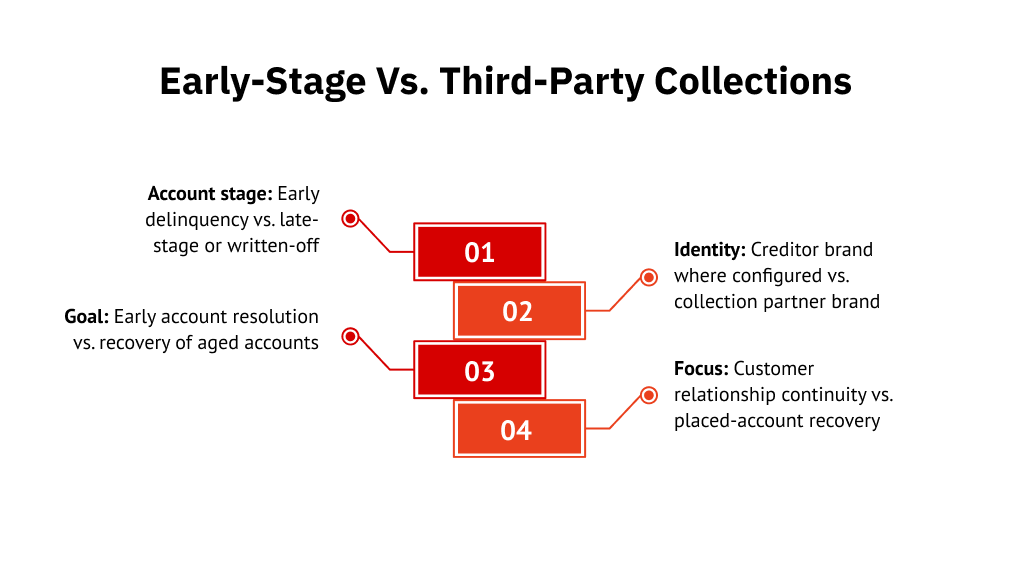
Early-stage and third-party collections support different points in the recovery lifecycle. Early-stage work usually focuses on pre-charge-off accounts, while third-party collections address late-stage or written-off accounts.
The distinction affects branding, communication, escalation, and recovery activity. In both models, the creditor retains ownership of the account.
| Area | Early-stage collections | Third-party collections |
| Account stage | Early delinquency or pre-charge-off | Late-stage or written-off accounts |
| Consumer-facing identity | Creditor brand where configured | Collection partner brand |
| Primary objective | Early account resolution | Recovery of aged accounts |
| Relationship focus | Customer relationship continuity | Recovery of placed accounts |
How account stage changes the operating model
Early-stage programs often use a first-party model when creditors want to maintain branded communications. Where configured, partners follow approved messaging and treatment rules under the creditor’s identity.
By contrast, third-party collections involve contact under the collection partner’s name during late recovery stages. This changes the customer-facing identity, while account stage influences recovery priorities.
As an account ages, the operating model may require different escalation rules, staffing, and recovery priorities. Creditors need clear criteria for deciding when an account should move between stages.
Stage-transition criteria should reflect delinquency status, prior outreach, internal policy, and the creditor’s recovery strategy. A consistent handoff process can also reduce gaps when responsibility shifts between teams or partners.
| Creditor Tip Evaluate recovery needs by account stage instead of applying one approach across the full portfolio. Different stages can require different communication models, workflows, and engagement strategies. |
Taken together, those criteria help creditors choose an appropriate model without losing continuity at handoff. Third-party collections remain a distinct option for late-stage accounts.
What creditors should evaluate in an early-stage collections agency
Creditors should evaluate whether an early-stage collections agency can execute reliably, support applicable compliance requirements, and operate at scale. The strongest fit depends on governance, technology, reporting, implementation, and alignment with the portfolio.
Compliance and governance capabilities
Compliance review should begin with the rules that apply to the program and the parties performing the work. Relevant requirements may include the Fair Debt Collection Practices Act (FDCPA) and Regulation F.
Once the applicable obligations are clear, evaluate how a provider applies them to daily operations. Training, monitoring, audits, and escalation procedures should reflect the requirements of each program.
Governance defines who owns decisions, exceptions, and program changes. Clear accountability helps teams respond when workflows create compliance concerns or require adjustment.
A provider’s debt collection compliance framework should therefore be evaluated alongside its operational processes and oversight model.
Technology, reporting, and operational visibility
Technology should support coordinated recovery workflows instead of operating as disconnected tools. Teams need visibility into outreach activity, consumer responses, payments, and changing account status.
Reporting should support operating decisions and reflect available data, portfolio needs, and program design. Data movement can become an implementation constraint when transfer requirements are unclear.
Depending on the environment, information may move through an application programming interface (API) or secure file transfer protocol (SFTP). Direct customer relationship management (CRM) synchronization may also support data movement, depending on the onboarding design.
Whatever method is selected, teams need clarity on how data enters the program and returns internally. That flow should also support meaningful reporting and oversight.
More data adds little value when teams cannot connect reporting to account treatment decisions.
Implementation and portfolio fit
A capable provider can still be a poor fit when the operating model does not match the portfolio. Account volume, internal resources, recovery objectives, and escalation rules should shape program design.
Once portfolio needs are clear, agree on data transfer, messaging, staffing, reporting, escalation, and approvals before launch.
| Implementation Tip Define ownership, escalation points, reporting expectations, and communication workflows before launch. Clear responsibilities reduce ambiguity once live recovery activity begins. |
An early-stage recovery evaluation should cover five areas:
- compliance framework;
- communication channels;
- reporting approach;
- integration requirements; and
- recovery experience.
Together, the five criteria reveal whether a provider can support the required operating model beyond its service descriptions.
A well-matched operating model can remain consistent as account volume, treatment rules, and reporting needs change after launch.
How First Credit Services operates early-stage recovery programs for creditors
High delinquent-account volumes can strain internal teams when outreach, reporting, follow-up, and compliance controls must remain coordinated. At First Credit Services, we address those coordination demands through a managed recovery model.
We bring trained teams, technology, structured workflows, and compliance expertise into one managed recovery process. We manage recovery operations on the client’s behalf and align execution with the agreed program design.
Our teams coordinate outreach and monitor account activity as recovery needs change. That continuity becomes especially relevant when failed payments recur across multiple locations.
One health and fitness client faced 500-700 failed payments per club each month, creating a substantial recurring recovery workload. Through a 60-day failed-payment management program, we used coordinated phone and email follow-up.
The program helped recover and retain up to 70% of monthly failed payments. This represented approximately $6,000 in recovered revenue and 400 members per club monthly.
This model fits creditors managing significant early-stage volumes that need coordinated execution, reporting, and program oversight.
A managed-service model built around creditor workflows
We design early-stage programs around account flow, communication, reporting, and escalation. That structure aligns daily activity with each client’s recovery strategy and internal responsibilities.
To support those workflows, we operate our Unified Consumer Engagement Platform (UCEP) across SMS, email, chat, and phone. We also manage outreach strategy, sequencing, reporting, and ongoing program adjustments.
Managed execution can reduce internal coordination demands while preserving creditor oversight of recovery strategy. Reporting gives both teams a shared view of program activity and emerging execution needs. Regular program oversight helps us adjust execution as portfolio requirements change.
Building an early-stage recovery approach that fits your portfolio
Creditors should build early-stage recovery around the portfolio’s delinquency patterns, internal capacity, communication needs, and operational goals. The approach should reflect how accounts move through recovery and where additional support is needed.
Start by defining when an account enters delinquency and when structured outreach should begin. That schedule must also match available staffing and expected account volume.
Once capacity is clear, select appropriate channels for customer engagement. A coordinated omnichannel debt collection approach can align phone, email, SMS, and digital outreach.
Responses and account status then determine whether the original treatment remains appropriate. Define thresholds for changing workflows or moving an account into another recovery stage.
Reporting should show whether those decisions produce account movement and where balances remain unresolved. Managers can then review engagement and adjust capacity before queues grow.
| Question | Why it matters |
| Where does delinquency begin? | Determines intervention timing |
| Which channels support engagement? | Shapes communication strategy |
| What reporting is required? | Defines operational visibility |
The final program design should balance recovery goals with staffing, account volume, and governance. Portfolio fit depends on matching resources with intervention timing, communication, escalation, and reporting.
Strengthening recovery before accounts escalate
Early-stage recovery becomes more effective when creditors act before delinquency creates operational strain. The right approach should match portfolio needs with execution capacity.
Maintaining that timing advantage becomes harder as delinquent account volumes grow. Before engaging a recovery partner, identify where internal follow-up breaks down and which activities need support.
Use that assessment to assign ownership, set reporting expectations, and define escalation responsibilities. Those decisions help preserve continuity as account volumes and recovery needs change.
Ready to strengthen early-stage recovery without adding unnecessary internal complexity? Talk with First Credit Services about your early-stage recovery needs to evaluate a managed approach for your portfolio and resources.
FAQs
1. Can an early-stage collections agency work alongside an internal collections team?
Yes. Many creditors split recovery responsibilities by account segment, balance tier, or delinquency stage. Clear ownership rules and defined handoff criteria help both teams avoid duplicated outreach or missed follow-up across the shared portfolio.
2. What metrics should creditors track for early-stage collection performance?
Useful measures include cure rate, roll rate, contact rate, promise-to-pay conversion, payment completion rate, and progression into late-stage recovery. Together, these indicators show whether early-stage outreach is resolving accounts or allowing them to age further.
3. How much does an early-stage collections agency cost?
Pricing typically depends on program scope, account volume, channel mix, staffing requirements, and reporting needs. Depending on the program, digital-only first-party recovery may use contingency pricing, while live-agent services can follow a per-seat model. Creditors should evaluate total program value alongside the fee arrangement.
4. Does the FDCPA apply to early-stage collections programs?
It depends on who performs collections and the nature of the arrangement. An agency collecting another creditor’s debts may fall under the FDCPA, even when using the creditor’s brand. Other federal and state laws may also apply.
5. Does placing accounts with an early-stage agency affect credit bureau reporting?
In most cases, early-stage recovery activity does not trigger credit bureau reporting on its own. Reporting practices typically depend on creditor policy, account status, and the terms defined in the program agreement. Creditors should confirm reporting expectations before launch.
6. How long does it typically take to launch an early-stage collections program?
Timelines vary by program complexity. Programs that require custom messaging, agent training, data integration, and reporting setup typically take 30 to 60 days. Simpler placements with less integration can launch faster, depending on approval processes and data readiness.