


When does an aging patient or payer balance stop being routine follow-up and start needing medical receivables management instead?
Knowing when to make that shift comes down to aging. HFMA’s MAP Keys framework tracks receivables across five buckets, from 0-30 days to past 120. A growing 90-plus bucket signals stalled escalation, and every week of delay narrows the payment window further.
This guide breaks down what medical receivables management covers, how it differs from routine AR management, and how first-party, third-party, and EBO recovery connect. It also covers what to check before an account moves to a medical receivables collection agency.
What is medical receivables management?
Medical receivables management refers to the recovery work that healthcare organizations perform once a balance moves beyond normal front-end billing. It differs from medical accounts receivable management, which handles claims and balances while they’re still fresh and worked internally.
The difference is significant for budgeting and staffing. Typically, medical accounts receivable management sits with the billing office. Once internal follow-up has run its course, recovery work, also called healthcare receivables management, kicks in.
Three layers make up that recovery work:
- First-party outreach: The account stays under your organization’s own name during early-stage delinquency.
- Third-party recovery: Once internal effort is exhausted, a partner works the account under its own name.
- Extended business office (EBO) support: Payer-side follow-up runs alongside patient recovery, chasing denials and unpaid claims.
Compliance follows this same structure. The Health Insurance Portability and Accountability Act (HIPAA) governs how protected health information (PHI) can be used at every stage of recovery, no matter which layer an account sits in.
Each layer carries its own rules, timing, and cost structure. The rest of this guide walks through how they connect and when to move an account from one to the next.
| Did you know? HIPAA’s minimum necessary standard limits protected health information used in payment-related recovery work to only what that purpose requires. |
Medical receivables management vs. medical billing and revenue cycle management
These terms get used interchangeably, and as a result, the habit causes real confusion about who should be working an account at any given moment.
In practice, medical billing creates the receivable. Coding a visit and submitting a clean claim turns clinical work into a dollar amount owed. From there, medical accounts receivable management, the routine AR follow-up stage, involves balancing while it’s still fresh, chasing slow payers, and following up on unpaid claims before they age.
Medical receivables management recovers the balance once it has aged past that early follow-up. Revenue cycle management (RCM) is the umbrella term covering the entire financial process, from patient registration through final payment.
This recovery-focused piece sits inside that larger process. It becomes relevant once early follow-up has run its course and healthcare accounts receivable recovery is actually needed.
| Stage | Function | What It Does |
| Medical billing | Creates the receivable | Codes the visit and submits a clean claim |
| AR follow-up | Works the balance early | Chases slow payers before the balance ages |
| Medical receivables management | Recovers the aged balance | Escalates through first-party, third-party, or EBO channels |
The accounts receivable versus collections distinction matters here too, particularly when understanding the early AR follow-up process covered in healthcare accounts receivable management.
Collections begins after a write-off, once the balance has been formally moved off the books as bad debt. These are separate stages, with separate rules, budgets, and often separate teams inside the same organization.
The escalation stack: first-party, third-party, and EBO recovery
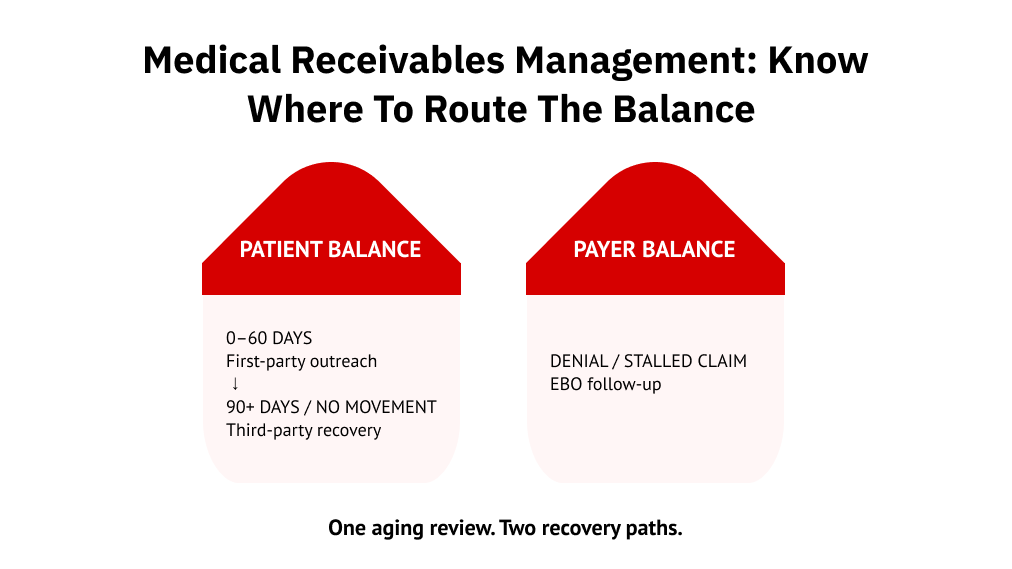
Medical receivables management works as a stack rather than a single approach. Which layer applies depends on where the account currently sits. Is it still under your name, or has it moved to a partner working it under a separate one? The rules that apply change along with it.
The aging buckets covered earlier decide where an account sits in the stack. A balance in the 0-30 or 31-60 bucket usually stays in first-party outreach. Once it drifts past 90 days with no movement, it becomes a candidate for third-party escalation.
Start with the layer closest to the patient relationship.
1. First-party (early-out)
First-party recovery keeps the account under your organization’s own name during the early window of delinquency. The goal is resolution before the balance ever needs to move to a third party.
Original creditors collecting their own accounts generally fall outside the Fair Debt Collection Practices Act (FDCPA), which was written to govern third-party debt collectors. That gives your team more flexibility in tone and timing during this window, within your own compliance policies.
First-party collections programs typically run scripted outreach sequences, patient-friendly payment plans, and self-service portals before an account ever reaches escalation.
When first-party effort does not resolve the balance, the account escalates to the next layer of the stack.
2. Third-party recovery
Third-party recovery begins once internal effort is exhausted. At this point, the account moves to a medical receivables collection agency, and the partner works it under its own name.
This shift changes the rules that apply. The FDCPA, Regulation F, and state-level collection laws all apply directly once an account reaches this stage. This is what industry professionals mean by third-party collections.
Third-party collections partners are built for this regulatory environment. Compliance is their core function, rather than a secondary task layered onto billing work.
The patient side is only half of the balance. The payer side needs its own track.
3. EBO and payer-side follow-up
EBO support runs in parallel with patient recovery, aimed at the payer side of the same aging balance. It covers insurance claim follow-up, denial management, and payment monitoring on claims that have stalled with a payer.
Organizations that manage medical AR recovery in-house often catch the payer side late. Patient balances get worked on a schedule, while payer follow-up waits until someone notices a claim has gone quiet.
Extended business office support treats both sides of the balance as a single aging review. A stalled claim gets flagged at the same point a slow-paying patient account would.
On the healthcare side, First Credit Services structures recovery this same way. First-party outreach and EBO-driven payer follow-up handle the earlier stages, with third-party recovery brought in for accounts that need to move further along the stack.
| Pro tip: Build payer follow-up into the same aging review as patient balances. Don’t let EBO run as a separate workflow that only gets attention once a claim is already old. |
How to measure medical receivables management performance
A recovery program only proves itself through what it measures.
Here are the five metrics to track:
- Days in AR: The average number of days a balance stays outstanding. The American Academy of Family Physicians (AAFP) sets the floor below 50 days, with 30 to 40 preferable.
- Net collection rate: The percentage of collectible revenue you actually collect. AAFP sets the floor at 95%, with top performers reaching 99% or higher.
- AR aging distribution: The share of receivables sitting in each aging bucket. HFMA’s MAP Keys framework tracks this across five buckets, and a growing 91-120 or 120-plus bucket means accounts are not escalating fast enough.
- Denial rate: The percentage of claims denied on first submission. AAFP cites 5% to 10% as the industry average, with anything under 5% considered desirable. A rate above 10% usually means front-end issues are feeding your receivables pipeline with claims that should not be there.
- Clean claim rate: The percentage of claims accepted without manual intervention. HFMA defines this metric but does not publish a universal benchmark, since it varies by specialty and payer mix. Track it internally and watch the trend.
| Did you know? AAFP’s benchmark puts the adjusted collection rate floor at 95%, with high performers reaching 99% or above. |
Watch these together rather than in isolation, since a healthy days-in-AR number can mask a growing 120-plus bucket sitting underneath it.
Numbers alone won’t catch every problem, though; some of the biggest leaks come from execution habits the metrics don’t show until it’s too late.
Common mistakes in medical receivables management
The same execution mistakes tend to show up across most receivables programs, and they compound over time.
Here’s the list to check your own process against:
- Working accounts by arrival order: A handful of large, aging balances near an appeal deadline outweigh a stack of small, recent ones. Sort by dollar value and age together, rather than by the order accounts land on a desk.
- Staying phone-only: Patients respond through text, email, and self-service portals as often as they respond to calls. An omnichannel outreach approach coordinates all of them instead of relying on one channel.
- Skipping a written escalation policy: Without one, accounts get a single attempt and then sit untouched instead of moving forward on schedule.
- Blurring AR follow-up and recovery: Treating medical accounts receivable management and recovery work as the same activity hides the point where a balance should have already escalated.
- Writing off small balances by default: They look negligible individually, but they add up, and they are often the easiest accounts to resolve through automated outreach.
- Missing timely filing deadlines: Every payer sets a window for claim submission and appeals, typically 90 to 180 days. An account that ages past that window becomes impossible to collect, turning a recoverable balance into a permanent write-off.
Most of these mistakes are process gaps rather than compliance failures, but the two categories don’t stay separate for long.
A missed deadline or an untracked escalation policy can just as easily turn into a documentation problem, which is exactly where the next section picks up.
What a compliant medical receivables program must and must not include
Compliance is not optional at any stage of the stack, and the rules tighten considerably once an account reaches third-party recovery. This applies whether recovery is handled in-house or through a medical receivables collection agency handling healthcare debt collection on your behalf.
Four rules define the boundary between a compliant program and one carrying real risk:
- Permitted channels: The CFPB permits phone, mail, email, text, and other approved channels for third-party collection activity under Regulation F, provided outreach stays within federal and state requirements.
- Contact frequency: 12 CFR § 1006.14(b) caps outreach at seven calls in seven consecutive days about the same debt and blocks a follow-up call within seven days of an actual conversation about it.
- Accurate representation: 15 U.S.C. § 1692e prohibits misrepresenting the amount owed or overstating what nonpayment leads to, regardless of channel.
- PHI handling: Any PHI used in recovery work must stay within HIPAA’s minimum necessary standard, limited to what the specific recovery step requires.
Laid out side by side, here’s how permitted and prohibited practices compare:
| Permitted | Prohibited |
| Contacting a patient by phone, mail, email, or text | Contacting a patient more than seven times in seven consecutive days about a single debt |
| Sending payment reminders through approved digital channels | Calling within seven days of an actual conversation about the same debt |
| Disclosing the accurate amount owed | Misrepresenting the amount owed or the debt’s status |
| Describing the actual consequences of nonpayment | Overstating what nonpayment leads to |
| Using PHI limited to what a payment-related purpose requires | Using more PHI than the specific recovery purpose requires |
| Working an account under HIPAA’s minimum necessary standard | Sharing PHI beyond what a given recovery step needs |
FCS builds these controls into the placement workflow by default, with documentation to show for each one, well before a client ever has to ask.
Meeting these standards has a cost, and that cost shows up differently depending on how a partner structures its pricing.
How medical receivables management is typically priced
Pricing shifts with where an account sits on the escalation stack, how old it is, and whether payer-side follow-up is bundled into the arrangement.
Contingency pricing ties payment to results.
Contingency fee
Payment is a percentage of what is actually recovered. The rate moves with account age, balance size, volume, and stack position, since early first-party work and older third-party placements carry different economics.
Flat pricing works differently.
Flat fee per account
A flat fee sets a cost per account placed, regardless of outcome. It tends to fit high volumes of smaller balances better than a handful of large accounts.
Some organizations split the difference.
Hybrid/retainer
A fixed monthly cost covers EBO or payer-side work, while patient balances run on contingency separately. This fits organizations that want one partner handling both sides of the balance, with predictable costs on the payer-follow-up half. This is similar to how patient financial services outsourcing arrangements are typically structured.
How to evaluate a medical receivables management partner
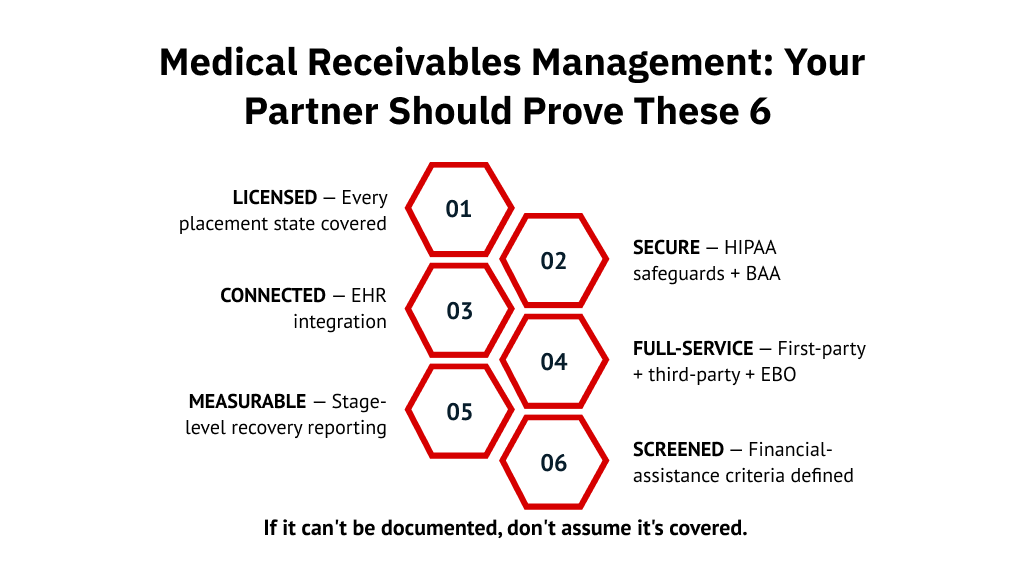
A partner should be able to answer these questions before you sign anything, not after.
Here’s what to confirm during procurement:
- Confirm licensing in every state where accounts will actually be placed.
- Request HIPAA safeguards in writing, plus a signed Business Associate Agreement (BAA).
- Confirm coverage across first-party, third-party, and EBO recovery. A partner limited to one layer cannot cover the full stack.
- Confirm integration with your electronic health record (EHR) or practice-management system, whether that is Epic, Athenahealth, or Cerner.
- Ask for recovery and complaint rates broken out by placement stage, not one blended number.
- Confirm how financial-assistance screening and exclusion criteria work before any accounts go out.
These are reasonable questions for any medical receivables collection agency to answer during procurement.
FCS applies the same standard to its own hospital collections services, answering them at the RFP stage rather than after signing.
The bottom line on medical receivables management
Medical receivables management works when you know what belongs at each stage of the stack. First-party outreach, third-party recovery, and EBO follow-up each carry a different compliance requirement and a different case for use.
The real test of a medical receivables management program is whether a partner can back up that claim with real documentation. Confirm that before any account moves, and you protect both the balance and the patient relationship behind it.
Want a clearer view of where your organization’s aged receivables stand? Explore how FCS can review your aging report and map out how first-party, third-party, and EBO recovery would apply.
FAQs
1. What HIPAA requirements apply to medical receivables management?
Medical receivables management involves protected health information (PHI), so partners need appropriate HIPAA safeguards in place. This includes secure PHI handling, controlled access, and a signed Business Associate Agreement where required. Before signing, confirm how a partner accesses, transmits, stores, and protects PHI throughout the entire recovery process.
2. What’s the difference between first-party and third-party medical receivables recovery?
First-party recovery stays under your organization’s own name during early-stage delinquency. Third-party recovery takes over once internal efforts are exhausted, with the partner working the account under its own name instead. This later stage is also called third-party collections, and different compliance rules apply once it starts.
3. Is outsourcing medical receivables management HIPAA compliant?
Yes. Outsourcing is HIPAA compliant when the partner is set up correctly as a business associate, with a signed BAA in place and PHI handled within HIPAA’s minimum necessary standard at every stage. Confirm both of these in writing before any accounts are placed with a partner.
4. When should an organization escalate an account beyond routine AR follow-up?
Escalation timing depends on account age, balance type, recovery history, and internal capacity. AR aging trends, tracked across the standard 0-30, 31-60, 61-90, 91-120, and 120-plus day buckets, help set a documented threshold for when accounts move into first-party, third-party, or EBO recovery.
5. Can medical receivables management recover payer-owed balances, not just patient balances?
Yes. EBO handles payer-owed balances specifically, working denials, insurance follow-up, and rebilling as part of broader healthcare revenue recovery. This work often runs through the same partner handling patient balances, keeping both sides of the aging balance on one coordinated review.
6. What should a healthcare organization look for in a receivables partner?
Look for real healthcare experience, coverage across first-party, third-party, and EBO recovery, documented HIPAA safeguards, state licensing, EHR integration, and reporting broken out by placement stage. A single blended recovery number hides which stage of the stack is actually underperforming.