


Patient-pay balances now carry more weight in healthcare revenue recovery. As deductibles rise, providers need clearer ways to help people understand and resolve what they owe.
The pressure is building fast. The KFF 2025 Employer Health Benefits Survey found that the average deductible for workers with single coverage and a general annual deductible reached $1,886. For revenue cycle teams, this means recovering more from individuals while managing compliance risk, limited staff capacity, and patient trust.
This is why healthcare debt collection has become a revenue cycle priority, not a back-office task. It gives providers a structured, compliant process for protecting cash flow without turning financial follow-up into a poor patient experience.
This guide explains how healthcare debt collection works, what makes it different, which compliance rules matter, and how to choose the right healthcare collections services partner.
What Is Healthcare Debt Collection?
Healthcare debt collection is the process of recovering unpaid patient balances for hospitals, physician practices, specialty groups, and other healthcare providers. It also covers outstanding receivables that remain unresolved after billing and insurance follow-up.
Because it sits within the broader revenue cycle, healthcare debt collection must balance recovery, patient experience, healthcare privacy rules, and consumer debt collection laws. In practice, this means it:
- Recovers balances after billing, insurance follow-up, and internal outreach
- Operates under HIPAA, FDCPA, Regulation F, FCRA, TCPA, and state medical debt laws
- Includes first-party, early-out, third-party, and bad debt models
- Uses phone, SMS, email, portals, chat, and payment plans
- Requires a patient-sensitive approach because the debt is often unexpected or disputed
What Makes Healthcare Collections Different?
Healthcare collections is not the same as credit card, auto, utility, or subscription collections. The balance may appear as a receivable in your AR report, but the experience behind it is deeply personal to the patient. These differences show up in the following three areas:
The Compliance Stack Is Doubled
Most collection verticals focus mainly on consumer debt rules. Healthcare collections adds Health Insurance Portability and Accountability Act (HIPAA).
That means a medical debt collection agency has to manage how it contacts the patient and what data it can access. It also has to control how protected health information is handled and whether a valid Business Associate Agreement is in place.
The U.S. Department of Health and Human Services states that disclosures to collection agencies are governed by HIPAA’s business associate and minimum necessary requirements. That rule affects data files, call scripts, agent permissions, portals, and audit trails.
Patients Are Not Typical Debtors
A patient with a $4,000 emergency room bill did not choose that debt like a borrower chooses a loan. The balance may involve insurance delays, surprise costs, confusing statements, charity care eligibility, or billing errors.
That is why tone matters. A harsh collection experience can damage patient trust, provider reputation, reviews, referrals, and future appointment behavior.
The best patient debt collection programs help patients understand the balance, see their options, ask questions, dispute errors, and resolve the account without feeling pushed into a corner.
Patient Financial Responsibility Keeps Rising
Higher deductibles, coinsurance, and out-of-pocket costs have shifted more payment responsibility to patients.
For providers, that means patient collections cannot be treated as an afterthought. If the patient-pay workflow is weak, cash flow suffers even when payer reimbursement is stable.
State Laws Are Rewriting The Rulebook
Medical debt reporting is changing fast. According to Experian’s joint credit bureau announcement, the three major credit bureaus have removed paid medical collections, collections under $500, and medical collections less than one year old from consumer credit reports.
States are also adding their own rules. New York, Colorado, Maryland, Oregon, Minnesota, and others now limit how medical debt can be reported, collected, or enforced. Since the federal CFPB rule was vacated in July 2025, providers need to closely track state-specific requirements.
| Did you know? In Maryland, the 2025 Fair Medical Debt Reporting Act restricts certain medical debt information from appearing in consumer reports. |
The Models: First-Party, Third-Party, Early Out, And Bad Debt
Healthcare debt collection is not one single handoff. Most providers need a staged model that matches outreach intensity to AR age, patient experience, and likelihood of recovery.
These are the main models providers use across the patient AR lifecycle.
First-Party Collections: Early-Out And EBO
First-party healthcare collections happens in the provider’s name. Patients still feel like they are interacting with the hospital, clinic, or practice.
This model is typically used in the late self-pay stage, often 30 to 120 days after discharge or final billing. It may also be called early-out collections or Extended Business Office support.
The goal is to resolve the balance before it becomes bad debt. At this stage, the outreach should feel helpful, not forceful.
A strong first-party workflow gives patients clear ways to act. It can include payment reminders, balance clarification, insurance question routing, financial assistance prompts, payment plans, digital payment links, callback scheduling, and dispute routing.
For providers managing this at scale, First Credit Services’ first-party collections can extend the internal revenue cycle team’s capabilities without disrupting the patient experience. Therefore, the outreach stays aligned with the provider’s brand, while internal teams gain the capacity to manage more accounts earlier.
Third-Party Collections: Bad Debt
Third-party collections begins after the account has moved out of active AR and into bad debt. The agency works under its own name, and FDCPA obligations apply more directly.
This model is usually used for older, harder-to-resolve accounts. Recovery rates are often lower because the easiest balances have already been worked. However, bad debt collections can still produce meaningful revenue when a provider has high account volume and a disciplined placement strategy.
For this stage, FCS’s third-party debt collection services give providers a compliant way to pursue late-stage recovery without expanding internal collection workload. The focus stays on efficient account resolution, proper documentation, and controlled patient communication.
When To Use Each
Use early-out collections when the account is still fresh and the balance may be resolved through reminders, clarification, or payment options.
On the other hand, third-party collections is a suitable choice when earlier efforts have been exhausted, the account has aged beyond active AR, or recovery needs a more formal workflow.
The best healthcare AR programs use both as connected stages rather than competing options.
The Compliance Stack Every Healthcare Collections Partner Must Meet
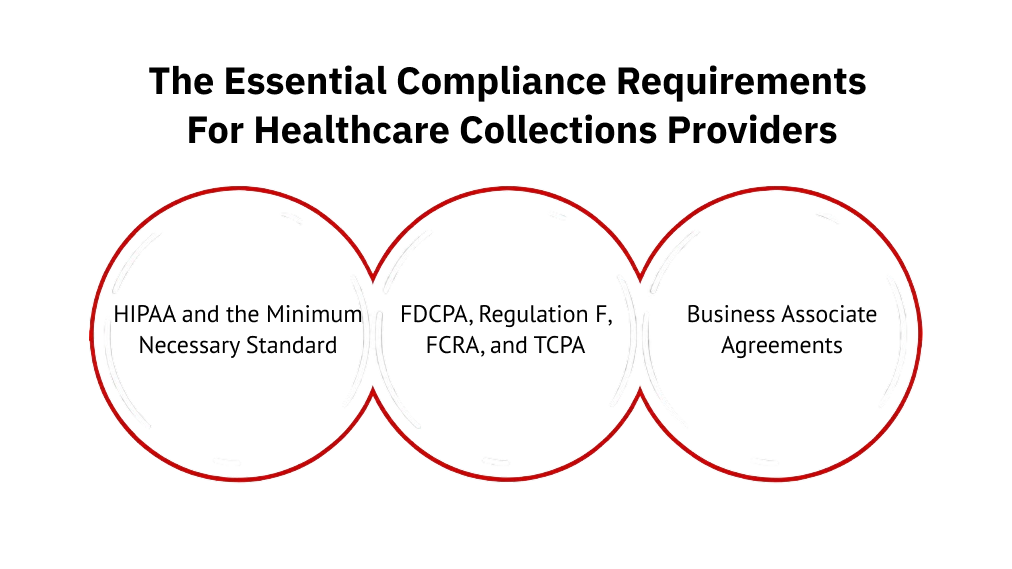
Compliance should be the first filter when evaluating healthcare collections services. A partner that improves recovery but creates regulatory risk is not a good partner. Here’s what you should assess:
1. HIPAA and the Minimum Necessary Standard
HIPAA allows providers and business associates to disclose protected health information as needed to obtain payment. But that does not mean every agent should see every detail.
A HIPAA-compliant debt collection partner should limit access to what is needed to resolve the account. That may include the patient name, contact information, account number, balance, service date, provider name, payment status, and relevant billing notes.
Agents usually do not need diagnosis details, treatment notes, full clinical records, or unrelated medical history to resolve a balance.
The agency should also have HIPAA training, role-based access controls, secure file transfer, audit logs, breach response procedures, a signed BAA, and clear PHI retention policies.
2. FDCPA, Regulation F, FCRA, and TCPA
The Fair Debt Collection Practices Act governs how third-party collectors communicate with consumers. It prohibits harassment, false statements, unfair practices, and misleading representations.
According to the Federal Trade Commission’s FDCPA report, debt collectors must provide a debt validation notice within five days of the initial communication unless that information was already included in the first contact.
Regulation F added more structure around call frequency, electronic communication, and validation notice formatting. This matters because patients now expect SMS, email, portals, and chat.
Credit reporting adds another layer. The Fair Credit Reporting Act governs how medical debt may appear on credit reports, while state laws can further restrict it. For example, New York’s Fair Medical Debt Reporting Act limits medical debt reporting to consumer reporting agencies.
Phone and text outreach also need Telephone Consumer Protection Act (TCPA) controls. When agencies use calls, prerecorded messages, texts, or automated dialing, they must document consent, honor opt-outs, follow quiet-hour rules, and respect channel preferences.
3. Business Associate Agreements
Any agency handling PHI for a healthcare provider is a HIPAA business associate. That means the BAA is not optional.
Before sending patient accounts to an agency, confirm that the BAA is signed, permitted uses of PHI are defined, security safeguards are documented, and breach notification timelines are clear.
No BAA should mean no placement.
How To Evaluate a Healthcare Debt Collection Agency
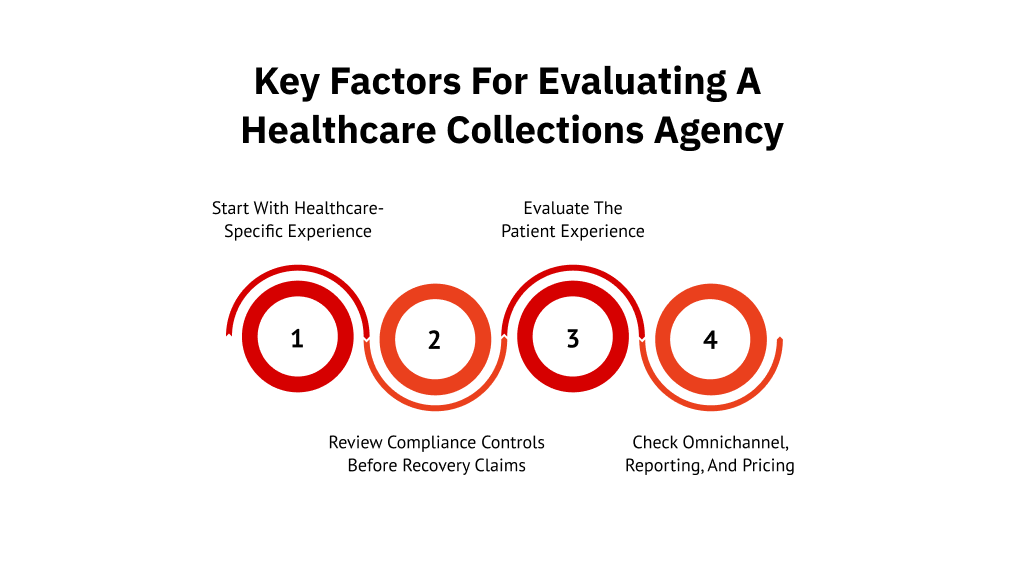
Choosing a healthcare debt collection agency affects revenue, compliance, patient experience, and your brand. These are the factors to evaluate:
1. Start With Healthcare-Specific Experience
A general collections agency is not always equipped to handle hospital or patient debt collection. Healthcare balance billing involves payer delays, charity care policies, insurance disputes, itemized bill requests, and PHI rules.
Check whether the agency works with hospitals, health systems, or physician groups. In addition, confirm whether its agents are trained on healthcare communication.
The agency should also be able to support both early-out and bad debt collections. It should also understand the state medical debt laws that apply in your service areas.
2. Review Compliance Controls Before Recovery Claims
Do not let recovery promises distract from compliance basics.
Your checklist should include:
- HIPAA training
- A signed BAA process
- FDCPA and Regulation F policies
- FCRA and state-law monitoring
- TCPA controls
- Payment Card Industry Data Security Standard (PCI DSS) controls
- Complaint management and audit-ready reporting
Ask for documentation, not just verbal assurance.
3. Evaluate The Patient Experience
The agency may become the last meaningful touchpoint a patient has with your organization. That makes tone and channel strategy critical.
Review call scripts, SMS templates, email templates, portal screenshots, dispute workflows, payment plan options, and complaint handling processes. A good agency should make payment easier, not just louder.
4. Check Omnichannel, Reporting, And Pricing
Phone-only collections no longer match how patients prefer to resolve balances. Many want to review what they owe privately, act after hours, and pay from a mobile device.
So, the right partner should offer more than outreach. Look for SMS, email, secure payment links, a mobile-first portal, payment plans, chat support, and coordinated follow-up. FCS’s digital debt collection platform brings these channels into one managed process, giving patients clearer options while helping providers scale follow-up.
Beyond outreach, review the operational side too. Ask how data moves, how often files are refreshed, how payments and disputes are reported back, and what dashboards your team will receive.
Finally, clarify pricing early. Most third-party medical collections outsourcing runs on a contingency basis, while early-out collections may use contingency, flat-per-account, or seat-based pricing when call center staffing is involved.
Questions To Ask Before Signing
Use these questions in your RFP or vendor review:
- Are you HIPAA trained, and will you sign a BAA?
- What is your minimum necessary policy for PHI access?
- How do you comply with FDCPA, Regulation F, FCRA, TCPA, and state medical debt laws?
- Can you support both early-out and bad debt collections?
- Do you work in the provider’s name for first-party accounts?
- What channels do you use, and how are they sequenced?
- How are disputes, complaints, and recalls handled?
- What reports and dashboards will our team receive?
- What is your pricing model?
How First Credit Services Approaches Healthcare Debt Collection
FCS supports healthcare organizations that need scalable recovery without turning patient communication into a blunt collection process.
It combines healthcare collections services, digital-first outreach, compliance controls, and managed operational support for providers dealing with high-volume patient AR. Here’s what it offers:
1. Built For Healthcare AR
FCS works with healthcare and hospital networks, as well as other regulated industries, where compliance and customer experience matter. Its teams are trained around debt collection regulations, privacy expectations, and patient-sensitive communication.
The goal is to help patients understand their options and resolve accounts through the right channel at the right time.
2. First-Party And Third-Party Support
FCS works across both stages of healthcare collections: first-party and third-party.
In first-party mode, FCS can support outreach under the provider’s brand. This works well for early-out or EBO collections, where patients may need reminders, balance clarification, payment options, or account support.
In third-party mode, FCS works under its own name after the account is formally placed for collections. This is better suited for older accounts that need a more structured recovery process, while still keeping communication compliant, respectful, and patient-aware.
3. UCEP: Managed Digital Engagement
FCS’s Unified Consumer Engagement Platform (UCEP) is the technology layer behind its digital collection workflows. It is operated by FCS as a managed service, not software that clients have to run themselves.
UCEP supports SMS, email, phone, chat, portal-based outreach, personalized payment links, payment plans, pay-now options, callback scheduling, and reporting visibility.
For first-party healthcare collections, the white-labeled portal helps patients see the provider’s brand. For third-party collections, FCS operates under its own brand as required.
To learn more, explore FCS’s omnichannel debt collection services.
Recover Patient Balances While Protecting Trust and Compliance
Unpaid patient balances do not have to turn into strained relationships, compliance gaps, or mounting write-offs. With the right process, healthcare providers can recover revenue while giving patients a clearer, more respectful path to resolution.
That requires more than basic follow-up. It takes healthcare-trained teams, HIPAA-aware workflows, compliant communication, digital payment options, transparent reporting, and a clear handoff between early-out and bad debt collections.
For revenue cycle teams already stretched by rising patient AR, FCS brings the operational support, technology, and collection expertise needed to manage recovery at scale.
Talk to FCS about your healthcare AR.
FAQs
1. What is healthcare debt collection?
Healthcare debt collection is the process of recovering unpaid patient balances for hospitals, physician practices, specialty groups, and other providers. It includes early-out, first-party, third-party, and bad-debt collections and must comply with HIPAA, FDCPA, Regulation F, FCRA, TCPA, and state medical debt laws.
2. Is medical debt collection HIPAA compliant?
Medical debt collection can be HIPAA compliant when the agency is treated as a business associate, signs a BAA, follows the minimum necessary standard, and secures PHI. It should also train agents properly and use compliant systems for communication, reporting, payment processing, and data transfer.
3. What is the difference between early-out and bad debt collections?
Early-out collections happen before the account becomes bad debt and often use the provider’s name. Bad debt collections occur after the provider writes off the account or places it with a third-party agency. Early-out focuses on resolution and retention, while bad debt focuses on recovering older balances.
4. Can medical debt be reported to credit bureaus in 2026?
It depends on the type of debt, the amount, the account status, and state law. The major credit bureaus removed paid medical collections, medical collections under $500, and recent medical collections. Several states now further restrict medical debt reporting, so providers should review the rules by jurisdiction.
5. What does a healthcare debt collection agency charge?
Most third-party healthcare collections use contingency pricing, in which the agency earns a percentage of the dollars recovered. Early-out services may use contingency, flat-per-account, or seat-based pricing depending on whether the work is digital-only, agent-supported, or fully outsourced.
6. How do I choose the right healthcare debt collection agency?
Look for healthcare-specific experience, HIPAA readiness, a signed BAA process, FDCPA and Regulation F controls, omnichannel outreach, self-service payment options, clear reporting, and secure integrations. The right agency should also use patient-sensitive communication and offer pricing that matches your account volume and AR stage.