

Automotive debt recovery services are first-party and third-party collection programs that help auto lenders recover unpaid balances on delinquent or defaulted loans and leases. That includes deficiency balances left after a vehicle is repossessed and resold.
In practice, recovery programs also have to run in compliance with the Fair Debt Collection Practices Act (FDCPA), Regulation F, and state licensing rules.
Compliance is already a strain across the industry. The LexisNexis Risk Solutions State of Collections Study 2025 found that 62% of third-party collectors call regulatory and compliance requirements one of their biggest challenges.
The stakes compound with time. Accounts worked early in delinquency still carry strong recovery potential. That potential collapses once an account ages into late-stage or charge-off status, and it rarely comes back.
As portfolio supply grows, that decay curve moves fast. Vehicles depreciate, files age, and deficiency balances get harder to work the longer they sit.
This guide covers how first-party and third-party recovery work in auto finance, a framework to manage decay, and how to evaluate a recovery partner.
First-party vs. third-party automotive debt recovery: what actually changes
In first-party collections, a recovery partner works the account under the lender’s own brand. The account holder never knows a partner is involved. This stage sits early in the lifecycle, before charge-off, and pricing typically runs fee-for-service.
Third-party collections start once an account has gone seriously past due or been charged off. The partner now contacts the account holder under its own name, after internal efforts are exhausted. This is where car loan debt collection shifts from a quiet, brand-safe process into a specialized, contingency-based one, where the partner gets paid only when it collects.
| Factor | First-Party | Third-Party |
| Who owns the debt | Lender, account stays active | Lender, often charged off by this point |
| Whose brand the account holder sees | The lender’s own brand | The partner’s own name |
| How the partner is paid | Fee-for-service | Contingency-based |
| Where it sits on the recovery curve | Early-stage, stronger recovery potential | Late-stage, recovery potential drops sharply |
For most auto lenders, the real decision is when to move an account from first-party to third-party. It also comes down to whether one partner can run both stages without a handoff gap.
An automotive loan recovery framework (5 steps)
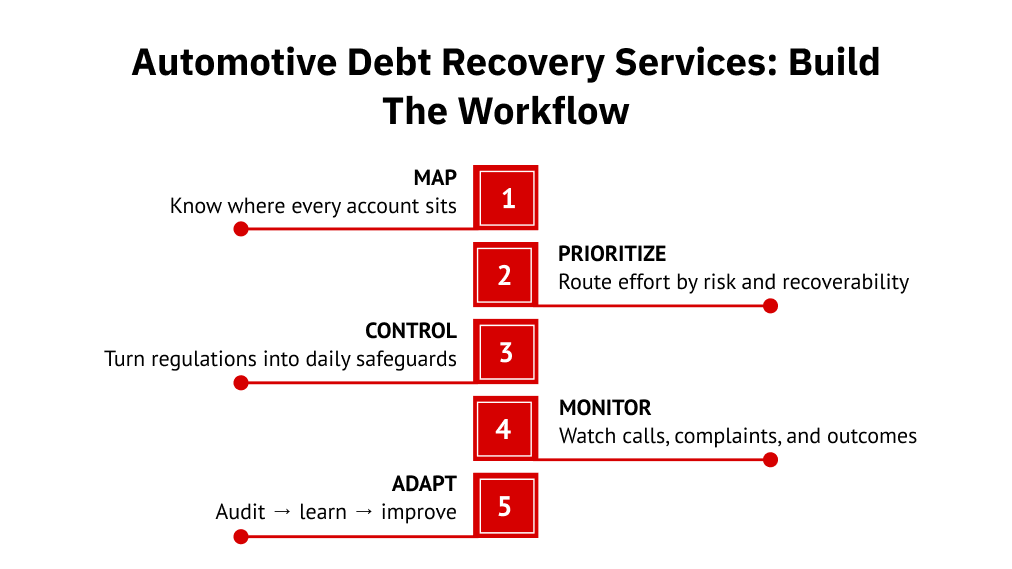
Here is a five-step framework that keeps first-party and third-party recovery aligned instead of running as separate efforts.
Before any outreach begins, map exactly where each account sits in the process.
Step 1: Segment and map the lifecycle
Every account moves through a defined path: first-party outreach, then third-party escalation, then repossession, then a post-repossession deficiency balance, then settlement or write-off.
Mapping this lifecycle up front keeps auto deficiency balance collections visible as a distinct stage instead of buried inside a general aging report. It tells you exactly which stage of contact applies to each account.
Once the lifecycle is mapped, the next question is which accounts to prioritize.
Step 2: Assess and score
Recovery odds vary widely by account, so score each one for risk and recoverability before assigning agent time:
- Prime versus subprime status
- Account age and days past due
- Likelihood of right-party contact
This scoring determines where agents spend their time first, rather than working accounts in the order they arrive.
Scoring only helps if the outreach behind it stays inside the rules.
Step 3: Build controls
Map each regulation to a specific operational control. Licensing requirements need a state-by-state tracking system. Consent management needs a documented opt-in and opt-out process.
Similarly, payment security needs controls built to the PCI Data Security Standard. Agent scripting needs to reflect auto-specific timelines, not generic collection language.
Ultimately, controls only hold up if someone is watching how they perform in practice.
Step 4: Monitor and manage complaints
Track every call and complaint as it happens. Quality assurance monitoring should run continuously, not on a sample basis. A rising complaint rate is a leading risk indicator, not an isolated incident.
The final step closes the loop rather than ending it.
Step 5: Audit and adapt
Renewing licenses on schedule, staying audit-ready year-round, and tracking regulatory changes as they happen are ongoing requirements of debt collection compliance and regulations, not tasks you complete once and set aside. Keeping those controls active and up to date is what makes the framework work over time.
First Credit Services runs this exact loop as a managed, compliance-first operating model across both first-party and third-party stages, so lenders inherit the controls instead of building them internally.
Mapping regulations to controls: an automotive debt recovery compliance checklist
These regulations only matter once they turn into real operational controls that run every day.
The regulation-to-control table
Every regulation maps to a specific, ongoing operational task, and this mapping is the backbone of any credible automotive loan recovery program.
The System and Organization Controls 2 (SOC 2) framework rounds out the list below, alongside the rules already covered.
| Regulation or Standard | Requirement | Control |
| Fair Debt Collection Practices Act (FDCPA) | Conduct and timing rules for every account contact | Scripted, monitored, and timed outreach |
| Regulation F | Seven phone-call attempts within seven days, plus a validation notice | Automated frequency tracking and notice delivery |
| State licensing | Deficiency-balance rules and statute of limitations (SOL) variance by state | State-by-state license tracking, updated as rules change |
| PCI DSS | Payment data security | Encrypted, tokenized payment processing |
| SOC 2 | Data-handling integrity | Audited access controls and data logs |
Once the controls are in place, the next question is why timing matters so much.
Why it cannot be an afterthought
The later an account moves into recovery, the more that first attempt matters. Files are older, contact information is less reliable, and a single non-compliant outreach attempt creates outsized legal exposure. That exposure lands at exactly the stage where a lender can least afford it.
First Credit Services operates compliance-first across every account and every stage. With state-by-state licensing tracking and documented audit trails that give a lender an evidence trail before a regulator ever asks for one.
Data security and vendor risk in auto recovery
Compliance controls only work if the data behind them stays secure. That protection extends to every vendor a lender brings into the recovery chain, starting with how account and payment data actually gets handled.
Protecting account and payment data
PCI DSS governs how payment data moves through the recovery process, and SOC 2 governs the integrity of the systems behind it. The same two certifications that anchor a compliant portfolio recovery services program from day one.
A data breach on an auto deficiency balance collections file carries real consequences. It exposes the lender to regulatory penalties, and it damages the accountholder relationship at the exact moment a lender is trying to preserve it.
Data protection sets the baseline. Vendor oversight decides whether that baseline actually holds.
Third-party and vendor oversight
A lender retains liability for the partners it hires, even after the account changes hands. Vendor vetting is therefore a lender’s own risk decision.
Certifications and audit history deserve real scrutiny before the contract is signed, since any gap becomes the lender’s own exposure later.
Common mistakes auto lenders make, and what to do instead
Recovery programs break down in patterns, not surprises. These five mistakes show up often enough to name directly.
- Waiting too long to escalate an account from first-party to third-party. Moving it before charge-off protects recovery value that only gets harder to reclaim as the file ages.
- Choosing a partner on price alone. Compliance track record deserves equal weight in the decision, since a cheap rate that turns into a violation ends up costing far more.
- Letting deficiency-balance files sit unworked. Prioritize them early, before the statute of limitations narrows what’s still collectible.
- Hiring a generalist partner instead of a dedicated auto finance collections agency. Auto finance calls for demonstrated experience across prime and subprime portfolios, at both first-party and third-party stages.
- Treating vendor onboarding compliance as a one-time check. Audit it on an ongoing basis, since a vendor’s compliance posture can drift well after the contract is signed.
Each mistake traces back to the same root cause. Recovery gets treated as a single event rather than a continuous operating discipline.
How to operationalize recovery without killing recovery rates
Controls only add value when they route effort toward the right accounts rather than freeze work across the board. That balance is where most recovery programs either scale well or stall out.
1. The recovery-versus-risk balance
Risk scoring should route agent time toward the accounts most likely to pay, rather than add friction to every account equally. In practice, that means aging deficiency balances get priority treatment before the statute of limitations narrows what is left to work, a core piece of any working automotive loan recovery program.
Once accounts are scored correctly, technology becomes the layer that keeps every action inside the rules.
2. Technology as a control layer
Automated data scrubs catch bad contact information before an agent wastes a call on it. Consent tracking and call-frequency enforcement keep every attempt inside Regulation F limits. Skip tracing locates account holders who have moved, and quality assurance analytics flag agent behavior that drifts from the script.
Frameworks read well on paper. The real test is whether a partner has actually run one at scale.
3. Proof in practice
FCS has worked auto finance recovery for more than 30 years, with the depth typically associated with a Tier 1 agency, spanning both first-party and third-party work under one model.
That track record shows up outside auto finance too. For a top 10 U.S. credit card issuer, FCS tripled the recovery rate against the client’s prior baseline on a $750 million book, scaling to more than 350 agents and roughly 85,000 people engaged each month. The client named FCS its Collections Agency of the Year in 2024 and 2025. Read the full case study here.
The UCEP (Unified Consumer Experience Platform) is FCS’ proprietary engagement platform. It scores each account and sequences outreach across SMS, email, chat, and phone to lift recovery while keeping every contact attempt compliant.
This model fits lenders placing multiple millions of dollars in auto receivables annually. Smaller portfolios are typically better served by an in-house team.
Car loan debt collection after repossession: The auto deficiency balance problem
Once a lender repossesses a vehicle, the vehicle goes to auction. The sale price rarely covers the outstanding loan balance, especially on a depreciating asset. The shortfall becomes a deficiency balance the lender can still pursue.
At that point, car loan debt collection turns into a specialized problem. It stops resembling general delinquency work and starts requiring a third-party, post-charge-off recovery effort with its own requirements.
Deficiency accounts are harder to collect for a few concrete reasons:
- Files are dated, often with outdated contact information
- Documentation is weaker than on a still-active loan
- Account holders have often moved on financially from the vehicle by the time the deficiency balance surfaces
- Specialized handling knowledge is required that a generalist partner typically lacks
State-by-state statute of limitations variance adds another layer of urgency. Some states give a lender years to pursue a deficiency balance. Others narrow that window fast.
Either way, the recovery-decay curve from the intro applies directly here: the longer a deficiency file sits, the further it drifts from the recovery odds it had on day one.
| Pro tip: Flag deficiency balances for third-party placement within 30 days of the auction sale, before contact information ages and the file loses its strongest recovery odds. |
How to measure an automotive debt recovery partner’s performance
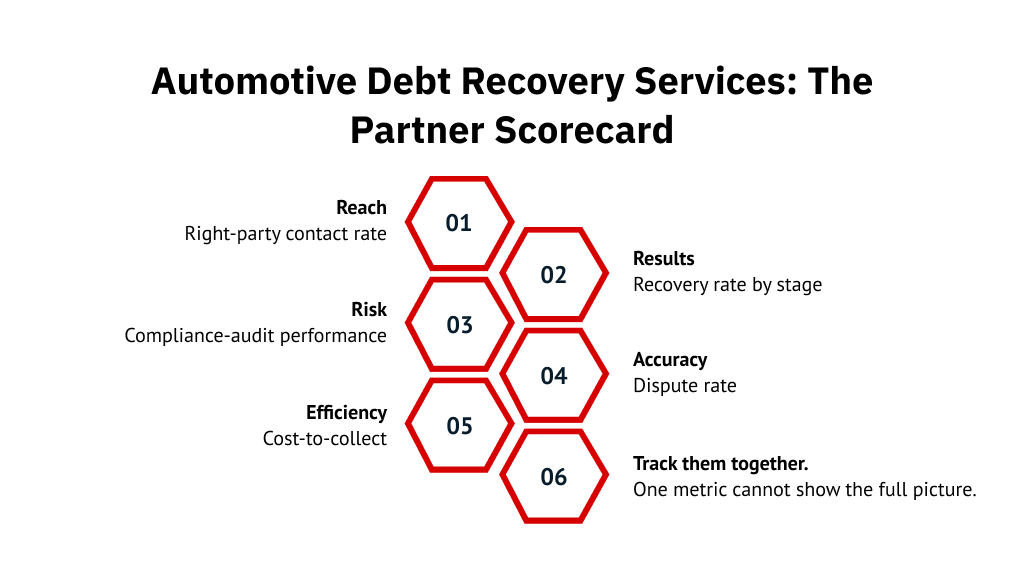
Ongoing measurement is what tells you whether the choice was actually right.
The KPIs that matter
A handful of metrics separate a well-run auto finance collections agency relationship from a guessing game.
| KPI | What It Signals |
| Complaint rate | Whether outreach stays within brand and compliance limits |
| Dispute rate | Data accuracy and documentation quality |
| Compliance-audit pass rate | Whether controls hold up under real scrutiny |
| Right-party-contact rate | Whether the partner can actually reach account holders |
| Recovery rate, by stage | Performance tracked separately for first-party and third-party work |
| Cost-to-collect | Efficiency relative to what gets recovered |
| Deficiency-balance recovery rate | Performance on the hardest, latest-stage accounts |
Once you know which numbers to track, the next step is judging how mature your program actually is.
A quick maturity self-check
Score your current setup against these three stages.
| Stage | What It Looks Like |
| Reactive | Accounts get worked in the order they arrive, with little segmentation |
| Managed | Accounts are scored and routed, but first-party and third-party results are not tracked separately |
| Optimized | Recovery rate, cost-to-collect, and compliance metrics are tracked by stage and reviewed on a regular cycle. |
| Pro tip: If a partner cannot report recovery rate separately for first-party and third-party work, you cannot tell whether the recovery-decay curve is being managed or ignored. |
The standard for smarter auto recovery
Risk in auto recovery stays quiet until it surfaces as a real problem. A wrong-party call, an unlicensed state, or a deficiency file that has outrun its statute of limitations can turn a manageable account into a liability.
Lenders who sleep well at night run automotive debt recovery services that keep every account, at every stage, compliant and documented. That standard covers first-party outreach and third-party escalation alike.
Ready to close the gaps in your recovery program? Talk to us at FCS about where your exposure sits and which gaps are worth closing first.
FAQs
1. What’s the difference between first-party and third-party automotive debt recovery services?
First-party recovery works under the lender’s own brand for early-stage, pre-charge-off accounts, and the account holder never knows a partner is involved. Third-party recovery works under the partner’s own name for defaulted or charged-off accounts, typically on a contingency basis, once internal recovery efforts have been exhausted.
2. How much do automotive debt recovery partners typically charge?
First-party work typically runs fee-for-service, billed regardless of outcome. Third-party work typically runs on contingency, generally 15% to 50% of the amount recovered, depending on account age, balance size, and whether the account is fresh delinquency or a post-repossession deficiency balance.
3. Can a lender still collect an auto deficiency balance after the vehicle is repossessed?
Yes. Once a vehicle is repossessed and resold, any shortfall between the sale price and the remaining loan balance becomes the deficiency balance at the center of auto deficiency balance collections. Lenders can typically pursue that balance for years, subject to each state’s statute of limitations.
4. Does the FDCPA apply to auto lenders collecting their own loans?
No. The FDCPA targets third-party debt collectors, not original creditors collecting on their own portfolios. Once an account is charged off, sold, or placed with a third-party partner, FDCPA and Regulation F requirements start to apply to every subsequent contact attempt.
5. What should auto lenders check before hiring a recovery partner?
Verify state licensing, FDCPA and Regulation F compliance history, data-security certifications like SOC 2 and PCI DSS, and demonstrated experience across both first-party and third-party stages. Documented recovery-rate performance by stage, tracked separately, matters just as much as any certification on paper.
6. Does moving accounts to third-party recovery damage a lender’s relationship with its customers?
No. A partner using segmented, brand-appropriate outreach protects the lender’s reputation at every stage. Many account holders return as repeat customers once their finances stabilize, especially when third-party contact stayed professional and compliant throughout.