


Medical debt can remain unresolved after healthcare services are provided, leaving organizations to balance revenue recovery with accurate billing, compliance, and patient relationships. A medical debt collector can enter this process when eligible patient balances move from billing and early recovery efforts into third-party collections.
At the same time, insurance adjustments, disputes, financial assistance, privacy requirements, and patient communications can remain part of the account lifecycle. These dependencies can complicate decisions about when an account is ready for third-party placement and what information should move with it.
An effective collection strategy therefore requires more than transferring delinquent accounts to an outside agency. Healthcare leaders need clear placement criteria, accurate account information, coordinated handoffs, and processes that account for compliance obligations and patient experience.
This guide explains how third-party medical debt collection fits into the patient revenue cycle and what healthcare organizations should evaluate when managing recovery.
What does a medical debt collector do for healthcare organizations?
A medical debt collector is a third-party collection partner that a healthcare organization engages to recover seriously delinquent patient balances. The collector works with placed accounts on the provider’s behalf after billing and early recovery efforts have not resolved the balance.
In third-party collection, the creditor generally retains ownership while the agency handles placed accounts under its own identity. The Consumer Financial Protection Bureau explains that healthcare providers may use third-party collectors for unpaid medical bills. Applicable debt collection requirements continue to govern covered activity.
Operationally, this handoff changes who manages outreach, account follow-up, dispute handling, and payment resolution. However, providers remain responsible for supplying accurate account information and communicating updates that can affect the balance.
For healthcare leaders, timing is the key distinction. Billing and early recovery remain upstream. Third-party medical collections begin when eligible accounts reach a late recovery stage.
Where does a medical debt collector fit in the patient revenue cycle?
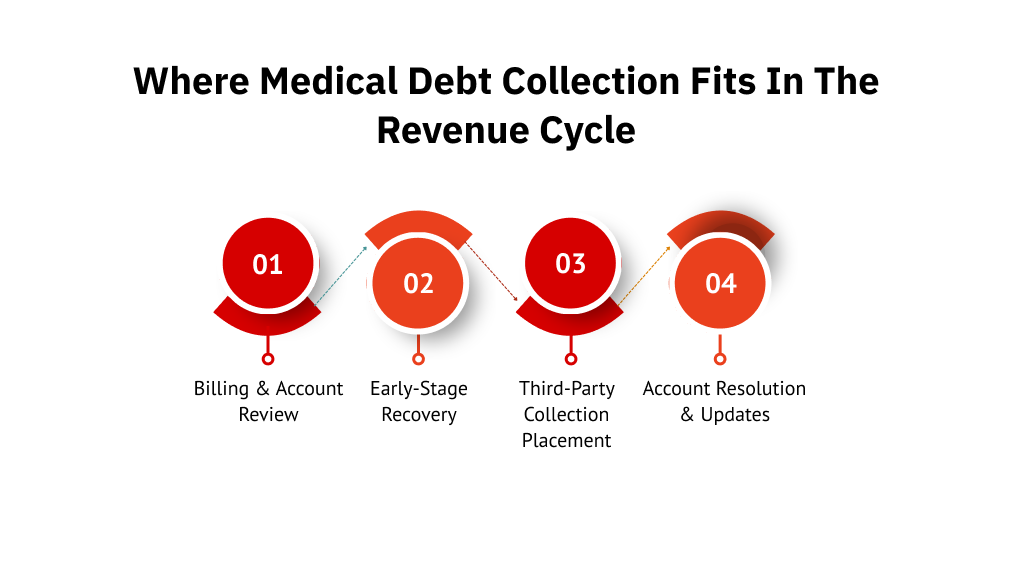
A medical debt collector typically enters the patient revenue cycle after billing and early account-resolution efforts have not resolved an eligible balance. Third-party placement occurs when the account meets the organization’s criteria for an external recovery handoff.
How third-party medical collections differ from early first-party recovery
Early first-party recovery can occur under the healthcare organization’s brand when configured. By contrast, third-party collections operate under the collection partner’s identity at a late recovery stage.
| Dimension | First-party collections | Third-party collections |
| Typical stage | Early-stage recovery before third-party placement | Late-stage delinquency or post-write-off recovery, depending on the program |
| Patient-facing identity | Healthcare organization’s brand, where configured | Collection partner’s brand |
| Primary role | Recover eligible balances earlier under the creditor’s brand | Recover late-stage accounts under the collection partner’s identity |
| Operational focus | Brand continuity and earlier engagement | Structured late-stage recovery |
That distinction affects who communicates with the patient, who manages follow-up, and how account exceptions move between teams.
Why the handoff point matters
Before placement, healthcare organizations should confirm that the balance reflects current insurance adjustments, dispute activity, financial-assistance decisions, and prior outreach. They should also define who owns corrections or exceptions once the account moves to a collection partner.
Poor handoffs can create duplicate outreach, returned accounts, patient confusion, and avoidable complaints. The CFPB’s medical debt resources also identify problems involving inaccurate or disputed medical balances.
Documented placement criteria help billing, revenue-cycle, and collection teams apply consistent escalation logic across similar accounts. They also help collection partners recognize accounts that require provider review.
There is no single placement timeline for every healthcare organization. Timing depends on account status, organizational policy, applicable requirements, and unresolved issues affecting patient responsibility. A well-defined healthcare revenue cycle collections process can help teams distinguish accounts that remain appropriate for earlier recovery from those ready for third-party placement.
What happens after a healthcare organization places medical debt with a collector?
Placing medical debt with a collector starts a structured third-party workflow. The collector receives account data, reviews it, begins permitted outreach, and manages responses through resolution or return.
Account intake, validation, and dispute handling
The process depends on accurate creditor, balance, insurance, and account-status information at intake. Errors at this stage can trigger avoidable disputes, complaints, corrections, or returned accounts later.
The provider therefore needs to supply current account data and maintain a clear path for updates. If a balance is disputed, the collector may need additional information from the provider. The same applies when insurance responsibility or another billing issue is questioned.
Covered collectors must also follow applicable validation and dispute-handling requirements. CFPB medical debt guidance underscores the need for processes addressing inaccurate or already resolved medical balances.
For healthcare organizations, timely updates help collection partners work from current information. They also reduce the risk of account activity continuing after the underlying balance changes.
Communication and payment resolution
Once an account is ready for outreach, the collector can use permitted channels according to the program and applicable requirements. Coordinated communication helps align account status, patient responses, and next actions.
Resolution can include payment arrangements, account clarification, dispute review, or referral back to the provider. The appropriate path depends on the issue raised and the supporting account information.
For revenue-cycle leaders, clear ownership is essential throughout this process. Teams should define which issues the collector can address and which require provider input.
Corrected information should then return through an established workflow. This allows collection activity to reflect the updated account status without unnecessary repetition or conflicting communication.
Why healthcare debt collection requires a different operating approach
Healthcare debt collection requires a different operating approach because patient responsibility can remain connected to unresolved billing and coverage issues. Those dependencies can persist even after an account enters third-party collection.
Insurance adjudication may change the amount a patient ultimately owes. Several other factors can also alter patient responsibility after the original statement, including:
- Billing corrections that change the balance or account status.
- Coding questions that require provider review.
- Prior payments that may not yet be reflected correctly.
- Financial-assistance decisions that affect what remains collectible.
As a result, collection teams need reliable processes for receiving and acting on updated account information.
Some disputes also require direct provider involvement. A collection partner may identify an issue involving insurance, coding, prior payments, or financial assistance that it cannot resolve independently. In those cases, the appropriate provider team may need to review the account before the recovery workflow continues.
Patient experience adds another operating consideration. Conflicting messages, outdated balances, or unclear payment options can increase complaints and create additional work for billing and revenue-cycle teams. They can also weaken trust when patients receive inconsistent information from the provider and collection partner.
These dependencies mean outsourced collection activity can still require ongoing provider participation. Provider teams may need to resolve upstream issues that affect the validity, amount, or status of placed accounts.
Accordingly, healthcare organizations need coordination across billing, patient financial services, and third-party recovery workflows. That coordination allows collection activity to respond appropriately when underlying account information changes after placement.
What compliance requirements should healthcare organizations evaluate in medical debt collection?
Healthcare organizations should evaluate requirements governing their own account practices and the activities of third-party collection partners. Applicability can vary by facility, account, communication method, collector, and jurisdiction, so controls should reflect the specific recovery program.
Fair Debt Collection Practices Act and Regulation F
For covered debt collectors, the Fair Debt Collection Practices Act (FDCPA) and Regulation F shape communications, validation, dispute handling, and prohibited conduct. The Consumer Financial Protection Bureau’s Regulation F guidance explains that Regulation F implements the FDCPA.
Because these requirements govern collector conduct, healthcare organizations should evaluate how a partner manages:
- communication controls;
- validation and dispute workflows;
- compliance monitoring; and
- escalation when an issue requires provider involvement.
Documented procedures help provider teams understand how exceptions are managed and when their involvement is required.
A practical review should examine whether the collection partner has defined processes for handling disputed balances and updating account information. Healthcare organizations should also understand how compliance monitoring connects to operational follow-up when an issue is identified.
HIPAA and patient information
The Health Insurance Portability and Accountability Act (HIPAA) permits covered entities to use collection agencies for qualifying payment activities. However, privacy obligations remain relevant when patient information enters a collection workflow.
The U.S. Department of Health and Human Services explains that providers may disclose protected health information to collection agencies as necessary for payment purposes. Those disclosures remain subject to applicable HIPAA requirements.
Healthcare organizations therefore need controls governing what information moves to the collection partner and how that information is handled. Teams should understand what the recovery workflow requires and maintain appropriate processes when account information changes.
Financial assistance and nonprofit hospital rules
For applicable tax-exempt hospital facilities, Section 501(r) requires reasonable efforts to determine financial-assistance eligibility before extraordinary collection actions. IRS guidance specifies a 120-day notification period and a 240-day application period.
Both periods begin with the first post-discharge billing statement. They apply to the financial-assistance and extraordinary-collection-action framework rather than creating a universal deadline for third-party placement.
Healthcare organizations subject to these requirements should coordinate financial-assistance processes with applicable recovery workflows. That coordination helps identify accounts requiring further review before particular collection actions proceed.
Billing protections, credit reporting compliance, and state requirements
Medical debt workflows may also need controls for applicable billing protections, credit-reporting requirements, and state-specific rules. These requirements can affect whether particular balances are appropriate for collection or require additional review.
For example, applicable No Surprises Act protections can affect the underlying validity or amount of certain medical bills. Healthcare organizations should therefore identify relevant billing issues before those balances progress through recovery workflows.
The CFPB’s January 2025 Regulation V medical-debt rule was vacated on July 11, 2025. Organizations should not design current policies as though that rule remains operative.
Because requirements can differ across accounts and jurisdictions, healthcare organizations need processes for identifying affected balances. They also need defined routes for exceptions before applicable collection activity proceeds.
What should healthcare organizations check before sending medical debt to collections?
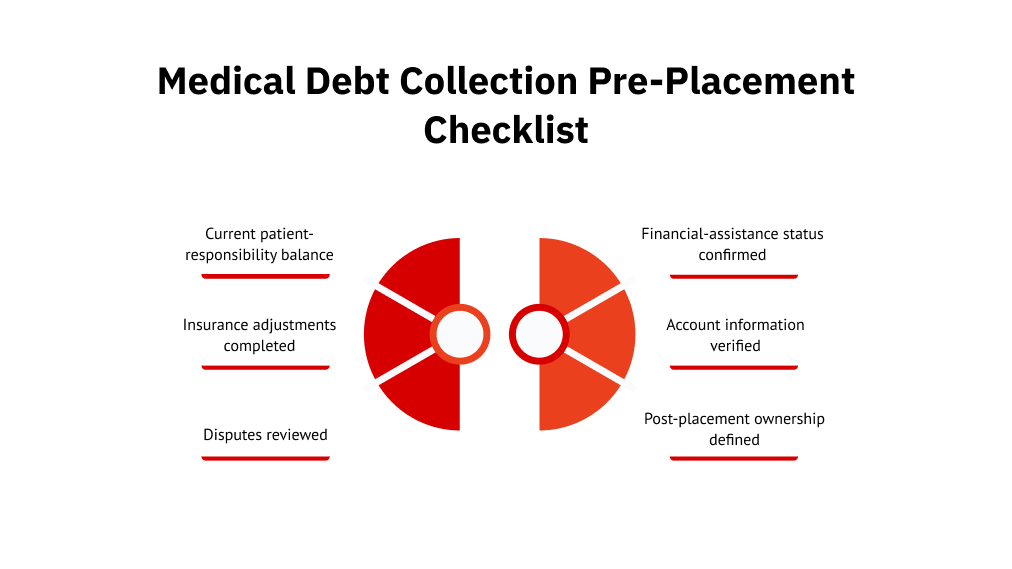
Healthcare organizations should confirm that each account is accurate, eligible for placement, and supported by complete information before third-party recovery begins. Before moving eligible accounts into third-party collections, teams should also define consistent placement criteria and clear ownership for exceptions after handoff.
Clean data and defined escalation rules
Before placement, teams should verify that account information reflects the latest billing activity, insurance processing, dispute status, and financial-assistance decisions. Current contact information and a documented history of prior outreach also give the collection partner a reliable starting point.
Healthcare organizations should establish documented placement criteria and define who handles exceptions when account information changes later. These controls give internal teams and collection partners a shared basis for deciding when provider review is required.
For example, a corrected balance or unresolved billing issue may require provider action before collection activity continues. Defined ownership helps keep these exceptions from moving repeatedly between teams.
Placement criteria should also be applied consistently across similar accounts. Consistent rules make handoffs easier to audit and reduce uncertainty about why one account moved into third-party recovery while another remained upstream.
Patient communication and resolution paths
Communication expectations should be established before accounts enter third-party recovery. Depending on the collection partner, program design, and applicable requirements, outreach may include phone and permitted digital channels.
Coordinated communication gives patients clearer pathways for payment, dispute review, or provider follow-up when needed. Consistent information can also reduce repeated contacts and unnecessary handoffs.
For healthcare organizations, these controls support payment access, complaint management, brand protection, and coordinated recovery operations. They also help internal teams understand where patient responses should be routed when provider action is required.
| Pre-Placement Checklist: Before sending an account to third-party collections, confirm: 1. Current patient-responsibility balance 2. Completed insurance adjustments 3. Unresolved disputes or billing questions 4. Financial-assistance status 5. Complete account and contact information 6. Clear ownership for post-placement corrections and escalations |
How First Credit Services supports third-party medical debt recovery
At First Credit Services, we support healthcare organizations with managed third-party revenue recovery and customer engagement programs. Our approach combines trained people, proprietary technology, and compliance expertise for late-stage patient balances.
We bring more than 30 years of compliant collections and receivables-management experience to healthcare recovery programs.
We manage outreach, account follow-up, and payment interactions within the agreed program structure. We also operate UCEP (Unified Consumer Engagement Platform) on the client’s behalf to coordinate digital and voice engagement.
Because we manage the service and technology, healthcare organizations do not need to operate the platform themselves. Provider teams can maintain defined paths for escalations, account updates, and performance visibility.
Our model fits medium-to-large medical groups, hospital networks, and health systems with substantial patient-account volumes and ongoing recovery needs.
Build a more controlled medical debt recovery process
Effective third-party medical debt recovery depends on accurate account data, applicable patient protections, coordinated communication, and clear ownership when balances or account details change.
To support that control, healthcare organizations should define a deliberate transition from billing and any early first-party recovery activity into third-party collections. Early stages should resolve eligible issues before placement. Clear criteria can then help prevent premature escalation and give the collection partner reliable information.
After placement, providers and collection partners still need defined processes for exceptions and account updates. These processes help recovery activity reflect relevant changes without creating unnecessary confusion for patients or internal teams.
For healthcare leaders, the central decision is where third-party recovery belongs within the patient-balance lifecycle. That decision should align placement criteria, account readiness, communication, and ongoing ownership.
Ready to strengthen your third-party medical debt recovery process? Discuss your patient-balance workflow with our team to evaluate where third-party recovery fits.
FAQs
1. What should healthcare organizations look for in a medical debt collector?
Look for healthcare experience, documented compliance controls, clear escalation procedures, appropriate communication capabilities, useful reporting, and portfolio fit. The partner should also explain how it handles disputes, account updates, and provider involvement.
2. How should healthcare organizations compare medical debt collection pricing?
Compare pricing alongside account stage, included services, communication channels, compliance support, reporting, and portfolio requirements. A lower fee may offer less operational coverage, so evaluate the full service model rather than price alone.
3. What reporting should a healthcare debt collector provide?
Reporting should give healthcare organizations visibility into account status, payment activity, disputes, exceptions, and agreed program measures. The exact reporting format and cadence should reflect available data and the needs established for the program.
4. How should healthcare organizations measure a medical debt collector’s performance?
Measure performance using agreed program metrics that reflect recovery and operational quality. Useful measures can include recovery results, complaint trends, dispute volumes, account accuracy, responsiveness, exception handling, and other service levels defined for the engagement.
5. What should healthcare organizations expect during medical debt collection onboarding?
Onboarding should establish data-transfer methods, account mapping, communication rules, reporting requirements, security controls, escalation ownership, and operational responsibilities. The specific implementation process varies with the organization’s infrastructure, portfolio complexity, and program design.
6. How should a medical debt collector exchange account information with a healthcare organization?
Account exchange should support accurate placements, updates, payments, disputes, exceptions, and returned accounts. The specific transfer method depends on the healthcare organization’s infrastructure and the collection partner’s implementation approach.