

Every failed subscription payment starts a clock. For the first few weeks, retries and branded reminders can usually resolve the balance while the business relationship holds. Subscription payment recovery often fails because no one decides what happens after that window closes. Instead, the balance ages in first-party outreach until the revenue and the customer are both gone.
The fix is a documented escalation point. Your team sets it in advance, using account age, cadence completion, and engagement signals. The right threshold helps you recover failed subscription payments early and escalate the rest before they go stale.
This guide shows what belongs in first-party recovery and where the aging threshold should sit. It also covers the compliance rules that change once an account moves to third-party collections.
Why subscription payments fail
Subscription payment recovery is the process a business uses to recover revenue from recurring charges that fail to process. It starts with automated retries and branded outreach, then moves to third-party recovery when internal efforts cannot resolve the balance.
In most cases, the trigger is a technical or funding issue, and the business customer still wants the service. The decline reason determines what happens next.
Soft declines, such as a temporary funding gap or processor error, are worth retrying. Hard declines, such as a closed business account or a reported-stolen corporate card, fail on every attempt. In other words, effective failed payment recovery treats the two differently from the first decline.
At the same time, decline type decides which lane an account enters and how fast it moves toward escalation:
- Hard declines skip retries and go straight to outreach with the billing contact. Every day spent retrying them delays the escalation decision.
- Soft declines stay in retry first and move to outreach once retries fail to clear the charge.
| Did you know? Visa classifies some declines as Category 1, meaning the issuer will never approve the charge. Under Visa’s resubmission rules, merchants may not reattempt those transactions at all. |
Even so, many billing systems still run every failed charge through one fixed retry schedule. Dead cards absorb wasted attempts, while recoverable accounts wait longer for the update request that could save them.
From there, each account enters the first-party recovery window, where your team has the best chance to resolve it.
The first-party recovery window
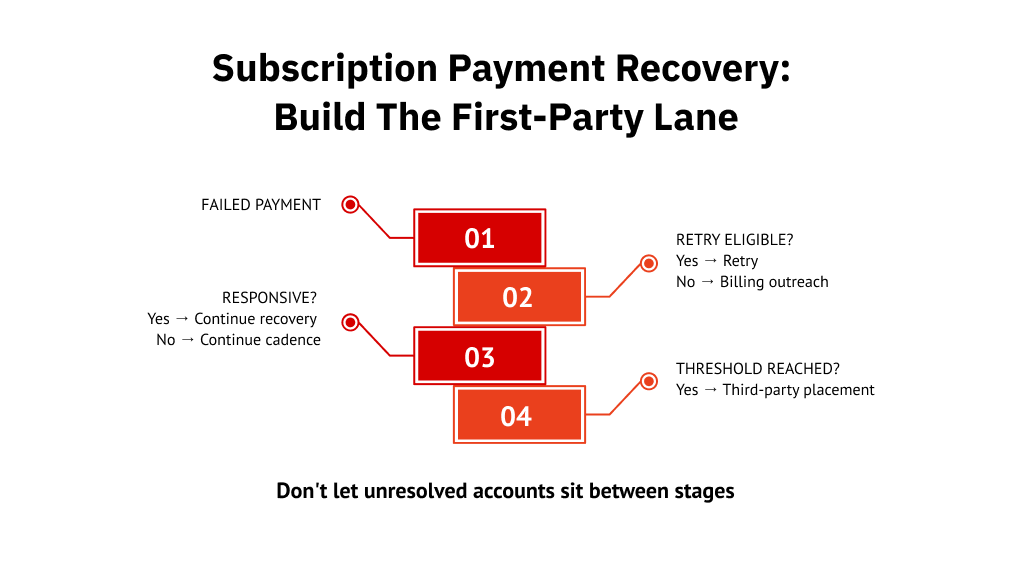
Every subscription provider serving business customers runs first-party recovery by default. This stage covers every account before it is old enough for third-party collections. The window also starts earlier than most teams assume, before a charge ever fails.
Prevention before the decline
Account updater services refresh stored card credentials when issuers reissue cards, preventing some declines before they occur.
However, card updates only protect one payment rail. Offering Automated Clearing House (ACH) or direct debit alongside cards gives a declined charge a second path. Digital wallets add a third option for smaller business accounts.
For higher-ticket contracts, diversification also changes the failures you plan for. A card decline arrives instantly through network decline codes. Conversely, an ACH failure follows bank timelines and may surface days later as a non-sufficient funds return.
Some declines will still get through, and those move into the retry queue.
Where smart retries plateau
Within dunning management, smart retries that adjust timing by decline type outperform fixed schedules. Still, every retry sequence eventually reaches a point where it stops working. Your team can recognize that plateau through three signals:
- Retries are exhausted for the decline type, with no status change from the processor
- The billing contact has ignored multiple payment update prompts
- The account has crossed your documented threshold for internal recovery
Once all three appear, the plateau becomes a trigger for branded outreach to take over.
First-party outreach extended by a partner
Internal teams often hit their limit before accounts hit the escalation threshold. Typically, retries have failed across several billing cycles, and internal outreach no longer draws replies. That is when a first-party partner can extend the window under your own brand.
At First Credit Services, our first-party collections are built for exactly this stage. We run outreach across phone, email, SMS, and chat, all under your brand. Our program can recover up to 80% of failed payments.
Beyond this stage, third-party collections work under a separate name and compliance framework.
The benchmarks below show how results change between the two stages.
Recovery benchmarks: first party versus third party
Next comes the question of what each stage actually produces. Unfortunately, most subscription businesses answer it with one blended number, which hides where revenue is leaking.
| Stage | What it measures | What changes |
| First-party recovery | Failed recurring payments recovered before third-party placement | Retries, payment updates, and branded outreach remain available. The customer relationship stays intact. |
| Third-party recovery | Balances left unresolved after first-party efforts end | Account age, placement timing, and compliance requirements take priority. Outreach no longer carries your brand. |
| Recovery performance | Recovery rate by account age and placement stage | A blended rate hides the leak. Segmenting shows whether the gap sits in execution, escalation, or placement. |
For that reason, accurate subscription revenue recovery reporting starts with stage-level tracking, which turns each gap into a diagnosis:
- Strong first-party rates, weak overall recovery: Escalation timing is usually the problem. Accounts sit in outreach long after the cadence is exhausted.
- Weak first-party rates: The issue sits upstream in retry logic, outreach quality, or payment method coverage.
- A long gap between cadence completion and placement: That dead time erodes recoverable revenue, so track the handoff as its own metric.
For instance, at First Credit Services, we helped a health club chain recover up to 70% of its monthly failed payments through our failed payment management program. That translated to an average of $6,000 in recovered revenue per club each month.
Once you know where recovery is breaking down, the next step is building a first-party cadence that gives each account the right retry and outreach sequence before escalation.
Building a first-party outreach cadence
Stage-level benchmarks show where the gap is, and the cadence is how you close it. That cadence covers every retry and message sent under your brand before an account is considered for escalation. For most teams, it is also the most controllable part of involuntary churn recovery. The timeline below gives you a working baseline.
Example four-touch recovery timeline
Timing follows two signals: when a decline is likely to clear and when a billing contact is likely to act. Spacing touches around customer payment runs and issuer retry cooldown windows beats firing on a fixed daily loop.
The same principle drives collections workflow automation, where account signals choose the next action.
The four touchpoints below apply it, from the first retry to the final branded notice:
- Touch one, within hours of the decline: An automated retry runs for soft declines, which clear most often after a short delay. Hard declines skip straight to touch two.
- Touch two, day one to two: Branded outreach sends the billing contact a direct link to update the payment method. The aim is to resolve the balance before a second billing cycle compounds it.
- Touch three, day five to seven: A follow-up adjusts to account status and prior response. Opened-but-ignored messages shift toward service continuity, while zero engagement calls for a channel change, such as email to phone.
- Touch four, day twelve to fourteen: A final first-party notice states a specific date before the escalation threshold. It is the last branded message before third-party placement.
| Pro tip: Ask each billing contact which day their accounts payable team runs payments. Then schedule retries and touches to land just after that run. |
That baseline works for most accounts, although some need a faster or slower pace.
When the cadence should move faster or slower
The four-touch timeline is a starting point that your team should adjust by account type.
Shorten the cadence and escalate sooner for these accounts:
- Accounts with a prior failed-payment history: A second failure is less likely to self-resolve than the first.
- High-value accounts: A compounding balance on a large contract carries more revenue risk per day of delay.
- Repeat hard declines: Continued first-party effort against a closed or reported-stolen card has little chance of clearing.
Meanwhile, accounts billed through invoice or ACH need a longer cadence. Bank processing timelines run longer than card-network cycles, and approval often involves someone other than the billing contact. As a result, a fourteen-day timeline can close the account before a legitimate resolution plays out.
If returns drop off at a specific touch, compress the remaining touches and escalate sooner. If accounts keep resolving after the escalation point, give the cadence more room.
Before adding SMS to any touch, your team also needs to confirm its consent records.
TCPA compliance before adding SMS to the cadence
Texting can help recover failed subscription payments faster, provided the right consent is on file. Before SMS joins any touch, your business needs consent that meets Telephone Consumer Protection Act (TCPA) requirements.
These rules apply to mobile numbers, even when the number belongs to a billing contact at a company. A text sent to a reassigned or reissued number without valid consent carries real liability, regardless of intent.
Most often, the gap comes from consent collected for a different purpose. Opt-in language for service alerts or account notifications does not automatically extend to payment recovery messages.
A compliant opt-in for payment recovery texts requires three elements:
- Express consent that names billing messages: A blanket marketing checkbox leaves recovery outreach uncovered. The consent language should reference payment or billing communications directly.
- A documented record of capture: The record should show when and how the contact opted in, plus the exact language displayed.
- A working per-channel opt-out: A billing contact who stops texts should still receive email and phone touches.
The Federal Communications Commission (FCC) updates TCPA guidance periodically, and state rules layer on top of the federal baseline. Beyond the initial opt-in, treat consent audits as part of a broader compliance program, reviewed at least once a year.
With consent in place, the next decision is when an account should leave the first-party lane entirely.
First party or third party: how to decide
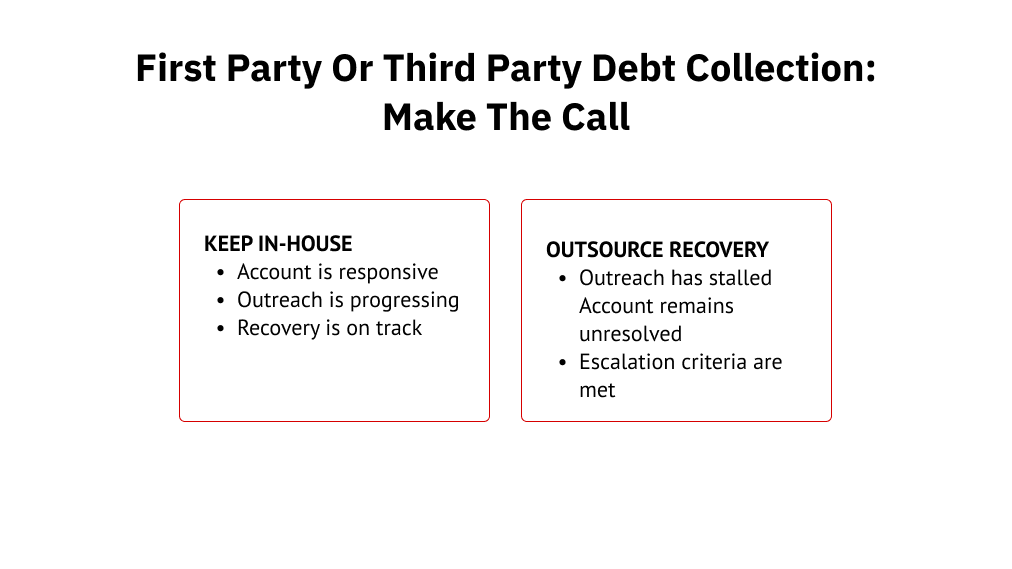
The cadence, benchmarks, and compliance rules above all lead to one staging question. At what point should an account leave the first-party lane and enter the third-party lane?
Mapping first-party vs. third-party collections by account stage makes the answer clear.
| Stage | What governs it | Who owns it |
| Automated first-party (day zero until retries are exhausted) | Decline type and retry eligibility | Your billing or operations team |
| Extended first-party outreach (under your brand until the cadence ends) | Cadence completion and engagement signals | Billing, operations, or a first-party recovery partner |
| Third-party placement (after your documented escalation threshold) | Account age and debt collection laws such as the Fair Debt Collection Practices Act (FDCPA), where they apply | A third-party recovery partner |
Above all, your program needs four things in place before any account moves between stages:
- A defined aging threshold that triggers escalation
- A documented handoff point between first-party and third-party recovery
- Compliant vendor contracts covering both stages
- Recovery reported by account age and stage
At FCS, we cover both sides of that handoff. Our first-party team runs outreach under your brand across phone, email, SMS, and chat. When that outreach is exhausted, unresolved accounts move into our third-party collections operation without a second vendor handoff.
In short, one partner can carry subscription revenue recovery from branded outreach to final resolution, with one reporting view.
The right partner helps, yet several common gaps can still break a recovery program.
Where recovery programs break down
Many subscription recovery programs have solid tactics and still lose revenue at the handoff between stages. Accounts stall in the space between lanes, where no clear rule decides what comes next.
Even a well-built dunning management setup leaks revenue when these four gaps appear:
- No escalation threshold by account age: Without a documented trigger, accounts drift in first-party limbo while your team keeps retrying.
- Hard declines held in retry past the handoff date: With no rule pulling them out, they reach escalation late. Consequently, accounts that need outreach lose days they cannot recover.
- No documented handoff between first-party and third-party recovery: The transition happens informally, usually when someone notices an old account. By then, the recovery window has narrowed.
- Reporting that cannot show where accounts stalled: A blended rate hides whether accounts lingered in retries, outreach, or the gap before placement.
The handoff also changes your legal footing. After placement, collectors of FDCPA-covered debts must follow its limits on harassment, abuse, and misleading representations. Validation notices, cease-communication requests, and contact timing limits also apply.
Commercial balances usually fall outside the FDCPA, although some state laws extend similar rules to business debts. Either way, the FDCPA does not govern first-party outreach under your own brand. That difference is why the handoff point should be documented, dated, and auditable.
Closing these gaps turns recovery into a lifecycle your team can manage from end to end.
Where should your escalation threshold sit?
Subscription payment recovery works best when every account follows a clear path from the first failed charge to final resolution. Retries and branded outreach give your team the best chance to keep the customer, but only for a limited window. When that window closes, the account needs to move to a third-party partner without sitting idle in between.
That is why the aging threshold matters so much. When it is documented, tied to engagement signals, and tracked by stage, your team knows exactly when to escalate. It also creates a dated handoff record, which matters because FDCPA and state rules may apply after placement.
If you are evaluating a recovery partner, look for one that can handle both sides of that handoff. Branded first-party outreach, third-party collections, and a documented compliance process should all sit with the same team.
Considering where your escalation threshold should sit? See how FCS can support first-party and third-party recovery for your subscription accounts.
FAQs
1. What signals show a subscription account is ready for third-party placement?
An account is ready when the full first-party cadence is complete, and the billing contact has not responded or paid. It should also have passed your documented aging threshold. A promised payment date usually justifies more first-party time.
2. What account data should transfer to a third-party partner at handoff?
Send the full account history: balance, decline codes, every outreach touch and response, payment update attempts, and any disputes. Include billing contact details and consent records. Complete files let the partner resume contact without repeating steps.
3. Should escalation thresholds differ for ACH-billed and card-billed accounts?
Yes. ACH returns can surface days after a debit, and invoice-billed accounts often need multiple approvals. Card-billed accounts show declines instantly. Set a longer first-party window for ACH and invoice accounts so legitimate payments can clear.
4. Can first-party outreach continue while an account is disputed?
Pause outreach on the disputed amount until your team resolves the dispute. Log it, suppress automated reminders, and route the account to billing support. Escalating an unresolved dispute adds avoidable compliance and relationship risk.
5. Does placing an account with a third party cancel the subscription?
Service status is a separate decision from placement. Many businesses suspend access before escalating an account. Your terms should state when access pauses, when the contract ends, and whether paying the balance restores service.
6. Does TCPA compliance apply differently to payment recovery texts than to other SMS?
Yes. Consent collected for service alerts or account notifications does not cover payment recovery messages. Adding SMS to a recovery cadence requires separate, documented consent that names billing or payment communications. Each contact also needs a text-only opt-out.