

One collection text sent to the wrong person can turn a recovery attempt into a privacy complaint. For creditors, choosing who sends those messages deserves careful scrutiny.
An SMS debt collection agency is a licensed recovery partner that uses text messaging to help businesses collect past-due balances. It can also coordinate texts with calls, email, and letters.
Texting’s reach makes it an attractive channel. According to CTIA’s 2025 Annual Wireless Industry Survey, Americans exchanged nearly 2.2 trillion texts in 2024, up 42 billion from the previous year. However, that volume says little about an agency’s ability to handle your accounts responsibly.
Before placing accounts, verify how the agency addresses the Telephone Consumer Protection Act (TCPA), Regulation F, and carrier requirements. This guide explains the rules, what compliant messages look like, and how to evaluate an agency’s omnichannel recovery program.
Why creditors use SMS in debt collection
Creditors use SMS to make routine outreach easier to respond to and give customers a convenient route to payment. In turn, collection teams can spend less time on manual follow-ups. However, these benefits depend on knowing where texting works well and when a trained collector should step in.
Reach and response
According to the Federal Trade Commission 2025 report, estimated text open rates can reach 98%, with response rates up to 45%. It also cited email open and response rates of 20% and 6%, respectively. These are general messaging estimates, so assess your agency’s results on your own accounts.
Beyond visibility, texting lets customers respond without arranging a live call. This can move routine reminders off collectors’ desks, allowing your team to focus on accounts that need closer attention.
A shorter path to payment
Once customers are ready to act, a secure link can take them directly to a mobile payment portal. There, they can pay in full, arrange a plan, or review an authorized settlement offer.
Afterward, automatic confirmations and reminders help keep payment plans on track. This can reduce missed due dates and the need for follow-up calls.
Where SMS falls short
However, convenience has limits. Disputes, hardship cases, and complex negotiations need trained staff who can review individual circumstances. Your agency should recognize these situations and provide human support.
Number accuracy also matters. A wrong or reassigned number can expose debt details to someone else. For this reason, Regulation F includes procedures designed to reduce third-party disclosure risks when texting.
Even correctly addressed messages must earn customers’ trust because collection texts compete with scams.
| Did you know? As per the FTC 2025 report, consumers reported losing $470 million in 2024 to scams that began with a text. That was more than five times the 2020 figure. This makes clear sender identification and independently verifiable agency contact details especially important. |
SMS debt collection agencies: how they use text messaging
An SMS debt collection agency does more than send messages. It holds collection licenses, manages consent, and hires trained collectors for conversations texts cannot handle.
The agency sends secure payment links, honors opt-outs, and follows the Fair Debt Collection Practices Act (FDCPA), Regulation F, the TCPA, and carrier rules. Thus, your business can recover faster without carrying texting compliance risk.
Whether a program runs as first-party or third-party affects three things:
- the sender name your customers see
- which disclosures each message must include
- how the texts are routed through carriers
In a first-party program, texts carry your brand and your customers never see the agency’s name. In a third-party program, the agency identifies itself as a debt collector in every message.
How a compliant SMS collection program works
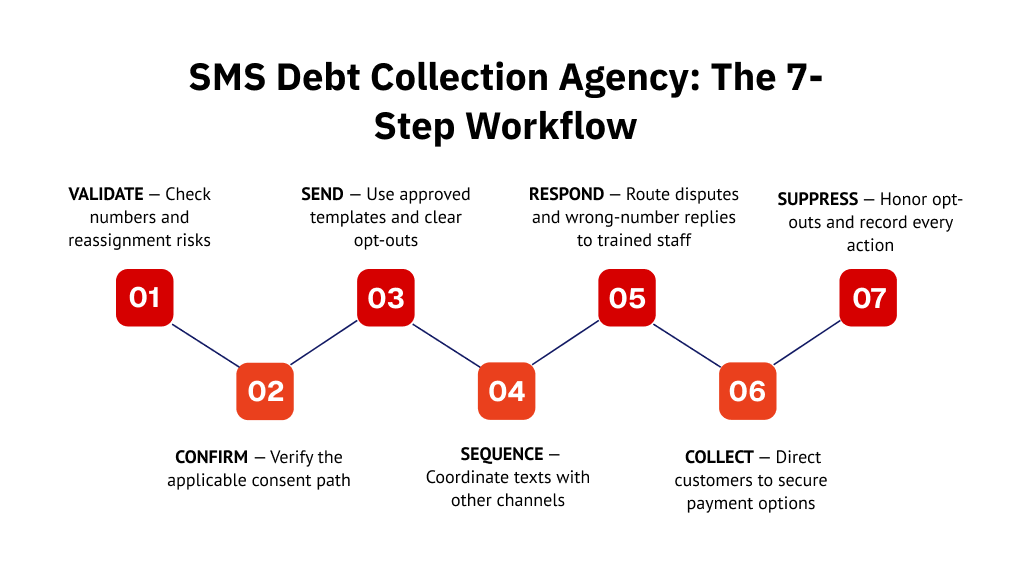
Each stage of a compliant texting program has specific compliance requirements. Here is how it works from account placement to payment.
- Validate numbers: Separate mobile numbers from landlines, check for reassigned numbers, and remove numbers already known to be wrong.
- Confirm the consent path: Verify that each number qualifies under Regulation F’s text-message procedures before sending the first text.
- Send the first message: Identify the agency, disclose it is a debt collector, give one clear action, and include an opt-out.
- Sequence follow-ups: Space texts deliberately and coordinate them with email, letters, and calls. Your customers should not receive contact on every channel at once.
- Handle replies: Route disputes, hardship messages, and “wrong person” replies to a trained collector. Pause automated texts on that account.
- Collect and confirm payment: Send your customers to a secure portal, then confirm every payment with an immediate text.
- Honor opt-outs and keep records: Suppress opted-out numbers across every system. Log the consent source, send times, and opt-out status for each account.
| Pro tip: Ask any agency for the full text history of one sample account: each message, its send time, the consent source, and the opt-out status. An agency that cannot produce this on request lacks working compliance controls. |
SMS debt collection rules agencies must follow in 2026
Before an agency texts your customers, its workflows should address applicable laws and carrier requirements. When evaluating a partner in 2026, use the rules below to assess how its controls apply to daily outreach.
Regulation F rules for text messages
Regulation F treats texts as collection communications. It sets rules for send times, which numbers qualify, and how your customers opt out.
Here is what you need to know:
| Requirement | What is allowed | What is not allowed |
| Send time | 8 a.m. to 9 p.m. in your customer’s local time | Texts outside that window |
| Time zone conflicts | Times convenient for every time zone on the account | Defaulting to the agency’s time zone instead of the consumer’s local time. |
| Opt-out notice | A clear opt-out in every text, such as “Reply STOP to stop texts” | Anything beyond the opt-out keyword |
| Number and consent | A number your customer used to text the collector, or one approved and re-verified within 60 days | Consent from a prior creditor or agency |
| Frequency | A spaced cadence, judged together with calls and emails | Numerous texts daily or combined contact amounting to harassment |
| After an opt-out | One confirmation text | Any further texts to that number |
TCPA consent and the FCC’s September 2026 revocation order
Text messages count as calls under the Telephone Consumer Protection Act (TCPA). The same is highlighted in the verdict given in the Campbell-Ewald Co. v. Gomez case.
Because of this, TCPA consent and revocation rules apply to collection texts in the first place. Hence, collection texts sent with automated technology need your customer’s prior express consent.
On September 30, 2026, the Federal Communications Commission revised its consent-revocation rules:
- Exclusive opt-out methods. Senders can designate specific methods, including reply keywords like “stop,” “quit,” or “cancel,” or a designated website.
- Category-specific revocation. Opting out of one type of text does not automatically stop other types from the same sender.
- Response window. Revocation requests must be honored within 10 business days.
§ 1006.14 separately requires a collector to stop using a channel when your customer asks, however the request is made.
| Did you know? Under the TCPA, consumers can recover $500 per violation. Courts can triple that to $1,500 for willful violations. Because damages are counted per message, one misconfigured campaign can create liability across thousands of texts. |
Carrier and deliverability rules
Business texts from standard 10-digit numbers must register through the carrier-approved A2P 10DLC (application-to-person, 10-digit long code) process. Registration verifies the sender and use case before carriers approve the traffic.
Yet carrier policies classify third-party debt collection as a prohibited 10DLC use case. Therefore, ask every agency how its collection texts are routed and approved.
Carriers also filter messages that use public URL shorteners like bit.ly. Hence, links should use the agency’s own branded domain. That’s because a consistent sender ID helps your customers recognize real messages.
Common myths about collection texts
Misconceptions about collection texts can lead you to overlook compliance gaps or dismiss a useful recovery channel. To assess an agency’s SMS program accurately, start by separating common assumptions from the rules and practices that shape responsible outreach.
| Myth | Fact | Source |
| Regulation F caps texts at 7 in 7 days | The 7-in-7 presumption applies to calls only. Texts fall under the general harassment standard. | 12 CFR 1006.14 |
| A collection text qualifies as a “limited-content message” | Regulation F defines limited-content messages as voicemails only. | 12 CFR 1006.2 |
| Collection texts require prior express written consent | Written consent applies to telemarketing. Collection texts need prior express consent. | 47 CFR 64.1200 |
What a compliant collection text looks like
Here is a sample compliant message, broken down element by element.
Sample: “[Agency name]: Hi [first name], this is [Agency], a debt collector, about your [creditor] account. See details and payment options: [branded secure link]. Reply STOP to opt out of texts.”
| Element | Why is it required | Example |
| Sender identity | Matches a consistent sender ID so your customers can verify the source | “[Agency name]:” |
| Debt collector disclosure | The FDCPA requires disclosure in every collection communication (15 U.S.C. § 1692e(11)) | “This is [Agency], a debt collector” |
| Personalization | Confirms the message is for the recipient without exposing account details | “Hi [first name]” |
| One clear action | Gives one secure step on a branded domain | “See details and payment options: pay.agency.com/acct” |
| Opt-out instruction | Regulation F requires an opt-out in every electronic collection message (12 CFR 1006.6(e)) | “Reply STOP to opt out of texts” |
What to leave out:
- Account details before the number is confirmed. Sending them risks disclosure to the wrong person.
- Threats of court action or credit damage. The FDCPA prohibits threatening action that is not intended or lawful, as mentioned in the 15 U.S.C. § 1692e(5).
- False urgency. “Final notice” language when no deadline exists misleads your customers.
- Long messages. Keep each text to a single message.
Ask an agency for its approved template library and the compliance sign-off record for each template. Agencies that test unreviewed copy on live accounts create risk for every creditor they serve.
Where SMS fits in an omnichannel collection strategy
Texting works best when coordinated with email, letters, calls, and self-service portals. Here is how each channel fits.
| Channel | Best use | Limitation |
| SMS | Nudges, payment links, and reminders | Needs per-message opt-out; unsuited to disputes |
| Account information, documents, and disclosures | Needs its own opt-out; spam filtering limits reach | |
| Letter | Validation notices and formal disclosures | Slow and costly per contact |
| Phone call | Disputes, hardship, and negotiations | Call-frequency presumptions; low answer rates |
| Self-service portal | Payments, plans, and settlement offers anytime | Must be mobile-first and secure |
A typical outreach sequence looks like this:
- Send the validation notice by mail or email.
- Follow with an SMS nudge that includes a payment link.
- Send an email with full account details.
- Place a call only if there is no digital engagement.
Regulation F judges the cumulative effect of contact across all channels. Texts, calls, and emails can add up to harassment even when each channel stays within its own limits, as stated in 12 CFR 1006.14.
How to evaluate an SMS debt collection agency
An agency’s reporting should show whether SMS outreach leads to payments and how it handles customer responses. To compare providers consistently, agree on KPI definitions and reporting frequency upfront. Start with the following measures to assess results and identify issues that need closer review.
SMS KPIs to require in reporting
- Delivery rate: texts delivered divided by texts sent.
- Reply rate: customer replies divided by texts delivered.
- Click-to-pay rate: payment link clicks divided by texts delivered.
- SMS payment conversion: payments completed divided by link clicks.
- Opt-out rate: opt-outs divided by customers texted. A rising rate signals over-texting.
- Complaint rate: complaints per 10,000 texts.
- Opt-out response time: time from STOP reply to full suppression.
SMS agency evaluation checklist
| Criterion | What to verify |
| Consent path | Which Regulation F procedure each number relies on, with per-number consent logs |
| Number validation | How often reassignment checks run before texting |
| Opt-out handling | How fast STOP replies suppress texts across all systems |
| Rule updates | Changes made after the FCC September 2026 revocation order |
| Carrier routing | Number type and carrier approval for collection use |
| Message governance | Approved template library with compliance sign-off per message |
| Human escalation | How disputes and wrong-number replies reach a trained collector |
| SMS reporting | Delivery, reply, click-to-pay, opt-out, and complaint rates |
| Data security | A current System and Organization Controls 2 (SOC 2) report and Payment Card Industry Data Security Standard (PCI DSS) attestation |
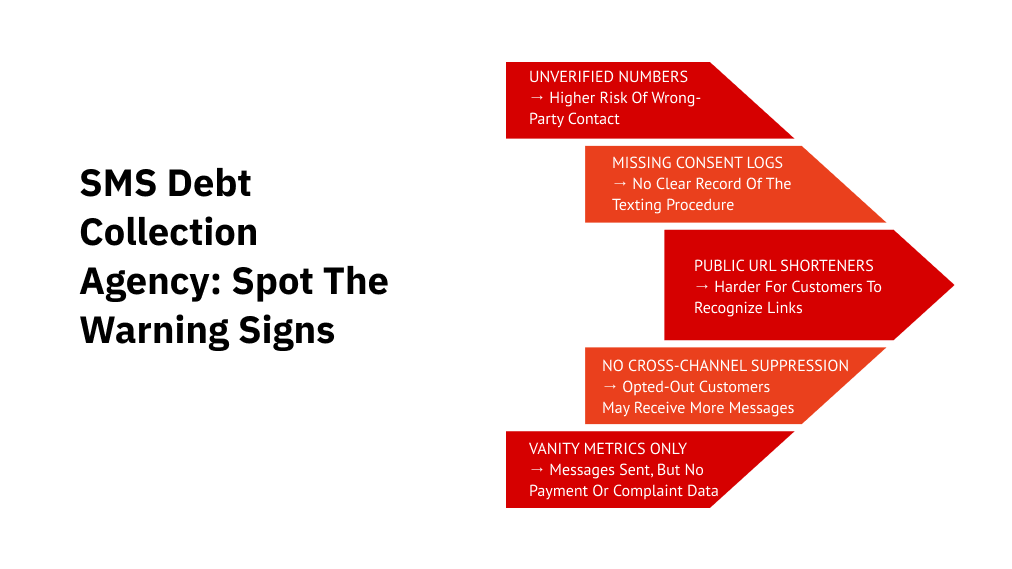
Red flags to watch for when evaluating a digital debt collection agency:
- The agency texts every number in the placement file without validation.
- It cannot produce consent records for individual numbers.
- Links use public URL shorteners instead of a branded domain.
- Collection and marketing texts run from the same number.
- SMS results are reported only as “messages sent” with no outcome data.
| Pro tip. Before signing, have the agency text a test number on your behalf, then reply STOP. You should get one confirmation text and nothing after it. |
How First Credit Services handles SMS-based recovery
The sections above outline what a compliant texting program requires. First Credit Services supports this approach through its Unified Consumer Engagement Platform (UCEP). This proprietary system builds a contact strategy for each consumer.
Using account-level insights, UCEP identifies the appropriate channel and timing for outreach. To support resolution, texts can direct consumers to a mobile-first payment portal. There, they can pay in full, set up a plan, or accept a personalized settlement offer.
For first-party programs, messaging is also fully white-labeled, so texts carry your brand name. Meanwhile, custom reporting shows delivery, reply, click-to-pay, and opt-out rates. This keeps your team informed while we manage the program.
Together, these capabilities support compliant omnichannel recovery without building and managing it internally.
Close the gap between SMS delivery and debt recovery
An SMS program should address the accounts your current outreach is struggling to resolve. That makes your portfolio’s recovery gaps a practical starting point for choosing an agency.
Before committing to a larger placement, identify a defined account segment and agree on recovery targets. Then, review the initial results to decide whether the approach merits expansion. This gives you evidence of fit before you commit more volume.
Discuss your recovery challenges and explore how managed SMS outreach could move those accounts forward.
FAQs
1. Can an SMS collection program accept payments by text reply?
Your customers should not send card numbers by text. Standard SMS does not protect card data the way PCI DSS requires. A compliant program uses a reply keyword that triggers a secure payment link, or it charges a card already stored securely on file.
2. Who is liable if an agency’s texts violate the TCPA?
The agency sending the texts is directly responsible. However, claims can also reach the business on whose behalf the messages were sent. Contracts should include TCPA indemnification, audit rights, and access to consent records.
3. Can an agency text your customers in Spanish or other languages?
Yes. Collection texts can go out in your customers’ preferred language. Debt collector disclosures and opt-out instructions must be just as clear as they would be in English. The agency should also honor opt-out replies written in that language.
4. Can an agency keep texting a customer who has filed for bankruptcy?
No. A bankruptcy filing triggers an automatic stay that halts all collection activity, including texts, on debts covered by the case. Flag bankrupt accounts before placement, and confirm the agency suppresses them across every channel immediately.
5. Are MMS and RCS messages treated the same as SMS under federal law?
Federal telecom law defines text messages to include both SMS and Multimedia Messaging Service (MMS). Rich Communication Services (RCS) and other rich messaging formats count as electronic collection communications under Regulation F. Apply the same consent and opt-out controls you use for standard SMS.
6. What happens to my internal reminder texts when accounts move to an agency?
Stop sending your own collection texts on placed accounts to avoid double messaging. Include opt-out records and notes about your customers’ contact preferences in the placement file. That way, the agency starts with the full picture.