


Medical collection services help healthcare providers recover unpaid patient balances through two layers of structured recovery. First-party outreach happens under the provider’s own name, while third-party recovery takes over once internal efforts are exhausted and moves to an outside agency.
A patient balance or a stalled insurance claim is more than an administrative loose end. Each dollar represents revenue that has stopped moving. Once an account ages past the billing cycle, that revenue sits unrecovered on the provider’s books until someone works it.
According to a CFPB report tied to Director Chopra’s January 7, 2025, remarks on the medical debt rule, $88 billion of outstanding medical bills are currently in collections, affecting one in five Americans and the finalized rule specifically targeted $49 billion of that debt carried by 15 million Americans on their credit reports.
This guide covers what medical collection services include and how first-party and third-party recovery work together. It also covers what to check before placing patient accounts with a partner.
The layers of medical collection services: first-party and third-party
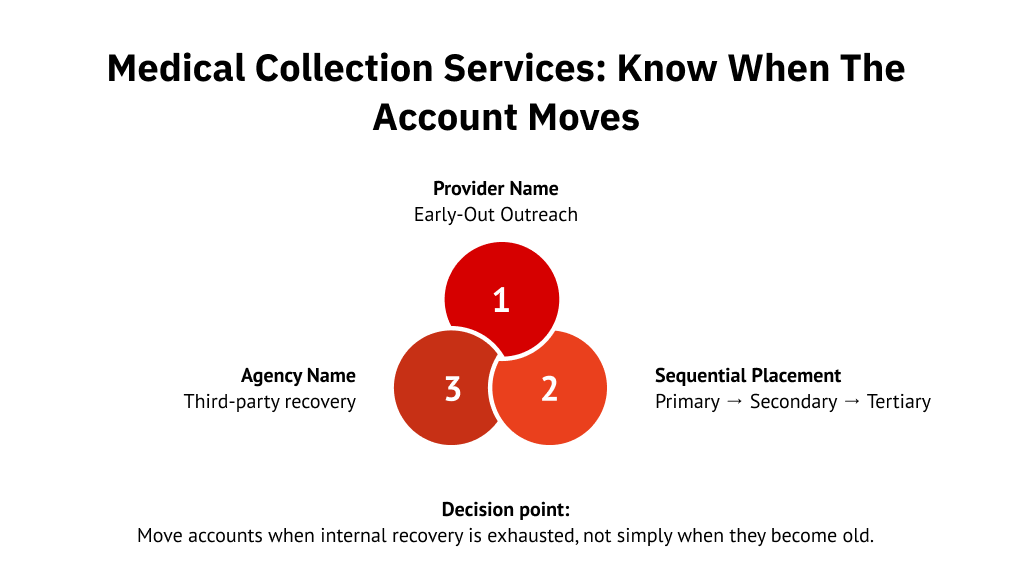
Accounts move through a sequence as they age, and each stage carries different rules. What changes at each step is simple: whether the account still operates under the provider’s name or has moved to an agency’s own name.
This staged structure is what separates a coordinated program from generic healthcare collection services bolted together without a clear handoff point.
Start with the stage every account passes through first, when the provider still owns the relationship and the outreach carries its name.
First-party (early-out)
First-party collection, often called early-out collections, keeps the account under the provider’s own name. It typically covers the window between a missed payment and formal write-off, often 30 to 120 days depending on the provider’s own policy.
The Fair Debt Collection Practices Act (FDCPA) generally governs third-party debt collectors. It typically excludes original creditors collecting their own accounts, according to the FTC’s FDCPA overview. This means providers running first-party outreach face fewer federal restrictions than a third-party agency does.
Many states still apply their own collection statutes to first-party outreach. Providers should confirm state-level requirements before relying on the federal exemption alone.
| Pro tip: Even when FDCPA does not apply to first-party outreach, check applicable state debt collection statutes before your team scripts patient-account calls. Several states extend FDCPA-style restrictions to original creditors. |
Once internal and first-party efforts run their course, the account typically moves outside the provider’s walls entirely.
Third-party (primary/secondary/tertiary bad debt)
Third-party recovery begins once internal efforts and first-party outreach fail to resolve the balance. At that point, an outside collection agency takes over, and the account moves under that agency’s own name rather than the provider’s.
Healthcare providers often place accounts in sequential waves. A primary placement goes to one agency first. If that agency cannot recover the balance within its contracted window, the account moves to a secondary placement. A third, or tertiary, placement can follow if recovery odds still look worthwhile.
Recovery odds decline with each subsequent placement, since accounts that survive one agency’s outreach are harder to resolve.
At this stage, the FDCPA and applicable state debt collection laws apply in full. The agency is now the third party attempting to collect the balance on the provider’s behalf.
Balance recovery only tells part of the story when a hospital or health system also carries payer-owed balances.
EBO/insurance follow-up
Extended business office (EBO) services address the other half of accounts receivable: money owed by payers rather than patients. A coordinated program typically bundles insurance claim follow-up, denial management, and payment monitoring alongside balance recovery.
This matters because denials that go unworked are functionally the same as an unpaid balance: revenue the provider earned but has not collected.
At the same time, coordinating payer and balance recovery only works within certain legal limits on what a provider can still bill for.
No Surprises Act
The No Surprises Act limits how much a provider can bill for emergency care and for certain out-of-network services delivered at an in-network facility. According to the CMS No Surprises Act overview, any collection effort on a restricted balance carries real compliance risk.
Before placing an account for collection, providers and their partners should confirm which portion of the balance is actually collectible under the Act.
FCS runs first-party, third-party, and EBO recovery as one coordinated program. This provides a single point of accountability instead of separate vendors for each stage.
| Did you know? According to the U.S. Department of Health and Human Services, HIPAA’s minimum necessary standard applies when a provider shares patient billing details with a collection partner. It limits that disclosure to only what the partner needs to work the account. |
What a compliant medical collection program must and must not include
A compliant medical collection program follows clear rules on how, when, and how often a provider or its partner can contact a patient. Some rules apply to every collection effort. Others kick in only once an account moves to third-party placement, which is why patient collection services built without stage-specific controls tend to run into trouble.
Providers and their partners may generally contact patients by phone, mail, email, text, and secure payment portal, provided the contact meets Regulation F’s requirements. Once an account reaches third-party placement, those requirements tighten considerably.
A well-run debt collection compliance program builds these limits into daily operations rather than treating them as a checklist reviewed once a year. This is the operational standard a compliant partner should build into its systems. It should give providers documented controls rather than compliance assurances made during a sales conversation.
| Permitted | Prohibited |
| Contacting patients by phone, mail, email, text, or secure payment portal, within Regulation F’s timing and frequency limits | Contacting a patient more than seven times in seven days about the same debt, under Regulation F. |
| Sending clear, itemized statements before an account escalates | Making false or misleading statements about the amount owed, prohibited under the FDCPA |
| Screening accounts for financial assistance before placement | Continuing collection on a balance restricted under the No Surprises Act |
| Verifying account and balance details before first contact | Disclosing more protected health information than needed, beyond HIPAA’s minimum necessary standard |
| Offering a payment plan suited to the account’s circumstances | Continuing contact after a cease-communication request, outside permitted exceptions under the FDCPA |
| Placing an account with a third-party agency once internal and first-party efforts are exhausted | Using harassing, oppressive, or abusive conduct, prohibited under the FDCPA |
These lines are the operating boundaries any compliant partner works inside every day.
How to evaluate a medical collection services partner
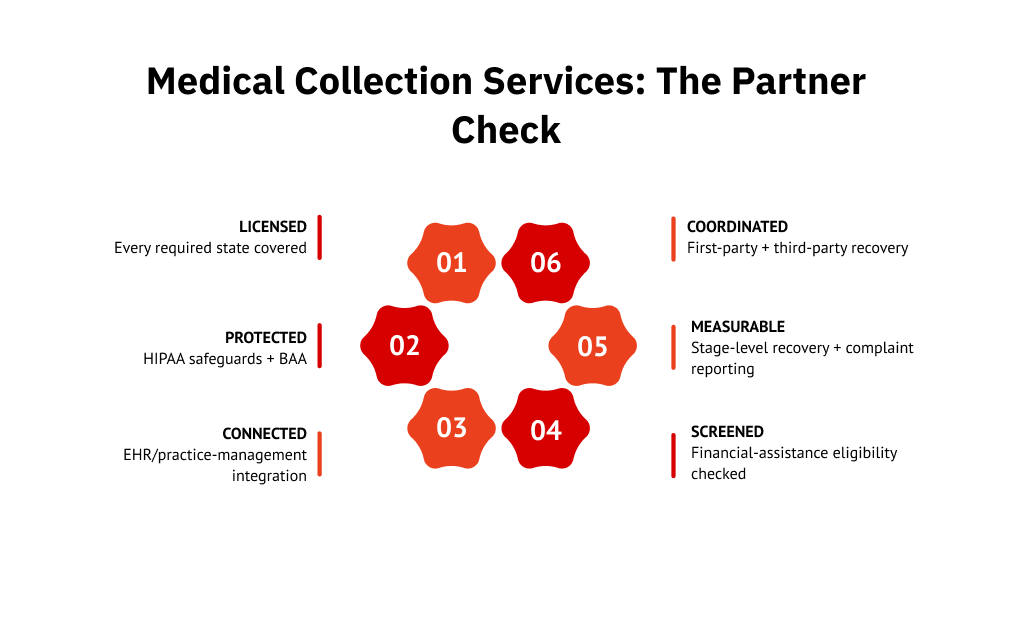
Confirming that a partner actually follows these requirements takes specific checks before any account changes hands. That evaluation should cover a few critical areas:
- State licensing: Confirm the partner holds active collection licenses in every state where accounts will be placed. Licensing requirements vary by state, and a gap here creates legal exposure fast.
- HIPAA safeguards and a signed BAA: Request documented HIPAA safeguards and a signed Business Associate Agreement before sharing any account data. A verbal assurance during a sales call is not a substitute for a signed agreement on file.
- Coordinated first-party and third-party recovery: Confirm the partner runs both layers as one coordinated program. Accounts should move from early-out outreach to third-party placement without a data gap or a process handoff that starts the clock over.
- EHR and practice-management integration: Confirm the partner integrates with your system, whether that is Epic, athenahealth, Cerner, or another platform. Manual file transfers add delay at every stage of a program that already has to move fast.
- Reporting by placement stage: Request recovery-rate, complaint-rate, and netback reporting broken out by placement stage, not just a single blended number. A strong overall rate can still hide weak performance at one specific stage.
- Financial-assistance screening: Confirm how the partner screens accounts for financial-assistance eligibility and which accounts get excluded from collection entirely. This keeps the provider’s program aligned with its own charity-care policy before an account is ever placed.
A partner that can answer all six clearly, with documentation rather than reassurance, is one worth moving forward with.
This is the same standard FCS holds itself to: checkable, documented, and built into day-to-day debt collection compliance rather than asserted during a sales conversation.
How medical collection services are typically priced
Pricing for medical collection services depends on the stage of recovery, account age, and whether insurance follow-up is included. As a result, medical AR collection services pricing rarely fits a single flat rate.
Three pricing models cover most arrangements: contingency fees, flat fees per account, and hybrid or retainer structures.
Contingency fee
Contingency is the most common pricing model in medical collections. The provider pays a percentage of the amount actually recovered, not a flat charge per account placed.
Rates typically scale with two factors:
- Placement stage: First-party, early-out accounts usually fall at the lower end of the rate range, since they are fresher and easier to resolve.
- Account age and type: Older third-party placements, especially secondary or tertiary waves, sit at the higher end, reflecting the added difficulty of recovery.
Because contingency ties the partner’s payment to results, it also aligns incentives: a partner and a provider are working toward the same outcome. Confirm the exact rate schedule in writing before placement, since rates vary by account volume as well as age and type.
Not every account fits the contingency model well, which is where flat-fee pricing comes in.
Flat fee per account
A flat fee charges a fixed amount per account placed, no matter what the partner recovers. This model shows up less often in healthcare collections than contingency does.
Flat fee pricing tends to fit high-volume, low-balance accounts, where processing many small balances efficiently matters more than maximizing recovery on any single one. For most provider portfolios, contingency remains the more common structure.
Some providers need pricing that reflects both sides of their accounts receivable, patient balances and payer balances, which is where a hybrid structure applies.
Hybrid/retainer
A hybrid or retainer structure combines a monthly retainer for EBO or insurance follow-up work with a contingency fee for balance recovery. Each revenue stream gets priced according to how the work actually happens.
This structure shows up most often when a provider bundles payer-side AR management with balance recovery under one healthcare revenue cycle collections partner. Coordinating both means one predictable retainer cost for ongoing insurance follow-up, plus contingency-based pricing tied to what gets collected.
Conclusion
Evaluating medical collection services comes down to three checks. First, determine what’s included in first-party and third-party recovery. Then, identify which compliance obligations apply at each stage and verify that a partner is actually meeting them.
A partner operating within every obligation covered here, running first-party, third-party, and insurance follow-up as one coordinated program, is the standard to hold any partner to. First Credit Services builds its healthcare recovery program around that exact standard.
Considering how a partner would handle your patient account portfolio? Explore FCS’ approach to compliance and recovery and what it can mean for your organization.
FAQs
1. What’s the difference between medical collection services and medical billing?
Medical billing generates and submits the claim or account statement. Collection services take over once a balance goes unpaid, working the account through first-party outreach and, if needed, third-party recovery. Billing initiates the charge, while recovery pursues payment once the standard billing cycle has passed without resolution.
2. What’s the difference between first-party and third-party medical collections?
First-party, or early-out, collection happens under the provider’s own name for accounts in an early stage of delinquency, before they move further. Third-party collection occurs once an outside agency takes over accounts that have exhausted internal or first-party efforts, operating under its own name and its own compliance obligations.
3. Is outsourcing medical collections HIPAA compliant?
Outsourcing can be HIPAA compliant when structured correctly. A collection partner acting as a business associate needs documented HIPAA safeguards and a signed Business Associate Agreement with the provider, with protected health information handled according to the minimum necessary standard throughout every stage of the arrangement.
4. How much do medical collection services typically cost?
Third-party medical collections are commonly billed on a contingency basis, with the provider paying a percentage of recovered amounts. Pricing varies by account age, volume, and placement stage, so providers should request a clearly disclosed fee schedule in writing before any account placement begins.
5. Can medical collection services recover unpaid insurance balances, not just balances owed by patients?
Some healthcare collection partners provide EBO services that address payer-owed balances through insurance follow-up, denial management, appeals, and rebilling. First Credit Services includes these capabilities within its EBO offering, coordinating payer-side recovery alongside balance recovery under one accountable program.
6. What should providers look for in a medical collection services partner?
Providers should evaluate healthcare collection experience, first-party and third-party capabilities, HIPAA safeguards, state licensing, EHR integration, and stage-by-stage reporting. Fee transparency and demonstrated recovery performance across the full account lifecycle matter more than a single headline recovery rate offered upfront.