

An overdue invoice does not just delay cash. It quietly pulls time, attention, and working capital out of the business. What starts as one missed due date can quickly turn into repeated follow-ups, rising DSO, strained AR teams, and harder cash-flow planning.
The damage is not always visible at first, but it adds up fast. According to PYMNTS’ 2026 Money Mobility Tracker, roughly 75% of SMB owners said invoice delays are becoming increasingly common.
The report also found that SMBs estimate average annual losses of $39,406 tied to delayed payments. That is why more finance teams are evaluating invoice collection outsourcing.
This guide explains when to outsource, what a partner handles, how pricing works, and which invoice collection services to compare.
What Is Invoice Collection Outsourcing?
Invoice collection outsourcing is the process of hiring a specialist partner to recover overdue customer invoices, unpaid balances, or past-due accounts.
In simple terms, accounts receivable is money coming in. Accounts payable is money going out. Both involve invoices, but they solve very different problems.
| Term | What it means |
| Accounts receivable | Money customers owe your business. |
| Accounts payable | Money your business owes vendors. |
| Invoice collection outsourcing | Hiring a partner to recover overdue customer invoices. |
An invoice collection partner may handle:
- Customer payment reminders.
- Receivables follow-up.
- Dispute intake and routing.
- Payment plan support.
- Digital payment links.
- Self-service payment portal access.
- Agent escalation.
- Compliance-managed communication.
- Reporting on DSO, recovery rate, and account status.
The focus is on faster revenue recovery, backed by clear communication, proper documentation, and a professional customer experience.
When Does It Make Sense to Outsource Invoice Collection?
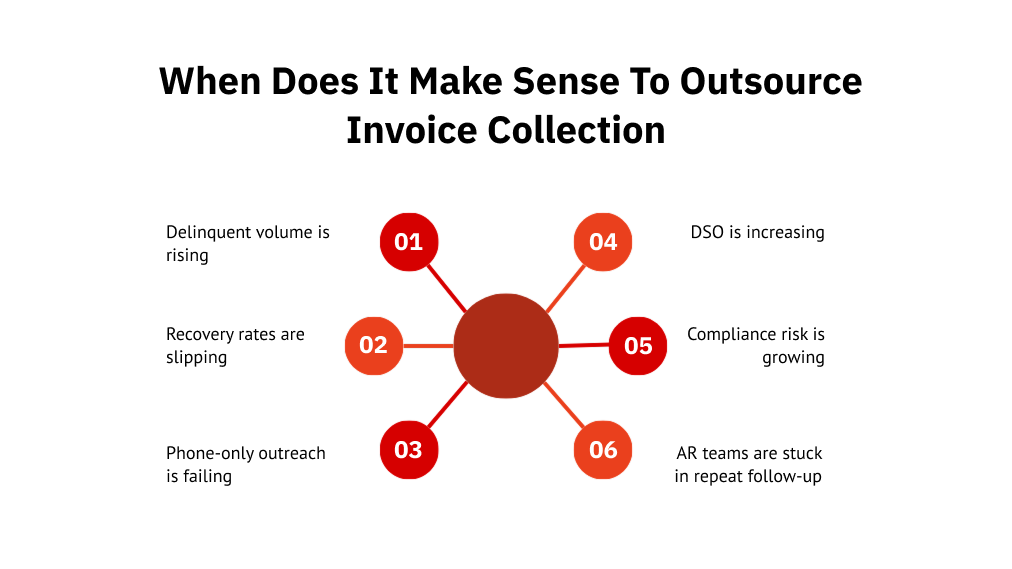
Outsourcing invoice collection makes sense when overdue accounts start moving faster than your internal process can manage.
It may be time to consider invoice collection outsourcing when:
- Delinquent volume is rising: Your AR team cannot follow up with every overdue account on time.
- Recovery rates are slipping: More balances are aging without resolution.
- Phone-only outreach is failing: Customers may respond better to SMS, email, chat, or payment links.
- DSO is increasing: Late payments are starting to affect working capital.
- Compliance risk is growing: Follow-up needs better documentation, consent tracking, and audit trails.
- AR teams are stuck in repeat follow-up: Skilled staff spend too much time sending reminders instead of managing cash strategy.
That said, outsourcing is not the right fit for every account. For example, very small businesses with only a few overdue invoices may manage follow-up internally. Similarly, highly sensitive customer relationships may need direct leadership involvement.
However, once volume rises, manual follow-up becomes harder to sustain. Earlier placement here can improve outcomes because recent accounts are usually easier to resolve than older balances.
| Pro Tip: Do not wait until invoices are close to write-off. Invoice recovery works best when accounts are still recent, reachable, and easier to cure. |
What Does an Outsourced Invoice Collection Partner Actually Do?
A good partner does more than call customers. It helps manage the recovery workflow from outreach to payment.
Most partners support one or both of these models.
First-party vs third-party invoice collections
| Model | How it works | Best fit |
| First-party collections | The partner works under your brand. | Early-stage invoices where the customer relationship still matters. |
| Third-party collections | The partner works under its own agency name. | Older, escalated, or harder-to-recover accounts. |
| Dual model | One partner supports both stages. | Businesses that want fewer handoffs as accounts age. |
First-party invoice collection is useful when accounts are 30, 45, or 60 days overdue. The tone stays closer to customer service because the relationship is still active.
For example, first-party collections can help businesses recover overdue balances while keeping the outreach experience closer to their own brand.
On the other hand, third-party collections are more formal. They usually fit accounts that have not responded to internal or first-party efforts. For older unpaid invoices, third-party collections can create a clearer escalation path.
Some providers support both. This can reduce vendor switching because the same partner can handle both early outreach and later recovery.
Digital-first outreach vs call-center-first collection
The traditional call-center model starts with calls. That can still work for some accounts, but it creates friction when customers prefer digital communication.
A digital-first model starts with SMS, email, chat, and payment links. Calls are still available, but they are used for support or escalation.
A modern outsourced collections workflow should include:
- SMS and email outreach.
- Secure payment links.
- A self-service payment portal.
- Payment plans.
- Approved settlement workflows.
- Chat support.
- Agent escalation.
- TCPA and Regulation F-aware communication controls.
- Clear records of every customer touchpoint.
The strongest programs do not use every channel at once. They use the right channel at the right time. That is where omnichannel debt collection helps teams coordinate outreach rather than treating each channel separately.
What Should You Look for in an Invoice Collection Outsourcing Partner?
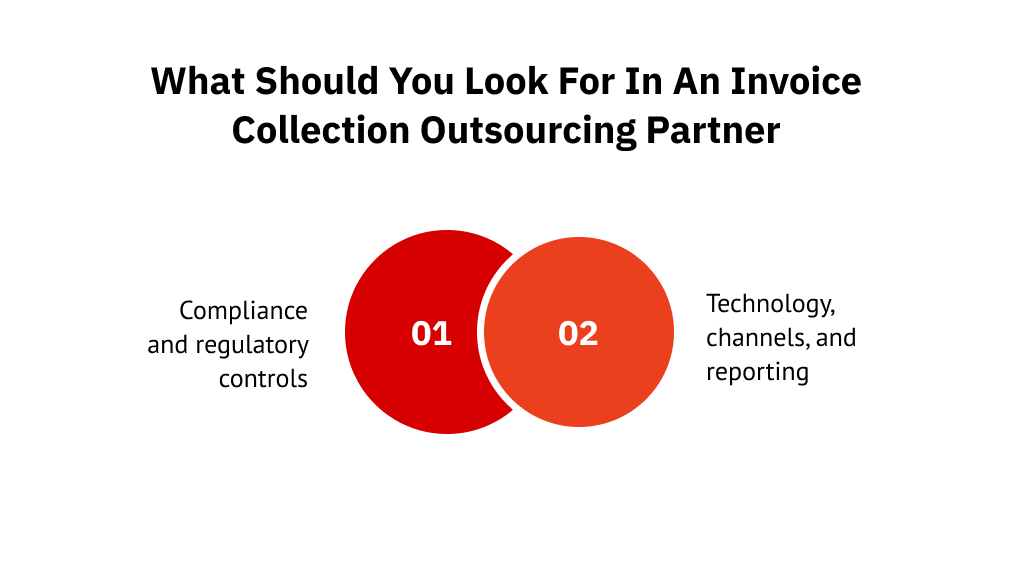
Before choosing a partner, look beyond price. The right provider should improve payment recovery without creating customer experience or compliance issues. These are the factors to consider:
1. Compliance and regulatory controls
Ask how the partner handles:
- FDCPA and Regulation F requirements.
- Call frequency and timing rules.
- Required disclosures.
- TCPA and SMS consent.
- Opt-outs.
- Disputes.
- State-law requirements.
- Contact logs and audit trails.
A good partner should be able to show how each contact attempt, consent event, dispute, payment, and status change is documented. If compliance is a major concern, review the provider’s debt collection compliance practices before signing.
2. Technology, channels, and reporting
Technology is not just a convenience. It shows whether the partner can operate consistently at scale. For better assessment, ask these questions:
- Does it support SMS, email, phone, chat, and portals?
- Is there a self-service payment portal?
- How does data move between systems?
- Can outreach be white-labeled?
- Can payment plans and offers be configured?
- Is reporting real-time, batch-based, or monthly?
- Can you see performance by account age, channel, segment, and outcome?
Technology transparency is also a compliance signal. If the provider cannot show what happened at the account level, it may be harder to prove what happened later.
What Does Invoice Collection Outsourcing Typically Cost?
Most invoice collection outsourcing uses contingency pricing. The partner earns a percentage of what it recovers. If there is no recovery, there is usually no fee.
Pricing usually depends on:
| Factor | Why it matters |
| Account age | Older invoices are harder to recover and may carry higher rates |
| Portfolio size | Larger placements may allow better pricing. |
| Recovery stage | First-party and third-party programs may be priced differently. |
| Account type | Consumer, commercial, healthcare, subscription, and loan accounts can vary. |
| Support model | Digital-only, agent-assisted, and legal escalation models may differ. |
Before signing, also check for setup fees, placement fees, reporting fees, legal fees, or other charges outside the contingency structure.
Comparing Top Invoice Collection Outsourcing Partners
The providers below were selected based on the outsourcing model, collections capability, digital workflows, compliance infrastructure, and fit for businesses evaluating unpaid invoice collection. Here is how they compare:
| Provider | Primary model | Best for |
| First Credit Services | Managed first-party and third-party recovery | Mid-to-large businesses that want digital-first recovery with fewer handoffs. |
| Bill Gosling Outsourcing | B2B collections platform and ARM support | Businesses that want fast-start B2B invoice placement. |
| IC System | Managed debt recovery programs | Businesses that want a long-established agency with structured recovery options. |
| Commercial Collectors Inc. | Commercial first-party and third-party recovery | Businesses that need commercial invoice recovery and aged receivables support. |
Now, let us compare each service provider in detail:
1. First Credit Services: Best for managed invoice recovery with digital-first engagement
First Credit Services is a debt collection and BPO company that supports accounts receivable management, customer engagement, first-party collections, and third-party recovery.
It is ideal for businesses that need more than invoice chasing. FCS combines people, processes, compliance, and technology into a single managed recovery model.
Key features
- First-party recovery: FCS supports early-stage, brand-sensitive invoice recovery, allowing outreach to operate under the client’s brand.
- Third-party escalation: Older or more complex accounts can be escalated to third-party recovery without forcing teams to start over with a new vendor.
- Digital-first engagement: FCS uses digital debt collection workflows across SMS, email, chat, phone, and portal-based engagement.
- White-labeled portal experience: In first-party programs, consumers can see the client’s brand while viewing balances, making payments, choosing plans, or starting chats.
- Managed technology model: FCS operates the Unified Consumer Experience Platform (UCEP) on behalf of clients for omnichannel debt collection. Thus, internal teams do not have to manage another software platform.
- Reporting and compliance support: Clients gain visibility into reporting while FCS manages outreach workflows, documentation, and recovery execution.
| A Case Study to Consider: A health club chain was dealing with 500 to 700 failed payments per club each month. FCS used a 60-day follow-up process with phone and email engagement under the client’s brand. The result was up to 70% monthly failed-payment recovery, equal to an average of $6,000, or 400 members, per club each month. While this example focuses on failed payments, the lesson applies to invoice recovery too. Faster outreach, brand-sensitive follow-up, and structured payment paths can help prevent recoverable balances from becoming aged debt. Read the full case study here. |
Best for: Mid-to-large businesses that want digital-first invoice recovery, first-party and third-party support, and managed execution.
2. Bill Gosling Outsourcing: Best for fast-start B2B invoice placement

Bill Gosling Outsourcing provides BPO, accounts receivable management, and B2B collections support. Its B2B collections platform is designed for businesses that want to upload unpaid invoices and move quickly into recovery.
Key features
- B2B invoice placement: Businesses can submit overdue invoices through a dedicated B2B collections platform.
- Fast customer contact: Bill Gosling states that customers are contacted within 48 hours after invoice submission.
- No upfront setup fees: The platform positions its fee model around recovery rather than upfront placement costs.
- Self-serve access: Businesses can send accounts for collection through a 24/7 self-serve platform.
- Real-time tracking: Users can track placed accounts and case movement through the platform.
- Multi-currency support: The platform supports collections across the UK, USA, and Canada.
What to consider: Bill Gosling might suit businesses that want a quick placement model with lower onboarding friction. However, if you need a deeper white-label strategy, first-party brand continuity, or full-lifecycle recovery across early and later stages, review how the operating model fits your portfolio.
Best for: Businesses that want fast-start B2B invoice collection with a digital placement process.
3. IC System: Best for established agency-led recovery
IC System is a long-established debt recovery agency that supports past-due account recovery across industries. Its Recovery Plus product outlines a two-phase recovery program for accounts requiring structured follow-up.
Key features
- Two-phase recovery program: Recovery Plus includes an initial letter-based phase and a second phase with trained collection professionals.
- Letter-based early outreach: Phase I can be used for accounts that need an economical first-step recovery.
- Professional collector involvement: Phase II adds more intensive recovery support when accounts do not respond.
- Online account submission: Clients can place accounts through online tools.
- Consumer payment access: IC System supports online payment options for consumers.
- Escalation pathways: The model can support further action when accounts require more than standard follow-up.
What to consider: IC System may be a fit for businesses that value a long operating history and structured recovery programs. But, buyers should confirm which program fits their invoice type, account volume, reporting needs, and desired digital engagement depth.
Best for: Businesses that want an established recovery agency with structured program options.
4. Commercial Collectors Inc. : Best for commercial invoice recovery
Commercial Collectors Inc. provides commercial collections and outsourcing support for businesses that need help recovering past-due accounts. Its first-party outsourcing model is designed to act as an extension of the client’s accounts receivable team, while its third-party collections support aged or written-off receivables.
Key features
- First-party outsourcing: CCI can contact customers under the client’s company name, using the client’s voice and process.
- Commercial collections: The company supports recovery for past-due commercial accounts.
- Third-party recovery: CCI can recover aged or written-off receivables under its own name.
- No recovery, no fee: Its collections model is positioned around performance-based recovery.
- Legal escalation support: CCI can support more difficult accounts through legal escalation when needed.
- Transparent reporting: Clients can access real-time updates and detailed case notes for placed accounts.
What to consider: CCI is more focused on commercial collections than consumer-heavy portfolios. Businesses with high-volume consumer accounts, subscription recovery, or first-party white-label digital workflows should compare how its model fits their customer base and account mix.
Best for: Businesses that need commercial invoice recovery with first-party outsourcing and third-party collection options.
How To Choose the Right Invoice Collection Outsourcing Partner
The right provider depends on your portfolio, customer base, and internal capacity. You can use this quick guide to make the decision:
| If your biggest issue is… | Look for… |
| Early-stage overdue invoices | First-party, white-labeled outreach |
| Older unpaid accounts | Third-party recovery experience |
| Phone-only outreach is failing | SMS, email, chat, and portal workflows |
| Compliance exposure | Audit trails, consent records, and Regulation F controls. |
| Limited internal capacity | Managed service support, not only software |
| High account volume | Scalable operations and clear reporting |
Before choosing a partner, ask for sample reports, onboarding timelines, data transfer methods, compliance documentation, and pricing structure. Also, ask what happens when accounts age. If the provider only handles one stage, your team may need another vendor later.
Recover More Without Adding More Follow-Up Work
Invoice collection outsourcing becomes valuable when overdue invoices drain cash flow, consume AR capacity, and delay recovery decisions.
Hence, the right partner should do more than follow up. It should make outreach consistent, give customers easier ways to pay, document every step, and protect relationships while moving balances toward resolution.
For high-volume portfolios, FCS brings technology, trained teams, and recovery execution into one managed model. With first-party and third-party support, businesses get a clearer path from early invoice recovery to later-stage escalation.
If your AR team needs stronger recovery without adding more manual follow-up, discuss your invoice collection goals with FCS.
FAQs
1. What is the difference between invoice collection outsourcing and accounts payable outsourcing?
Invoice collection outsourcing focuses on recovering money owed by customers to your business. Accounts payable outsourcing focuses on managing the bills your business owes vendors. One improves incoming cash. The other manages outgoing payments.
2. Does outsourcing invoice collection damage customer relationships?
It depends on the model. First-party, white-labeled outsourcing can protect the customer relationship because outreach happens under your brand. The tone, channel, timing, and payment options matter.
3. When should I place accounts with an invoice collection partner?
Many businesses start around 30 to 60 days overdue, especially when internal reminders are not working. Earlier placement can improve recovery because accounts are still more recent and easier to resolve.
4. Can I outsource only part of my AR portfolio?
Yes. Many businesses outsource by age bucket, balance size, region, customer segment, or risk level. This lets internal teams keep strategic accounts while a partner handles high-volume recovery.
5. How does an outsourced partner handle customer disputes?
A good partner should document the dispute, pause or adjust outreach as needed, route the issue to the appropriate team, and maintain a clear audit trail. Ask how disputes appear in reporting.
6. What should I expect during onboarding?
Onboarding usually includes data transfer setup, portfolio review, messaging approval, compliance checks, reporting setup, payment workflow alignment, and escalation rules. The timeline depends on volume, integration needs, and collection model.