

US household debt hit $18.8 trillion by the end of 2025, according to the Federal Reserve Bank of New York’s Q4 2025 report. More consumers are falling behind on credit card and auto loan payments. For businesses, that means more unpaid accounts piling up, more customers ignoring collection calls, and more pressure on internal teams that were never built to handle this volume.
That’s when most companies start looking for a digital debt collection company that can actually recover what’s owed, not just dial through a list.
IBISWorld data from 2025 shows there are over 5,400 collection firms in the US. Finding one isn’t the hard part. Finding one with the right compliance setup, the right technology, and a recovery approach that fits your business is.
This guide compares five digital debt collection companies, then covers when to outsource, how to evaluate partners, and how pricing works.
Contents
Top 5 Digital Debt Collection Companies
The top digital debt collection companies are First Credit Services, TrueAccord, IC System, InDebted, and January. The right fit depends on your industry, account volume, and how much of the recovery process you want to hand off. Here’s a side-by-side comparison, followed by a closer look at each one.
| Company | Best For | Collection Model | Key Strength | Industries |
| First Credit Services | Full-lifecycle recovery with digital-first engagement | Third-party core, with first-party option | UCEP platform (standalone or managed), omnichannel outreach | Healthcare, Auto Finance, Fintech, Insurance, Subscriptions, Banking |
| TrueAccord | Fully digital, ML-native collections | Third-party, with first-party via Sentry Credit | ML-based personalization, minimal phone contact | Fintech, E-commerce, Lending, BNPL, Telecom |
| IC System | Established agency with digital capabilities | Third-party | 85+ years of experience, SOC 2 Type II | Healthcare, Government, Utilities, SMBs |
| InDebted | Digital collections with global coverage | Third-party, with first-party via Receeve | ML-powered personalization, self-service portal, five-market reach | Fintech, Telecom, BNPL, Utilities |
| January | AI-driven recovery for financial institutions | Third-party | Compliance automation, digital-only outreach | Lenders, Credit Unions, Debt Buyers |
1. First Credit Services
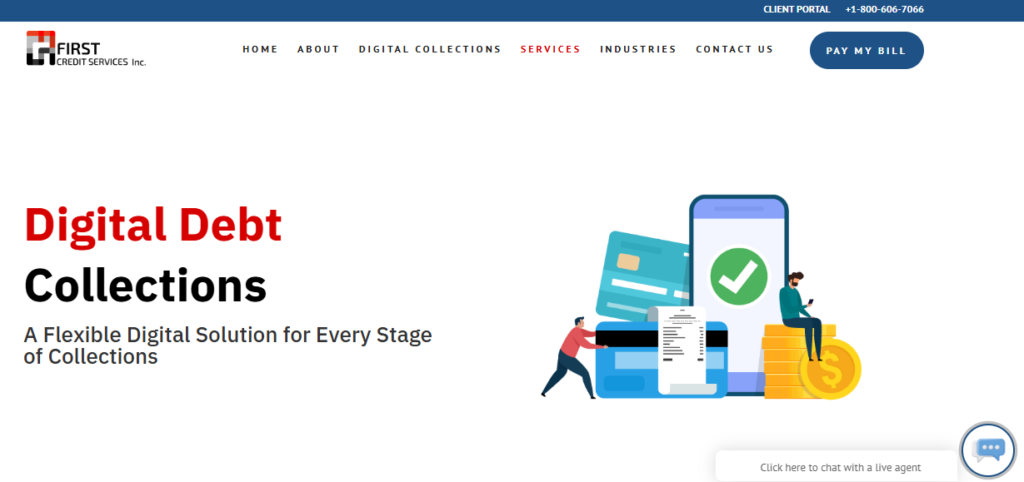
First Credit Services has operated in receivables management and BPO since 1993. They handle both third-party and first-party collections. Third-party drives their core business. First-party runs fully white-labeled, so the consumer interacts entirely under your brand. They never see First Credit Services’ name at any point.
Unlike most agencies that only step in after accounts are severely past due, First Credit Services gets involved early. They recover failed payments, lapsed subscriptions, and early-stage receivables before they age into harder-to-collect debt. The sooner an account gets attention, the higher the chances of recovery.
What makes them different:
- UCEP (Unified Consumer Engagement Platform): Their proprietary platform selects the right channel, timing, and tone for each customer contact. Customers can check balances, set up payment plans, and pay around the clock through self-service portals. You can have First Credit Services operate UCEP entirely on your behalf or license the platform and run it as your own.
- Buy the tech, not just the service: First Credit Services offers UCEP as a standalone digital collections platform or bundles it with their full managed service (calling + digital). Most agencies only sell services. First Credit Services also sells the technology itself.
- Integration with your systems: They connect directly with your CRM, billing platform, and payment gateway through API, SFTP, or direct sync. Once a customer pays, your systems update in real time. No manual reconciliation.
- Real-time reporting: Clients get dashboards showing contact rates, response rates, payment conversions, and recovery percentages. You see which segments are paying, which strategies are working, and where recovery is slowing down.
- Contingency pricing: You pay only when First Credit Services collects. No upfront fees, no setup costs.
First Credit Services works across a wide range of industries, from healthcare and hospital networks to auto finance, fintech, subscriptions, and banking. That range matters because each industry carries different compliance requirements, payment behaviors, and customer sensitivity. Their agents receive vertical-specific training, so you’re not getting a one-size-fits-all approach.
Best for: Mid-to-enterprise businesses whose internal teams can’t keep up and need a digital debt collection company that brings both the technology and the people to run it.
Fit consideration: First Credit Services offers more breadth than most agencies on this list. That works well for mid-to-enterprise businesses with complex recovery needs across multiple verticals.

2. IC System
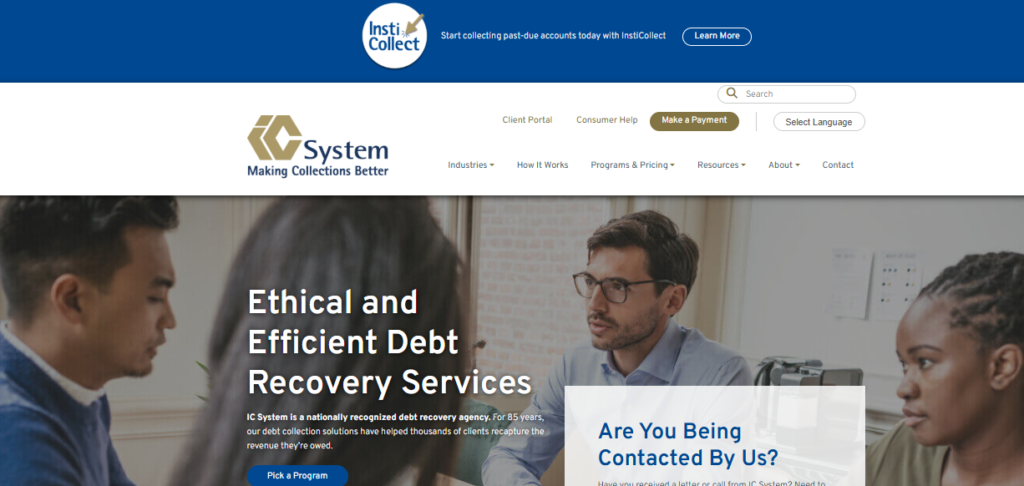
IC System has been family-owned since 1938, now in its third generation of management. With 85+ years in accounts receivable, they’re one of the longest-running collection agencies in North America.
In 2024, they launched OmniTouch, combining phone, text, email, letters, and a self-service payment portal with USA-based agents.
What stands out:
- Compliance depth. SOC 2 Type II certified. Only 6 complaints per 14 million digital interactions.
- Consumer experience tracking. They survey consumers during collections to measure satisfaction, which most agencies don’t do.
- Flexible pricing. Contingency, flat fee, and custom packages depending on volume.
Best for: Businesses that want an established, compliance-first agency with digital capabilities, especially in healthcare, government, and utilities.
Fit consideration: IC System is not a digital debt collection company in the same way as others on this list. Their foundation is traditional collections with digital added through OmniTouch. Businesses that need a digital-native platform may find better alignment elsewhere.
3. TrueAccord
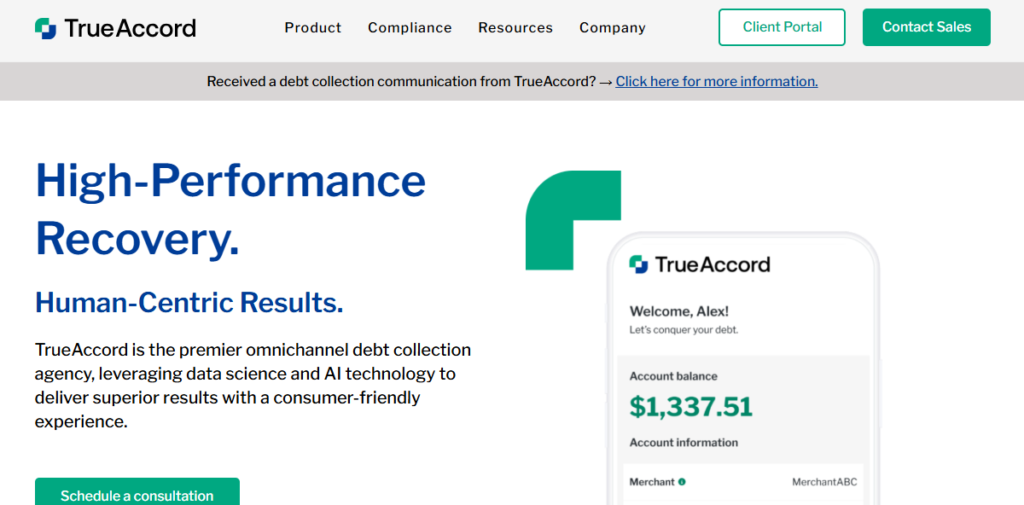
TrueAccord is one of the most recognized names in the digital debt collection company space. They run entirely on digital collections. Their patented HeartBeat engine uses machine learning to personalize every touchpoint per account.
In May 2025, TrueAccord acquired Sentry Credit, adding first-party collections and litigation services to its offering.
What stands out:
- Almost no phone contact. They reach consumers primarily through email and digital channels.
- Self-service resolution. Consumers settle accounts, set up payment plans, and make payments without ever talking to an agent.
- Machine learning at the core. HeartBeat learns from every interaction to optimize timing, channel, and messaging for each individual account.
Best for: Businesses in fintech, e-commerce, and lending that want a fully digital debt collection company and don’t need phone-based support for complex cases.
Fit consideration: The Sentry Credit acquisition added first-party and litigation capabilities, but TrueAccord’s core strength remains digital-only third-party collections. Accounts that require heavy human negotiation or combined calling + digital outreach may need a provider with deeper operational infrastructure.
4. InDebted
InDebted is a digital debt collection company founded in 2016 in Australia that now operates across the US, UK, Canada, and New Zealand. Their Collect product handles third-party consumer collections using machine learning to personalize outreach. They also added first-party capabilities through their acquisition of Receeve.
What stands out:
- Self-service resolution: Most customers resolve accounts independently through InDebted’s portal without speaking to an agent.
- Global footprint: They operate across five markets, which suits businesses with international receivables.
- Licensed in all US states, including New York City.
Best for: Fintech, telecom, BNPL, and utilities businesses that want a digital debt collection company with global coverage.
Fit consideration: InDebted entered the US market through acquisition and is still building its American track record. They don’t offer BPO or managed services that combine calling and digital outreach. Businesses needing deeper US-specific vertical expertise may need a more established partner.
5. January
January is a digital debt collection company founded in 2016 in New York City. Originally called Debtsy, they rebranded in 2022 and have since built an AI-driven collections platform serving lenders, credit unions, and debt buyers. They operate on a contingency model and reach consumers primarily through email, text, and a self-service portal.
What stands out:
- Compliance automation. They codify federal, state, and local rules into their system, reducing manual compliance oversight.
- Digital-only outreach. Minimal phone contact. Consumers resolve accounts through a self-service portal on their own terms.
- Built for financial institutions. Their client base is primarily lenders, credit unions, and debt buyers.
Best for: Lenders, credit unions, and fintech companies looking for a digital debt collection company focused on post-charge-off recovery.
Fit consideration: January’s client base is heavily weighted toward financial institutions and debt buyers. They don’t offer first-party collections, BPO, or managed services combining calling and digital. Businesses that need broader operational support or industry-specific expertise across verticals like healthcare or subscriptions will likely need a more full-service partner.
When Should You Outsource Debt Collection?
You should outsource debt collection when your internal team can no longer keep up with the volume of unpaid accounts, and your current recovery process isn’t bringing in the results it used to. Most businesses that reach this point already have an in-house collections team. The question isn’t whether they need one. It’s whether that team alone is enough.
Signs your current setup needs outside support:
- Unpaid accounts are piling up faster than your team can work them, and recovery rates are sliding. Gitnux 2025 data shows that 80% of collections happen within the first six months of an account going past due. The longer accounts sit, the harder they get to collect.
- Customers aren’t picking up the phone, and you don’t have other ways to reach them at scale.
- Your team spends more time chasing payments and handling disputes than doing their actual job. That drag on core operations adds up fast.
- Your current vendor isn’t performing. The recovery numbers aren’t where they need to be, or their approach feels outdated and aggressive.
- You’re moving into new states or verticals and don’t have the licensing or industry knowledge to collect compliantly in those markets.
- Compliance risks are growing, and your team doesn’t have dedicated oversight to keep up with changing regulations.
When you might not need to outsource yet:
- You have a small number of unpaid accounts and a strong internal process that resolves most of them quickly.
- Your average account value is too low to justify agency fees.
- You already have trained collections staff with dedicated compliance oversight in-house.
For most growing businesses, the tipping point hits when the cost of not collecting (bad debt write-offs, falling recovery rates, distracted teams) exceeds the cost of outsourcing debt collection to a professional agency.
At that point, the question shifts from “should I outsource?” to “which digital debt collection company should I outsource to?” The next section gives you the framework to evaluate that.
What to Check Before Choosing a Digital Debt Collection Partner
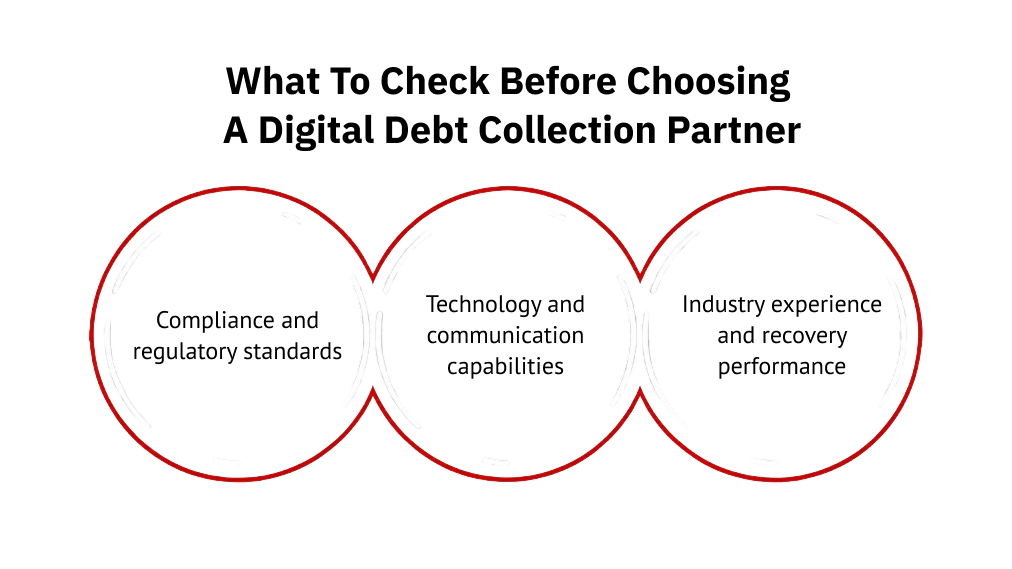
Before choosing a digital debt collection partner, verify three things: compliance and regulatory standards, technology and communication capabilities, and industry experience with recovery performance. A list of agencies is a starting point, not a decision. The right partner depends on how well they align with your specific requirements across these three areas.
This is the non-negotiable starting point. You carry legal liability if your collections partner violates regulations. A single compliance failure can expose your business to lawsuits, fines, and brand damage.
What to verify before signing:
- State-by-state licensing. Are they licensed where your customers are located?
- Bonding and errors-and-omissions insurance.
- Documented audit trails of all customer communications.
- Call monitoring and script compliance programs.
- Complaint resolution process and CFPB complaint history.
- Industry-specific requirements: HIPAA for healthcare accounts, PCI-DSS for payment processing.
Questions to ask:
- “Walk me through your compliance monitoring process.”
- “How do you handle a consumer complaint or dispute?”
- “Are you licensed in every state where our customers are located?”
Want to see how a compliance-first digital collections model works? Talk to First Credit Services.
Technology and Communication Capabilities
This is where modern agencies separate from legacy operators. Your customers already ignore phone-only outreach. The partner you pick should reach them where they actually respond.
What to evaluate:
- Do they use SMS, email, phone, chat, and digital portals, or just phone?
- Can customers self-serve (check balances, set up payment plans, pay around the clock) without speaking to an agent?
- Can they connect with your CRM, billing system, or payment gateway through API, SFTP, or direct sync?
- Do they offer both first-party (white-labeled, brand-sensitive early-stage recovery) and third-party collections? Agencies that offer both give you more flexibility across the account lifecycle.
Industry Experience and Recovery Performance
Collections in healthcare look different from auto finance or subscriptions. Each vertical carries different compliance layers, payment behaviors, and customer sensitivity.
What to ask:
- Which industries do they specialize in, and can they share anonymized recovery data from clients in your vertical?
- Do their agents receive industry-specific training?
- What reporting do they provide? Look for real-time dashboards or client portals, not monthly PDF summaries.
If an agency won’t share performance data when you ask, that tells you something. The best partners are upfront about their numbers because they know their results hold up. Treat transparency on recovery performance the same way you’d treat compliance: if it’s not there, walk away.
Conclusion
Start with compliance. Then evaluate technology and communication capabilities. After that, look at industry fit and recovery performance. Then compare pricing on a net-recovery basis. The right partner isn’t the biggest name or the cheapest fee. It’s the one whose compliance standards, technology, and industry depth match your business.
That’s the standard First Credit Services was built around. They combine compliance-first operations, digital-first collections through UCEP, and over 30 years of recovery experience across healthcare, auto finance, fintech, subscriptions, and more. Clients pay only when First Credit Services collects.
If you’re evaluating collection partners, schedule a consultation to see what the recovery model looks like with your account volume.
FAQs
1. How long does it take to set up with a digital debt collection agency?
Most agencies complete onboarding in 2 to 4 weeks. This includes data integration, compliance review, account segmentation, and communication setup. Complex integrations with CRMs or billing systems may take longer depending on your tech stack.
2. Can a debt collection agency report to credit bureaus on my behalf?
Yes. Most third-party agencies report account status to major credit bureaus as part of their standard process. Ask whether reporting is included in your agreement or charged as an add-on, and confirm they follow CFPB and FCRA reporting guidelines.
3. What happens to accounts that a collection agency can’t recover?
Unrecovered accounts are typically returned to the client after an agreed period, usually 90 to 180 days. At that point, you can place them with a different agency, pursue legal action, or write them off. Contingency clients pay nothing on returned accounts.
4. Can I use more than one collection agency at the same time?
Yes. Many businesses split placements by account age, balance size, or industry vertical. For example, you might use one agency for early-stage accounts and another for aged portfolios. Just make sure your agencies don’t contact the same consumer.
5. How does a collection agency protect my customer data?
Reputable agencies use encrypted file transfers (SFTP or API), SOC 2 certified infrastructure, and role-based access controls. Ask for their data security policy, breach notification process, and whether they carry cyber liability insurance before placing accounts.
6. What is the minimum number of accounts needed to work with a collection agency?
There’s no industry standard. Some agencies accept as few as 10 accounts per month, while others require minimum placement volumes or balance thresholds. Ask about minimums upfront so you don’t commit to a partner that doesn’t fit your volume.
