


Who owns an overdue invoice once your payment reminders go unanswered?
In many businesses, the answer is no one. The reminder is automated, but nobody was assigned the step that comes after it. The account then sits untouched and gets harder to recover each week.
Early stage debt recovery solutions exist to assign that step. They are the services, technology, and outsourced programs that work past-due accounts in the first 1 to 90 days. Their job is to resolve the balance before formal collection becomes necessary.
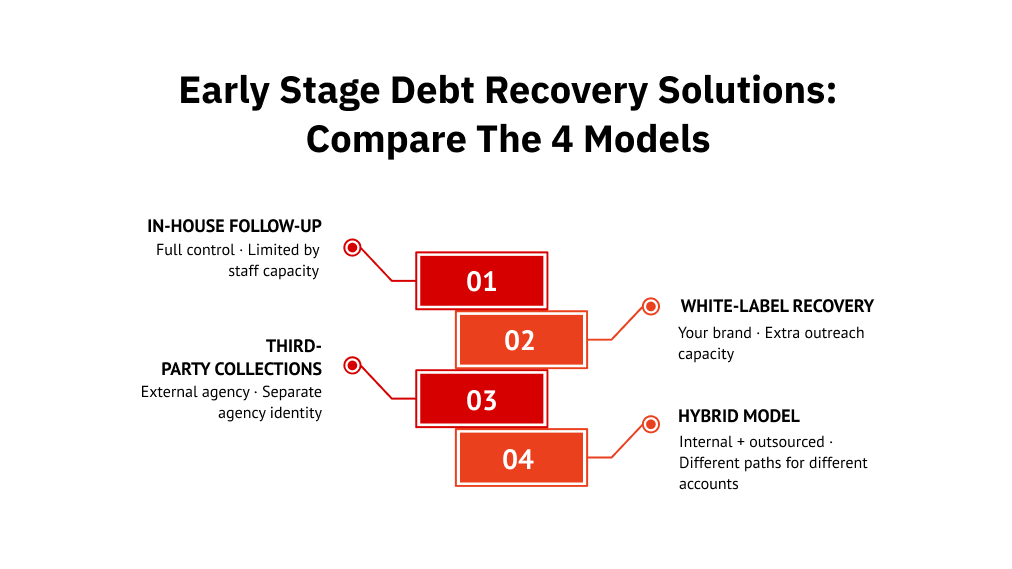
As a result, your real choice is which model takes that ownership. Your options include in-house follow-up, first-party outreach, third-party placement, or a blend.
This guide covers each model and how to match one to your business. It also shows what to evaluate before you commit.
What are early-stage debt recovery solutions?
Early-stage debt recovery solutions include tools, technology, and outsourced services for receivables 1 to 90 days past due. Put simply, they operate once standard dunning stalls and before write-off, third-party placement, or legal action.
A “solution” here is broader than a single product. It can be internal software, an outsourced first-party program, a third-party agency, or a combination. For example, some businesses pair their own reminders with pre-collection services from an outside partner.
The key difference is how overdue accounts are managed. Routine AR follow-up covers invoicing, reconciliation, and payment reminders. Early-stage recovery adds a structured process for accounts that remain unpaid, with defined outreach steps, dispute handling, and escalation criteria.
| Compliance check: Does the FDCPA cover commercial debt? Commercial debt generally falls outside the Fair Debt Collection Practices Act (FDCPA). The law applies to debts incurred for personal, family, or household purposes. Even so, coverage can vary under state laws. Therefore, confirm the applicable rules before assuming an exemption. |
The next step is to look at the models you can choose between.
The solution models businesses choose between
Before you select a recovery model, clarify five things about your operation:
- Control: How much of the outreach process does your internal team need to own?
- Brand experience: Should customers continue interacting under your company’s name?
- Internal capacity: Can your AR team manage follow-up as account volume grows?
- Escalation path: When should accounts move from early-stage recovery to third-party placement?
- Vendor management: Do you want separate providers for each stage or one partner across the lifecycle?
Your answers narrow the field to four models, starting with the one most teams already run.
In-house AR and credit team follow-up
This model keeps recovery inside your organization. Your internal staff handles reminders manually or with software support. They work through your existing ERP, invoicing, and account-management tools. This keeps full control and adds no new vendor relationship. The limit is staff capacity, since contact volume can only grow as far as your team allows.
When capacity runs out, the next option adds outside help without changing your brand.
White-label early-stage recovery
In this model, an outside partner contacts the customer under your brand. Your recovery capacity grows, and the customer still sees your company’s name on every message. That makes it a natural fit for early intervention debt collection. In addition, you avoid hiring or training more staff.
Still, some accounts stay silent, and those call for a firmer step.
Signals it’s time to change, and what a well-matched solution delivers
Switching recovery models carries cost and disruption. The following four signals show when staying put costs you more:
- Unworked accounts past 30 days: A rising share of overdue accounts sits idle because no one owns the follow-up.
- Disputes treated as non-payment: Disputes and short-pays pile up with no routing step. Legitimate billing disagreements then get the same treatment as unpaid accounts.
- Blind spots in recovery data: Recovery data exists, yet no one breaks it out by days past due. Because of this, nobody can see where the process is failing.
- No self-service payment option: Every resolution depends on a live call connecting. If the customer misses that call, the account waits for the next attempt.
| Did you know? According to the QuickBooks 2026 Small Business Late Payments Report, overdue invoices run deep for 22% of small businesses. For that group, at least 20% of invoices sit unpaid past 30 days. |
A well-matched solution fixes these signals directly. It segments accounts by age and balance. From there, it routes outreach through the channel most likely to get a response. Well-run early-stage collection services replace repeated generic reminders with this kind of targeted outreach.
Once that structure is in place, you can expect three changes:
- Accounts are worked on a defined schedule.
- Disputes move to their own resolution queue.
- Reporting shows where accounts stall in each days-past-due band.
With these signals in view, the next step is knowing what to evaluate before you choose.
What to evaluate before choosing a solution
Once you have a model in mind, test the specific provider behind it. The following four checks matter most in early debt recovery:
- Commercial documentation readiness: Confirm the solution can work from a signed credit application, purchase order, and invoice trail. It should also flag accounts missing a personal guarantee or purchase order match before outreach starts.
- Pricing model transparency: Get the fee structure in writing before you compare options. The structure may be contingency, flat license, or blended. Likewise, confirm what happens to cost if an account moves between models partway through.
- Contractual data rights: Confirm what happens to account history and payment records if you end the relationship entirely. This question goes beyond moving an account between stages with the same provider.
- Dispute and short-pay handling: Ask how the solution handles purchase order mismatches, short-pays, and retainage holds. Otherwise, a solution with no dispute-routing step will treat a billing disagreement like non-payment.
Once a provider passes these checks, the remaining question is whether the model fits your business.
Matching the solution to your business profile
The right recovery model depends on three variables specific to your operation:
- By invoice volume and average balance: High-volume, lower-balance portfolios usually justify automation or a managed first-party program first. For these portfolios, a per-account third-party fee structure tends to come later.
- By industry: Construction, distribution, and professional services carry different dispute rates and documentation needs. As such, the time an account takes to become recovery-ready varies by industry.
- By internal team capacity: A credit team stretched across invoicing, reconciliation, and reporting has less room for consistent early-stage outreach. In that case, outsourced pre-collection services can carry the follow-up for you.
At FCS, we run first-party outreach under your brand, so your team can focus on credit decisions. Unresolved accounts can move to our third-party collections under the same contract.
| Pro tip: Map how your team spends its week before you evaluate providers. If outreach and follow-up crowd out credit analysis and dispute resolution, capacity is your constraint. |
Common mistakes businesses make when choosing a solution
Four mistakes come up often when businesses select early-stage collection services:
- Forcing an either-or choice: Many businesses treat in-house and outsourced recovery as mutually exclusive. In-house software and debt collection outsourcing services can run side by side. Each one can serve a different account segment.
- Skipping the integration test: Test how the solution connects with your invoicing or ERP data before you commit.
- Signing a long-term contract too early: Start with a defined trial period. Then, confirm performance on your actual account mix before you sign for longer.
- Placing accounts before confirming certification: Confirm a third-party agency’s independent certification before any accounts move. Similarly, check for HIPAA compliance on healthcare accounts and PCI DSS compliance on card payments. Otherwise, compliance gaps may surface after accounts are already placed.
Avoiding these mistakes gets you to the right choice, and the rollout decides whether it works.
Rolling out a new early-stage recovery solution without disrupting current recovery
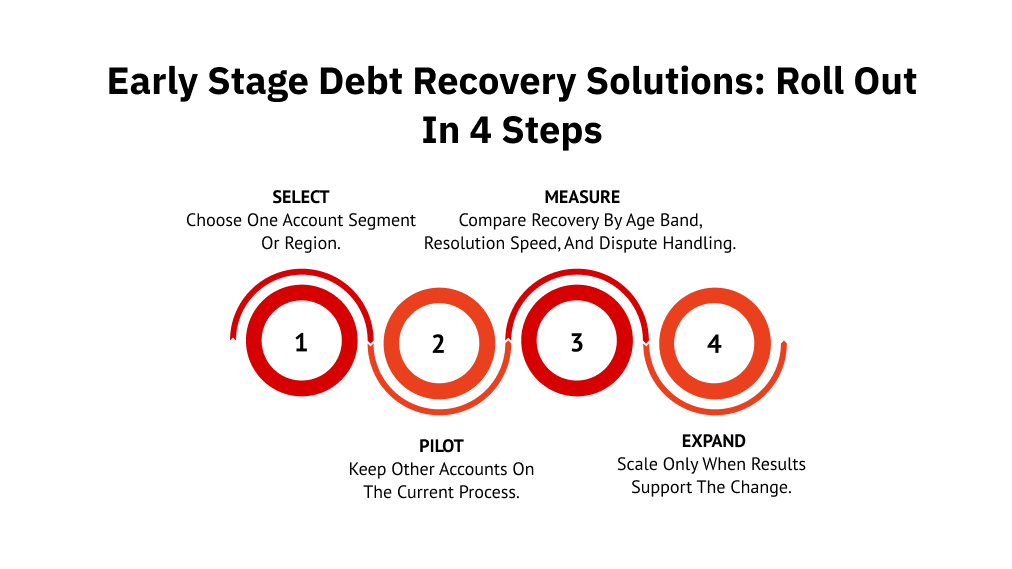
Switching models mid-portfolio is where most of the risk sits. A rollout that skips piloting or data handoff can cost more in disrupted recovery than the new solution gains back. Accounts already in an outreach cycle can lose momentum if the change lands on them all at once.
For this reason, any change to your early debt recovery process should begin with a pilot.
Piloting before a full portfolio switch
A pilot tests the new model on a small part of your portfolio first. Follow the steps below:
- Pick one account segment or one region for the new model.
- Keep every other account on your current process during the pilot.
- Track recovery by age band for the pilot group.
- Compare those results against your current baseline before you expand.
During the pilot, watch the two things below:
- Resolution speed: Track how quickly an account moves from first contact to payment or escalation.
- Dispute handling: Track how many billing disagreements get classified as non-payment. A high count points to a missing dispute-routing step.
That way, the decision to switch rests on evidence from your own accounts. A vendor’s pitch cannot give you that proof.
A pilot proves the model works, and the data handoff keeps it working at scale.
What a clean data handoff looks like
The handoff decides how much account context the new provider starts with. A clean one moves four types of data:
- Invoice details: what each customer owes and on which terms
- Payment history: what has been paid and what remains outstanding
- Contact records: who to reach on each account
- Dispute notes: which issues are open and what has been tried
This data should transfer through an application programming interface (API), SSH File Transfer Protocol (SFTP), or a direct system sync. Manual file transfer is the method to avoid. At the same time, confirm the new provider can ingest historical account notes along with the current balance. That step keeps account context intact when the account moves.
With the rollout planned, you are ready to make the final choice.
Choosing the right early-stage recovery solution for your business
The right early stage debt recovery solution depends on your invoice volume, your industry, and your team’s capacity.
Above all, any early debt recovery provider should offer certification, system integration, and reporting by account age. Unresolved accounts also need a defined next step.
Still deciding whether your overdue accounts need a new tool or a new team? Explore with FCS how your portfolio maps against our solution models. Together, we can identify where your in-house process works and where outside support adds value.
FAQs
1. When should a business outsource early-stage debt recovery?
Consider outsourcing when your internal team cannot consistently follow up on overdue accounts, payment promises are being missed, or disputes and aging balances are not being resolved promptly. Before moving accounts, verify the balances, review open disputes, and define which accounts the provider will handle. The right timing depends on your account types, internal capacity, contractual terms, and applicable requirements.
2. Does running more than one early-stage recovery solution at once create reporting conflicts?
Yes, if the two solutions track recovery differently. Confirm both report on the same days-past-due bands before you run them side by side. Without that match, the combined numbers will not be comparable. You would then struggle to see which solution is driving results.
3. Does the cost of an early-stage debt recovery solution typically drop after the first 90 days of a program?
Not necessarily. Pricing depends on the provider’s fee structure, account volume, account characteristics, and contracted services. Ask whether rates change over time or when accounts move between programs, and confirm the terms in writing.
4. How long does it take to see results after switching to a new early-stage debt recovery solution?
Most businesses see measurable movement within the first 60 to 90 days. Early-stage solutions are built around that window. Full portfolio impact takes longer to show in blended recovery rates. Compare results by age band during that period to judge progress fairly.
5. Can a solution built for one industry be reused if a business expands into another?
No. Dispute patterns and documentation requirements differ by industry. A solution tuned for one industry, such as construction, usually needs reconfiguring before it fits another. Review the dispute routing and the document checks again before you extend the solution to a new sector.
6. Do accounts already in progress need to pause or restart when a business adds a new early-stage recovery solution?
No. A phased rollout can run the new solution on new or select accounts first. Accounts already in an active outreach cycle continue under the current process until the pilot proves out. This approach keeps current recovery steady while you test the new model.