

A missed payment rarely starts as a major collection problem. It may begin with a forgotten due date, a failed payment method, or a customer facing a temporary financial challenge. But when hundreds or thousands of accounts enter delinquency at once, small delays can quickly turn into lost revenue, overloaded AR teams, and rising recovery costs.
The challenge is becoming more common. The Federal Reserve Bank of New York reported that 4.5% of outstanding household debt was in some stage of delinquency in Q3 2025, highlighting the continued pressure organizations face when managing overdue accounts.
The earlier businesses respond, the more opportunities they have to resolve accounts before they become harder to recover.
Early intervention debt collection services help organizations create a structured approach for engaging customers, simplifying payments, and managing accounts during the first stages of delinquency.
This guide explains what a strong early-stage collection program includes, how outreach should change across delinquency stages, and how to decide whether an in-house or outsourced model is the better fit for your organization.
What are early intervention debt collection services?
Early intervention debt collection services are first-party, early-lifecycle outreach programs designed to help resolve overdue accounts before they progress into later-stage collections. These programs typically focus on the first 1 to 90 days past due, when customers are still more likely to respond, make payments, or set up suitable arrangements.
Also known as early-out collections, pre-collection services, soft collections services, or early delinquency outreach, early intervention focuses on resolution rather than recovery after an account has already become severely delinquent. The goal is to reconnect with customers quickly, understand the reason behind the missed payment, and provide a simple path to resolution.
Unlike third-party collections, where an external agency typically contacts consumers after accounts have been assigned for recovery, early intervention usually happens while the original creditor still owns the customer relationship. This timing allows organizations to address payment issues while maintaining a more positive customer experience.
Why acting early is a business decision, not just an operations one
Early intervention is often viewed as a collections activity, but its impact extends directly into revenue protection, customer retention, and operational efficiency. The longer an account remains unpaid, the more difficult and expensive it becomes to resolve. A missed payment that could have been addressed with a simple reminder or payment option can eventually require more intensive recovery efforts.
According to the Federal Reserve Bank of New York, delinquency transitions continue to show that borrowers who move into more serious delinquency stages have a higher likelihood of remaining overdue or progressing further. The longer an account stays delinquent, the fewer opportunities businesses have to influence a voluntary resolution.
This creates a direct business case for early intervention. Organizations that wait until accounts become severely delinquent often face:
- Higher operational costs because teams spend more time chasing older accounts.
- Lower recovery rates because customers may become harder to reach or less able to pay.
- Increased account roll rates as balances move from early delinquency into later stages.
- Greater pressure on internal teams managing large follow-up queues.
A strong early intervention strategy helps prevent these issues by creating a repeatable process for identifying overdue accounts, prioritizing outreach, and guiding customers toward resolution.
Early intervention protects more than recoveries
The benefits of early-stage debt collection services extend beyond improving payment rates. They also help organizations build a more predictable accounts receivable process.
A structured early intervention program gives AR leaders better visibility into:
- Which customer segments are most likely to self-resolve.
- Which accounts need additional support or payment flexibility.
- Which communication channels generate the strongest response.
- When an account should move to the next stage of collections.
This data helps teams make better decisions instead of treating every delinquent account the same way.
For growing organizations, the challenge is rarely recognizing the value of early intervention. The harder part is building the systems, staff capacity, compliance controls, and outreach infrastructure needed to run it consistently. That is where managed early intervention debt collection services can help by providing the processes and technology needed to engage customers before delinquency becomes a larger financial issue.
What an early intervention program actually includes
A successful early intervention debt collection program creates a structured process that helps organizations identify overdue accounts, understand customer behavior, communicate through the right channels, and make payment resolution easier.
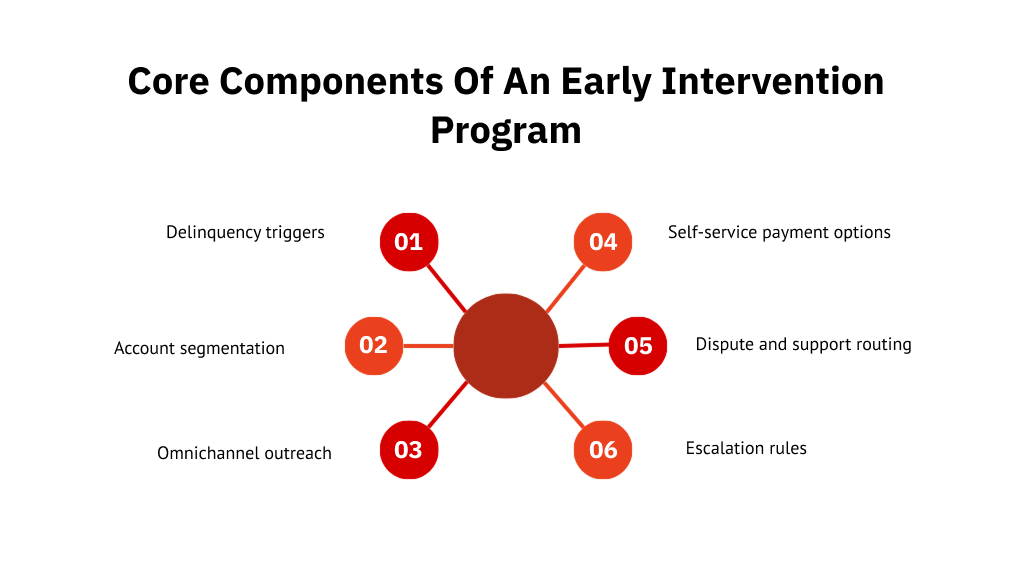
The strongest programs combine six core components:
- Delinquency triggers: Clear rules determine when an account enters early intervention. This could be immediately after a missed payment, after a specific number of days past due, or based on account risk indicators.
- Account segmentation: Accounts are grouped based on factors such as delinquency age, payment history, outstanding balance, customer behavior, and preferred communication channel. This allows teams to focus effort where it has the highest impact.
- Omnichannel outreach: Customers receive communication through channels that match their preferences and the urgency of the situation. This may include SMS, email, voice calls, and digital payment notifications.
- Self-service payment options: Customers should be able to resolve their accounts quickly without unnecessary steps. Payment links, online portals, automated plans, and digital confirmations reduce friction.
- Dispute and support routing: Not every overdue account is caused by an inability to pay. Some involve billing questions, service issues, or account errors. A strong program routes these cases to the right team instead of continuing collection activity.
- Escalation rules: Accounts that remain unresolved need clear next steps. Escalation criteria help determine when an account requires additional outreach, specialized handling, or transition into later-stage collections.
The goal is resolution, not repeated reminders
Many early collection programs fail because they focus only on increasing contact attempts. More messages do not automatically create more payments. Customers are more likely to resolve overdue balances when the process is simple, relevant, and connected to their specific situation.
For example, an account that is five days overdue because of a missed autopay setup requires a different approach from an account where the customer has disputed the balance or requested financial assistance.
A resolution-focused program considers:
- Why the account became overdue
- How likely the customer is to respond
- Which channel is most effective
- What payment option fits the situation
This approach improves customer experience while helping businesses recover more accounts earlier in the lifecycle.
Segmentation logic determines program effectiveness
Segmentation is one of the most important parts of early-stage collection services because every delinquent account carries different levels of risk and resolution potential. A simple segmentation model may consider:
| Segment factor | How it influences outreach |
| Days past due | Determines urgency and message frequency |
| Balance size | Helps prioritize high-value accounts |
| Previous payment behavior | Identifies reliable payers versus higher-risk accounts |
| Customer engagement history | Shows preferred channels and responsiveness |
| Account status | Separates payment issues from disputes or service concerns |
By combining segmentation with automation and human support, organizations can avoid treating every overdue account the same way. This improves efficiency for collection teams and creates a smoother experience for customers who are willing to resolve their balances.
Designing the outreach: Timing windows and channel cadence
The effectiveness of early intervention depends heavily on when outreach happens and how the message changes as an account moves further into delinquency. A customer who is one day late usually requires a different conversation than someone who has been overdue for 60 days.
A strong early delinquency outreach strategy follows a staged approach. The goal is to reach customers early, provide convenient resolution options, and increase support as the likelihood of non-payment grows.
The most important window is typically the period between the payment due date and the first 60 days past due. During this stage, many accounts can still be resolved through reminders, digital payment options, and customer-friendly conversations before they require more intensive collection efforts.
A practical early intervention timeline
| Delinquency stage | Primary objective | Recommended actions |
| 1–15 days past due | Remind and make payment easy | Send friendly payment reminders through SMS and email, provide direct payment links, confirm account details |
| 16–30 days past due | Encourage resolution and identify barriers | Increase communication frequency, offer self-service options, identify disputes or payment challenges |
| 31–60 days past due | Move toward active resolution | Add personalized outreach, agent-assisted conversations, payment arrangements, and hardship support where applicable |
| 61–90 days past due | Prevent further escalation | Prioritize unresolved accounts, review payment commitments, prepare appropriate next-stage actions |
1–15 days past due: focus on awareness and convenience
The first few days after a missed payment often involve simple issues. Customers may have forgotten the due date, experienced a failed payment method, or missed an automated transaction.
Communication during this stage should feel helpful rather than urgent. The objective is to remind customers while making the next step simple.
Common actions include:
- A short SMS reminder with a secure payment link.
- An email with account details and payment options.
- Automated notifications confirming available self-service options.
At this stage, businesses should avoid creating unnecessary friction. A customer who is ready to pay should not need to navigate multiple screens or contact support to complete a basic payment.
16–30 days past due: identify the reason behind delinquency
When an account remains unpaid beyond the initial reminder period, outreach should become more targeted. This is the stage where organizations can learn whether the issue is forgetfulness, a payment difficulty, a dispute, or a lack of engagement.
Messages can introduce additional support options, such as:
- Alternative payment methods.
- Flexible payment arrangements where applicable.
- Assistance for customers who need help understanding their balance.
This stage is also where segmentation becomes valuable. Customers with a history of reliable payments may respond well to automated reminders, while higher-risk accounts may require earlier agent involvement.
31–60 days past due: prioritize active resolution
Accounts that remain unpaid after a month require more personalized engagement. Automated communication can continue, but businesses should introduce human support for customers who need assistance.
Agent conversations can help:
- Understand payment challenges.
- Resolve account questions.
- Address disputes.
- Confirm payment commitments.
The focus shifts from simply notifying customers to actively helping them reach a resolution.
61–90 days past due: prepare for escalation while preserving context
At this stage, unresolved accounts carry a higher risk of becoming long-term delinquencies. Organizations should review account history, previous outreach attempts, and customer responses before deciding on the next action.
A well-managed early intervention program ensures that any account moving forward has complete context, including:
- Previous communication history.
- Customer preferences.
- Payment promises.
- Dispute details.
- Resolution attempts.
This prevents customers from repeating the same information during future collection stages and creates a smoother transition if escalation becomes necessary.
Channel sequencing matters as much as timing
Using multiple channels does not mean using every channel at every stage. Effective programs match the communication method to customer behavior, urgency, and the type of resolution required.
SMS for quick attention
SMS works well for short reminders because customers can see the message immediately. It is useful for:
- Payment reminders.
- Due date notifications.
- Direct payment links.
- Confirmation messages.
Email for detailed information
Email is better suited for messages that require more context, such as:
- Account summaries.
- Payment instructions.
- Policy explanations.
- Confirmation of arrangements.
Voice outreach for complex situations
Calls are valuable when automated channels do not resolve the issue or when customers need assistance. Agent conversations can address questions, disputes, and situations where a personalized approach improves the chance of resolution.
Digital portals for self-service resolution
A customer portal allows customers to review balances, select payment options, and complete transactions without waiting for assistance.
The strongest early intervention programs do not follow a fixed script for every account. They combine timing, segmentation, and channel preferences to create outreach that feels relevant while improving recovery outcomes.
| Did you know? According to McKinsey’s 2024 Digital Payments Survey, 92% of US consumers reported making some form of digital payment in the past year. The growing adoption of digital payment methods highlights why early intervention programs need simple digital payment options that allow customers to resolve overdue accounts quickly and conveniently. |
Build vs buy: Should you run early intervention in-house or outsource it?
Building an early intervention debt collection program requires more than assigning a team to follow up on overdue accounts. Organizations need the right people, technology, compliance processes, communication channels, reporting systems, and operational workflows to consistently manage accounts during the first stages of delinquency.
The right choice depends on account volume, operational complexity, customer expectations, and the level of infrastructure already available.
When managing early intervention in-house works
An internal early-stage collection program can be effective when organizations have:
- A manageable number of delinquent accounts.
- A dedicated AR team with enough capacity for proactive outreach.
- Existing customer communication systems.
- Established compliance and reporting processes.
- Simple account structures and limited channel requirements.
For example, a smaller organization with a predictable customer base may be able to manage early reminders through its existing billing platform. The team may already understand customer history and can handle payment questions directly.
However, as delinquency volumes increase, internal teams often face competing priorities. AR departments are responsible for invoicing, reconciliation, reporting, customer support, and revenue forecasting. Adding continuous early intervention outreach can create additional workload and make consistent follow-up difficult.
When outsourcing early intervention makes sense
Outsourcing becomes valuable when organizations need additional scale, specialized expertise, or stronger operational coverage. A managed early intervention partner can help when businesses experience:
- Growing delinquency volumes that exceed internal capacity.
- The need for omnichannel outreach across SMS, email, voice, and digital channels.
- Increasing compliance requirements across jurisdictions.
- Limited after-hours or multilingual customer engagement capabilities.
- A need for better reporting and performance visibility.
A specialized provider already has the workflows, technology, trained agents, and quality controls required to manage early delinquency outreach. This allows internal teams to focus on core financial operations while maintaining a consistent customer resolution process.
The cost of an in-house program is often measured by staffing needs alone. In reality, organizations also need to account for the systems and processes required to operate effectively.
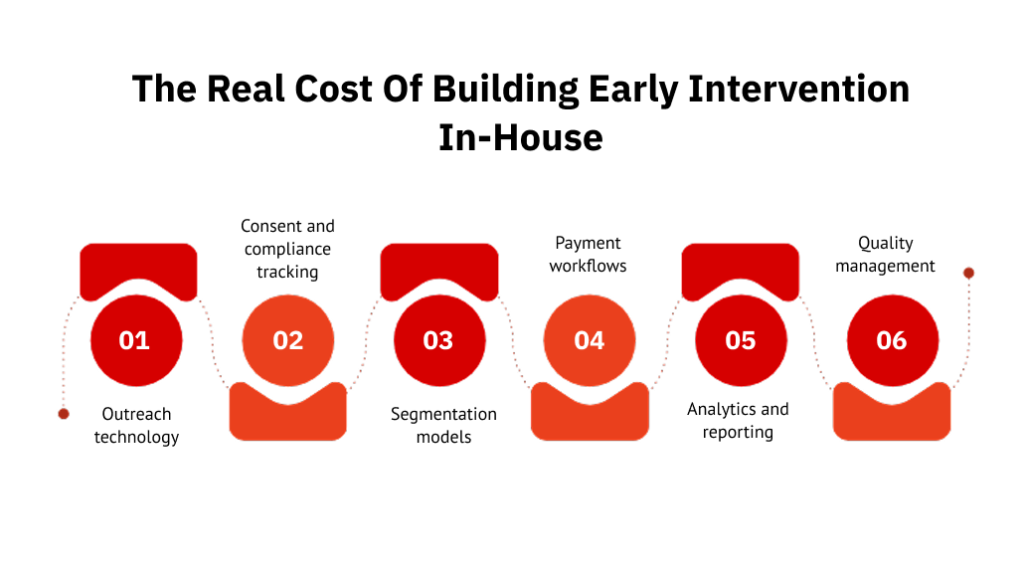
A mature early intervention program requires investment in:
- Outreach technology: Systems that manage customer communication across multiple channels.
- Consent and compliance tracking: Processes to document communication permissions and follow regulatory requirements.
- Segmentation models: Rules that determine which accounts receive automated outreach versus personalized handling.
- Payment workflows: Secure options that allow customers to resolve accounts quickly.
- Analytics and reporting: Dashboards that track recovery rates, response rates, and operational performance.
- Quality management: Training, monitoring, and process improvements for customer interactions.
These capabilities require ongoing maintenance as customer expectations, regulations, and communication preferences change.
A practical decision framework
Organizations can evaluate the build-versus-buy decision by asking:
| Question | If the answer is yes, consider |
| Do we have enough internal capacity to contact every eligible account consistently? | In-house management may work |
| Are delinquency volumes increasing faster than our team can handle? | Outsourcing may provide faster scalability |
| Do we need SMS, email, voice, and digital payment journeys? | A specialized partner may reduce complexity |
| Are compliance requirements becoming harder to manage? | External expertise may help strengthen controls |
| Do we need coverage outside normal business hours? | A managed service may provide better reach |
The decision is ultimately about creating a reliable early intervention process. Whether managed internally or through a partner, the program should deliver timely outreach, easy payment resolution, accurate reporting, and a consistent customer experience.
What good looks like: Compliance and performance standards
A strong early intervention debt collection program balances compliance, customer experience, and recovery outcomes. Success is not measured only by how many accounts are contacted, but by how effectively outreach resolves delinquency, prevents roll-forward, and follows required communication standards.
1. Compliance guardrails for early intervention outreach
Early intervention happens before charge-off, but programs still need to follow applicable consumer protection and communication requirements. While first-party programs differ from third-party collections, responsible outreach practices remain essential.
Key compliance areas include:
- Consent management: Maintain records of customer communication permissions, especially for SMS and automated calls.
- Contact controls: Set outreach frequency rules to prevent excessive communication.
- Account accuracy: Ensure teams use updated balance and account information to avoid errors and disputes.
- Dispute workflows: Provide clear processes for reviewing and resolving customer concerns.
- Data security: Protect payment details and customer information through secure systems.
Regulations such as the Consumer Financial Protection Bureau’s Regulation F provide guidance around debt collection communications, while TCPA and consumer protection requirements may also apply based on the outreach method and jurisdiction.
Measuring the performance of an early intervention program
A mature program tracks performance across each delinquency stage instead of relying on a single recovery metric. This helps teams understand which strategies resolve accounts and where improvements are needed.
| Metric | What it measures |
| Cure rate | Percentage of accounts returned to current status |
| Roll-rate reduction | Accounts prevented from moving into later delinquency stages |
| Promise-to-pay completion | Successful completion of customer payment commitments |
| Channel response rate | Customer engagement across SMS, email, voice, and digital channels |
| Cost per recovered dollar | Operational cost compared with recovered revenue |
| Resolution time | Time taken to resolve delinquent accounts |
Why stage-based measurement matters
A single overall recovery rate can hide important details. For example, a program may perform well with recently overdue accounts but struggle with accounts approaching 90 days past due.
Breaking performance down by delinquency stage helps organizations answer questions such as:
- Are customers responding to the first outreach attempt?
- Which channels create the highest engagement?
- Are payment arrangements being completed?
- Where do accounts begin rolling into more serious delinquency?
- Is additional human support needed at certain points?
This information allows teams to continuously improve outreach strategies instead of relying on fixed collection processes.
How First Credit Services runs early intervention
A successful early intervention program requires more than sending payment reminders. It needs structured outreach, payment resolution workflows, compliance controls, and visibility into account performance.
First Credit Services helps organizations manage early intervention as an extension of their accounts receivable team. Its managed first-party early-out approach allows businesses to maintain their customer relationships while using dedicated resources to engage customers during the early stages of delinquency.
The program operates as a white-label extension of the client’s brand, with First Credit Services managing outreach, resolution workflows, and operational support behind the scenes.
A managed extension of your AR team
Many organizations lack the time and resources to consistently manage early delinquency outreach. A managed early intervention model helps address this by providing:
- Dedicated teams trained in early account resolution.
- Structured outreach workflows across multiple channels.
- Reporting visibility into account activity and outcomes.
- Support for customer questions, disputes, and payment barriers.
- Seamless escalation of unresolved accounts when needed.
This allows internal AR teams to focus on broader financial operations while maintaining a consistent approach to overdue accounts.
Omnichannel outreach connected to payment resolution
Effective early intervention combines timely communication with convenient payment options. First Credit Services uses digital debt collection channels such as SMS, email, and voice outreach alongside digital payment solutions to help customers resolve accounts with less friction.
Customers can move from a payment reminder to a resolution option quickly, while trained representatives can step in when accounts require additional support, such as payment arrangements or dispute assistance.
Seamless escalation without losing customer context
Some accounts remain unresolved despite early outreach. When this happens, a connected workflow ensures the account history moves forward with the customer.
Important information, including communication history, payment commitments, disputes, and previous resolution attempts, helps create a smoother transition into later collection stages.
Technology-supported program management
First Credit Services uses UCEP as part of its managed early intervention approach. The platform supports account workflows, communication activity, and reporting visibility as part of a broader managed service model.
With contingency-based pricing, organizations can access the operational support and technology needed for early-stage collection activity without building every capability internally.
For businesses looking to improve early account resolution, First Credit Services provides the people, processes, and technology needed to engage customers earlier and reduce the number of accounts moving into more challenging collection stages.
Want to learn how an early intervention program can improve your recovery process?
Talk to us at First Credit Services to explore a managed approach built around your business needs.
FAQs
1. What is early intervention in debt collection?
Early intervention in debt collection is a first-party outreach process that resolves overdue accounts during the early stages of delinquency, usually within 1 to 90 days past due. It uses timely communication, payment options, and support to help customers resolve balances before escalation.
2. How is early intervention different from third-party collections?
Early intervention happens before accounts reach later collection stages, while the original creditor maintains the customer relationship. Third-party collections typically begin after further delinquency, when accounts require more intensive recovery efforts and external collection support.
3. When should an account enter early intervention?
Accounts typically enter early intervention immediately after a missed payment or within the first few days of delinquency. Acting during the first 60 days gives organizations an opportunity to resolve issues while customers are still more likely to respond.
4. Does early intervention comply with Regulation F and the FDCPA?
Early intervention programs should follow applicable consumer protection requirements, including communication rules, consent management, dispute handling, and data security practices. While first-party programs differ from third-party collections, responsible outreach standards still apply.
5. What does early intervention debt collection cost?
The cost of early intervention services depends on account volume, outreach channels, program complexity, and pricing model. Providers may charge through contingency-based pricing or per-account fees. Organizations should evaluate costs alongside recovery improvements and operational savings.
6. Should you run early intervention in-house or outsource it?
In-house programs may work for organizations with lower volumes and strong AR resources. Outsourcing can help businesses that need scalability, omnichannel outreach, compliance support, or specialized expertise without building the entire early intervention infrastructure internally.