

Every unpaid balance your team can’t recover chips away at earned revenue.
For lenders, healthcare providers, utilities, and subscription businesses, older accounts are hardest to resolve. Over time, calls go unanswered and staff time runs thin. Worse still, each month pushes more balances toward write-off.
A bad debt collection agency takes over accounts your team can no longer move. It works each account by age, balance, and reachability, then returns the funds. Choosing well means weighing models, fees, net recovery, compliance, and customer treatment.
To help you decide, this guide compares six agency types and their fees. It also covers a 100-point scorecard, red flags, and portfolio fit.
What is a bad debt collection agency?
Bad debt is a customer balance a business considers unlikely to collect, or has already written off as a loss. A bad debt collection agency is a third-party company hired to recover these balances after internal efforts have stalled.
To do this, the agency contacts your customers by phone, email, SMS, or self-service portals. It then collects payment and returns the funds, usually for a contingency fee.
In each of those conversations, a bad debt recovery agency also speaks for your brand. As a result, its tone shapes how your customers see you.
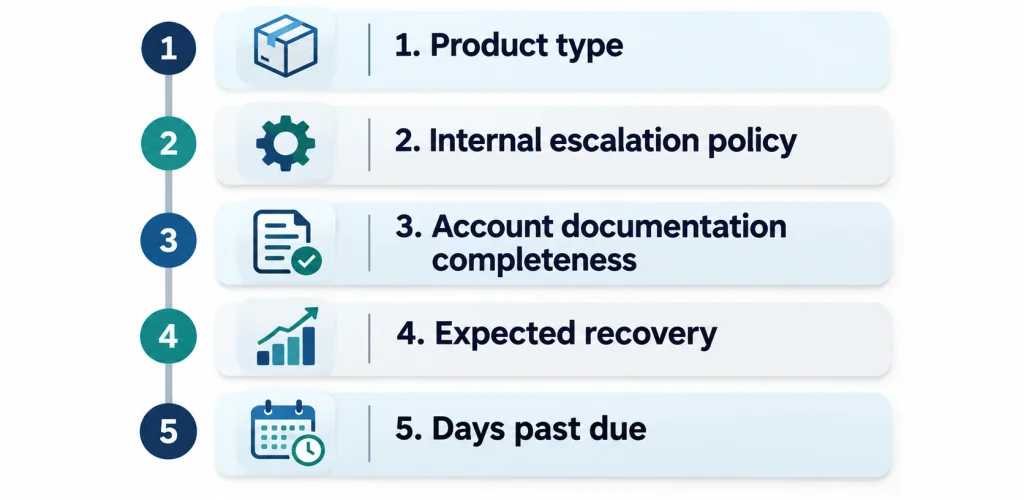
In addition, placement timing depends on several factors:
- The product type the balance came from
- Your internal escalation policy
- How complete the account documentation is
- The recovery you expect from the account
- How long the account has been past due
Every bad debt account sits at one stage of a longer lifecycle. To see where it fits, compare it with the earlier stages below.
Bad debt vs. delinquent accounts vs. charged-off debt
The stages below are illustrative. Actual timing varies by account type, creditor policy, and applicable accounting or regulatory rules.
| Account status | Illustrative age | What it means for your business | Who usually works it |
| Delinquent | Recently past due | The customer is behind but may still pay after reminders. | In-house team or first-party collections |
| Seriously delinquent | Several months past due | Internal efforts have stalled, and the risk of loss is rising. | Primary collection agency |
| Charged off (bad debt) | Set by product type and creditor policy | Written off as a loss, but the customer still owes the balance. | Primary or secondary agency, or a debt buyer |
Delinquent accounts generally remain part of accounts receivable until they are written off under the creditor’s accounting policy. However, businesses can place accounts with a collection agency before or after charge-off, depending on their internal policies and the type of debt.
| The numbers may surprise you: U.S. credit card balances reached $1.26 trillion in Q2 2026. Card balances also moved into serious delinquency at an annualized rate of 6.97%. |
Because accounts reach agencies at different stages, agencies come in several models, each built for a different kind of portfolio.
6 types of bad debt collection agencies compared
This section compares service models, so you can match one to your accounts. These models can overlap. For example, a specialist agency may also be digital-first. The table compares approaches, and some agencies fit more than one.
In the table, “control” means your say over branding, communication, account strategy, and recall rights. The actual level depends on each provider’s contract.
| Agency type | Fee model | Typical account stage | Typical control for your business |
| Full-service third-party agency | Contingency | Seriously delinquent, charged off | Medium |
| Digital-first (omnichannel) agency | Contingency or hybrid | Delinquent to charged off | Medium to high |
| Industry-specialist agency | Contingency | Varies by sector | Medium to high |
| Flat-fee or letter service | Fixed fee per account | Earlier-stage balances | Low |
| Collection law firm | Contingency plus court costs | Charged off, high balance | Low to medium |
| Debt buyer | Upfront purchase price | Older charged-off accounts | Limited after sale, subject to the sale agreement |
Comparing debt recovery services this way narrows your shortlist quickly. Each model below is broken down by fit and risk.
1. Full-service third-party agency
A full-service third-party agency manages accounts from initial contact through resolution, communicating with customers under its own name. It suits businesses with a mix of balance sizes across their customer accounts. However, some agencies work only the easiest accounts. Account-level reporting prevents this.
Where volume is high and balances are smaller, a different model often performs better.
2. Digital-first (omnichannel) agency
A digital-first agency reaches your customers by email, SMS, chat, and self-service payment portals, adding phone calls when needed. Data decides the best time and channel for each contact.
It is ideal for businesses with high volumes of small to mid-size balances and customers who can be reached on mobile. Before signing, check that the agency can show how opt-outs are tracked across email, text, and calls.
On the other hand, some sectors need deeper, rule-specific expertise.
3. Industry-specialist agency
An industry-specialist agency is built around one sector’s rules and terminology. Examples include healthcare billing, auto deficiency balances, and government receivables. It’s built for businesses in regulated or reputation-sensitive sectors. Still, watch for limited capacity when account volumes spike.
By contrast, smaller and newer balances often need only a light touch.
4. Flat-fee or letter service
A flat-fee or letter service charges a fixed price per account, mostly for letters and light outreach. It works best for high volumes of small, recent balances. That said, you pay the fee whether or not anything is recovered.
At the other end of the scale, large and well-documented balances may justify legal action.
5. Collection law firm
A collection law firm handles lawsuits, judgments, and garnishment where state law allows. It serves high balances with complete documentation, where the customer has assets you can pursue. Expect longer timelines and court costs. Above all, the firm cannot sue on time-barred debt.
Finally, some businesses exit older accounts through a sale.
6. Debt buyer
The key distinction here lies between placement and sale:
- Placement: you keep ownership, and the agency collects on your behalf.
- Sale: ownership passes to the buyer under the terms of the sale agreement.
This model is best reserved for older accounts that other agencies have already worked on. After a sale, you generally give up future recovery and direct control over collection activity. These limits remain subject to the sale agreement and applicable law.
| Worth knowing: You don’t have to choose just one agency type. Many businesses use them in sequence by account stage:A digital-first agency for the first placementA specialist or law firm for high-balance exceptionsA sale only after a secondary placement has run its courseThis sequence captures the most recovery at each stage before you exit the accounts. |
At First Credit Services, our agents handle first-party collections and third-party collections for businesses. Along the way, our platform picks the best channel and time to reach each customer and offers a self-service payment portal.
Whichever model fits your accounts, its fee structure decides how much of each recovered dollar you keep.
How bad debt collection agencies charge, and what you keep
Fees decide how much of each recovered dollar reaches your business. Most agencies use one of four models.
| Fee model | How it works | Best fit | Risk to your business |
| Contingency | The agency keeps a percentage of what it recovers | Most bad debt placements | Lower upfront cost, but contracts may add minimum fees, legal costs, or other charges |
| Flat fee per account | A fixed price per account placed | High volumes of small, recent balances | You pay even if nothing is recovered |
| Hybrid | A flat-fee first stage, then contingency on unresolved accounts | Portfolios with a mix of account ages | More complex to track and compare |
| Debt sale | The buyer pays an upfront price for the accounts | Older, already-worked accounts | Lower total return and loss of control after sale |
Beyond the model itself, fees typically depend on account age, balance size, placement volume, and documentation quality. Any overdue debt collection agency you consider should explain how these factors shape its rate.
Even so, the rate alone tells you little about what you keep.
Why net-back matters more than the fee rate
Net-back is the amount you keep after the agency’s fee. To calculate it, multiply the amount recovered by (1 – fee%).
Compare agencies only on similar portfolios. Account age, balance size, documentation, prior collection attempts, and legal eligibility all affect results. The example below uses illustrative figures for comparison only.
| Factors | Agency A | Agency B |
| Amount placed | $100,000 | $100,000 |
| Liquidation rate | 15% | 25% |
| Gross recovery | $15,000 | $25,000 |
| Contingency fee | 20% | 30% |
| Fee amount | $3,000 | $7,500 |
| Net-back before other costs | $12,000 | $17,500 |
Notably, Agency B charges 10 percentage points more yet returns $5,500 more to your business.
| Pro tip: Ask each agency for its liquidation rate on comparable accounts, broken down by placement month. A single blended success rate can hide weak results on older accounts behind strong newer ones. |
Once fees are clear, a weighted scorecard helps you compare everything else an agency brings.
How to evaluate a bad debt collection agency: a 100-point scorecard
A weighted scorecard lets you compare agencies on the same terms. It focuses on the criteria that matter most for bad debt.
According to the CFPB FDCPA Annual Report 2025, the bureau received about 207,800 debt collection complaints in 2024. For this reason, compliance and complaint handling carry heavy weight.
To score each agency:
- Rate it from 1 to 5 on each criterion.
- Multiply the weight by the rating, then divide by 5.
- Add the points for a total out of 100.
To illustrate, a 4 on a 15-point criterion earns 12 points. These weights are a suggested framework, so adjust them to your portfolio.
| S.no. | Criterion | What to verify | Weight |
| 1 | Compliance management | Written policies, call monitoring, a named compliance lead, and independent audits | 15 |
| 2 | Recovery on comparable accounts | Liquidation rates by placement month on accounts like yours | 15 |
| 3 | Reporting and transparency | Account-level data and a monthly report with defined metrics | 15 |
| 4 | Complaint and dispute handling | Documented process, resolution times, and complaint rate | 10 |
| 5 | Licensing | Licenses required where the agency operates and where your customers live | 10 |
| 6 | Data security and payment handling | SOC report scope and exceptions, plus PCI DSS validation where relevant | 10 |
| 7 | Contract terms | Fee definitions, legal-cost approval, recall rights, data return, and termination | 10 |
| 8 | Right-party contact | Skip tracing and contact-data validation | 5 |
| 9 | Digital channels | Email, SMS, and self-service payment with opt-out management | 5 |
| 10 | Industry experience and references | Clients in your sector who can confirm results | 5 |
| Total | 100 |
| A fact that puts things in perspective: CFPB examiners found that some debt collectors failed to send the required validation notice within five days of first contact. Lapses like this can create legal and reputational risk for your business. |
A strong score means little unless the contract holds the agency to it.
KPIs to include in the contract
Five KPIs give you a consistent way to track each agency after placement.
| KPI | How to calculate | What it shows |
| Liquidation rate | $ recovered ÷ $ placed | Overall recovery performance |
| Right-party contact rate | Contacts with the actual customer ÷ total contact attempts | Data quality and outreach reach |
| Promise-to-pay kept rate | Promises honored ÷ promises made | Quality of payment arrangements |
| Complaint rate | Complaints per 1,000 accounts worked | Whether compliance and customer treatment hold up |
| Dispute resolution time | Average days from dispute to resolution | Speed and accuracy of account handling |
Similarly, the monthly report should cover:
- Dollars placed and dollars recovered
- Net-back
- Payment arrangements
- Complaints and disputes
- Account-level status
| A better approach: Write KPI definitions and reporting dates into the contract along with the targets. If each agency defines “recovered” or “complaint” differently, you can’t compare their results. |
Next, ask a few direct questions before you hire a debt collection agency for bad debt.
Questions to ask before placing bad debt
Ask each shortlisted agency the same four questions, then compare the answers side by side.
- What liquidation rate do you see on accounts with our age and balance mix?
- Which data fields do you need at placement, and how do you handle accounts missing them?
- Which costs beyond the contingency fee need our written approval?
- What are your recall terms, and how is account history returned?
At FCS, we are an RMAI Certified Business, maintain PCI DSS validation, and undergo independent SOC 2 Type II assessments. As an ACA International member, our team brings deep experience in collections and receivables management to every placement.
Even a high-scoring agency can hide warning signs, and some hiring mistakes cost more than any fee.
Red flags and common mistakes when hiring a bad debt collection agency
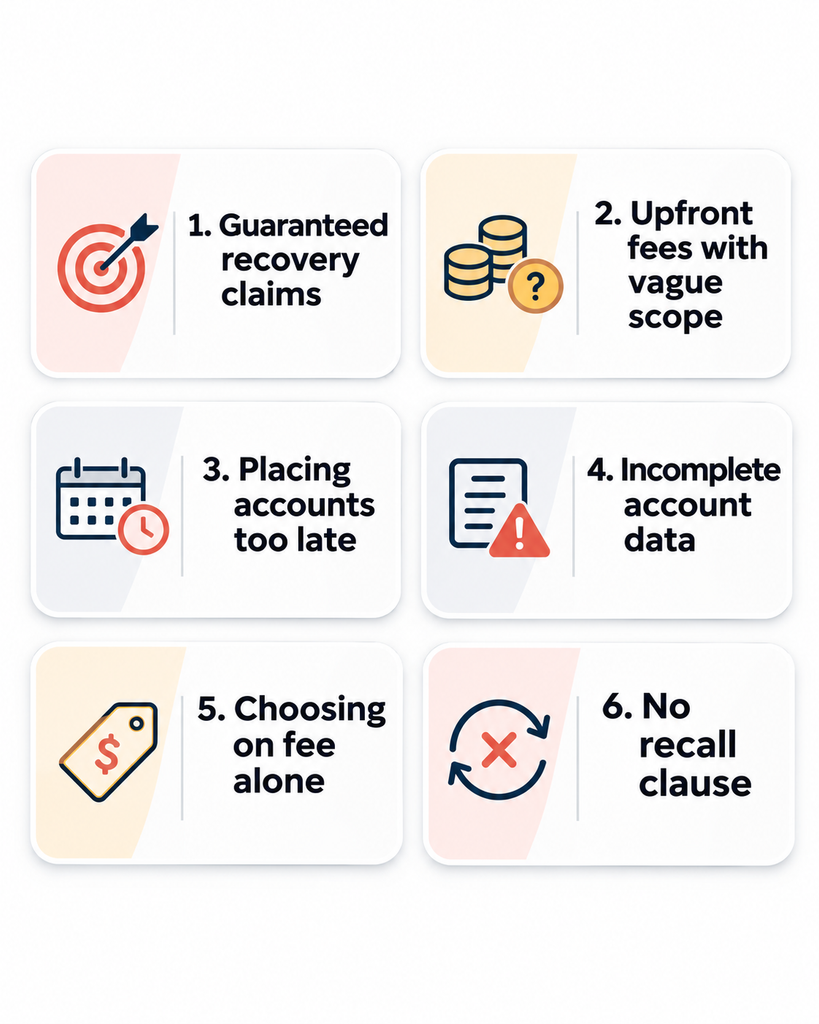
Several warning signs and hiring errors can quietly reduce what a bad debt recovery agency returns to you:
- Guaranteed recovery claims: Be cautious of promised results without clear definitions, conditions, or evidence.
- Upfront fees with a vague scope: Costs arrive before any recovery does.
- Placing accounts too late: Recovery odds fall as accounts age. An early-stage collections agency can stop some accounts from becoming bad debt.
- Sending incomplete account data: Missing fields lead to disputes, wrong-party contacts, and complaints.
- Choosing on fee alone: A lower fee can still produce a lower net-back.
- No recall clause: You can’t move underperforming accounts to another provider.
With these risks in mind, match each agency type to the accounts it handles best.
Which bad debt collection agency fits your accounts?
Your account mix should decide which model you choose. The table pairs common portfolio profiles with the debt recovery services that suit them best.
| Portfolio profile | Recommended agency type | Why |
| High volume, small customer balances | Digital-first agency | Low-cost outreach at scale through customers’ preferred channels |
| Regulated healthcare or government accounts | Industry-specialist agency | Sector-specific rules and careful customer handling |
| Mixed-balance loans or credit cards | Full-service third-party agency | End-to-end handling across balance sizes |
| High balances with documented assets | Collection law firm | Legal remedies can justify the cost |
| Older accounts already worked by other agencies | Secondary agency or debt buyer | Compare expected net-back from a new placement against the sale price |
| Small, recent balances | Flat-fee or letter service | Predictable cost on accounts likely to pay |
Taken together, these choices turn agency selection into a repeatable decision.
Recover more with the right bad debt collection agency
The right bad debt collection agency turns written-off balances into recovered revenue. It also reaches your customers in a way that protects your brand.
To choose that partner, start by matching each agency type to your account stages. Then compare net-back on similar accounts, score each finalist, and write KPI definitions into the contract. A debt collection agency worth hiring will welcome every one of these checks. Each month an account sits unworked, its recovery odds fall further.
Have bad debt your team can no longer recover? Contact us for a placement review of your portfolio. Our team will map each account to its best recovery path, with your customers treated respectfully throughout.
FAQs
1. Can a bad debt collection agency report accounts to credit bureaus?
Yes, but Regulation F requires it to contact your customer about the debt first. One option is speaking with the customer by phone or in person. Alternatively, it can send a written or electronic notice and wait for undeliverability reports.
2. Can an overdue debt collection agency add interest or fees to a balance?
No, unless the agreement that created the debt or applicable law authorizes it. This FDCPA rule covers interest, fees, and other charges added during collection. As a safeguard, check that your customer agreements state any charges the agency may collect.
3. Does placing accounts with an agency support a bad debt tax deduction?
Yes. The IRS requires proof of reasonable collection steps before a debt counts as worthless. Agency placement records help document those steps. Court action isn’t required if a judgment would be uncollectible. Confirm the details with your tax advisor.
4. What hours can an agency contact your customers?
Regulation F presumes contact before 8 a.m. or after 9 p.m. local time is inconvenient. Agencies also can’t call customers at work if they know the employer prohibits it. Any time a customer flags as inconvenient is off-limits too.
5. Can an agency collect bad debt from a customer who has died?
Yes, the agency can pursue the deceased customer’s estate. It can discuss the debt with the executor, administrator, or personal representative. Family members usually don’t pay from their own money unless they cosigned or state law requires it.
6. Will your customers see your business name on agency notices?
Yes. Regulation F requires the validation notice to name the creditor to whom the debt is currently owed. For placed accounts, that creditor is your business. This keeps customers clear about which account the agency is collecting.