

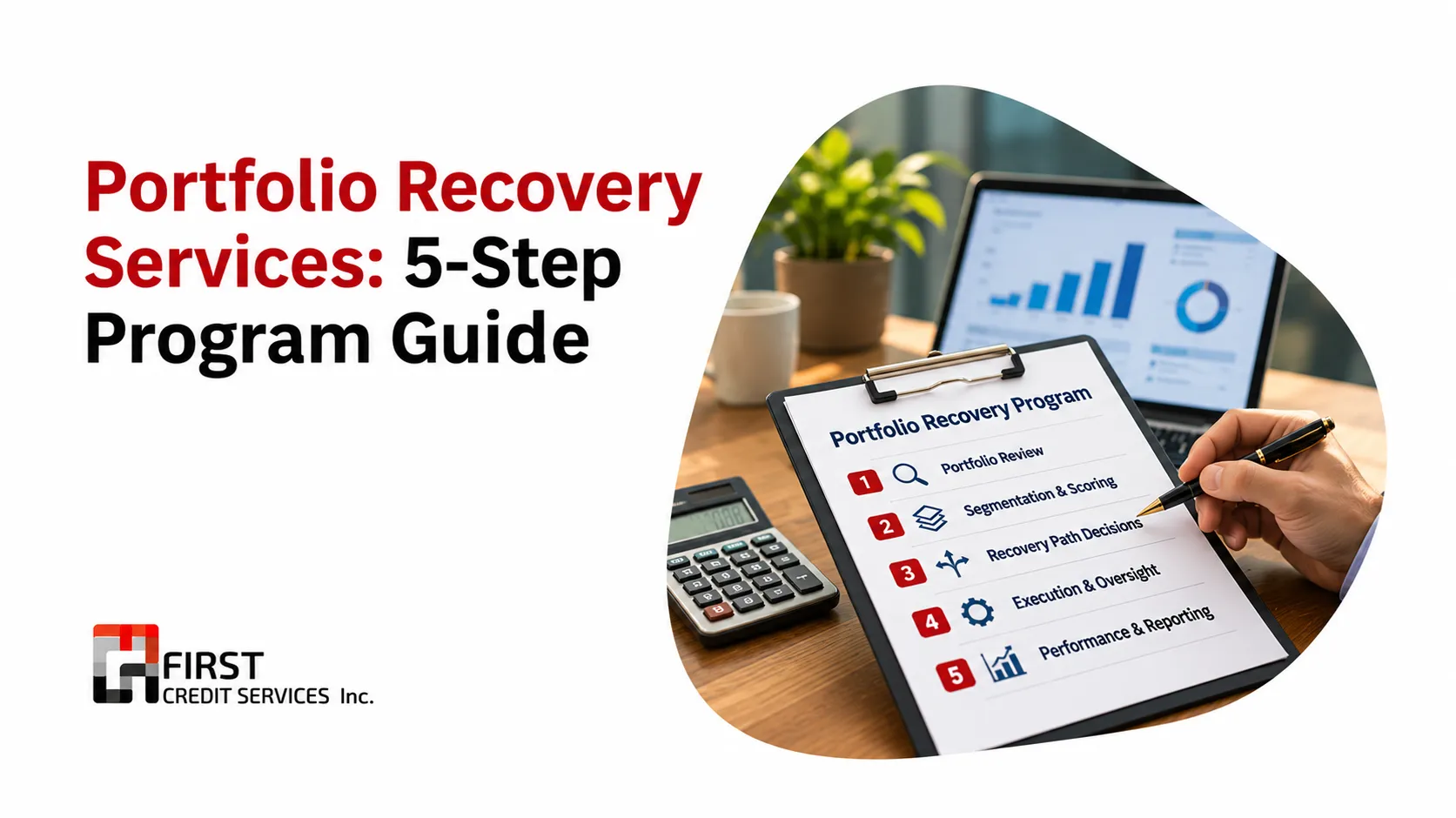
Are thousands of past-due customer accounts scattered across your collection vendors?
Lenders, healthcare providers, utilities, and subscription businesses often face this. Without a portfolio view, the oldest balances get no clear plan.
Portfolio recovery services are managed programs that recover unpaid balances across an entire portfolio of delinquent or charged-off accounts. A provider groups accounts by expected net recovery, picks a path for each group, and tracks results by placement month.
Meanwhile, more than 23 million Americans still carry charged-off card balances on their credit reports, according to a New York Fed (2026) analysis.
This guide covers what these services include, a five-step framework, key metrics, technology, common mistakes, and partner evaluation.
What do portfolio recovery services include?
A portfolio program covers every stage of recovery, from the first data review to monthly reporting. Beyond that, it differs from standard third-party collections and debt sales in one key way: who controls the strategy.
Before comparing those approaches, let’s understand what a typical program includes.
Core service components
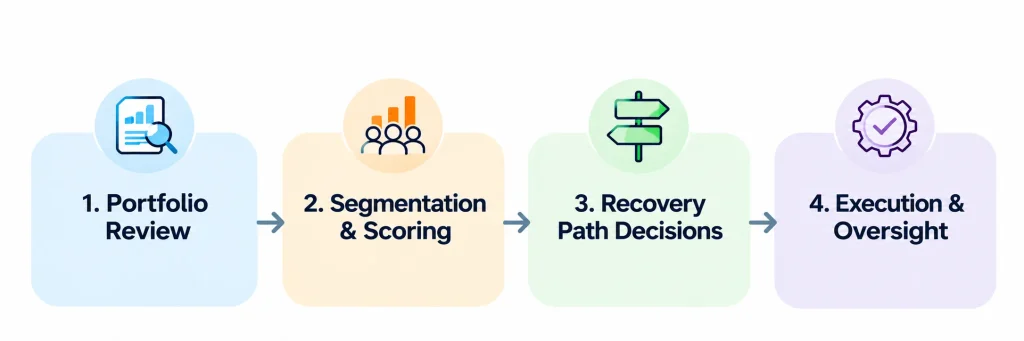
Most portfolio programs are built on four connected services:
- Portfolio review: The provider checks data completeness, account age mix, balance spread, and placement history.
- Segmentation and scoring: Accounts are grouped by likelihood to pay, reachability, and expected net recovery.
- Recovery path decisions: Each group is assigned a path, such as first-party recovery, agency placement, recall, legal review, or sale.
- Execution and oversight: This covers omnichannel outreach, payment options, compliance monitoring, and reporting.
Today, many businesses split their accounts across several debt recovery services. As a result, they use portfolio recovery services to coordinate multiple vendors and improve segmentation. They also use them to control recovery costs or add capacity as volumes rise.
Once those components are in place, the real question is how this model compares with the alternatives.
Portfolio recovery management vs. third-party collections vs. debt sale
Put simply, the main difference lies in who owns the accounts and who makes the decisions.
| Approach | Who owns the accounts | Who collects | What the business controls |
| Portfolio recovery management | The business | In-house team, agencies, or both | Segmentation, recovery paths, testing, and reporting across the whole portfolio |
| Third-party collections | The business | An agency, in its own name | Placement criteria, performance terms, and recall rules |
| Debt sale | Usually the buyer, after the sale | The buyer | Buyer selection, data accuracy, and contract terms before the sale |
With portfolio management, you keep ownership and set the strategy. By comparison, third-party collections split control with the agency, and a debt sale hands most of it to the buyer.
That control matters more now, as charged-off balances stay on credit reports longer.
Why portfolio-level recovery matters in 2026
Headline delinquency numbers and blended recovery averages can mislead when you read them without context. The following two developments explain why a portfolio-level view has become essential for any debt portfolio recovery program.
The first development concerns how long charged-off accounts now stay on credit reports.
Charged-off debts are staying on credit reports longer
From 2004 to 2012, about 40% of charged-off debts were still reported to credit bureaus a year later. By 2024, that share had doubled to 80%, according to the New York Fed’s 2026 analysis mentioned above.
Consequently, reported delinquency can rise even when new delinquencies hold steady, as older write-offs pile up in the data.
| Did you know? Between Q3 2022 and Q1 2026, the share of card balances 90+ days delinquent on credit reports rose from 7.6% to 12.8%. The same New York Fed analysis found older charged-off debts staying in the data drove almost all of that rise. |
For your team, a blended recovery rate can hide declining older cohorts behind strong new placements. Instead, read portfolio figures by placement cohort, meaning accounts grouped by the month they were placed.
Reading by cohort also changes how recovery itself should be managed.
Account-level vs. portfolio-level recovery
Account-level collections and portfolio-level recovery differ in what gets measured and who makes the decisions.
| Factor | Account-level collections | Portfolio-level recovery |
| What is managed | Individual accounts | Account groups and placement months across the full portfolio |
| How accounts are prioritized | Days past due and balance | Expected net recovery and reachability |
| Main decisions | Who to contact next and what to offer | Which recovery path each group takes, and when to recall, test, or sell |
| What is tracked | Calls, promises, and payments per collector | Recovery by group and placement month |
| Review rhythm | Daily activity reports | Monthly portfolio reviews |
| Who decides | Collectors and team leads | Recovery leadership, together with the provider |
Account-level tracking can miss a declining group of older accounts, since it measures activity per collector. In turn, a portfolio view shows where to shift effort and when a recall is overdue.
Acting on those signals takes a repeatable process, and that process starts with clean account data.
A 5-step framework to improve recovery across large portfolios
Improving portfolio recovery across a large book works as a repeating cycle. You and your recovery partner run it together, starting with clean data and ending with a monthly review.
Everything begins with the quality of the account file.
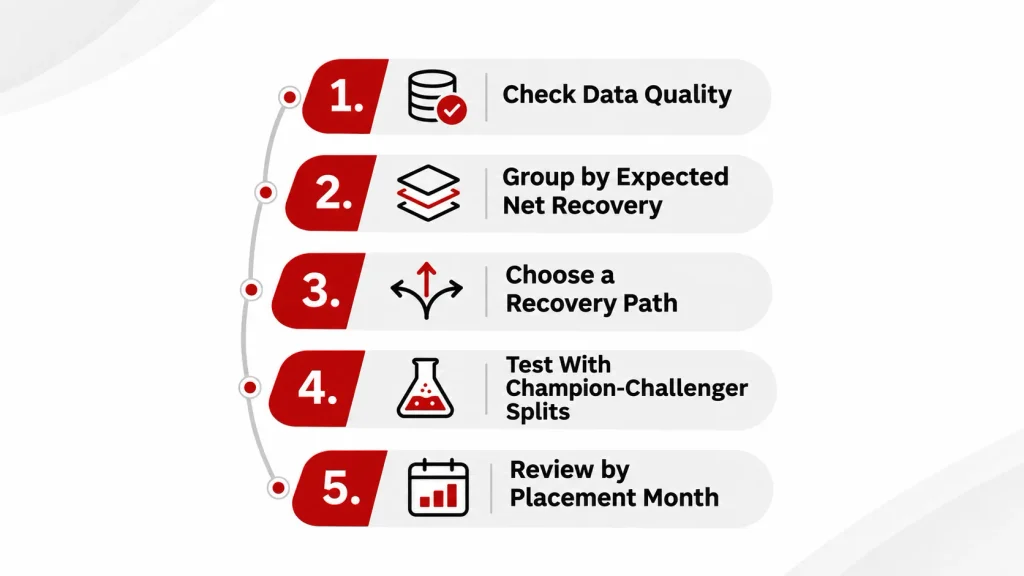
Step 1: Check data quality before placement
Before placement, confirm each account has:
- Accurate contact details, balance history, placement history, and dispute status
- Communication preferences, opt-outs, and documented consent where the channel requires it, such as automated calls or texts
- A flag if it is nearing the statute of limitations
Report data completeness separately from accuracy, since a complete file can still hold outdated phone numbers. Over time, data gaps show up as complaints. Complaints about unrecognized debts rose 240% in 2025, according to the CFPB Consumer Response Annual Report 2025. That rise compares with the prior two years’ monthly average.
With a clean file, you can start sorting accounts by what they are worth.
Step 2: Group accounts by expected net recovery
Start with expected recovery, which is balance multiplied by likelihood to pay. Then subtract the cost of the planned treatment, and confirm each account is legally eligible for that path.
Next, add reachability, meaning whether current data can actually reach the customer. The groupings below are examples, since account status, history, and legal restrictions also shape the final approach.
| Account group | Typical signals | Example approach | Typically handled by |
| High value, reachable | Larger balance, current contact details, past payments | Personal outreach and payment plans, where the account is eligible | In-house team or primary agency |
| High value, hard to reach | Larger balance, outdated contact details | Validate and update contact data before further outreach; legal review where eligible | Primary agency |
| Low value, reachable | Small balance, active email or mobile number | Digital-first outreach within contact and privacy rules | Digital recovery program |
| Low value, hard to reach | Small balance, older account, no recent response | Low-cost attempts, then compare expected net recovery from secondary placement, retention, or sale | Secondary agency, or sale review |
Each group then needs a destination, along with the rules for moving it.
Step 3: Choose a recovery path for each group
Recovery paths work as options in any order, and each group takes only the paths that fit it. Every path also needs clear criteria and an approval step, especially for charged-off accounts that have passed through other vendors.
| Recovery path | When it fits | Control to set |
| Keep in first-party recovery | The customer relationship still has value; the account is early-stage or responsive | A defined handoff point to third-party recovery |
| Place with a primary agency | Internal efforts have stalled; data is current; the account is eligible | Placement criteria and performance terms in the contract |
| Recall and place with a secondary agency | The placement is behind its cohort forecast after the agreed period | Recall rules, with the full account history transferred |
| Legal review | High balance, complete documentation, within the statute of limitations | Written creditor approval before any legal action |
| Sale | Expected net recovery from a sale exceeds the value of continuing to work the account | Buyer due diligence, an approval step, and accurate data transfer |
With paths assigned, the next task is proving which approach works best.
Step 4: Test strategies with champion-challenger splits
Randomly split comparable accounts between your current approach (the champion) and a new one (the challenger). Comparable accounts share a similar balance, age, and placement history.
The challenger could be a different vendor, offer, or channel mix.
- Change only one variable per test.
- Run each test with enough accounts, and for long enough, that any difference comes from the strategy itself.
- Shift more volume to the better performer each quarter.
Test results matter most when they feed back into your plan.
Step 5: Review results by placement month and account group
Hold a monthly review with your provider for each placement month’s accounts. Compare cohorts at the same age and against similar account groups. Then, use the findings to update your Step 2 groupings.
At First Credit Services, we handle both first-party and third-party debt collection. Every plan starts with an assessment of account details and consumer needs. From there, our AI predicts the best contact times and methods for each consumer.
Each review is only as useful as the metrics behind it.
Portfolio recovery metrics that show real performance
Recovery dollars alone can hide a program that is stalling. The right metrics show whether the collection portfolio services you pay for are recovering more money or simply generating more activity.
Each metric below answers a different question about your portfolio.
| Metric | How to calculate | What it shows |
| Cumulative recovery by placement month | $ recovered to date ÷ $ placed for one month’s placements, compared at the same age | Whether newer placements perform better or worse than older ones |
| Net recovery yield | ($ recovered − defined costs: vendor fees, operations, technology) ÷ $ placed | The real return after costs |
| Forecast attainment | Actual collections ÷ forecast collections for the same cohort and period; variance = (actual − forecast) ÷ forecast | Whether each cohort is on track |
| Group spread | Recovery gap between comparable account groups, each above a minimum size | Where an approach is working or falling short |
| Recovery speed | Months for a cohort to reach 50% of its forecast collections; newer cohorts reported separately | How quickly cash comes in |
| Data completeness at placement | % of accounts with all required fields at placement; accuracy reported separately | Data gaps by source or vendor |
| Compliance control failures | Contacts made outside allowed limits, or after an opt-out or suppression request, per 10,000 contacts | Whether compliance controls hold in practice |
| Dispute rate by account group | Disputes ÷ accounts worked, reviewed alongside source data and placement records | Possible data, balance, or placement errors |
Above all, read these metrics together. A strong recovery rate means less if net recovery yield is falling, because rising costs are eating the gains. Likewise, a low dispute rate may only reflect fewer contacts, so check it against data completeness.
Tracking all of this consistently across vendors depends on the right data and tools.
Technology and analytics behind modern portfolio recovery
Every step in the framework depends on the data, scoring, and governance tools underneath it. When you compare debt recovery services, these are the capabilities to expect.
The starting point is a single, consistent view of the portfolio.
Portfolio visibility and comparable data
When accounts sit with several vendors, each one reports in its own way. Your program needs a shared foundation that includes:
- One view of placements, payments, disputes, recalls, and outcomes across every vendor
- Consistent file formats, definitions, and reporting periods, so cohorts can be compared
- Account data you can export when a vendor relationship ends
With that view in place, scoring decides how each account is worked.
Predictive scoring and contact strategy
Models estimate each customer’s likelihood to pay, along with the best channel and time to reach them. Those scores decide which accounts get digital outreach, which go to collectors, and which need hardship options. Additionally, retrain the models as payment behavior shifts, and check scores against actual results by cohort.
Keep in mind that every outreach decision must stay within compliance limits across all vendors.
Governance and compliance controls
Share opt-out, suppression, and contact-history data across every vendor. How well limits hold depends on integration coverage and each vendor’s processes.
Regulation F presumes harassment when a collector calls about a debt more than seven times in seven days. For that reason, contact tracking must be accurate wherever outreach happens. Audit logs, access controls, and change records should also be ready for client reviews and regulatory exams.
At FCS, our Unified Consumer Engagement Platform (UCEP) predicts the best channel and time to reach each consumer. It also offers consumers a self-service payment portal. We are PCI DSS Level 1 and SOC 2 Type 2 compliant.
Even with strong tools in place, a few common mistakes can still drain recovery.
Common mistakes in portfolio recovery
Even a well-built debt portfolio recovery program can lose value through a few avoidable mistakes:
- Treating the portfolio as one pool: Equal effort on unequal accounts raises costs and lowers recovery.
- Leaving older accounts unassigned: These balances go without review, treatment, or performance tracking.
- Using different data formats with each vendor: Results can’t be compared, and some accounts get worked twice.
- Re-placing accounts without their history: Repeat contact frustrates customers and increases disputes. Every re-placement also needs a fresh compliance check.
- Selling older accounts without comparing options: Debt buyers typically purchase portfolios at a discount, so a fresh placement may deliver more net recovery than the sale price. Understanding how portfolio recovery works helps you weigh both options.
The right recovery partner helps you avoid each of these mistakes from the start.
How to evaluate a portfolio recovery services partner
Choosing a partner shapes recovery results across your whole portfolio for years. The checks below focus on portfolio-specific capabilities, beyond the basics most debt recovery services already cover.
Start with the capabilities you can verify on paper.
Capabilities to verify
Licensing, contracts, and service levels still matter whenever you hire a debt collection agency. Portfolio programs also need the capabilities below.
| S.no. | Criterion | What to verify |
| 1 | Reporting by group and placement month | Monthly cohort results with clear metric definitions |
| 2 | Openness to testing | Willing to be tested against your current vendor on randomly split accounts |
| 3 | Full-lifecycle coverage | Handles first-party collections and third-party debt collection with one shared account history |
| 4 | Recall and data return | Clear timelines to stop activity and return account data |
| 5 | Compliance controls | Suppression and opt-out handling, contact tracking, and exportable audit logs |
| 6 | Security credentials | A current SOC 2 Type 2 report and PCI DSS validation |
| 7 | Licensing | Active licenses and bonds in every state where your customers live |
After a provider clears that list, a few direct questions show how it will manage your accounts.
Questions to ask before placing a portfolio
Ask each shortlisted provider the questions below, and compare how specific their answers are. Vague replies often signal gaps in process or reporting.
- How would you group a portfolio like ours, and which data fields do you require?
- Can you share cohort results from a similar portfolio?
- How do accounts move between your first-party and third-party teams?
- What criteria trigger a recommendation to recall or sell accounts?
A national fitness brand with more than 200 locations has partnered with FCS since 2007. Since then, we have collected more than $17 million on its behalf. A Fortune 500 auto finance client says we consistently meet or exceed its targets and pass ongoing compliance audits.
Taken together, these checks turn partner selection into part of your recovery strategy.
Turning portfolio recovery into a managed strategy
Portfolio recovery services deliver the most value when they run as a repeating program. Each cycle starts with clean data and ends with a monthly review that sharpens the next round.
To recap, check your data before placement and group accounts by expected net recovery. After that, choose a recovery path for each group and test new approaches against your current one. Review results by placement month, and feed what you learn back into your groupings.
Throughout, judge success by net recovery after costs. Activity numbers alone can make a stalling program look healthy.
See where your recovery is slipping. Contact us for a portfolio assessment that shows which account groups and placement months need attention.
FAQs
1. How are portfolio recovery services usually priced?
Pricing depends on account age, balance, documentation quality, portfolio mix, and contract structure. Contingency fees, a percentage of amounts collected, are common and often vary by account group. Ask for the full rate schedule and cost definitions.
2. What is a forward flow agreement, and how does it differ from a one-time sale?
A one-time sale transfers a defined set of accounts once. A forward flow agreement sets terms upfront for repeated sales of new charge-offs, often each month or quarter. Those terms usually cover pricing, account eligibility, and the agreement’s length.
3. Does selling a debt portfolio end the creditor’s compliance responsibility?
Selling does not automatically end it. The OCC expects banks it supervises to manage debt sales safely and in line with consumer protection laws. For other creditors, obligations depend on their regulator, the law, and the sale contract.
4. What happens to portfolio accounts when a customer files for bankruptcy?
Filing triggers an automatic stay, which halts most collection activity, including lawsuits and garnishments. The stay usually lasts until the case closes, is dismissed, or a discharge is granted or denied. Counsel should review how these accounts are handled.
5. How do servicemember protections affect portfolio recovery?
The Servicemembers Civil Relief Act caps interest on pre-service debts at 6% during service. For mortgages, the cap lasts one extra year. Servicemembers must request it in writing with their orders. Creditors must forgive interest above the cap.
6. Can a portfolio recovery provider work under the creditor’s own brand?
Yes, in first-party programs, the provider contacts customers in your name and follows your brand standards. These programs are more common earlier in delinquency. Ask how calls, letters, and payment pages will reflect your brand.