

A strong sales performance does not always translate into a healthy cash position. Revenue may be recognized, but until customers settle their outstanding invoices, that money remains tied up in receivables. Meanwhile, supplier payments, payroll and other operating expenses continue to fall due. The resulting gap can strain liquidity, working capital, and a business’s ability to pay on time.
This is why accounts receivable (AR) and accounts payable (AP) need to be managed together. AR represents the money a business is owed by customers. AP represents what the business owes its suppliers and vendors. However, managing AR involves more than issuing invoices and tracking due dates. It requires consistent follow-ups and effective dispute resolution. When balances go overdue, a structured collections process keeps them from turning into long-term cash flow problems. AP requires businesses to time their payments carefully, without damaging supplier relationships or missing favorable terms.
This guide explains AR and AP, their accounting treatment, and their cash flow impact. It also covers the cash conversion cycle, key metrics, and what to do when customer balances go past due.
What is accounts receivable (AR)?
Accounts receivable represents the money customers owe your business after you deliver a product or service on credit. It is recorded as a current asset because it is expected to convert to cash within the normal operating cycle.
What is accounts payable (AP)?
Accounts payable represents the money your business owes suppliers for goods or services purchased on credit. It is recorded as a current liability because payment is typically due within the operating cycle.
AP covers amounts owed to suppliers for goods and services. Payroll liabilities and loan balances are usually recorded in separate accounts.
Suppliers may offer early-payment discounts, such as 2/10 net 30: a 2% discount if paid within 10 days, with the full amount due in 30 days.
AR vs AP: side-by-side comparison
The table below compares accounts receivable and accounts payable across the factors that matter most to finance teams.
| Factor | Accounts Receivable (AR) | Accounts Payable (AP) |
| What it is | Money customers owe the business | Money the business owes suppliers |
| Created by | Providing goods or services before payment | Buying goods or services on credit |
| Balance sheet classification | Usually a current asset | Usually a current liability |
| Normal balance | Debit | Credit |
| Cash direction | Inflow when collected | Outflow when paid |
| Key metric | Days sales outstanding (DSO) | Days payable outstanding (DPO) |
| Main risk | Late payment or non-payment (bad debt) | Late fees and strained supplier relationships |
| Goal | Collect within agreed terms | Pay within agreed terms |
| Owned by | Billing, AR, or collections team | AP or procurement team |
How AR and AP are treated in accounting
Both accounts follow accrual accounting rules under US GAAP. Where each appears on the financial statements tells you a lot about your cash position.
Where they sit on the balance sheet
AR is usually classified as a current asset when collection is expected within one year or the operating cycle. AP is classified as a current liability under the same timeframe. Balances due beyond that window may be classified as non-current.
AR is also reported net of expected losses: Net AR = Gross AR minus the allowance for credit losses.
Generally Accepted Accounting Principles (GAAP) rules that apply to both
Under accrual accounting, receivables and payables are recorded when the underlying sale or purchase occurs. Cash does not need to change hands for the entry to be made. This distinction is why a profitable company can still run short on cash, even when revenue is growing.
| Did you know? Expected losses on receivables are estimated under ASC 326 as an “allowance for credit losses. The FASB’s ASU 2025 report adds an optional practical expedient for estimating credit losses on eligible current receivables, effective for annual periods beginning after December 15, 2025. |
How AR and AP affect cash flow and working capital
A company can report strong revenue and still struggle to cover payroll. The gap between earning revenue and collecting cash is where working capital risk lives.
Why profit and cash differ
Under accrual accounting, a credit sale is recognized as revenue before the customer pays. Reported income rises while cash does not.
On the other hand, a supplier cost is recognized before the invoice is paid. Expenses rise while cash stays in the business for now.
The net effect on cash depends on how quickly customers pay compared with how quickly the business pays suppliers.
Impact on working capital
These timing differences feed directly into the working capital formula.
Working capital equals current assets minus current liabilities. If other balances stay the same, higher AR raises it on paper, while higher AP lowers it.
However, high AR does not mean cash is available. If customers pay slowly, some businesses use accounts receivable financing to cover the shortfall.
Impact on the cash flow statement
The cash flow statement captures these same movements. Under the indirect method, changes in AR and AP adjust net income to arrive at operating cash flow. The simplified example below assumes these are the only adjustments. In practice, other non-cash items and working capital changes also apply.
| Line item | Amount |
| Net income | $100,000 |
| Less: increase in accounts receivable | −$30,000 |
| Add: increase in accounts payable | +$10,000 |
| Net cash from operating activities | $80,000 |
| Pro tip: Rising AR alongside growing revenue can indicate that collections are not keeping pace with sales. Monitoring this relationship helps businesses identify potential cash flow pressure before overdue balances accumulate. |
Worked example: a healthcare clinic’s transaction cycle
The following example shows how these timing gaps play out in practice.
| Day | Event | Effect |
| 0 | Clinic buys $20,000 of medical supplies on net 15 | AP increases by $20,000 |
| 15 | Clinic pays the supplier | Cash decreases by $20,000; AP cleared |
| 20 | Clinic bills $50,000 in patient balances, due in 45 days | AR increases by $50,000 |
| 65 | Patients pay their balances | Cash increases by $50,000; AR cleared |
The clinic funds 50 days (day 15 to day 65) out of its own cash. Faster collection of patient balances, or longer supplier terms, shortens that gap.
The cash conversion cycle: where AR and AP meet
The cash conversion cycle (CCC) combines receivables, payables, and inventory into one number. It shows how long cash stays tied up in the operating cycle.
CCC = Days Inventory Outstanding (DIO) + Days Sales Outstanding (DSO) − Days Payable Outstanding (DPO)
CCC is most useful for businesses that hold inventory, such as retailers and medical practices that stock supplies. For service businesses, inventory days are often negligible. Lending businesses typically rely on other liquidity measures altogether.
| Scenario | DIO | DSO | DPO |
| Current state | 40 days | 45 days | 30 days |
| After reducing DSO by 10 days | 40 days | 35 days | 30 days |
Cutting DSO by 10 days shortens the cycle by 10 days. That frees cash faster without new borrowing or delaying supplier payments.
Key metrics to Track for AR and AP
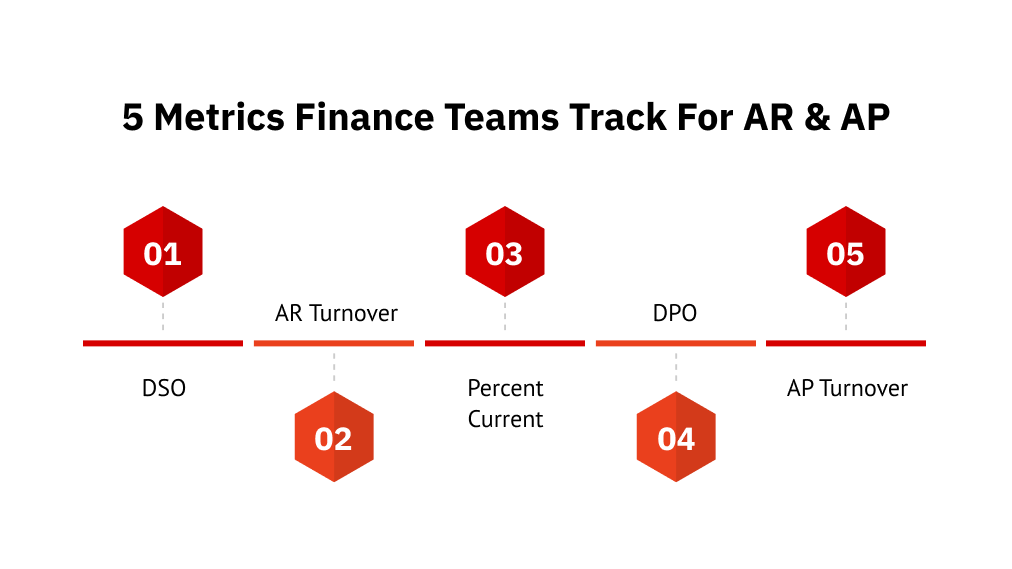
The metrics below show how each side is performing. All formulas use average balances and credit activity for the period.
| Metric | Side | Formula | What it shows |
| Days sales outstanding (DSO) | AR | (Average accounts receivable ÷ Net credit sales) × Days in period | Average days to collect customer balances |
| AR turnover ratio | AR | Net credit sales ÷ Average accounts receivable | How many times receivables are collected per period |
| Percent current | AR | Current receivables ÷ Total receivables × 100 | Share of customer balances not yet past due |
| Days payable outstanding (DPO) | AP | (Average accounts payable ÷ Credit purchases) × Days in period | Average days taken to pay suppliers |
| AP turnover ratio | AP | Credit purchases ÷ Average accounts payable | How many times payables are paid per period |
If credit purchase data is unavailable, cost of goods sold is a common substitute for calculating DPO and AP turnover. Either way, use the same method each period to keep results comparable.
However, DSO and DPO are not goals on their own. For example, DSO can change with sales volume or customer mix. Meanwhile, a higher DPO preserves cash only until late payments damage supplier relationships or trigger penalties.
| Pro tip: Forgoing a 2/10 net 30 discount carries an approximate annualized cost of about 37% (2/98 × 365/20). Compare that with your cost of funds and cash position before deciding whether to pay early. |
What happens when customer balances go past due
When receivables age beyond their due date, they move from a timing issue to a collection risk. Tracking that aging is the first step toward managing it.
Reading the AR aging report
The buckets below are examples, not universal deadlines. Account terms, industry, applicable laws, and the reason for non-payment all affect the right next step.
| Aging bucket | What it may signal | Example action |
| Current | Within the due date | Standard billing reminders |
| 1–30 days past due | An oversight or a failed card payment | Reminder by email or SMS with a payment link |
| 31–60 days past due | Payment is slipping | Direct outreach and payment plan options |
| 61–90 days past due | Higher risk of non-payment | Escalation to first-party or third-party recovery |
| 90+ days past due | Unlikely to be paid without further action | Third-party collections or write-off against the allowance |
The escalation path
The approach changes as balances age. First-party collections contact customers under the business’s own name, usually earlier in delinquency. Third-party collections use the collector’s name, usually for older balances.
| Did you know? Once consumer accounts move to a third-party debt collector, federal rules apply. Under Regulation F, a debt collector is presumed to violate call-frequency limits if it calls about a debt more than seven times within seven days. |
At First Credit Services, we help healthcare providers, lenders, and fitness brands recover outstanding consumer balances. Our accounts receivable management programs cover both first-party and third-party collections.
We operate our Unified Consumer Engagement Platform (UCEP) on your behalf. It coordinates digital outreach and gives your customers self-service payment options.
Common AR and AP mistakes to avoid
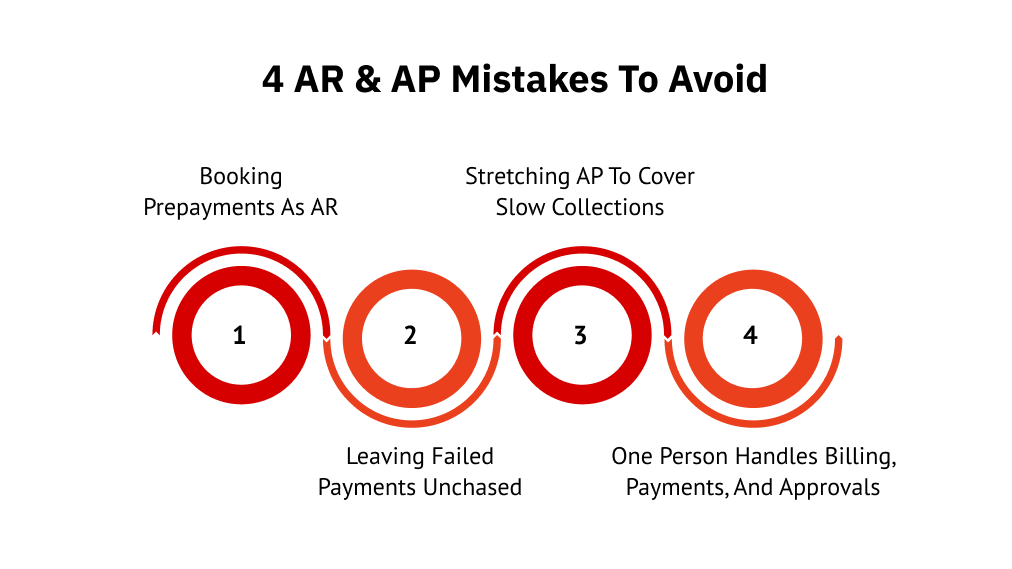
Even well-run finance teams make errors that distort the books or strain cash flow. The four below are among the most common.
- Recording prepayments as AR: Prepaid memberships or patient deposits for services not yet provided are a liability (unearned revenue), not a receivable. Booking them as AR overstates what customers actually owe.
- Leaving failed payments unchased: Declined cards on memberships or subscriptions sit in AR and age quickly without prompt follow-up. Automated retry logic and timely outreach prevent balances from slipping into delinquency.
- Stretching AP past terms to cover slow collections: This preserves cash in the short term but weakens supplier relationships. It can also lead to stricter terms or lost early-payment discounts.
- Having one person bill customers, record payments, and approve bills: Without segregation of duties, errors and fraud are harder to catch. Splitting these roles adds a layer of review that protects the books.
Which side should you fix first? A quick checklist
Not every business needs to overhaul both AR and AP at the same time. The questions below help you decide where to start.
- Is DSO rising while sales and customer mix are stable? Start with AR.
- Are you paying late fees or missing early-payment discounts that would have been worth taking? Start with AP.
- Is a growing share of customer balances more than 60 days past due? Review follow-up processes and consider outside support.
- Can you see AR aging and upcoming AP due dates in one weekly view? If not, build that view first.
Keep receivables and payables in balance
AR tracks what customers owe you, while AP tracks what you owe suppliers. The timing of those collections and payments, in turn, determines how much of your own cash funds operations.
To see where that cash gap is widening, track DSO and DPO together, alongside the cash conversion cycle where relevant.
If customer payments are taking longer to collect, talk to us.
FAQs
1. Is accounts payable an expense?
No. Accounts payable is a liability that tracks an unpaid bill. The cost itself is recorded as an expense, or held as inventory, when it is incurred. Paying the bill later reduces AP and cash, not expenses.
2. What is the difference between accounts payable and accrued expenses?
Accounts payable covers costs a supplier has already invoiced. Accrued expenses are costs incurred but not yet invoiced or paid at period end, such as utilities. Both are current liabilities, but accruals are estimated until the bill arrives.
3. Do cash-basis businesses have accounts receivable and accounts payable?
No. Cash-basis accounting records income when cash is received and expenses when paid. AR and AP accounts do not appear under this method. Larger businesses, including C corporations above the IRS gross receipts threshold, generally must use accrual accounting.
4. What is the difference between accounts receivable and notes receivable?
Accounts receivable comes from ordinary billing, is usually due within 30 to 90 days, and carries no interest. A note receivable is a signed written promise to pay, often with interest and a set schedule, and is non-current if due after a year.
5. Can accounts receivable have a credit balance?
Yes, temporarily. Overpayments, duplicate payments, or unapplied credits can leave a customer account with a credit balance. That amount is owed back to the customer, so it should be refunded or applied to a future bill.
6. Are debtors and creditors the same as accounts receivable and accounts payable?
In US accounting under GAAP, the standard terms are accounts receivable and accounts payable. Debtors and creditors are more common in countries that follow IFRS. The underlying concepts are the same, but the terminology differs by reporting framework.