

Your recovery dashboard shows more payment-link clicks, reminder replies, and promises to pay, yet your recovered revenue barely moves. You might see consumers abandon payment steps, miss promised dates, or leave account questions unresolved.
Each unresolved balance can require repeated follow-ups without producing a confirmed payment. AI payment recovery can help you identify where consumers lose momentum and choose the next action. With predictive analytics, you can prioritize accounts and use personalized outreach to connect consumers with payment options.
When consumers need assistance, trained agents can answer questions automated reminders cannot resolve. Even then, your team needs confirmed payment records before treating promised amounts as recovered revenue.
This guide examines common conversion gaps, ways to improve payment follow-through, and the metrics that reveal recovery performance. It also explains what to look for when evaluating a managed recovery partner.
What does AI payment recovery optimize beyond payment reminders?
AI payment recovery optimizes what happens between consumer outreach and a confirmed payment. Predictive analytics can help you prioritize accounts, while automated workflows support follow-ups, payment options, and agent assistance. For creditors, these workflows address overdue consumer balances rather than automate commercial invoices.
To choose your next action, examine consumer responses and payment activity instead of counting messages. Replies and link clicks indicate engagement, while questions about payment options may suggest intent. An agreed payment date records a commitment, although the balance remains unresolved until payment arrives.
By tracking these differences, you can verify account status before offering another payment option or involving an agent. This keeps each recovery action tied to the consumer’s current situation and the payment outcome you still need to confirm.
Where do automated payment recovery workflows lose conversions?
Automated payment recovery workflows lose conversions when consumers respond without completing payments, or account records fail to reflect outcomes. These gaps leave outstanding balances requiring attention, even when outreach reports suggest consumers are engaging.
Engagement without payment action
A consumer may reply to a reminder without completing payment when the balance is unclear, or payment steps seem difficult. Likewise, an opened link may lead to an abandoned payment attempt. Without examining what happened afterward, your team may miss the obstacle preventing the transaction from moving forward.
| Conversion Check: A consumer response indicates engagement. Confirm subsequent payment activity and account status before treating that interaction as a successful recovery. |
Payment friction and unresolved account issues
Even when consumers intend to pay, the payment process can stall. A transaction may fail or reverse, while a disputed balance may require clarification before resolution. Repeating a generic reminder cannot address either problem.
Meanwhile, delayed account updates can trigger unnecessary outreach after a payment or leave your team working with an incorrect balance. The point where progress stops determines what your team needs to investigate:
| Recovery stage | Conversion gap | Operational consequence |
| Response | No payment action follows | Extra contact without payment progress |
| Payment attempt | Transaction incomplete or reversed | Balance remains due |
| Commitment | Scheduled payment not received | Expected recovery fails to materialize |
| Account update | Payment status not reconciled | Avoidable outreach or incorrect treatment |
The appropriate action depends on whether the obstacle involves payment access, account accuracy, or a request for assistance.
How can AI-powered payment recovery turn responses into completed payments?
AI-powered payment recovery can turn responses into completed payments by guiding consumers toward appropriate actions and verifying outcomes.
For your recovery team, this means connecting outreach with payment options and timely assistance when a request needs attention.
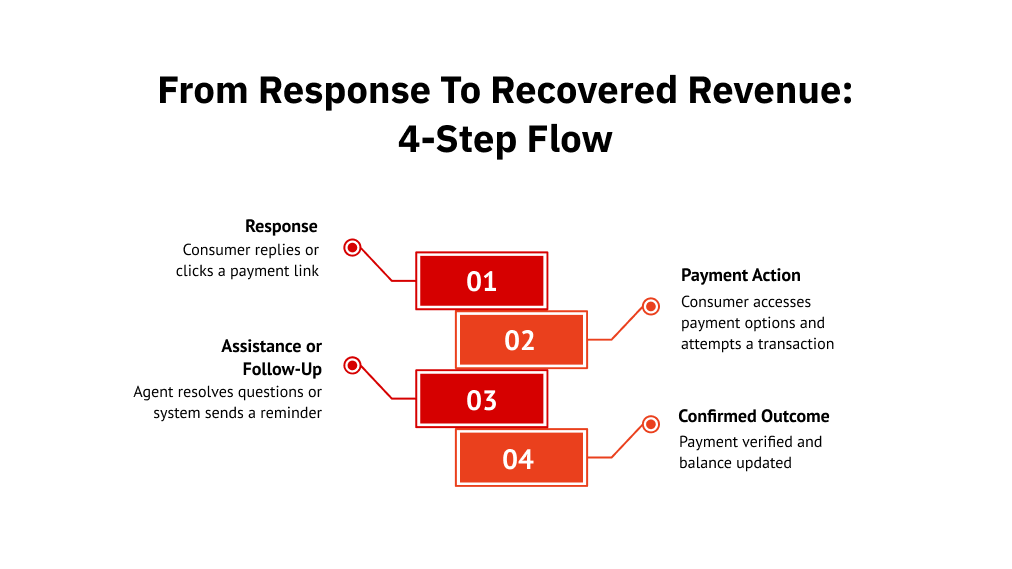
The process follows four connected stages: response → payment action → assistance or follow-up → confirmed outcome. Each stage depends on accurate account information and the consumer’s latest response.
Identifying when consumer engagement requires a different action
A text reply may contain a balance question, a request for more time, or interest in payment options. Each calls for a different response, even though all three appear as engagement.
Behavioral insights can help you recognize response patterns and refine follow-up timing or channel selection.
As consumers move between channels, omnichannel debt collection services can connect SMS, email, chat, and phone interactions. Your team needs shared context, so an agent knows which questions remain open or what payment options were already offered.
| Compliance note: Before changing follow-up timing or switching channels, check the consumer’s preferences and applicable contact restrictions. AI recommendations must operate within approved outreach policies and relevant legal requirements. |
Connecting responses with available payment options
When a consumer is ready to act, the next step should reflect the options authorized for that account. A secure, personalized payment link can provide access to the balance and relevant payment choices.
Depending on the program, consumers may pay in full, select a configured installment plan, or review an authorized offer. This reduces unnecessary steps between their response and a payment attempt.
Before presenting an arrangement, verify eligibility and ensure the message matches approved terms. Otherwise, a seemingly helpful offer may create another unresolved request.
Providing human support for unresolved payment situations
Some requests require a person, particularly when consumers question their balance or need an explanation of available arrangements. Sending another automated message may leave the underlying concern unanswered.
A trained agent can clarify the issue, explain authorized options, and handle situations requiring judgment. Depending on program design, chat or phone interactions may route to your staff or an outsourced recovery team.
The handoff should include relevant account context so consumers do not need to repeat their questions.
Updating recovery workflows after payment outcomes
After a consumer starts a payment, your team still needs to verify the transaction’s status. Authorization can precede settlement, so define when a payment counts as confirmed recovery. A submitted payment may remain pending, fail, or reverse, leaving some or all of the balance outstanding.
Updated account records should guide subsequent outreach. When systems refresh at different times, reconcile the payment status before sending another reminder.
Only then can the next action reflect the verified balance and the consumer’s current situation.
How can creditors improve promise-to-pay fulfillment?
Creditors can improve promise-to-pay fulfillment by recording agreed terms, aligning follow-ups with payment dates, and confirming each payment. A commitment sets an expected date, but your team must confirm payment before counting the amount as recovered.
Managing payment commitments before their due dates
Start with an accurate record of the agreed amount, payment date, and authorized arrangement. Your follow-up schedule should reflect those terms, alongside the latest balance and consumer communication preferences. For installment plans, confirm each payment separately before recording the arrangement as fulfilled.
In early-stage first-party collections, these communications can remain under your brand. Consistent branding helps consumers recognize the follow-up as part of their original creditor relationship.
Automated follow-ups can reinforce an existing agreement and provide a clear payment path. If the arrangement changes, revise upcoming messages so the dates and authorized options remain accurate. Otherwise, you risk contacting consumers about outdated terms and generating avoidable questions for your staff.
Responding when expected payments are not received
An overdue commitment may reflect changed circumstances, unclear terms, or a payment attempt that was never completed. Review the original arrangement and any recent consumer response before deciding how to proceed.
If the balance remains due, offer an authorized next step or route unresolved questions to a trained agent.
| Implementation Tip: Before following up on a missed commitment, verify the latest payment status. Delayed account updates can trigger unnecessary outreach, even when the original reminder sequence was correctly configured. |
Once payment status is confirmed, the remaining balance can guide decisions about revised terms or further assistance.
Which payment recovery metrics reveal collection workflow gaps?
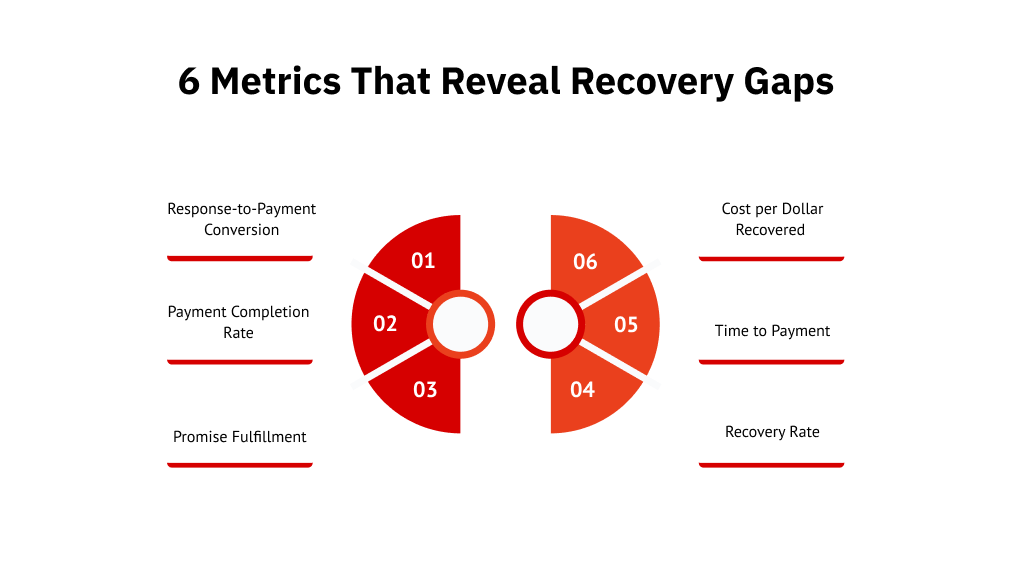
Response-to-payment conversion, payment completion, promise fulfillment, recovery rate, timing, and costs reveal collection workflow gaps. Compare these results within similar delinquency groups before judging a treatment’s effectiveness.
Measuring consumer progress from engagement to recovery
Response-to-payment conversion and payment completion track different stages, so they need separate denominators.
- Response-to-payment conversion: Engaged accounts with confirmed payments divided by all engaged accounts in the same cohort.
- Payment completion rate: Confirmed transactions divided by initiated payment attempts, allowing pending payments time to settle.
For promise fulfillment, compare commitments paid as agreed with commitments due during the reporting period. Report partially fulfilled commitments separately so incomplete arrangements do not inflate the result.
| Metric Trap: Higher response rates can coincide with unchanged recovered revenue. Compare confirmed and partial payments alongside operating costs and portfolio differences before evaluating an outreach change. |
Connecting recovery results with operational costs
Recovered dollars describe financial results, while payment timing and collection costs reveal operating efficiency. Track recovery rate against eligible balances, time to payment from a defined starting point, and cost per dollar recovered.
Account stage further shapes these comparisons, as the Consumer Financial Protection Bureau’s 2025 Consumer Credit Card Market Report illustrates. It separates pre-charge-off collection performance from post-charge-off recoveries. Keeping those stages separate supports more meaningful portfolio comparisons.
These measures show where to investigate and what to adjust:
| Metric | What it measures | Recovery decision it supports |
| Response-to-payment conversion | Engaged accounts with confirmed payments divided by engaged accounts | Identify engagement-to-payment losses |
| Payment completion rate | Confirmed transactions divided by initiated attempts | Investigate payment-stage friction |
| Promise fulfillment | Commitments fulfilled as agreed divided by commitments due | Review arrangement follow-through |
| Recovery rate | Collected dollars against eligible balance | Compare portfolio performance |
| Time to payment | Days until confirmed receipt | Assess recovery speed |
| Cost per dollar recovered | Collection costs divided by recovered dollars | Evaluate operating efficiency |
Improving AI-driven recovery through outcome reviews
Begin with the weakest conversion stage, then examine account records and consumer responses for the likely cause. If incomplete payment attempts rise, check payment access and transaction status before changing outreach frequency.
After an approved adjustment, compare outcomes for similar accounts across the same reporting period. Keep delinquency stage, portfolio mix, and treatment eligibility visible when interpreting the results. Those comparisons show whether confirmed recoveries improved or activity simply shifted between channels.
How should creditors evaluate managed AI-driven recovery solutions?
Creditors should evaluate managed AI-driven recovery solutions by checking payment execution, personalized outreach, agent support, and reporting. Use those performance measures to assess accountability for unresolved cases, verified payments, and recovery reporting.
Recovery accountability and payment-outcome visibility
Reporting should connect personalized outreach with payment attempts, confirmed transactions, and unresolved requests. Assess who investigates payment failures, reconciles account records, and handles consumer questions requiring agent assistance. For escalations, ensure agents receive account history and retain responsibility until resolution.
Late-stage placements need coordination when consumers pay the creditor directly. Confirm how payments reach the recovery partner and when its records are updated. For third-party collections, confirm that consumer communications use the agency’s brand.
Implementation, staffing, and commercial fit
Before onboarding, agree on how account data will transfer and who will correct rejected records. Consumer inquiries may reach your team or the provider’s agents, so establish ownership of responses and escalations. Once those roles are clear, define how treatment changes are approved and communicated.
Use this checklist to compare proposals:
- Outcomes: Can reports distinguish pending payments, partial recoveries, and confirmed results?
- Data: Who reconciles transferred records and payment updates?
- Staffing: Who handles exceptions, escalations, and agent training?
- Governance: Who authorizes treatment changes?
- Commercial terms: Does the pricing structure match the stage and service model?
For third-party placements, review contingency terms and payment reconciliation responsibilities. For first-party work, compare digital-only contingency options with live-agent per-seat arrangements where offered. Compare proposals against placement volume, staffing responsibilities, and the services included at each stage.
How First Credit Services connects payment intent to actual recovery
At First Credit Services, we connect consumer responses with payment actions through managed outreach, self-service options, and trained-agent assistance.
- Accessible payment options: Consumers can review balances, make payments, or access configured arrangements through personalized links.
- Trained-agent assistance: When questions interrupt progress, our agents clarify outstanding balances and explain appropriate next steps.
- Coordinated outreach: Our proprietary, in-house AI-powered UCEP (Unified Consumer Engagement Platform) supports adaptive SMS, email, chat, and phone engagement. We operate it on your behalf, coordinating approved outreach.
- Recovery visibility: We provide customizable reporting to help your team monitor engagement and payment activity without administering the platform.
This coordination helps limit manual handoffs and keeps payment-related requests with the appropriate team. Across our operations, we handle more than 125 million customer interactions annually. For creditors managing high account volumes, our managed approach supports consistent execution alongside existing recovery operations.
Close the gap between consumer engagement and recovered revenue
Unfulfilled payment commitments can turn a promising recovery pipeline into an expensive backlog. When those cases multiply, even a busy recovery operation can struggle to turn its efforts into cash.
AI payment recovery helps pinpoint why consumer intent fails to become a completed transaction. When progress stalls, it can guide consumers toward an authorized option or timely agent assistance. Accurate payment updates help prevent unnecessary follow-ups and keep your team focused on actual recovery.
Before investing in additional outreach, find where commitments and transactions repeatedly break down. Compare confirmed collections and operating costs across comparable delinquency groups. If gaps persist, evaluate whether managed recovery support can provide stronger follow-through without adding pressure to your team.
Ready to improve payment outcomes across your portfolio? Discuss your recovery gaps and managed options with us.
FAQs
1. Can AI payment recovery work with existing collection systems?
Yes, managed AI payment recovery can work alongside existing collection systems through agreed data-transfer methods. Depending on your infrastructure, these may include APIs, secure file transfers, or CRM synchronization. Compatibility should be confirmed during onboarding.
2. How long does it take to launch a managed payment recovery program?
There is no universal onboarding timeframe for managed payment recovery programs. Timelines depend on collection stage, account data readiness, communication approvals, and staffing. First-party programs may also require creditor-branded workflow configuration.
3. Who approves payment plans and settlement offers in automated collections?
The creditor’s approved policies and authorization limits determine which arrangements may be offered. A recovery partner should follow those limits and escalate requests outside its authority.
4. What happens to an existing payment plan when an account moves to third-party collections?
Whether an existing payment plan continues depends on the creditor’s placement instructions and the agency’s agreed responsibilities. Both parties should verify scheduled installments, payments already received, and responsibility for administering the remaining arrangement.
5. How should partial payments and settlements appear in recovery reports?
Reports should separate cash collected from amounts reduced under an authorized settlement. They should also identify any remaining balance and whether settlement terms were fulfilled, without counting forgiven amounts as recovered cash.
6. What data security questions should creditors ask an AI collections provider?
Ask how consumer payment information is handled, who can access account records, and which security standards apply. Clarify responsibility for secure transfers, payment processing, and incident response before onboarding.