


An ambulance completes a transport. Insurance then processes the claim, but a valid patient balance remains. That is where EMS debt collection begins.
For municipal, fire-based, hospital-based, and private ambulance providers, recovery requires more than payment reminders. You need to collect legitimate revenue while managing compliance obligations and protecting community trust.
However, effective recovery starts before an account reaches collections. According to the CMS report appendix 2025, about one in five ground ambulance organizations do not always bill patients in one or more payer categories. Billing practices therefore form an important part of the recovery process.
Success depends on how well each stage connects, from accurate billing data to appropriate collection placement.
This guide explains where EMS collections fit into the revenue cycle and why ambulance balances can be difficult to recover. It also covers recovery timelines, compliance controls, and KPIs, helping you choose the right operating model for your organization.
What is EMS debt collection?
EMS debt collection is the process of recovering valid patient balances that remain unpaid after an ambulance provider has billed insurance. It usually begins with early-out outreach under the agency’s name. Eligible aged accounts may later move to third-party collections.
An important thing to note here is that billing determines what insurance or another payer owes. On the other hand, collections begins after a valid patient responsibility remains.
Where EMS patient balances come from
Patient balances result commonly from:
- Deductibles, coinsurance, and copays remaining after insurance pays
- Uninsured self-pay transports
- Out-of-network balances that can legally be billed
- Claims denied because required documentation was missing
- Medical-necessity denials where a valid patient balance remains
Before collection activity begins, confirm that the balance is accurate and legally collectible. Doing so reduces disputes and unnecessary patient friction later.
The three stages of EMS revenue recovery
EMS revenue recovery typically moves through three stages.
- Billing and payer recovery: Claims are submitted, eligibility is verified, errors are corrected, and denials are appealed. An internal team or EMS billing company usually handles this work.
- First-party recovery: The EMS organization continues patient outreach under its own identity. This can include statements, reminders, payment options, and payment plans.
- Third-party collections: Eligible aged accounts move to an outside collection agency for further recovery.
Many organizations already outsource payer billing. Thus, their remaining gap may be patient-balance recovery rather than billing itself.
A specialized first-party debt recovery agency can extend early-stage recovery before accounts move into third-party collections.
Why ambulance bill collections are harder than other healthcare collections
Emergency care cannot wait for insurance checks or payment discussions. Your billing team must fill those inefficiencies later, while looking after billing rules and protecting community trust.
The following three factors make ambulance bill collections especially challenging:
1. No registration desk, no choice of provider
Unlike hospitals or physician offices, EMS crews may have no opportunity to complete a traditional registration process.
Patients can be unconscious, injured, or unable to provide accurate information. Demographic data may instead come from the electronic patient care report or hospital facesheet.
As a result, common problems include:
- Incorrect addresses
- Missing insurance information
- Wrong subscriber details
- Returned statements
- Accounts treated as self-pay because coverage was not identified.
If those problems are not corrected early, they can follow the account into collections.
2. The No Surprises Act gap and state balance-billing laws
Federal No Surprises Act protections do not currently cover ground ambulance services.
Meanwhile, states have developed their own protections. According to the Commonwealth Fund, 22 states had some ground ambulance surprise-billing protection as of February 2026.
However, payment methods and scope vary. State protections also generally apply to state-regulated plans rather than self-funded employer plans.
Therefore, verify both the applicable state law and the patient’s plan type before billing a balance.
3. Public-agency EMS vs. private ambulance services
Ownership can also change the recovery environment.
According to the GADCS Report Appendix, 52% of ground ambulance organizations belong to organizations providing other public safety services. Fire department-based organizations are the most common type, representing 42%.
Public agencies may have access to state recovery mechanisms unavailable to private operators. However, they also answer to councils, boards, residents, or voters.
| Did you know? NC Health News reported that MEDIC collected $2.5 million through North Carolina’s debt setoff program in 2024. The example shows why a legal recovery option can still create reputational risk. |
The EMS debt collection timeline: from transport to write-off
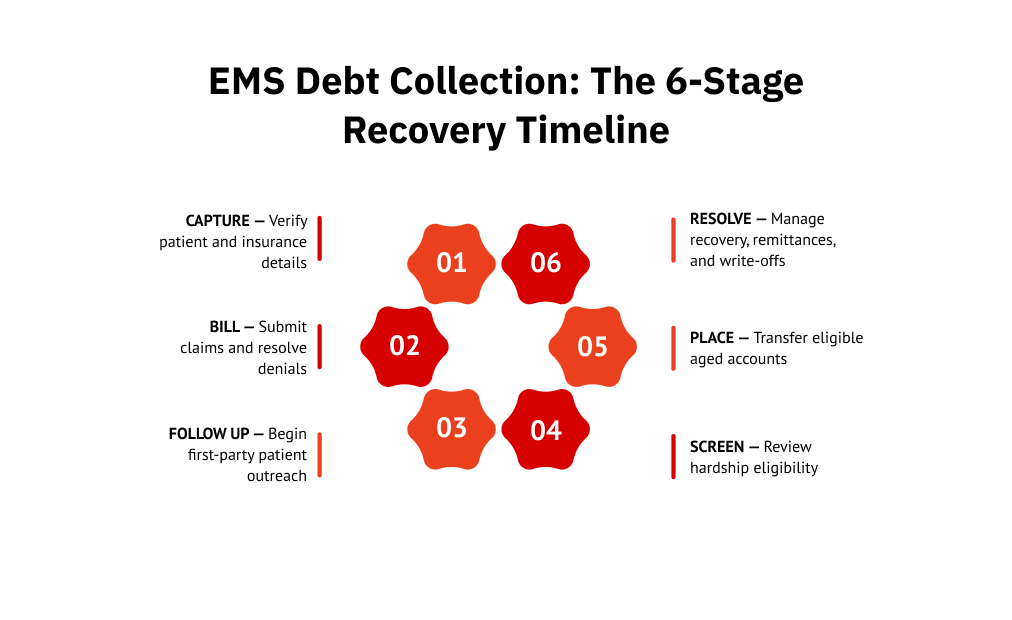
There is no universal EMS recovery timeline. Payer requirements, state rules, internal policy, and account characteristics can all change the sequence.
Still, an illustrative workflow helps establish ownership at every stage.
1. Capture and verify: Days 0–3
Pull demographic information from the electronic patient care record and hospital facesheet. Then check insurance eligibility, including potential retroactive Medicaid coverage where applicable.
2. Claims and denials: Days 3–30
Submit claims using the appropriate coding and documentation. The GADCS Report Appendix identifies HCPCS codes A0426 through A0434 for ground ambulance transports. Work denials before shifting responsibility to the patient.
3. Patient statements and early outreach: Days 30–90
Once patient responsibility is confirmed, begin first-party communication. Send clear statements, digital reminders, and appropriate payment options.
4. Hardship screening: Days 60–120
Apply written financial-assistance criteria before escalating an account. Then use consistent rules and document each decision.
5. Third-party placement: Days 90–180
Placement timing should follow written policy. For example, Goffstown, New Hampshire, remits EMS bad debt after 180 days uncollected, according to a June 2025 town memo.
6. Post-placement recovery and write-off
After placement, the collection agency may handle approved skip tracing, disputes, and escalation. Finally, your policy should define when an account becomes eligible for write-off and who can approve it.
| Pro tip: Document placement triggers, minimum balances, and write-off authority. Consistent rules are easier to defend than case-by-case decisions. |
Compliance guardrails for EMS debt recovery
EMS debt recovery involves healthcare information, consumer communication, and state-specific billing requirements. That is why providers should verify how their policies and partner requirements translate into operational controls.
FDCPA and Regulation F
The Fair Debt Collection Practices Act (FDCPA) and Regulation F apply to covered debt collectors, including qualifying third-party agencies.
Key requirements under Regulation F include:
| Requirement | What’s allowed | What’s not allowed |
| Telephone call frequency | Under §1006.14, up to seven calls within seven days about a particular debt is generally presumed compliant | An eighth call within seven days can create a presumption of violation. Another call within seven days after a telephone conversation can also trigger that presumption, subject to applicable exclusions |
| Contact times | Under §1006.6, communication is generally permitted between 8 a.m. and 9 p.m. locally | Contact outside permitted hours or at known inconvenient times |
| Channel opt-outs | Continue through channels the consumer has not opted out of | Continue using a channel after the consumer requests that communication stop |
| Validation information | Provide information required under §1006.34 | Send incomplete or inaccurate validation information |
| Fees and interest | Collect amounts authorized by agreement or law under §1006.22 | Add unauthorized fees or interest |
The goal is to move these requirements from policy documents into the actual collection workflow.
HIPAA: minimum necessary and BAAs
Apply the Health Insurance Portability and Accountability Act (HIPAA) minimum-necessary principle when sharing patient information. Then provide the billing information required for recovery rather than automatically transferring the complete ambulance run report.
Relevant information may include contact details, date of service, balance, and payer information. Additionally, put an appropriate Business Associate Agreement (BAA) in place before protected health information is transferred to a business associate.
State ambulance billing and medical-debt laws
Federal rules are only one layer.
State requirements can affect balance billing, interest, fees, notices, and medical-debt reporting. Therefore, reconcile payer payments and contractual adjustments first. Then verify the rules that apply where the patient resides.
Medical-debt credit reporting in 2026
A federal court vacated the Consumer Financial Protection Bureau’s medical-debt credit-reporting rule on July 11, 2025. The CFPB’s archived rule page provides background on the rule.
Several states have also enacted their own restrictions. It’s recommended to confirm applicable state requirements with counsel before reporting an EMS account.
| Pro tip: Ask a collection partner to demonstrate how its system blocks prohibited activity. A compliance control is more meaningful when you can see it stop an improper action. |
Best practices to recover more EMS patient balances
Stronger EMS debt recovery depends on better information, appropriate treatment rules, and easier payment access. Here are the best practices to follow:
1. Fix data at the source
Retrieve hospital facesheets quickly where permitted and verify contact information before the first statement. If mail is returned, begin the approved address-resolution process instead of repeatedly using the same information.
2. Segment by payer, balance, and age
Different accounts need different treatment, such as:
- Insurance pending: Continue payer follow-up rather than shifting responsibility prematurely.
- Self-pay, lower balance: Offer a straightforward digital payment path
- Self-pay, larger balance: Apply hardship screening before escalation
- Out-of-network, insured: Confirm state protections and plan type before billing
- Aged beyond the threshold: Apply the approved third-party placement policy.
As a result, the entire portfolio does not enter the same recovery cadence.
3. Make paying easy
Successful contact matters only when the patient can take the next step. Offer appropriate options such as text-to-pay, mobile self-service, and payment plans. Automated reminders can also support existing arrangements.
A digital debt collection strategy should connect outreach directly to a valid resolution path.
4. Set a hardship policy before you need it
Create written eligibility criteria before difficult cases arise. Once done, apply the policy consistently and document each decision. This becomes particularly important for public agencies facing resident or elected-official scrutiny.
| Did you know? According to the Commonwealth Fund, more than one in four privately insured emergency ambulance trips may result in a surprise bill. Therefore, clear communication matters early. |
Which KPIs show an EMS collections program is working?
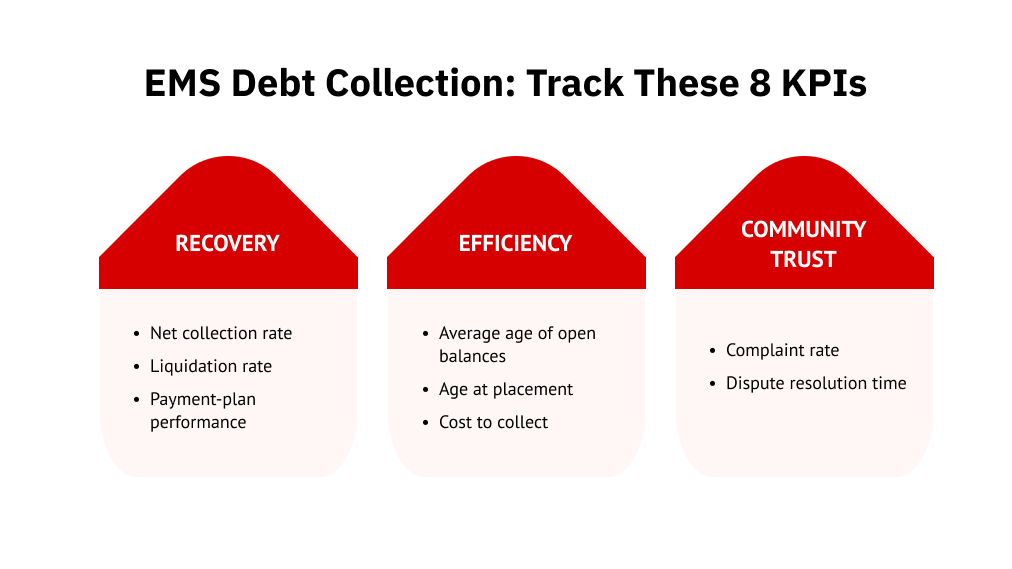
Recovery dollars matter, but they do not explain why performance changed. A useful scorecard should combine recovery, efficiency, and community-trust measures. Here is an example:
| Category | KPI | Definition | What it shows |
| Recovery | Net collection rate | Dollars collected ÷ net collectible dollars | Overall recovery performance |
| Recovery | Liquidation rate | Dollars collected ÷ dollars placed for the same placement cohort | Performance on placed accounts |
| Recovery | Payment-plan performance | Plans current or completed ÷ plans established | Whether arrangements remain sustainable |
| Efficiency | Average age of open balances | Average days since transport across open balances | How quickly balances move toward resolution |
| Efficiency | Age at placement | Average days from transport to agency placement | Whether accounts reach recovery early enough |
| Efficiency | Cost to collect | Total collection cost ÷ dollars collected | True cost of recovery |
| Community trust | Complaint rate | Complaints per 1,000 accounts worked | Reputational or compliance warning signals |
| Community trust | Dispute resolution time | Average days from dispute receipt to documented resolution | Effectiveness of escalation |
Most importantly, compare these metrics together rather than in isolation.
A higher liquidation rate matters less if complaint volume rises sharply. Likewise, a lower contingency fee may still produce a higher cost per dollar recovered.
Report complaint trends alongside recovery performance in leadership or governing-board updates.
| Pro tip: Compare vendors on similar account cohorts. Placement age, payer type, and balance size can materially affect raw liquidation rates. |
In-house, billing company or collection agency: which model fits?
Internal teams, EMS billing companies, and collection agencies solve different parts of the revenue cycle.
According to the GADCS Report Appendix, 79% of ground ambulance organizations contract out billing.
Therefore, identify the operating inefficiency before selecting another vendor. Here is a comparative breakdown for your reference:
| Factor | In-house billing | EMS billing company | Collection agency |
| Main role | Billing and sometimes early-out | Claims, denials, and payer recovery | First-party and third-party patient-balance recovery |
| Control | High | Shared | Shared through policy and reporting |
| Internal effort | High | Moderate | Lower |
| Typical cost model | Salaries, software, and internal overhead | Often percentage-based or contract-based | Often contingency-based for third-party placements; first-party pricing varies by service model |
| Best fit | Stable volume and strong internal expertise | Need for claims, coding, or denial expertise | Aging balances or insufficient patient-recovery capacity |
EMS partner checklist
Once you identify the recovery gap, evaluate whether a prospective partner can operate within your requirements.
Look for:
- Relevant experience: Healthcare, EMS, fire, government, or municipal references
- HIPAA readiness: Appropriate Business Associate Agreement before data transfer
- State licensing: Coverage where patients reside
- Compliance controls: Automated call, timing, and opt-out controls
- Hardship workflow: Clear routing for disputes and hardship cases
- Reporting: Cohort-based recovery, complaint, and dispute reporting
- Contract terms: Recall rights, complaint handling, data return, and exit procedures
How First Credit Services supports EMS debt recovery
Your payer billing may be covered, but recovering patient balances can still stretch your team’s capacity. At First Credit Services, we help your team recover outstanding patient balances without adding to its workload.
We support early-stage first-party programs and later-stage third-party collections. Through our Healthcare Extended Business Office services, we also help recover insurance balances and manage denied-claim follow-up and appeals.
We bring more than 30 years of collections and receivables-management experience. Our clients include healthcare providers as well as government and municipal organizations.
Our proprietary Unified Consumer Engagement Platform (UCEP) coordinates outreach across SMS, email, chat, and phone. Also, we manage the platform and outreach on your behalf.
This gives your team additional recovery capacity, supported by defined compliance controls, reporting, and oversight.
Common EMS debt collection mistakes
Even a well-designed process can weaken after accounts reach the wrong workflow or partner. Here are the most common mistakes to avoid:
1. Choosing a partner on contingency rate alone
A low contingency percentage does not automatically reduce collection costs. Instead, compare liquidation performance on similar account cohorts and calculate the cost per dollar recovered.
2. Placing the same accounts with multiple vendors
Duplicate ownership can create conflicting outreach and complicate communication-frequency controls. As a result, maintain one clear owner for every placed account.
3. Skipping monthly remittance reconciliation
Incorrect payment posting can leave patients receiving notices for balances they already paid. Consider reconciling vendor remittances against your account system consistently.
4. Signing without recall or exit terms
Your agreement should define how accounts return if performance declines or the relationship ends. It should also address patient data, active disputes, payment arrangements, and pending remittances.
A structured process for how to hire a debt collection agency helps you compare more than price.
Building an EMS Debt Collection program that protects revenue and trust
Your EMS recovery results should hold up beyond the monthly report. Each placement needs an accurate balance behind it, and each patient interaction should reflect the standards of your service.
That foundation begins with resolving payer issues before pursuing patient balances. Clear placement criteria and consistent hardship policies then help your team make sound recovery decisions.
Once accounts enter collections, keep financial performance and patient experience in view. Review complaints alongside recoveries, and compare similar account groups to understand what is improving.
Use those findings to decide where your internal team needs support. The right partner should add recovery capacity while giving you clear visibility into how accounts are handled.
Discuss your EMS recovery needs and identify the support your program needs.
FAQs
1. Can EMS agencies bill patients for treatment without transport?
Often yes, if local rules permit treat-no-transport charges. The GADCS Report Appendix found that 24% of responses did not result in transport. About 11% involved treatment at the scene.
2. How should EMS agencies collect a balance when the patient has died?
Agencies generally pursue the patient’s estate rather than surviving relatives unless another party is legally liable. Collection teams should identify the authorized estate representative and follow applicable probate requirements and deadlines.
3. How should EMS agencies handle ambulance bills from car accidents?
Bill applicable auto coverage first where appropriate, then determine remaining insurance and patient responsibility. Check for pending liability claims before moving an eligible balance into patient collections.
4. Is there a time limit on collecting old EMS debt?
Yes. State statutes determine how long legal action may be taken on unpaid balances. Regulation F prohibits covered debt collectors from suing or threatening to sue on time-barred debt.
5. Should EMS agencies sell ambulance debt instead of placing it with an agency?
Selling provides immediate cash but transfers ownership and reduces control over later patient treatment. Collection placement preserves ownership while outsourcing recovery activity. Public agencies should also confirm their legal authority before selling receivables.
6. What can EMS agencies bill Medicare patients for an ambulance transport?
For covered ground ambulance transport, Medicare beneficiaries generally owe 20% of the Medicare-approved amount after the Part B deductible. Certain non-emergency services Medicare may deny can also require advance beneficiary notice procedures.