
An AI debt recovery platform promises faster recoveries, lower costs, and fewer compliance violations. But most vendors make these claims. How do you know which can deliver for your portfolio?
Start by understanding what the platform does. An AI debt recovery platform is a software solution that uses predictive analytics, automation, and digital payment tools to help businesses recover past-due balances. It can support in-house collections teams or form part of a managed recovery service. Depending on its capabilities, it can also automate collection workflows and compliance controls to help reduce risk.
Meanwhile, borrower profiles are changing. According to the Philadelphia Fed’s Q2 2026 report, borrowers scoring below 660 represented 18.5% of new credit card accounts at large banks. That share rose from 16.1% a year earlier. This means higher-risk borrowers make up a growing share of new accounts. Hence, recovery infrastructure needs to keep pace with that changing borrower mix.
This guide covers evaluation criteria, delivery models, costs, and performance measurement, plus how to pilot before you sign.
How to choose an AI debt recovery platform
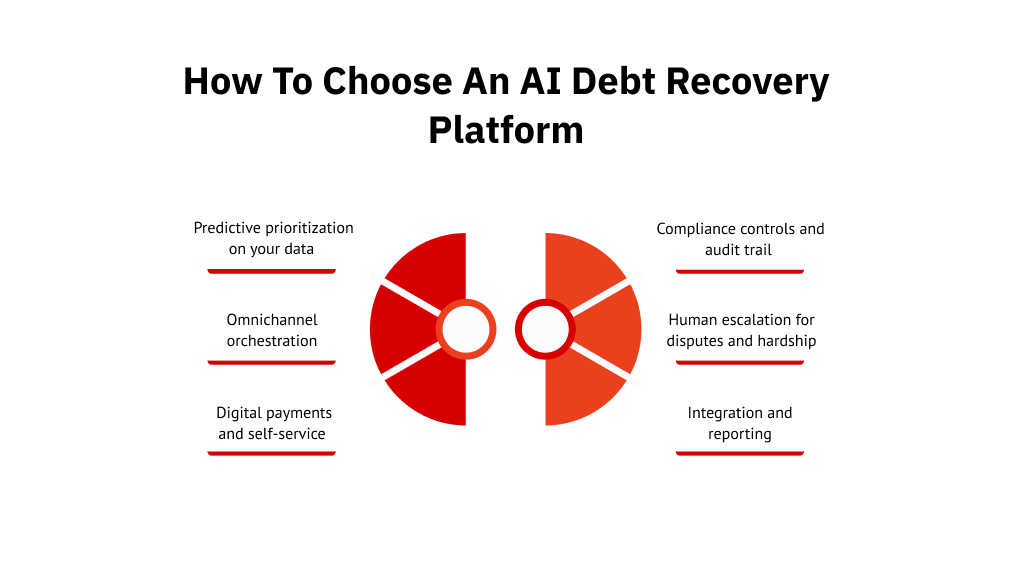
Six capabilities help you judge whether a platform can deliver on its claims. During evaluation, test each one on your own data before you sign.
1. Predictive prioritization on your data
Start with how the platform prioritizes accounts. It should score each account’s likelihood to pay using payment history, balance, delinquency stage, and engagement signals. To assess accuracy, validate those scores on your portfolio during evaluation.
Since payment behavior shifts with economic conditions, also ask for a documented retraining schedule and drift monitoring. A model trained on outdated data may misrank accounts today.
2. Omnichannel orchestration
Next, check whether SMS, email, chat, voice, and letters operate within one coordinated workflow. Regulation F’s numerical frequency rules apply to telephone calls. However, its harassment protections consider cumulative outreach across channels. The system should therefore track call frequency and overall contact patterns.
The same workflow should use past response behavior to choose the channel and send time. A shared conversation record also makes personalized recovery possible at scale.
3. Digital payments and self-service
Once customers are ready to pay, a mobile-first portal should let them make full payments, arrange payment plans, or accept authorized settlement offers.
It should also support Automated Clearing House (ACH) transfers, cards, and digital wallets. Card-processing infrastructure should meet the Payment Card Industry Data Security Standard (PCI DSS). Automatic confirmations and reminders can then help keep plans on track.
4. Compliance controls and audit trail
Across these workflows, the system should automatically enforce applicable contact limits, time windows, and opt-outs. This reduces dependence on agent memory. Otherwise, a missed channel opt-out can lead to repeated prohibited messages.
For accountability, require timestamped logs of every message, call attempt, and AI decision. These records should be exportable for audits or regulatory exams.
5. Human escalation for disputes and hardship
Even with these controls, some conversations need human attention. The platform should detect dispute language, hardship signals, and stop-contact requests. It should then pause automated outreach and route the account to a trained collector with the full history attached.
To assess these handoffs, track escalation volume and resolution time. These metrics help reveal whether complex accounts receive timely attention or remain unresolved in the queue.
6. Integration and reporting
Check that the platform syncs both ways with your loan servicing, billing, payment, and customer relationship management (CRM) systems. Without that exchange, stale balances and duplicate outreach become harder to prevent.
That connected data should feed real-time dashboards covering recoveries, contact rates, and payment plan performance. Also, look for white-label messaging that carries your brand and standard export formats that make switching providers easier.
Use this checklist to compare vendors side by side:
| Criterion | What to verify |
| Compliance rule enforcement | Contact caps, time windows, and opt-outs blocked automatically |
| Audit trail | Every AI decision and message logged and reproducible |
| Human escalation | Clear routing for disputes, hardship, and vulnerable customers |
| Prioritization accuracy | Scoring tested on your portfolio, with drift monitoring |
| Omnichannel coverage | SMS, email, chat, voice, and letters in one workflow |
| Digital payments | Self-service portal, flexible plans, PCI DSS processing |
| Security certifications | Current System and Organization Controls (SOC 2) report and PCI DSS attestation |
| Integration | Two-way sync with servicing, billing, or CRM systems |
| Reporting transparency | Real-time KPIs, including complaints and opt-outs |
| Pricing transparency | Full fee breakdown with no hidden minimums |
| Pro tip:Ask each vendor to demo a blocked action, such as the platform refusing an eighth call attempt within seven days. How a platform says “no” reveals more about its compliance controls than how it says “yes.” |
Why compliance decides the shortlist
A platform can check every capability box and still fail you on compliance. Here are some rules an AI platform must enforce and how to verify them.
Why AI outreach carries the same liability as a human collector
A payment negotiation handled by an AI agent is a collection communication under federal law. The creditor or agency using the platform remains responsible for every message the AI sends.
Unlike a single human error, one misconfigured rule in an AI system can repeat across thousands of accounts in a day.
That is why compliance should be the first filter. Under Regulation F and the Federal Communications Commission’s (FCC) 2024 ruling on AI-generated voices, these are the actions an AI platform can and cannot take:
| Requirement | Allowed | Prohibited |
| Call frequency | Up to 7 attempts within 7 days per debt | An 8th attempt within 7 days, or calling within 7 days after a conversation about the debt |
| Contact times | Between 8 a.m. and 9 p.m. in the customer’s local time | Outside those hours, or at times the customer has flagged as inconvenient |
| Email and text | Messages with a clear, simple opt-out | Messages missing an opt-out, or contact after the customer opts out |
| Validation | A notice with accurate debt details | Missing required details or incorrect amounts |
| AI-voice calls | Calls made with prior express consent | AI-voice calls to cell phones without consent |
Compliance questions to ask every vendor
Before signing, ask these questions and request documented answers:
- How are Regulation F limits tracked across all channels for the same account?
- Can you export a full audit log for a sample of accounts before we sign?
- How are consent records captured, stored, and checked before an AI-voice call?
- Who is contractually accountable if the platform causes a violation?
If a vendor cannot answer these clearly, they should not make your shortlist.
| Pro tip: According to the Consumer Financial Protection Bureau (CFPB) 2025 Consumer Response Annual Report, the bureau received about 387,400 debt collection complaints in 2025. Attempts to collect debt not owed remained the top issue, followed by calls made too often or outside permitted hours. |
Software, agency, or managed service: which platform model fits?
AI debt recovery reaches businesses through three models. Each involves different trade-offs on control, internal effort, and cost.
Licensed AI software
Your team runs the platform: configuring strategies, writing messages, and managing compliance. This gives full control over data, workflows, and the customer experience. It requires in-house collectors, compliance staff, and technical resources for integration. Licensed software fits large lenders with established collections operations.
AI-first collection agency
You place accounts with an agency that uses its own AI tools to collect. Setup effort is low, and pricing is usually contingency-based, meaning you pay only when the agency recovers.
However, the tradeoff is visibility. You will get less control over how customers are contacted and less influence over the brand experience. This model typically covers late-stage or charged-off accounts.
Managed AI service
The provider runs the AI platform on your behalf, often under your brand, with specialists managing strategy and compliance. Trained collectors handle conversations the AI should not, such as disputes and hardship cases.
This model can cover early-stage first-party recovery and third-party collections in one program. It fits businesses that want AI-driven results without building an internal team.
Here is a brief comparison of all the models we discussed above:
| Factor | Licensed AI software | AI-first agency | Managed AI service |
| Who runs it | Your in-house team | The agency | Provider’s specialists |
| Control over strategy | Full | Limited | Shared, with full reporting |
| Compliance responsibility | Mostly yours | Mostly the agency’s | Shared, with provider oversight |
| Upfront effort | High | Low | Low to moderate |
| Human collectors | Your staff | Agency staff | Provider’s trained collectors |
| Best fit | Large teams with high volume | Late-stage, no internal capacity | AI results without building a team |
How First Credit Services delivers managed AI recovery
First Credit Services operates its proprietary Unified Consumer Engagement Platform (UCEP) as a managed service on the client’s behalf. The platform scores each account using behavioral data, then sequences outreach across SMS, email, chat, and phone from a single workflow.
Thus, clients never log in or run campaigns. Instead, our team handles integration, white-labeled messaging, contact strategy, and reporting. When a conversation requires human judgment, our trained collectors step in with the full account history. This approach fits mid-market and enterprise creditors placing accounts at high volume.
What does an AI debt recovery platform cost?
Cost is where many evaluations stall. The quoted price rarely reflects the full spend, and comparing vendors on headline rates alone hides important differences.
Common pricing models
Each pricing model ties your costs to platform access, outreach activity, or recovered payments. Here are the common options and where each fits best.
| Pricing | How it works | Best fit |
| Contingency | Percentage of the amount collected | Costs tied to results |
| SaaS subscription | Fixed fee per user, account, or month | In-house teams with steady volume |
| Usage-based | Per message, call, or minute | Validate outreach volume |
| Hybrid | Platform fee plus performance component | Shared risk at larger scale |
Hidden Costs to Ask About
The following costs often sit outside the quoted price. Catching them during evaluation prevents surprises after launch.
- Integration and data mapping: Often billed separately, especially for complex portfolios.
- Consent and opt-out management: Required for compliant texting and AI-voice calls. Some vendors charge extra.
- Messaging and carrier fees: SMS costs grow with volume. Confirm whether per-message fees are included or passed through.
- Script and compliance review: Legal review adds time and cost before launch.
- Minimum volume commitments: These can make low-volume programs uneconomical.
- Exit and data return: Switching vendors gets costly when data terms are unclear.
When comparing total cost, use cost to collect (total collection cost divided by dollars collected) as your benchmark. For a broader look at cost tradeoffs, explore benefits of outsourcing collections.
Which KPIs prove an AI debt recovery platform works?
Vendor dashboards tend to highlight activity metrics: messages sent, calls attempted, accounts touched. Before launch, define the KPIs that measure recovery performance, efficiency, and customer impact.
Recovery KPIs
- Liquidation rate: Dollars collected divided by dollars placed. Your headline recovery measure.
- Right-party contact rate: Right-party contacts divided by accounts attempted. Shows whether outreach reaches the correct customer.
- Promise-to-pay kept rate: Promises kept divided by promises made. This reflects the quality of payment arrangements.
Efficiency KPIs
- Digital self-cure rate: Accounts resolved through the portal with no agent, divided by total resolved. Shows how much work the platform automates.
- Cost to collect: Total collection cost divided by dollars collected. Reveals true efficiency beyond headline pricing.
- ROI: Additional amount recovered minus additional cost, divided by additional cost. Use it to benchmark the platform against your current process.
Customer-relationship and compliance KPIs
- Complaint rate: Complaints per 10,000 contacts. Track this to identify customer concerns and potential compliance issues.
- Opt-out rate: The percentage of messaged customers who opt out. An increase may indicate overly frequent or poorly targeted outreach.
- Dispute resolution time: The average number of days from dispute submission to resolution. Use this to assess how efficiently your escalation process works.
| Did you know? In a Gartner’s 2026 survey, 63% of finance organizations stated AI implementation was slower as compared to 2025. Hence, defining KPIs before launch is the clearest way to separate real value from activity. |
Common mistakes when choosing an AI debt collector or platform
Most buying mistakes surface only after a contract is signed. But knowing them upfront gives you better questions during evaluation.
- Accepting compliance claims without proof: A vendor that says “100% compliant” should provide rule logic and audit logs you can review.
- Comparing vendors on headline price alone: A low platform fee can hide integration, messaging, and minimum-volume costs. Compare the cost to collect instead.
- Trusting recovery claims without portfolio context: Results vary by account type, balance size, and delinquency stage. Ask for results on portfolios similar to yours.
- Underestimating the internal workload: Data cleanup, script approvals, and integration testing take staff time, even with a managed provider.
- Letting the vendor define success: If the vendor picks the metrics, results will favor activity over recoveries. Set your KPIs before the pilot starts.
For more on how AI is reshaping debt collection and where these pitfalls appear in practice, see our detailed guide.
How to evaluate and pilot a platform before you sign
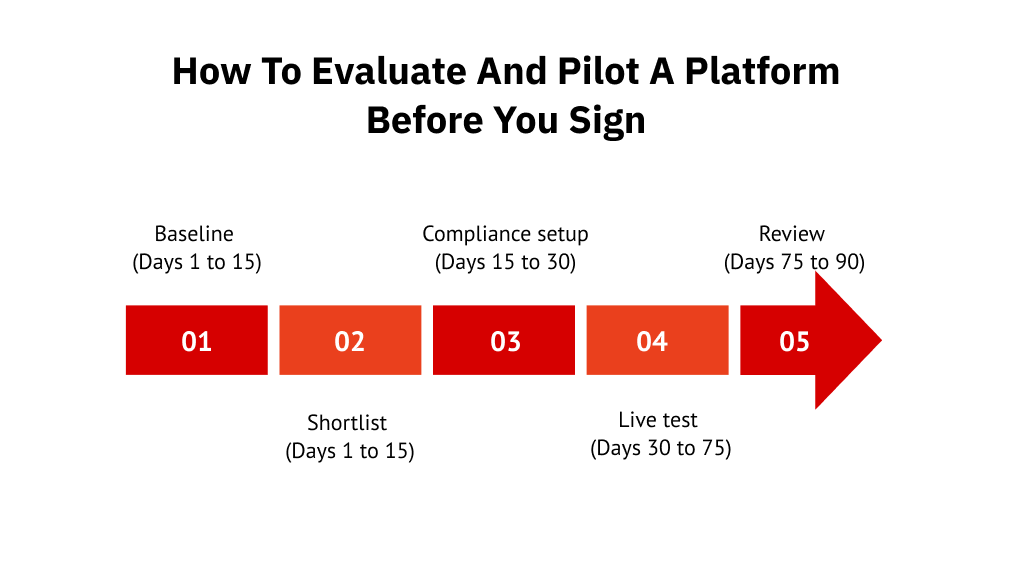
A controlled pilot on real accounts is the only reliable way to test a platform’s claims. This 90-day framework gives you structured proof before you commit.
- Baseline (Days 1 to 15): Record current KPIs for the segment you plan to test. Clean account data and agree on the test population with your vendor.
- Shortlist (Days 1 to 15): Assess three to five vendors against the checklist above. Collect compliance documentation and sample audit logs from each.
- Compliance setup (Days 15 to 30): Approve scripts, load consent records, and configure contact limits and settlement boundaries.
- Live test (Days 30 to 75): Run the platform on one segment against a control group continuing your current process. Track KPIs weekly.
- Review (Days 75 to 90): Compare results between the pilot and control groups across all KPIs. Decide whether to scale, adjust, or exit.
| Pro tip: Write success thresholds and exit terms into the contract before the pilot begins. When targets are agreed upfront, the results speak for themselves. |
Choose an AI debt recovery platform that proves its value
Your investment should rest on evidence from your own portfolio. Start by testing recovery capabilities and verifying how automated controls enforce collection rules. Then, assess whether the operating model and total cost fit your team’s resources. Consider using a controlled pilot to establish measurable results before committing to a wider rollout.
Turn your evaluation into a practical recovery plan. Talk to our experts about an AI-driven approach aligned with your recovery goals and compliance requirements.
FAQs
1. What is the difference between an AI debt collector and an AI debt recovery platform?
An AI debt collector usually refers to a single conversational agent handling outreach by voice or chat. A platform is the full system: account scoring, channel orchestration, payment portals, compliance controls, and reporting. The business using the technology remains legally responsible.
2. Can an AI debt recovery platform work alongside an existing collection agency or in-house team?
Yes. Many businesses use AI for early-stage outreach and self-service payments, then hand complex or late-stage accounts to collectors. The key is a clear handoff process, so the account history moves with each customer.
3. Do businesses need to tell customers they are interacting with AI?
It depends on the state and the communication channel. Some states, including California and Utah, have disclosure laws covering AI or automated communications. Confirm your specific requirements with compliance counsel before launch.
4. Is an AI debt recovery platform practical for smaller businesses?
Yes, especially through a managed or contingency-based model. That gives smaller businesses access to AI scoring and digital outreach without hiring specialists. Check each provider’s minimum volume requirements before committing.
5. Will a vendor use my portfolio data to train its AI models?
Some vendors do. Ask whether your data trains shared models, how it is anonymized, and how it is returned or deleted when the contract ends. Get those terms in writing.
6. Can an AI platform report accounts to the credit bureaus?
Some platforms support credit reporting, but timing rules apply. Under Regulation F, a collector cannot furnish information about a debt to a bureau before communicating with the customer about it.