


If your team already handles early-stage recovery, why bring in an outside agency to do the same work?
The answer usually shows up in the queue. Past-due volume keeps climbing while headcount stays flat, and older balances age untouched. At that point, a first-party debt recovery agency becomes a serious option.
However, the more useful question is whether an outside agency can add recovery capacity. The right partner should do this without forcing you to build a second operating model. Because these accounts are still receivables, it resolves them under your brand. Meanwhile, you keep full control of policy and strategy.
This guide covers when to move beyond in-house recovery and what an outside agency should add beyond extra staff. It also explains how first-party recovery differs from third-party collections and what to evaluate before choosing a partner.
What is a first-party debt recovery agency?
A first-party debt recovery agency is an outsourced partner that works early-stage overdue accounts under your company’s brand. These can be invoices owed by other businesses or balances owed by individual customers. Either way, the agency uses your terms, tone, and credit policies. To your customers, every contact reads as coming from your own receivables team.
When applied, this goes well beyond putting your name on emails. A strong first-party recovery program matches your operation in four areas:
- Sender identity: the email domain, phone greeting, and SMS name your customers already recognize and trust
- Tone and scripts: the language and escalation rules your own team uses
- Payment options: the same credit terms, payment plans, extensions, and settlement authority you approve
- Account policy: credit holds, dispute routing, and the key accounts that stay off-limits
This level of detail matters because customers screen unfamiliar senders closely. Without that match, an off-brand message can get flagged as phishing or ignored as spam.
At this stage, no write-off has happened, so these balances are still part of your accounts receivable. That is why the goal is to resolve them while keeping the customer relationship strong.
The main difference from an in-house team comes down to who runs the work. The agency provides the people, technology, and systems. In return, you keep control of the program, the brand, and the account strategy. That split is the core idea behind first-party collections outsourcing.
With that difference clear, the next step is knowing when your in-house team has reached its limit.
Why in-house recovery reaches its ceiling
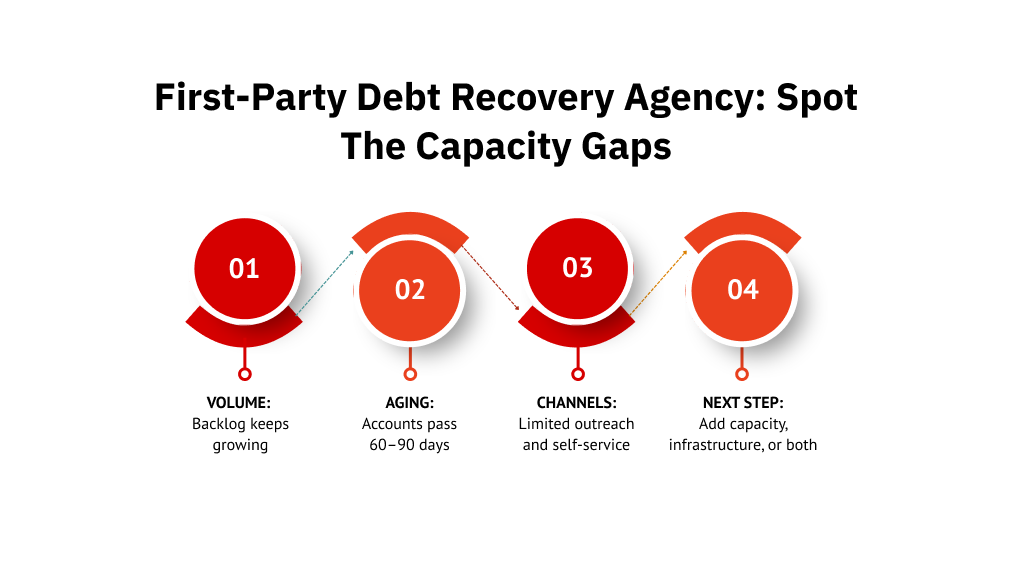
In-house recovery tends to wear down gradually. Over time, extra effort stops producing extra revenue. The warning signs tend to appear in three places, and each one points to a different constraint.
Volume outpaces staff capacity
The first sign is a queue your team can no longer clear. Most teams respond by working the largest balances first, which makes sense on paper. As the backlog grows, smaller balances go weeks without a single touch. Many of those accounts would settle after one timely reminder. On top of that, admin work eats into capacity, since agents spend hours logging calls, matching remittances, and updating records.
Extra hires can close the gap for a quarter. Even so, seasonal spikes and billing cycles tend to bring the backlog back.
Recovery rates drop past 60 to 90 days
The second sign sits in your aging report. Accounts that reach 60 to 90 days past due resolve at lower rates than newer ones. Business customers tend to become less responsive as an invoice ages. A stretched team also reaches those accounts late. Consequently, its recovery rate falls even when effort stays the same.
No omnichannel or self-service infrastructure
The third sign is structural. Many in-house programs still rely on phone calls and manual emails. By comparison, business customers who prefer to reply by text or pay after hours have few easy options.
Building omnichannel outreach internally usually means adding:
- Messaging tools for SMS, email, and chat
- A self-service payment portal
- Contact preference and opt-out tracking
Each piece needs budget, IT time, and ongoing upkeep. For most finance teams, that project competes with core priorities and often loses out. Without these tools, early-stage debt recovery stays slower and more manual than it needs to be.
Once these signs appear, the next question is what an outside agency should add beyond extra headcount.
What an outside agency should add beyond extra headcount
Hiring extra collectors can ease a staffing gap for a while. Underneath that gap, the deeper constraint is usually the operating setup. According to PYMNTS Intelligence’s From Friction to Flow 2025 report, 35% of mid-sized firms rely entirely on manual AR processes. For that reason, a strong partner should fix the setup as well as add people. Six additions matter most:
- Dedicated recovery capacity: In-house staff often split time across recovery, billing questions, and disputes. A partner should assign agents to your accounts alone and scale them up during volume spikes.
- Technology and workflow infrastructure: Messaging tools, payment portals, and contact records rarely sit in one internal system. Ideally, the agency brings a ready-built recovery stack and connects it to your billing data.
- Portfolio segmentation: One outreach plan treats a first missed payment like a chronic one. Look for scoring that sorts accounts by balance, age, and payment history.
- Channel management: Business customers respond on different channels at different times. The partner should sequence email, SMS, chat, and phone so each attempt informs the next.
- Reporting: A monthly total hides where accounts stall. Ask for results by age band, segment, and channel on a fixed schedule.
- Operational expertise: Script updates, agent coaching, and quality reviews all take specialist time. An experienced agency runs them on a set schedule, well before problems surface.
With these in view, apply one test to any proposal. If a first-party collection agency only supplies collectors, you are simply outsourcing labor. The stronger case appears when it also absorbs the infrastructure and operational complexity behind early-stage recovery.
At First Credit Services, we provide first-party collections as an extension of your receivables team. Our agents work within your system of record and reach business customers through SMS, email, chat, and phone. This approach has helped us deliver ROI exceeding 600%.
Still, some compliance responsibilities stay with you, even with the right partner in place.
What compliance responsibilities stay with the creditor?
Handing recovery to a partner shifts the daily work to another team. Accountability for that work stays with you.
Federal law sets the baseline, and its scope is narrower than many creditors expect. The Fair Debt Collection Practices Act defines a debt as one incurred primarily for personal, family, or household purposes. Consumer balances fall squarely within that definition. As a result, an outside agency collecting them for you may count as a debt collector under the Act. That status often turns on whether the account was already in default at placement.
By contrast, business debt generally falls outside the Act, regardless of who collects. Many creditors take that as proof that commercial recovery sits beyond consumer-style rules. At the state level, that assumption is narrowing.
| Did you know? According to the California Legislature’s SB 1286 bill text, Rosenthal Act protections now reach certain business debts of $500,000 or less. This applies to debts owed or guaranteed by a natural person, entered into on or after July 1, 2025. |
Branding adds another layer. An outside agency does not become the creditor simply by using your name. Before launch, define its role, communications, compliance duties, and share of risk in writing.
Signing up for first-party debt collection services never moves compliance off your plate. Before the agency handles live accounts, name an owner for each area:
- Compliance monitoring: Decide who reviews scripts, messages, and contact frequency against federal and state rules.
- QA review: Decide who samples calls and messages, and how often those reviews happen.
- Complaint escalation: Decide who receives disputes and how quickly they return to your team.
A partner with a documented debt collection compliance program makes these handoffs easier to assign. Once ownership is clear, you can compare the three operating models side by side.
Common mistakes creditors make when evaluating a first-party agency
Well-prepared teams can still misjudge a partner during evaluation. Four mistakes come up again and again when creditors assess a first-party collection agency:
- Treating the “first-party” label as a compliance answer: The brand on a message does not settle which rules apply. State laws such as SB 1286 can still reach certain business debts. Therefore, verify that live messages match your approved scripts, and confirm the legal basis in writing.
- Skipping an agreed escalation threshold: Without one, accounts either linger in first-party outreach too long or move on too early. Both outcomes cost you recoverable revenue. Instead, set clear triggers based on account age, balance, or contact attempts.
- Leaving compliance and QA ownerless after go-live: A contract can promise compliance while nobody checks daily execution. Without ongoing oversight, gaps may surface only when complaints arrive. On consumer accounts, those gaps can also create FDCPA exposure if the agency counts as a debt collector. Name one owner on each side before the program launches.
- Comparing agencies on cost per account alone: A low price can hide thin technology, limited channels, or weak reporting. In that case, the cheapest proposal can end up recovering the least. Weigh each price against recovery by age band and the first-party collections software behind it.
Each mistake traces back to the same root cause. The evaluation focused on the pitch, while the operating details went unchecked. Those details matter most when an account cannot be resolved at the first-party stage.
What happens when the agency can’t resolve an account
Some accounts stay unresolved even after strong early-stage debt recovery work. When that happens, a few steps follow in sequence:
- First-party contact stops, so your customer never hears from two sources at once
- The account file moves with its payment history, contact attempts, short payments, and open disputes
- The third-party agency takes over contact under its own name
- Your finance team records any write-off, and the account moves from receivables into collections
- Your sales or account teams are notified, so no one extends new credit on that account
Beyond the operational steps, the compliance picture shifts too. On consumer accounts, the third-party collector now falls fully under the Fair Debt Collection Practices Act (FDCPA). It must provide validation information within five days of its first communication. Business accounts may still fall under state rules, such as California’s SB 1286.
Each step depends on clean data. A missing dispute note or payment record can restart the wrong conversation with your customer. Typically, the handoff runs most smoothly when one partner covers both stages.
FCS runs first party and third-party recovery under one roof. As a nationally licensed third-party debt collection agency, it takes over unresolved accounts without a new vendor search. Its team already recovers both consumer and commercial debt.
To make that handoff dependable, the key terms belong in your contract before you sign.
What to lock into the contract before you sign
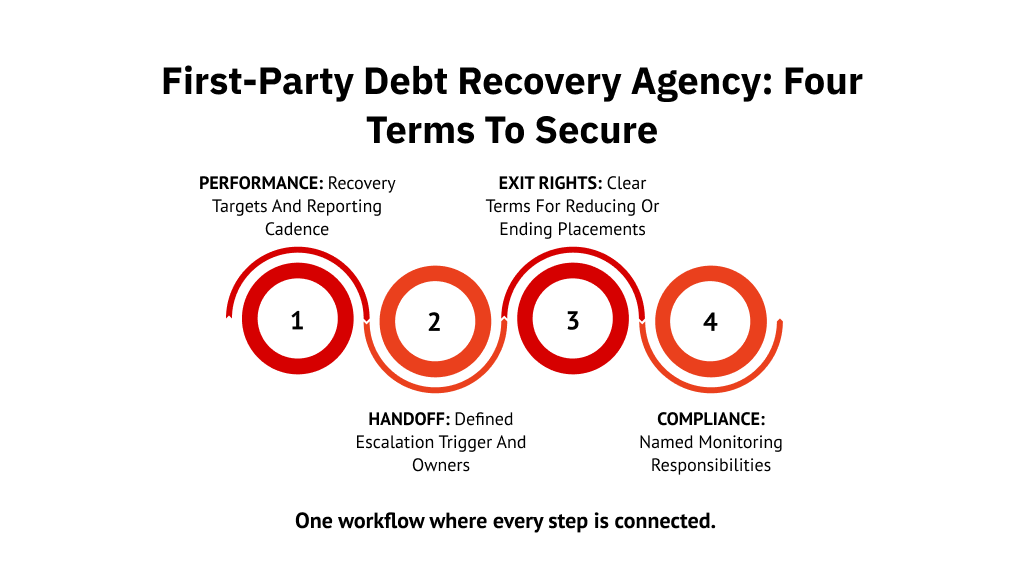
The evaluation shows what a partner promises. In turn, the contract decides what you can actually enforce. Before signing for first-party debt collection services, make sure the agreement covers four terms:
- Performance and reporting: The recovery rate and reporting cadence agreed during evaluation should appear as written terms.
- Escalation hand-off: The threshold from your readiness checklist should become the formal hand-off point to third-party recovery. Name an owner on each side for that transfer.
- Exit or pull-back rights: A defined clause lets you reduce placements or leave if performance slips.
- Compliance ownership: The agreement should name who monitors compliance, including any state-level rules that apply to your portfolio.
| Pro tip: Ask for compliance-monitoring and complaint-escalation answers in writing during evaluation, before anyone drafts the contract. A verbal assurance from a sales call carries little weight once the program is live. |
With those terms in writing, the last question is whether this model fits your operation.
Is a first-party debt recovery agency right for your operation?
Ultimately, an outside agency earns its place when it adds infrastructure and operational depth beyond extra headcount. Compliance accountability stays with you under any model. Beyond that, the right operating model and contract terms decide whether the program holds up after launch.
Hold every first-party collection agency you evaluate to one standard. A strong partner should show operational capacity and clean integration with your billing and CRM tools. It should also prove recovery performance by account age and document its compliance processes. Finally, it needs a defined path for accounts it cannot resolve.
If your in-house team is nearing its ceiling, that standard is the right place to start.
Are you weighing in-house recovery against an outside partner? Contact FCS to explore first-party recovery built around your brand.
FAQs
1. Can a first-party agency handle invoice disputes and short payments?
Yes. Short payments often trace back to pricing errors, deductions, or missing credits. The agency can document the stated reason on each account and flag it for your team. That helps you fix the root cause before the same shortfall repeats.
2. Does a first-party debt recovery agency need state licensing?
Yes. Licensing rules vary by state and by how the agency operates. Requirements can also differ for agencies working under a creditor’s name. Before launch, confirm the agency holds licenses for every state where your business customers operate.
3. Can a first-party agency recover failed payments on recurring B2B billing?
Yes. Failed card or ACH payments on subscriptions and service contracts are a common first-party use case. The agency contacts the customer quickly, updates payment details, and retries collection under your brand. Early action helps prevent involuntary churn.
4. Can customer payments go directly to the creditor’s account?
Yes. Many first-party programs route payments straight to your own merchant account or payment portal. Others collect funds and remit them on a set schedule. Before launch, confirm the payment flow, remittance timing, and reconciliation reports.
5. Are agency agents treated as the creditor’s employees?
No. Agency agents remain the agency’s employees, even when they work under your brand. The agency hires, trains, pays, and supervises them. You typically set the scripts, policies, and escalation rules, while day-to-day management stays with the agency.
6. Can the agency work through customer AP portals and remittance matching?
Yes. Some agencies can submit invoices through customer AP portals and match incoming remittances to open balances. This matters when large buyers accept invoices only through their own portals. Before launch, confirm the agency supports both.