

Why does one account settle within a week while an identical-looking account goes silent for months? Most collection programs still run every delinquent account through the same script and the same cadence. Personalized debt collection closes that gap.
The fix comes from smarter targeting. Account-level data decides who gets contacted, through which channel, and on what terms. That targeting rests on three connected levers: segmentation, communication design, and payment plan structure. None of them does much alone.
This guide walks through what personalized debt collection looks like in practice, and what it costs you to skip. It also covers how the approach shifts between first-party and third-party accounts, and what to evaluate before you build or buy the capability.
What is personalized debt collection?
Personalized debt collection tailors the channel, timing, tone, and repayment structure of outreach to each account’s own data and behavior. Instead of one fixed script across the entire portfolio, segmentation and scoring route different accounts toward different treatments. In this way, behavior-based debt collection treats every account as its own case within the portfolio.
The mechanism itself sits in scoring and workflow design at the portfolio level. Rewriting a call script in a warmer tone, for instance, changes how one call sounds. However, it does not change which account gets contacted, on which channel, or at what point in the account’s lifecycle.
In practice, three account-level inputs drive that routing:
- Behavioral signals: prior channel engagement, response history, and payment history.
- Financial signals: balance size, account age, and prior missed payments.
- Contact signals: a verified phone number, a verified email address, or no confirmed contact method.
Each signal moves an account toward a different treatment path, and that path then sets the channel, cadence, and payment options your team offers on that account.
Naturally, portfolio growth makes this kind of routing essential for larger books. Total debt balances rose 33.1% between Q2 2019 and Q2 2025, according to the TransUnion 2025 Debt Collection Industry Report. A portfolio expanding at that pace cannot run on one fixed script without losing ground somewhere.
Without that routing, low-propensity accounts absorb contact attempts they will never convert on. High-propensity accounts get the same light touch as everyone else. Both outcomes cost you recovery. That routing decision starts with one thing: how you segment the portfolio in the first place.
Debt collection customer segmentation: where personalization starts
Debt collection customer segmentation is the prerequisite for every other personalization decision. It determines which account gets which treatment, and it happens before any channel choice, tone shift, or plan offer.
Without it, personalization collapses back into a generic sequence. You may vary the wording, but the routing stays flat. As a result, high-propensity accounts get the same effort as low-propensity accounts, and collector time gets spent evenly across a book where recovery odds are anything but even.
Given this, two questions decide whether segmentation works: what signals you feed it, and how many segments you build. Both matter, but signal choice is the harder of the two, so start there.
Why a single variable isn’t enough
To begin with, a single variable like credit score or zip code is a weak basis for segmentation. Either one flattens accounts that behave very differently in the real world.
For example, two accounts can have the same 620 credit score. One responded to a payment reminder last cycle and is 15 days past due on a $200 balance. The other has ignored three outreach attempts and is 90 days past due on $1,800. Even so, a single-variable model treats them the same, when in practice they need very different sequences.
Similarly, balance size alone falls into the same trap. Prioritizing by balance alone systematically underweights smaller accounts that are easy to reach and easy to close, while overinvesting effort in larger accounts that may never respond.
Instead, a workable segmentation model combines at least three signal types:
- Propensity to pay: a score ranking how likely each account is to resolve. It draws on past payment behavior and account history.
- Contactability: whether you have a verified phone number, a verified email address, and confirmed permission to use each channel.
- Stage and balance: where the account sits in the aging cycle, and what dollar value is at stake.
Combining these signals lets you match effort to opportunity, rather than spreading it evenly across accounts with very different odds of paying.
Once the signals are in place, the next question is what segments they should actually produce.
Common segments and recommended treatment
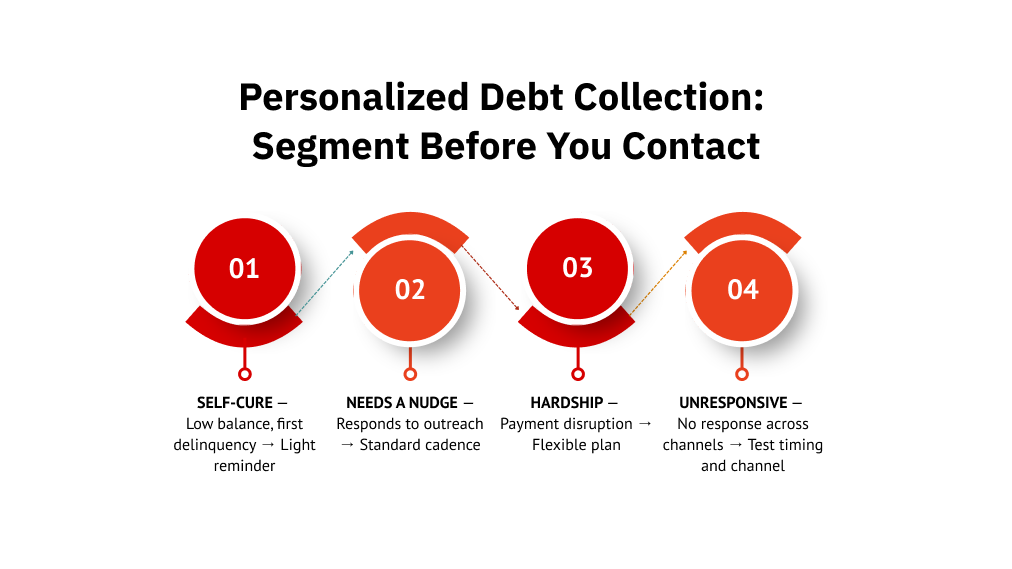
Operationally, most personalized programs settle on four to five segments as a starting point, and each one carries a distinct treatment path.
| Segment | Primary signal | Recommended treatment |
| Self-Cure | Low balance, first delinquency, no prior missed payments | Light-touch reminder, minimal contact |
| Needs a Nudge | Moderate balance, responsive to prior contact | Standard-cadence outreach, standard plan offer |
| Hardship | Missed payments increasing, income or expense disruption | Reduced cadence, hardship-specific plan |
| Unresponsive | No contact across two or more channels, aged account | Channel and timing test sequence |
Each segment is essentially a hypothesis about how the account will behave, and each treatment is what your team tests against it. Over time, the response data should then feed back into the scoring model, so segments stay accurate as portfolio behavior shifts.
Beyond segment design, refresh cadence matters more than segment count. A static model built once and left alone stops describing your portfolio within a few billing cycles, so a quarterly refresh keeps the segments honest.
For instance, First Credit Services builds its scoring models to prioritize collection effort and improve reach rates, the same logic this kind of segmentation framework runs on.
| Pro tip: Start with three to four segments rather than a dozen. Over-segmenting before there is enough account volume to support distinct treatments is the most common reason these programs stall before launch. |
With segments defined, the next step is turning them into an actual outreach sequence.
Personalizing debt collection communication
Channel personalization means matching each account to the outreach channel it actually responds to. This replaces running the same fixed sequence for every account. In other words, this is where personalized debt collection communication shows up in day-to-day operations. It uses the response data you already have to decide where the next contact should land.
To start, most digital-first programs work across four channels:
- SMS: short, high open rate, best for reminders and portal links.
- Email: longer messaging, better for detailed plan options and dispute rights.
- Self-service portal: the payment destination, reachable from every other channel.
- Voice: the highest-cost channel, reserved for high-balance or high-difficulty accounts.
From there, channel choice should follow the account’s behavior rather than a fixed calendar.
For example, suppose an account has responded to three of the last four SMS reminders but ignored every email. In that case, keep pushing SMS. Consequently, you would drop the email track from that sequence. This kind of automated, omnichannel debt collection routing is exactly what digital-first platforms are built to run in the background.
Beyond channel choice, timing and frequency make up the other half of the picture. A fixed cadence across the whole portfolio wastes contacts on accounts that would resolve on a lighter touch. At the same time, it under-contacts accounts that need more attention.
Aligning cadence to segment response is what makes the difference here. For example, an early-stage digital sequence might look like this:
| Day | Self-Cure | Needs a Nudge |
| Day 1 | SMS reminder with portal link | SMS reminder with portal link |
| Day 5 | No contact | Email with plan options |
| Day 10 | Email nudge if unpaid | SMS follow-up, live-agent option |
| Day 14 | Close if resolved | Voice call for accounts still open |
As the table shows, two accounts get the same first touch, then follow different paths. That is what channel personalization looks like on the ground.
Beyond channel and cadence, tone matters at the message level too. A self-cure reminder that reads like a warning, for instance, damages the customer relationship. This holds even for a balance that would have paid on its own. Conversely, a hardship message that reads like a routine reminder misses the actual context. Match the tone to what the segment signals, rather than relying on a single house voice.
| Pro tip: Match one additional channel at a time to a segment’s confirmed response pattern. Avoid rolling out full omnichannel coverage all at once. It becomes harder to isolate what is actually driving the lift. |
With communication matched to the segment, the next step is deciding what the account holder can actually do about the balance. That is where payment plan design comes in.
Personalized payment plans
Personalization has to end in an action the account holder can actually take, which is exactly what personalized payment plans are meant to deliver. Otherwise, a tailored channel and tone with only one payment option delivers friction without benefit.
To that end, plan type should map to the segments defined earlier, so each treatment path ends in the right offer.
Common plan types
Plan structures fall into four categories, each distinguished by how the balance resolves and how much risk the business carries until it is paid off.
- Lump-sum settlement: resolved in one payment, often at a discount, fastest to close with the lowest ongoing risk.
- Installment plans: split into equal monthly payments over a fixed term, the standard option for most working accounts.
- Short-term hardship pauses: payments suspended for 30 to 90 days, then the original schedule resumes.
- Income-scaled plans: monthly payments calibrated to reported income and expense data, common in hardship and healthcare settings.
Lump-sum resolution closes faster than installments, which carry ongoing non-payment risk.
Given these categories, the mapping to segments follows directly:
- Self-Cure accounts: lead with a light settlement offer.
- Needs a Nudge accounts: default to a short installment plan with a portal link.
- Hardship accounts: lead with a short-term pause, then reassess with an income-scaled plan if hardship persists.
- Unresponsive accounts: hold offers until channel and timing testing produces a live signal.
Building the plan library, however, is only half the work. The other half is reaching the right account at scale, which is where self-service earns its place.
Scaling plans through self-service
Self-service portals let a business offer segment-specific plans at scale without adding headcount. The account holder gets a link, lands on a page tailored to their segment, and picks a plan that fits.
As a result, volume rises because the portal runs around the clock. Cost per contact drops because self-serve resolution costs a fraction of an agent-led call. Friction also drops because the account holder never has to repeat themselves. The system also leaves a cleaner audit trail, with every option, offer, and payment attempt logged with a timestamp, which holds up better than an agent’s memory of a call.
This is exactly the model First Credit Services runs through its Unified Consumer Engagement Platform, or UCEP. Account holders choose from tailored payment plans and settlement offers through the same self-service portal, rather than a single fixed repayment option. Your organization gets this flexibility without having to build the infrastructure from scratch.
Why the approach changes: first-party vs. third-party personalization
Personalization tactics differ by account stage, splitting personalized debt recovery into two playbooks. Pre-charge-off accounts sit in first-party recovery, under the creditor’s own brand, treating the account holder as a customer worth keeping. However, post-charge-off accounts move to third-party recovery, where the focus shifts to liquidation under the agency’s brand.
That said, both stages use scoring, segmentation, and channel personalization; only the goal changes. In first-party recovery, the account holder is still a customer, so the wrong tone in one SMS can hurt renewal and lifetime value.
Accordingly, personalization here leans on:
- Warmer, service-forward messaging under the creditor’s own brand
- Digital-first sequencing, with SMS and email ahead of voice
- Plan options that surface early, before the balance ages
Once an account is charged off, however, the customer relationship the creditor was protecting is either already broken or nearly so.
As a result, personalization now leans on:
- Contactability and skip-trace enrichment to re-establish reach
- Settlement-forward offers built to close in fewer contacts
- Compliance-tight scripting under Regulation F contact rules
Here is how the same levers show up differently across the two stages:
| Lever | First-Party Recovery | Third-Party Recovery |
| Brand shown | The creditor’s own brand | The agency’s brand |
| Tone | Warm, service-forward | Direct, resolution-focused |
| Channel default | SMS and email before voice | Verified channels first, then skip-trace |
| Plan emphasis | Flexible installments, early options | Settlement-forward, fewer contacts to close |
| Primary metric | Early-stage resolution plus retention | Net liquidation per dollar placed |
Even so, the handoff between stages is where personalization programs most often break. If the third-party team starts from scratch on data the first-party program already collected, the account holder gets treated like a stranger, and response rates drop.
A clean handoff, therefore, carries three things forward:
- the most recent verified contact information
- the account holder’s confirmed communication preferences and opt-outs
- the plan offers already made or refused
Continuity across the handoff is what lets segmentation keep working after write-off.
FCS runs both first-party collections and third-party collections recovery under a single contract, powered by the same UCEP platform. This allows the personalization approach to shift by account stage without switching providers or losing handoff data, a continuity advantage that is difficult to replicate with an in-house team alone.
What happens when personalization is skipped: cost and relationship risk
Programs that skip personalization pay for it in three places. To start, without tiering, collector time gets spent evenly across accounts regardless of collectability. This wastes effort on low-propensity accounts while under-resourcing high-propensity ones.
Beyond that, generic outreach on pre-charge-off, first-party accounts also risks damaging a retainable customer relationship the business would otherwise have kept. A self-cure account hit with aggressive voicemails, for instance, does not just pay slower but also churns.
Finally, undifferentiated, high-frequency outreach carries litigation exposure too, since the CFPB’s Regulation F caps contact frequency. A fixed cadence is the fastest way to trip that limit at scale.
A segmented program keeps all three costs in check. This is because debt collection compliance and regulations get enforced at the account level rather than the campaign level.
How to choose the right partner for personalized collections
Once you decide a personalized program needs to live outside your business, the question shifts to what you evaluate. Most agencies now claim scoring, omnichannel, and self-service. However, the real differences show up two or three questions deeper. That is exactly where weak personalized debt collection strategies get exposed.
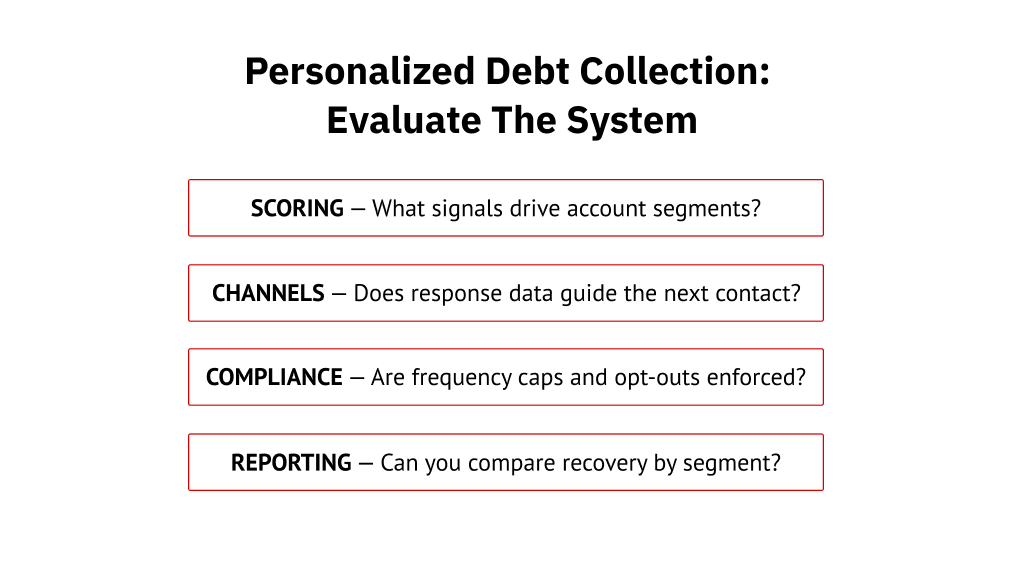
Four areas separate a working program from a repackaged phone-call operation:
- Scoring and segmentation capability: ask how segments are built, which signals drive them, and how often the model refreshes. A static model is a warning sign, whatever the marketing says.
- Channel range: the vendor should run SMS, email, a self-service payment portal, and voice inside one system. Routing should be decided by account response, not a fixed calendar.
- Compliance guardrails built into the system: contact-frequency caps, opt-out propagation, and proxy-variable testing should sit inside the platform’s default behavior. They should not be bolted on as a separate checklist.
- Reporting and visibility by segment: you should see recovery by segment, channel, and treatment path in near real time. Portfolio-level roll-ups hide where personalization actually paid off.
For each area, ask for a concrete example from a comparable client rather than a capability slide. Of the four, compliance carries the most downside if misread, so it is worth its own look.
Compliance guardrails to build in
Personalizing channel, timing, and tone is permitted. Personalizing required disclosures or exceeding contact-frequency limits under Regulation F, however, crosses the line.
Four guardrails belong in any personalized program before it goes live:
- Account-level frequency caps: the 7-in-7 call limit applies at the account level regardless of scoring tier. Segmentation can decide who gets contacted first, but not how many times a high-priority account gets called.
- Cross-channel opt-out sync: a stop request on SMS has to propagate to email and voice in near real time, or the program keeps contacting someone who already opted out.
- Proxy-variable testing: this is a shifting area. CFPB’s April 2026 rule eliminated disparate-impact liability under ECOA, effective July 2026, though the rule faces active legal challenges. Even so, a variable like zip code can still function as a proxy for a protected characteristic. That still carries reputational and state-law risk, regardless of where the federal standard lands.
- Full audit trail: every message, offer, and payment attempt should be logged with a timestamp at the account level, your defense if a complaint escalates.
None of these are optional in a 2026 program. A vendor that treats them as add-ons is a program you will spend the next audit cleaning up after.
With the evaluation criteria in place, the last step is deciding whether your own program is ready to make this shift at all.
Is your collection program ready to personalize?
The three levers in this piece work together: scoring-driven segmentation, channel and message personalization, and segment-matched payment plans. Running one without the others caps how much recovery lift any of them can deliver alone. That is the core case for personalized debt collection over a fixed, one-size-fits-all process.
The account’s stage decides which lever matters most. First-party recovery leans on tone and channel to protect the customer relationship. Third-party recovery leans on contactability and settlement-forward offers to close at the lowest cost. A single playbook applied evenly across the portfolio leaves recovery on the table at both stages.
Putting that approach into practice starts with the right operating model.
Weighing whether to build scoring and segmentation in-house, or bring in a partner that already runs it at scale? See how FCS can tailor recovery to your portfolio.
FAQs
1. How much account data do you need to personalize a debt collection program?
You need account status, contact history, channel response, and payment behavior at a minimum. Segmenting on three to four signals already outperforms undifferentiated outreach in most portfolios. Richer inputs such as propensity scores and third-party enrichment data lift results further as the program matures.
2. Does personalizing debt collection cost more to run than a standard program?
Not necessarily. Digital channels cost less per contact than voice calls or mail, and better tiering redirects collector time to higher-propensity accounts. In most portfolios, the operational savings from those two shifts fund the scoring and platform investment within the first year.
3. Does a personalized recovery program change how accounts get reported to credit bureaus?
Personalization changes how you contact and offer terms to an account. It does not change the underlying credit bureau reporting rules. Those follow the Fair Credit Reporting Act (FCRA) and Metro 2 formatting standards, so reporting cadence and status codes stay the same across segments.
4. Does personalization work differently across a mixed portfolio of consumer and commercial receivables?
Yes. Commercial accounts personalize around relationship history, purchase order status, and the accounts payable (AP) contact’s role at the buyer. Individual, non-commercial accounts personalize around payment behavior, hardship signals, and channel response instead. Running both from the same playbook usually blunts recovery on both sides.
5. Can a smaller operation personalize without investing in AI software?
Yes. Manually segmenting by balance, age, and past channel response, then matching plan options and cadence to each segment, captures most of the benefit. That result usually shows before any spend on scoring technology. Automation makes the same approach faster and more consistent.
6. How long does it take a program to see results after adopting personalization?
Most portfolios see measurable shifts in contact and response rates within 60 to 90 days. Full recovery-rate impact typically shows up over two to three billing cycles. That is roughly how long the scoring model needs to absorb enough response data to differentiate treatment paths cleanly.