

Every collections call at a credit union is a call to one of its owners.
That makes credit union debt collection a delicate job, because you must recover the balance and keep the member. Push too hard, and you lose members, yet wait too long and balances roll toward charge-off.
Fortunately, you do not have to choose between recovery and the relationship. A staged program resolves most accounts early through timely outreach and flexible workout options. For older accounts, a specialized third-party partner can extend your reach without changing your tone.
This guide covers the core strategies, the in-house versus third-party decision, agency evaluation criteria, and the KPIs to track.
What is credit union debt collection and why is it different?
Credit union debt collection is the recovery of overdue balances owed by delinquent member accounts. It covers auto loans, credit cards, personal loans, home equity lines of credit (HELOCs), overdrafts, and negative share accounts.
The key difference is ownership, because every borrower at your credit union is also a shareholder. As a result, member debt collection carries a higher standard than bank recovery, even on seriously delinquent balances.
Regulation reinforces that contrast. Your credit union answers to the National Credit Union Administration (NCUA), and three laws influence every collection decision:
- Fair Debt Collection Practices Act (FDCPA): You are generally exempt when you collect in your own name. However, any third-party agency you hire is fully subject to the Act.
- Telephone Consumer Protection Act (TCPA): Automated calls and texts to a member’s cell phone require documented, revocable consent. Therefore, consent tracking deserves close attention.
- Servicemembers Civil Relief Act (SCRA): You must screen for active-duty status before you take certain collection actions.
Together, these obligations call for a more measured approach than banks or fintech lenders use. That balance is harder to hold today, because industry delinquency has climbed over the past year.
Why delinquency is a growing problem for credit unions
Credit union delinquency has climbed over the past year, and charge-offs remain heavy. The NCUA Quarterly Credit Union Data Summary 2026 Q1 reports:
- A delinquency rate of 85 basis points, up 5 basis points year over year
- Annualized net charge-offs of $13.9 billion across 4,250 federally insured credit unions
Those numbers land differently in a cooperative than they would at a bank. When a bank charges off a balance, outside shareholders absorb the loss through lower earnings. By comparison, your members absorb each charge-off through reduced dividends, tighter loan pricing, or fewer services.
The cost reaches the full membership, including members who have no overdue obligations. Across the industry, that membership now totals 145.8 million people.
That dynamic creates a compounding problem:
- Rising delinquency pressures you to tighten underwriting or raise rates.
- Tighter terms push marginal borrowers toward higher-cost lenders.
- In turn, the members who need the cooperative model most become the hardest to serve.
The NCUA Quarterly U.S. Map Review First Quarter 2026 adds to the concern. According to the report, about 55% of federally insured credit unions lost members over the past year. Many factors drive attrition, and the collection experience is one that you control. For that reason, credit union loan collections deserve the same attention as lending and service.
| Did you know? Credit card delinquency at credit unions reached 204 basis points in Q1 2026, the highest rate among major loan categories. Auto loans held steady at 80 basis points, while commercial loans climbed to 101. |
5 core strategies for effective credit union debt collection
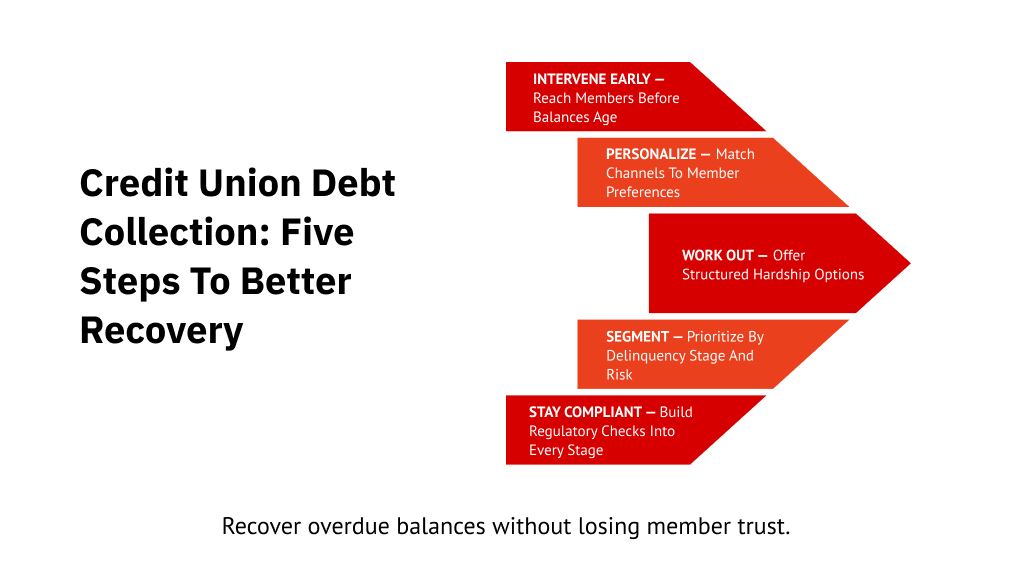
A structured program moves accounts through defined stages, with the right outreach at the right time. The five strategies below form the building blocks of effective credit union debt recovery. To start, focus on the window where accounts are easiest to cure.
1. Early intervention before accounts age past 30 days
The first 30 days after a missed payment offer the highest probability of cure. After that point, recovery odds drop and the cost per dollar collected climbs.
Effective early intervention runs three actions in parallel:
- Automated payment reminders: Send an email, text, or push notification within 5 to 15 days, with a direct payment link.
- Proactive outreach: Call or message higher-risk accounts on days 15 to 20, before a hardship escalates.
- Hardship screening: Ask about job loss, medical costs, or income disruption at first contact.
A common mistake is waiting until day 30 to begin outreach. By then, the member has missed a full billing cycle, and catching up feels harder.
Even so, good timing achieves little if the message arrives on the wrong channel.
2. Member-centric communication across channels
Members expect to hear from you on the channel they prefer. For example, a program built on phone calls alone misses members who rarely answer. An omnichannel approach gives each channel a role:
- Phone: Use calls for high-balance or escalated accounts, where a live conversation can settle terms.
- Email: Send formal notices, payment confirmations, and documentation by email.
- Text: Reserve texts for time-sensitive reminders and payment links, sent with documented TCPA consent.
- Online portal: Offer self-service payment arrangements, balance checks, and plan setup.
- In-branch: Support members who prefer face-to-face help with hardship options.
Tone matters as much as channel, because the borrower is a co-owner. An adversarial message can trigger a board complaint, a public post, or a closed membership. As such, every template and script should reflect your cooperative’s values.
At First Credit Services, we build our omnichannel debt collection programs around each member’s preferred channel.
Respectful outreach also opens the door to the next strategy, which gives struggling members a workable path.
3. Structured hardship and workout programs
A modified loan that performs is worth more to your members than a charged-off balance. Hardship programs are recovery tools, and they work best as standard procedure. The core options include:
- Loan modifications: Extend the term or adjust the rate to lower the monthly payment
- Forbearance agreements: Pause payments for a defined period during a documented hardship
- Payment plan restructuring: Spread an arrearage across future payments without a lump sum
- Skip-a-payment programs: Give performing borrowers a short reprieve during seasonal income dips
Each option needs documented eligibility criteria, approval workflows, and reporting triggers. Otherwise, decisions vary between loan officers, which creates compliance risk and member confusion.
From there, segmentation tells you which accounts should receive which offer.
4. Data-driven segmentation by delinquency stage
Treating every delinquent account the same wastes resources and weakens results. Segmentation fixes this by matching the effort on each account to its stage and risk. Most teams group accounts along three lines:
- Delinquency stage: Early accounts respond to reminders, while older accounts need direct contact and structured offers.
- Loan product and balance: A small overdraft and a large auto loan deficiency call for different playbooks.
- Borrower behavior: Payment history and past responses show which accounts are likely to resolve on their own.
Segmentation improves recovery because your staff spends time where a conversation changes the outcome. In addition, automated tools can handle the early, low-risk accounts at little cost.
| Pro tip: Review your segments every quarter. Account behavior shifts over time, and stale groupings send effort to the wrong accounts. |
Finally, every segment must hold up under regulatory review.
5. Compliance-first operations at every stage
Regulators are watching collections closely this year. According to the NCUA 2026 Supervisory Priorities letter, delinquency and loss rates are at their highest in over a decade. Examiners may review your loss mitigation programs, charge-off practices, and third-party risk management.
These five obligations need ongoing attention:
- NCUA expectations: Keep documentation and loss mitigation records ready for examiners.
- FDCPA exposure: Full obligations apply once a third-party agency takes over an account.
- TCPA consent: Keep consent for automated calls and texts documented, revocable, and auditable.
- SCRA screening: Check active-duty status before any default judgment, repossession, or foreclosure.
- State rules: Track local variation in collection timing, fee caps, right-to-cure windows, and licensing.
Strong programs build these checks into daily workflows. Automated SCRA checks, consent management, and call auditing reduce both examiner findings and member complaints.
With the five strategies in place, the next question is who should carry them out.
What to look for in a credit union debt collection agency
Choosing a credit union debt collection agency takes more than a reference check. The agency will contact your members, handle sensitive financial data, and operate within your regulatory framework. A poor fit creates compliance exposure, member complaints, and weaker recovery results.
Before you place accounts with any partner, verify these seven criteria:
- NCUA-aligned vendor management documentation: The agency should supply what your examiner will request, including certifications, audit reports, and a business continuity plan.
- RMAI certification, PCI DSS compliance, and a SOC audit: These credentials cover collection standards, payment data security, and operational controls. You can confirm an agency’s status in RMAI’s directory of certified businesses.
- Credit union product experience: Auto loans, HELOCs, credit cards, and negative share balances each carry different recovery economics. Ask for results on the products you plan to place.
- Member communication protocols: Request outreach templates, call scripts, and escalation procedures. Then compare them with your own member communication standards before you sign.
- Transparent reporting with real-time access: You should see account status, payment activity, and contact history without waiting for a monthly summary.
- Omnichannel contact capability: The agency should reach members by phone, letter, email, and text, and offer a self-service portal.
- Digital-first and AI-driven contact strategies: The platform should score each account and select the message, channel, and timing for each member.
At FCS, we meet every item on this list, with 30+ years of collecting for financial institutions. Our third-party collections program holds RMAI certification and maintains PCI DSS and SOC 2 Type II compliance. Additionally, our Unified Consumer Engagement Platform (UCEP) tailors outreach to each member’s communication preferences.
Once a partner is in place, you need a way to measure the results.
Measuring credit union collection performance: 5 KPIs that matter
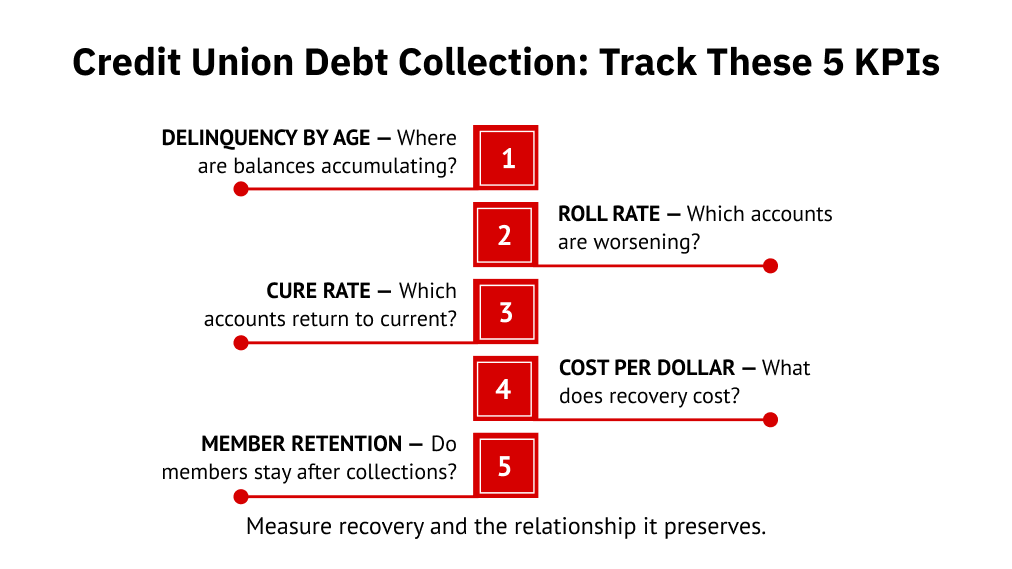
Recovering overdue balances is only part of the job. You also need to know whether your credit union loan collections produce results at a sustainable cost. These five key performance indicators (KPIs) give your board and collections team a clear baseline:
- Delinquency rate by aging bucket: Track the 30-, 60-, and 90-day buckets for each loan product. A falling 30-day rate beside a rising 90-day rate points to weak late-stage recovery.
- Roll rate and cure rate: Roll rate shows how many accounts move into the next aging bucket each month. Conversely, cure rate shows how many return to current status.
- Net charge-off rate: According to the NCUA Quarterly Credit Union Data Summary 2026 Q1, the industry rate was 81 basis points. Compare your own portfolio against that benchmark every quarter.
- Cost per dollar collected (CPDC): Divide total collection costs by total dollars recovered. Afterward, compare your internal CPDC with agency fees to guide placement decisions.
- Member retention after collections: Count the members who remain active 12 months after a collections contact. A recovered member who stays is worth more than the recovered balance alone.
| Pro tip: Review your roll rate every month, because quarterly reviews surface problems too late. A sudden rise in the 30-to-60-day roll rate signals that early intervention needs adjustment. Charge-offs will show the same problem months later. |
With these measures in place, you can bring the whole program together.
Strengthen your collections without losing members
Rising delinquency calls for a structured, staged approach to credit union debt collection. Early intervention, member-centric communication, and compliance work best as one system. Above all, the member-owner philosophy should guide every contact.
In short, a hybrid model is the practical route to stronger credit union debt recovery. Your staff keeps early accounts, and a vetted partner handles aged and charged-off balances.
Is your credit union’s delinquency outpacing your internal team’s capacity? Talk to us at FCS. Our compliance-first team helps you recover overdue balances while protecting member relationships.
FAQs
1. Can a credit union send a delinquent member to a third-party collection agency?
Yes, credit unions routinely place accounts once internal efforts are exhausted. Placement often happens at 60 to 90 days past due or after charge-off. Beforehand, NCUA guidance expects due diligence on the agency’s certifications, audits, and communication practices.
2. How long does a credit union wait before charging off a delinquent loan?
NCUA guidance sets no single deadline, so your board defines the timing in its charge-off policy. A common reference point is the bank standard of 120 days for closed-end loans. Under that same standard, open-end credit is charged off at 180 days. Importantly, charge-off is an accounting event, and collection of the balance can continue.
3. What compliance requirements apply specifically to credit union collections?
You are generally exempt from the FDCPA when you collect in your own name. Even then, NCUA oversight, the TCPA, the SCRA, and state consumer protection laws still apply. Unfair or deceptive practice standards apply as well, and any agency you hire falls fully under the FDCPA.
4. What is the difference between first-party and third-party credit union collections?
In first-party collections, outreach happens under your credit union’s name, by your staff or an outsourced team. In third-party collections, an outside agency collects on your behalf under its own name. That handoff triggers full FDCPA obligations for the agency.
5. How can credit unions reduce delinquency without damaging member relationships?
Start with early intervention, including automated reminders in the first 15 days and proactive hardship screening. Next, offer structured workouts such as forbearance, loan modification, or a restructured payment plan. Members who receive early support tend to cure and stay.
6. What KPIs should a credit union track to measure collection effectiveness?
Track five metrics for member debt collection, starting with delinquency by aging bucket and roll and cure rates. Also follow net charge-off rate, cost per dollar collected, and member retention after collections. For context, the NCUA industry net charge-off rate was 81 basis points in Q1 2026.