

Revenue disappears long before write-off. It disappears the week your team stops following up, and most teams stop sooner than they think.
The typical accounts receivable operation is a billing function. It sends reminders on a schedule, and when those reminders stop working, the account just ages. That gap between a past-due notice and actual collection is where recoverable revenue quietly turns into a loss.
Accounts receivable recovery services are third-party solutions built specifically to close that gap. They take over unpaid invoice collection on your behalf across the full lifecycle, from early-stage outreach through escalation and resolution.
This guide breaks down what these services include, how the process works, and what to look for in a provider. It also answers when outsourcing recovery makes sense and when it does not.
What accounts receivable recovery services include
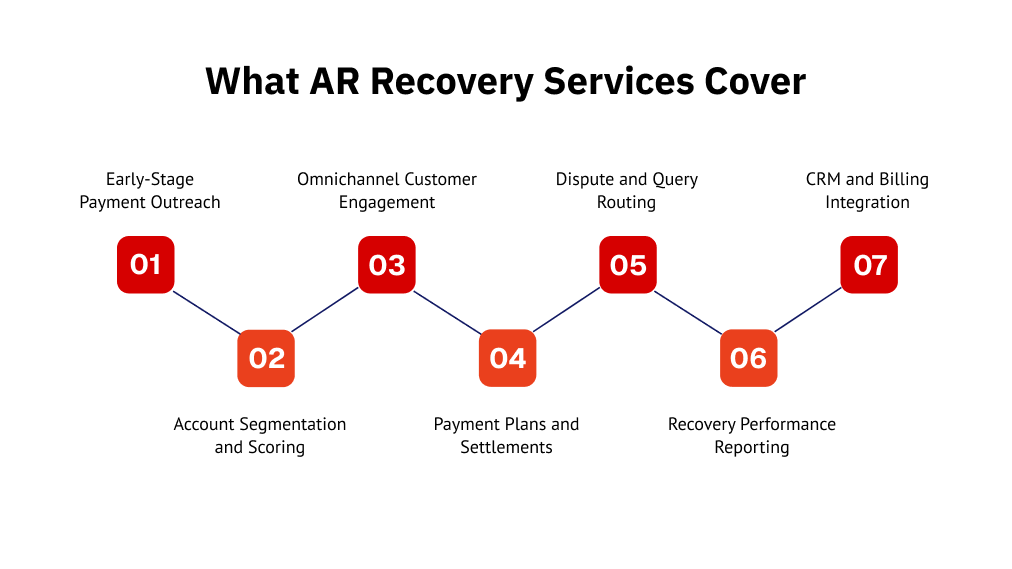
Accounts receivable recovery services collect overdue customer balances on your behalf through structured outreach, segmentation, digital engagement, and performance reporting. Coverage may span early-stage payment recovery, later-stage debt collection, or both, depending on your delinquency volume and receivables management strategy.
For a finance leader watching days sales outstanding climb, this is the function that stops aging receivables from becoming write-offs. The service scope typically covers:
- Early-stage outreach after missed or failed payments: Contact begins within days, while the customer still recognizes the balance and is most likely to respond.
- Account segmentation and prioritization: Each account is scored by balance size, age, risk profile, and payment history. The score determines which channel, message, and timing it receives.
- Omnichannel engagement across SMS, email, phone, chat, and self-service portals: The channel mix adapts to how each customer segment responds rather than defaulting to phone calls.
- Payment plans, settlements, and resolution support: Customers resolve balances through digital self-service or live agents, with arrangements matched to the balance and situation.
- Dispute and billing-query routing: When a customer disputes a charge or raises an account question, the recovery team routes it to you or resolves it within agreed guidelines.
- Recovery performance reporting: You see placement volumes, contact rates, resolution rates, and dollars recovered, broken down by segment and strategy.
- System integration: Your CRM, billing system, payment gateway, or accounting software stays synchronized with the outsourced recovery operation. No manual reconciliation.
What separates a strong outsourced operation from a basic one is how the data connects. Segmentation shapes channel selection. Contact outcomes update account scoring. Reporting shows which approaches work by segment, so the strategy evolves instead of running on assumptions.
First-party vs third-party recovery
Most accounts receivable recovery services offer one or both of these models. The distinction determines your customer experience, your brand exposure, and where each model sits in the delinquency cycle.
First-party recovery means the provider operates as an extension of your receivables department. Agents work under your brand name, use your systems, and follow your scripts.
The customer does not know that a third party is involved. This model applies during early-stage delinquency, typically the first 30 to 90 days, while the account is still on your books.
Third-party debt collection takes over after internal and first-party efforts are exhausted. The account has typically aged well past due or been written off.
A collection agency contacts the customer under its own name, with a more formal, regulatory-aligned tone. The agency carries a larger share of the compliance burden at this stage.
| Factor | First-Party Recovery | Third-Party Debt Collection |
| Brand identity | Your company name | Collection agency’s name |
| Timing | Early-stage, typically 0 to 90 days | Later-stage and aged or written-off accounts |
| Customer experience | Relationship-preserving | Resolution-focused |
| Compliance ownership | Shared with your team | Agency-led |
| Outreach tone | Matches your brand voice | Formal, regulatory-aligned |
Many organizations use both models across the revenue recovery lifecycle. First-party covers early delinquency. Third-party takes over once first-party outreach has run its course. The handoff depends on industry, balance size, and risk tolerance.
| Pro tip. Base your first-party-to-third-party handoff on contact attempt outcomes rather than calendar days alone. An account with zero engagement after 15 attempts is colder than one at 90 days with partial payments in progress. |
A provider that covers both models under one operation keeps account data and outreach history intact across the transition.
How accounts receivable recovery services work
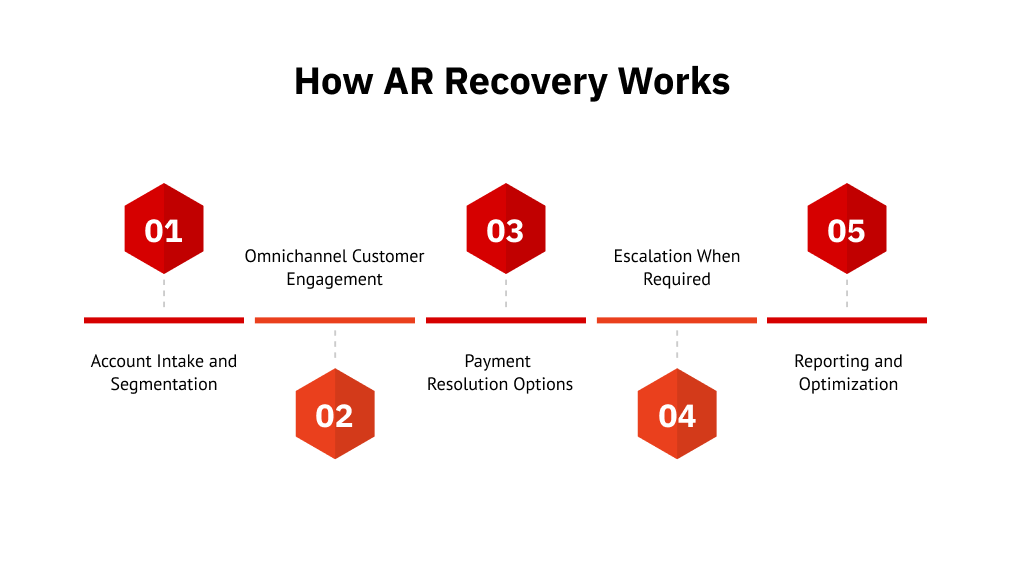
Accounts receivable recovery follows a five-stage lifecycle: account intake and segmentation, customer engagement, payment resolution, escalation, and reporting. The details vary by provider, but this structure is consistent across managed AR recovery programs.
1. Account intake and segmentation
You place delinquent accounts with the provider. The provider scores each account by delinquency stage, balance size, payment history, and response patterns. This scoring drives every downstream decision: which channel reaches each customer, how urgent the outreach is, and how quickly it starts.
The speed of this step matters. Providers that take days to process new placements lose the window when customers are most likely to respond. Ask how quickly accounts move from your system to active outreach.
2. Customer engagement
Outreach begins through the channels scored as most effective for each segment: SMS, email, phone, chat, or digital self-service. What separates strong AR recovery services from basic ones is how these channels coordinate.
A customer who opens an email without acting might receive an SMS the next day. Clicking a text link might route to a payment page or a live agent. Each interaction informs the next, creating one connected sequence.
3. Payment resolution
When a customer responds, the focus shifts to closing the balance. Options include full payment, a payment plan, updated payment details, or a settlement through approved terms.
Self-service portals handle a growing share of resolutions. Customers click a personalized link, see their balance, and choose a payment option without calling anyone. Live agents handle accounts that need negotiation or clarification.
4. Escalation when required
Accounts that stay unresolved after initial outreach move through escalation steps defined during onboarding. Triggers might include a set number of unanswered contacts, a delinquency threshold, or a balance cutoff.
Escalation could mean increasing outreach frequency, shifting from digital to phone, or transitioning to third-party collections. Providers that cover both first-party and third-party models keep account data and outreach history intact across that transition.
5. Reporting and optimization
You see contact rates, resolution rates, channel performance, dollars recovered, and how accounts move through AR aging stages. Reporting should operate at both the portfolio and individual account levels.
The real value shows over time. Each placement cycle generates data on which segments, channels, and timing produce the strongest recoveries. That data feeds back into segmentation and outreach strategy for the next cycle, so receivables recovery improves with each round of placements.
The economics of this entire lifecycle depend on how fast outreach begins. Accounts contacted within the first weeks of delinquency recover at significantly higher rates than aged balances.
Every week of delay extends DSO, shrinks cash flow recovery potential, and moves the balance closer to write-off. When evaluating providers, ask how quickly they move from intake to first contact.
When outsourced AR recovery makes sense
Outsourced accounts receivable recovery services make sense when your internal team can no longer keep up with delinquent account volumes. Rising roll rates, gaps in digital engagement, and growing compliance demands are equally strong signals.
- Volume outpaces headcount: Delinquent balances are growing faster than staff. Accounts sit untouched for weeks, and by the time someone reaches out, customers have moved into later delinquency stages where resolution odds drop.
- Roll rates are climbing: More accounts are moving from 30-day to 60-day to 90-day buckets. This is the clearest sign that your AR aging management process cannot keep pace. Each stage transition reduces recovery rates and increases DSO.
- Outreach depends on manual effort: Without coordinated digital engagement across SMS, email, chat, and self-service portals, contact rates stay low and the process stalls.
- Compliance requirements exceed internal resources: Managing Fair Debt Collection Practices Act (FDCPA) compliance, Telephone Consumer Protection Act (TCPA) requirements, and dispute handling requires dedicated staff. Add call monitoring, audit trails, and script approvals, and the costs add up fast.
- Customer experience is inconsistent: Recovery outreach that feels aggressive or disjointed damages the customer relationship. A dedicated operation protects your brand during a sensitive interaction.
- You need technology and trained agents without building either: Omnichannel engagement, self-service payment portals, behavioral scoring, and real-time reporting cost millions to build internally. Managed AR recovery services give you trained agents and proven infrastructure through one provider.
The regulatory and technology burdens alone justify AR outsourcing for many mid-market organizations. However, timing matters. Early-stage accounts recover at significantly higher rates than aged balances. Organizations that wait until 90 or 120 days leave potential revenue on the table.
Once the decision to outsource is clear, the harder question is selecting the right partner for your portfolio.
How to evaluate an accounts receivable recovery partner
Evaluate an accounts receivable recovery partner against five criteria: portfolio and vertical experience, compliance and data security, technology and reporting, onboarding, and commercial terms. Strong providers give specific proof against every one, in writing, before the contract is signed.
Managed AR recovery services fit best when you already have an internal collections team, your monthly delinquent volume runs into the hundreds of thousands or millions, and internal follow-up has hit its ceiling. Aged-account recovery is slipping, your internal team is stretched thin, and your current vendor is still phone-first. When those pressures line up, finance and collections leaders start the search. Use the criteria below to run it well.
Portfolio and vertical experience
Receivables recovery workflows for a credit card issuer look nothing like those for a hospital network or a national gym chain. Payer behavior, dispute patterns, and the regulatory stack all differ.
Request references from clients in your specific vertical: banking and credit cards, healthcare, auto finance, fintech, health and fitness, insurance, or utilities. Confirm what portion of the partner’s book sits in your industry.
In healthcare, that means a partner who understands guarantor accounts, denial workflows, and patient balance recovery, not one who treats hospital receivables like credit card debt. In auto finance, it means a partner who handles skip-tracing and asset-recovery workflows. In fintech, it means a partner who can run digital-only recovery for a customer base that never expects a phone call.
Vertical experience shortens the ramp and lifts early-stage recovery rates.
Compliance scope and data security
Consumer debt recovery sits inside a stacked regulatory environment. A managed AR recovery partner must demonstrate active compliance across the frameworks that touch your book:
- FDCPA and Regulation F govern third-party consumer recovery activity. Confirm contact frequency caps are enforced at the account level.
- TCPA governs automated calls and SMS to consumer numbers. Ask how consent is captured, tracked, and honored across channels.
- HIPAA applies to healthcare receivables where patient data touches the recovery workflow.
- PCI DSS Level 1 applies to card issuers and any partner handling cardholder data during payment resolution.
- SOC 2 Type II certification covers information security. Request the current report.
- State consumer collection licensing varies by jurisdiction. Verify that the partner’s map covers every state where your customers live and was refreshed within the last 12 months.
Vague answers or a deflection to “our legal team can walk you through it” is a red flag.
Technology, omnichannel, and reporting
The gap between a strong provider and a basic one shows in the technology stack. Look for:
- Omnichannel orchestration across SMS, email, phone, chat, and self-service portals is coordinated as one strategy, where the outcome of each interaction shapes the next.
- A white-labeled customer portal where consumers view balances, choose payment plans, and pay without agent involvement. Self-service resolutions lower cost per recovery, shorten resolution time, and protect the customer relationship.
- Real-time reporting with account-level visibility through a live portal.
- Integration or file exchange with your CRM, billing system, or accounting platform documented before contract signature.
Request sample reports at the weekly and monthly cadence. Vague or PDF-only reporting signals a partner without a mature data program.
Onboarding and commercial terms
Ask how long the partner needs to go live end-to-end, from placement through first customer contact. File-based placement with standard workflows typically runs for one to two weeks. First-party programs that require system integration and script approvals run for 30 to 60 days.
Read the contract terms. Watch for:
- Placement minimums and volume commitments that lock in more inventory than you intend to place.
- Exit clauses, account return process, and payment reconciliation on wind-down.
- Legal escalation authorization thresholds that control what the partner can do without your sign-off.
A partner that can go live in a week is often running a shallow engagement.
Shortlist scorecard
Before signing, every vendor on your shortlist should answer these ten questions in writing:
- Recovery rate by aging bucket on portfolios like yours, past 12 months
- Full fee schedule, including hidden or pass-through fees
- Named references in your vertical
- State-by-state consumer collection licensing map verified in the last 12 months
- Current SOC 2 Type II report, plus HIPAA or PCI DSS certifications where relevant
- Sample reports at a weekly and monthly cadence
- Onboarding plan with named milestones and owner assignments
- Sample scripts and communication controls, including approval workflow
- Documented dispute handling workflow
- Exit terms and account return process
Turn these ten questions into a scoring rubric with your finance and legal team before the first sales call. The vendors that survive that filter are the ones worth a real conversation.
How First Credit Services delivers managed ar recovery
First Credit Services is a managed accounts receivable recovery and customer engagement partner that runs first-party collections and third-party collections for enterprise clients across banking, credit cards, healthcare, auto finance, fintech, health and fitness, insurance, and utilities. The team operates the platform, workflows, and compliance stack on your behalf. You place accounts. First Credit Services works with them.
How the model fits the criteria
The five evaluation criteria in the section above map cleanly to how First Credit Services structures its programs.
- Portfolio and vertical experience: Over 30 years of operating in consumer debt recovery across the verticals named above. Programs are staffed by teams that specialize in the payer behavior, dispute patterns, and regulatory rules of each industry, so healthcare accounts are worked by teams that know guarantor and denial workflows, and auto finance accounts are worked by teams that know skip-tracing and asset-recovery.
- Compliance and data security: SOC 2 Type II, PCI DSS Level 1, and HIPAA certified. Regulation F contact frequency controls are enforced at the account level. State consumer collection licensing is maintained across every jurisdiction where clients operate.
- Technology and reporting: UCEP (Unified Consumer Engagement Platform) is the in-house AI-powered platform that coordinates omnichannel outreach, decides which channel and message reach each consumer, and gives consumers a self-service portal where they can view balances, choose payment plans, or resolve balances without an agent.
- Onboarding: Third-party file-based placement typically runs for one to two weeks. First-party programs that require system integration and script approvals run for 30 to 60 days.
- Commercial terms. Contingency-based for third-party and digital-only first-party programs. Per-seat pricing is available for first-party programs that include live agents.
Proof point
First Credit Services was engaged by a top 10 US credit card issuer on a $750M charged-off portfolio previously worked by three other agencies. Within the engagement, recovery rates lifted from 1% to 3%, a 3x improvement on a portfolio the market had already given up on. The program now runs with 350+ full-time agents, 7 million+ monthly outbound dials, and 85,000+ consumers engaged monthly across SMS, email, chat, and phone.
When First Credit Services is the right fit
First Credit Services is built for enterprise finance and collections leaders who already run an internal team, place multiple millions of dollars in delinquent debt annually, and need managed digital-first recovery without building the platform themselves. The health and fitness vertical is the one exception where smaller operators fit through a pooled third-party program.
First Credit Services is not the right fit for teams looking for software they can license and run themselves, or for businesses whose annual delinquent volume does not justify a dedicated managed program.
Choosing an accounts receivable recovery services partner
The gap between watching receivables age and recovering them is closing time you cannot get back. If your internal team is at capacity, your recovery rates are flat, and your current vendor is phone-first, the question is not whether to outsource. It is up to which partner to trust with the accounts.
Run the ten-question scorecard against every vendor before the first sales call. Ask for named references in your vertical. Ask for the proof in writing before you sign.
If your program fits the enterprise profile above, talk to First Credit Services about how a managed AR recovery program would run across your delinquent portfolio. Ask what recovery lift looks like against your current baseline.
FAQs
1. How much do accounts receivable recovery services cost?
Most third-party programs work on contingency, typically 15% to 35% of what is recovered, depending on age, balance size, and vertical. First-party programs with live agents run on per-seat pricing. Digital-only first-party programs stay on contingency, usually at lower rates than aged-account third-party work.
2. What is the difference between AR recovery services and debt collection software?
AR recovery services are fully managed programs where a partner handles outreach, staffing, compliance, and reporting on your behalf. Debt collection software is a platform you license and run with your own team. Managed services suit organizations that need trained agents and omnichannel infrastructure without building either internally. First Credit Services operates as a managed recovery partner, not a software vendor.
3. Do AR recovery services report to credit bureaus?
Third-party consumer collection agencies can report unpaid accounts to credit bureaus (Experian, Equifax, TransUnion) once specific requirements under Regulation F are met, including a validation notice. First-party recovery programs do not report to bureaus, since accounts stay on the client’s books during that stage.
4. When should you move accounts from first-party to third-party recovery?
Most programs shift accounts from first-party to third-party once first-party outreach has been exhausted, typically after 90 to 120 days of delinquency or 15 to 20 unanswered contact attempts. Base the trigger on engagement outcomes, not calendar days alone, since active accounts still resolve past 90 days.
5. What happens if a consumer disputes a debt during recovery?
Under Regulation F, collection activity must pause immediately when a consumer disputes a debt in writing during the 30-day validation window. The agency then verifies the debt with the creditor and provides the consumer with documentation before resuming outreach. Verbal disputes trigger internal investigation and logging.
6. Which businesses should not outsource AR recovery?
Businesses with low monthly delinquent volume (under six figures), no internal collections team, or receivables that are still current do not typically benefit from managed AR recovery services. The economics of outsourced programs favor enterprise portfolios with sustained delinquent volume and existing internal recovery capacity.