


Patient collections is the process healthcare providers use to recover what a patient owes after insurance pays: copays, deductibles, coinsurance, and self-pay balances. The work runs from registration through final resolution, and it can stay fully in-house or move to an outside partner at a defined point.
Patient financial responsibility has overtaken payer reimbursement as many providers’ top revenue concern, as health plans shift more cost onto individuals. According to the HFMA 2026 survey, pre-service collections, as a share of self-pay collections, grew from 16% in 2025 to 21% in 2026.
That shift changes what a revenue cycle leader needs to manage. Every account that ages past what your internal team can handle carries a decision. Your organization either keeps working it in-house or moves it to a partner, and most haven’t set that threshold formally.
This guide covers what patient collections include, the best practices behind strong internal programs, the KPIs to track, and when to bring in a partner.
What is patient collections?
Patient collections is the process healthcare providers use to recover what a patient owes on a bill after insurance pays its share. It spans copays, deductibles, coinsurance, and self-pay balances. The patient collections process starts at registration and continues until an account is paid, written off, or moved to an outside partner.
Every provider runs two distinct lanes side by side, and the difference between them determines who handles an account and how.
- In-house work: pre-service estimates, point-of-service payment collection, and the first rounds of post-visit statements, all handled by your internal team.
- Escalated work: accounts moved to an outside partner once internal effort is exhausted, worked either under your brand (first-party) or the partner’s brand (third-party).
Most organizations treat this handoff informally, deciding account by account rather than by policy.
That inconsistency is often where recoverable balances start slipping through the cracks, right around the point where internal effort plateaus and a partner such as First Credit Services would typically step in.
The next few sections walk through where that threshold should sit.
The patient collections lifecycle: what stays in-house, and what escalates
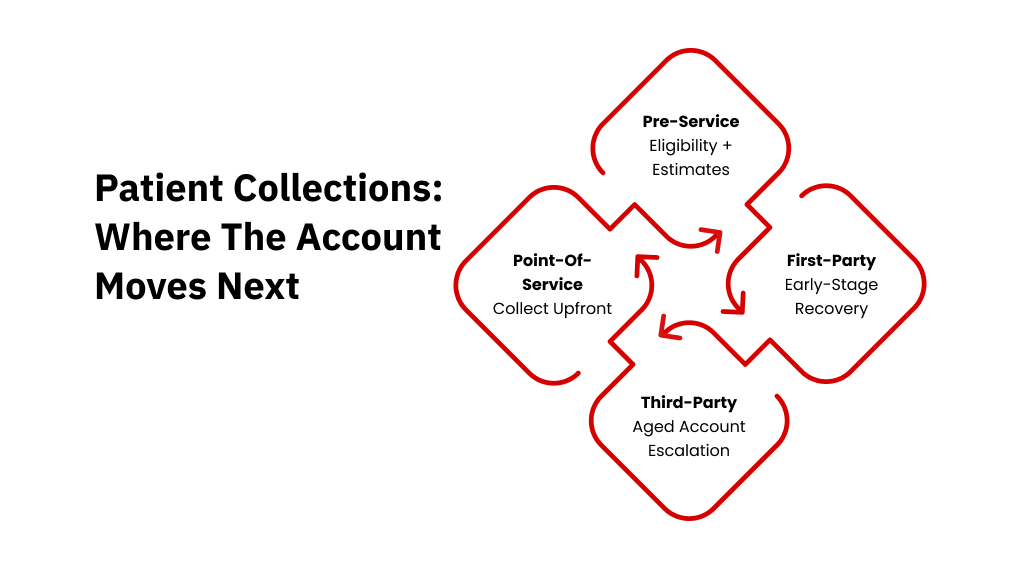
Every provider runs the same core lifecycle before an account ever reaches a decision point. It starts with eligibility and an estimate at registration, continues through copay collection at the visit, and moves into the first rounds of post-visit statements.
What happens across those three stages determines whether a balance resolves quickly or turns into a harder problem for your team later.
Pre-service: eligibility, estimates, and upfront transparency
The lifecycle begins well before a bill goes out, starting with the information your team gathers at registration as part of your broader healthcare revenue cycle management process.
Eligibility verification and a cost estimate at registration set the tone for everything that follows. Confirming coverage and calculating an accurate estimate before the visit lets your staff set clear cost expectations, well ahead of the bill.
The No Surprises Act requires a Good Faith Estimate for uninsured and self-pay patients. That step carries both a compliance obligation and a collection opportunity. Skipping it risks a billing dispute and a regulatory complaint alike.
Providers who set payment expectations before the visit see stronger downstream collection outcomes, with fewer disputed balances and faster resolution once the invoice goes out.
Point-of-service: the highest-leverage moment
Once eligibility and estimates are settled, the next collection opportunity arrives at the visit itself.
Point-of-service collection is the single highest-leverage moment in the entire lifecycle. Recovery odds drop sharply once a balance goes uncollected at the visit, and every day after that works against your team.
Card-on-file programs and pre-visit payment links move the payment request earlier, before front-desk staff is working the request in person. A definitive script, one that asks directly how a balance will be paid, converts more consistently than a passive statement handed over at checkout.
| Did you know? Point-of-service collection rates climbed to 24.8% of total patient payments in Q1 2026, up from 22.7% a year earlier, according to HFMA, 2026. |
That gain still leaves room. The point-of-service moment deserves a defined process built into front-desk workflow, not a single line on a checkout form.
First-party vs. third-party placement
When statements and calls under your own name don’t resolve a balance, the account needs to move somewhere, and how it moves matters.
First-party placement keeps the account under your brand and runs this model as part of its healthcare debt collection work. It uses early intervention and omnichannel engagement to recover balances before they move to third-party collections. A partner runs the outreach, but the account stays visibly tied to your organization rather than a separate agency name.
This model works best early, while the account is still fully recoverable and the brand relationship is worth protecting. First-party collections perform best for accounts still within the first few billing cycles, before recovery odds start to fall.
On the other hand, third-party collections move the account to the partner’s own name, typically after internal efforts have run their course. Recovery drops the longer an account sits, so this stage usually runs on a contingency-fee basis tied to what actually gets collected.
Most providers treat this handoff as a last resort instead of a scheduled decision. That’s a mistake, because a documented threshold protects both the account’s recovery value and your compliance posture, a theme this piece returns to later.
Patient collections best practices: what good internal programs get right
A strong internal program comes down to a handful of habits done consistently, not a single fix. These are the baseline practices worth auditing first, before an account even needs to move anywhere.
Offer payment plans and screen for financial assistance
Payment plans are the first line of defense once a balance grows past what most patients can pay in one shot.
Auto-enrolling larger balances into an installment plan, timed to a patient’s typical pay cycle, keeps the account moving instead of stalling at the first statement. Smaller, predictable payments get paid more consistently than one large ask.
For nonprofit hospitals, this step carries a legal dimension too. Before pursuing extraordinary collection actions, federal rules require reasonable efforts to screen a patient for financial assistance eligibility, under Internal Revenue Code Section 501(r). Skipping that screening risks both recoverable revenue and your organization’s tax-exempt standing.
Send clear, fast, digital statements
Payment plans work best when the statement behind them is easy to understand and act on.
Clear, fast, digital statements outperform mailed paper on almost every measure that matters. An itemized, plain-language bill delivered by text or email gets read faster than a mailed envelope, and it converts to payment faster too, which shows up directly in patient collection rate over time.
A one-tap pay link shortens that conversion window further, cutting the steps between statement and payment down to a single action.
Offering several payment channels reduces the friction that stalls a payment before it starts. A patient portal, text-to-pay, a mobile wallet option, phone, and traditional mail together widen the paths a balance can resolve through. This lifts overall collection rate rather than concentrating it in one channel.
Use technology to reduce manual chase
Even the best statement and the best channel mix still depend on staff following up consistently, which is where most internal teams start to strain.
Manual follow-up is the part of patient collections that burns the most internal capacity for the least return. Patient portals, automated reminder sequences, card-on-file programs, and autopay enrollment shift that follow-up off your staff’s plate and onto the workflow itself.
Propensity-to-pay scoring and account segmentation sharpen where that freed-up staff time goes. A $50 copay and an $8,000 deductible carry very different odds of self-resolving. Treating them identically wastes live outreach on balances that would have cleared on their own.
The same principle underpins collections workflow automation; segmentation directs staff time to the accounts where a call actually changes the outcome.
The KPIs a revenue cycle leader tracks for this function
Once those baseline practices are running, the next question is how you know whether they’re working. Three KPIs answer that, but they get conflated constantly, which makes benchmarking harder than it should be.
Net collection rate measures how much of the revenue you’re legitimately owed actually gets collected. It excludes the contractual write-offs a payer builds into a contract from the start, so it reflects true collection performance rather than gross billing.
Patient collection rate is narrower and more specific to this topic. It tracks how much of a patient’s own balance you actually recover, after insurance pays its share. That makes it the number most directly tied to the work covered in this guide.
Days in accounts receivable (AR) measures how long it takes, on average, to turn a charge into cash. It applies to both payer and patient balances, and it tells you whether accounts are moving through the system or stalling somewhere along the way.
| KPI | Formula | What It Signals When It Slips |
| Net collection rate | Payments received ÷ (charges minus contractual adjustments) | Revenue is leaking somewhere beyond expected write-offs |
| Patient collection rate | Patient payments received ÷ total patient responsibility billed | Internal patient-balance efforts are losing ground |
| Days in AR | Average days from charge to payment | Accounts are aging faster than staff can work them |
| Did you know? The patient collection rate for commercially insured patients fell from 37.6% in 2023 to 34.4% in 2024, according to Kodiak Solutions, 2025. |
A KPI that’s trending down only tells you there’s a problem. It doesn’t tell you what to do next.
That’s why pairing these numbers with a defined escalation policy matters more than tracking them alone. It’s the standard First Credit Services builds into how it works accounts once a provider hands them off.
Where internal programs typically break down
KPI benchmarks tell you something is off. The patterns below are usually where it started, worth auditing against your organization’s own debt collection compliance posture, not assumed away because collections still happen.
- No defined escalation threshold by account age, so placement decisions happen case by case instead of by policy.
- Inconsistent compliance training across staff, which raises the odds of a costly misstep on any single call or message.
- Every account treated the same regardless of recoverability, which wastes staff time on balances unlikely to resolve.
- Communication practices that create regulatory exposure instead of protecting revenue, often without anyone noticing until a complaint arrives.
That exposure doesn’t disappear once an account moves to an outside partner; it just shifts to a different set of rules.
Third-party collection agencies must comply with the Fair Debt Collection Practices Act, which prohibits harassment and abuse under 15 U.S.C. §1692d and false or misleading representations under 15 U.S.C. §1692e.
A quick self-audit worth running against these gaps:
- Defined aging threshold set by policy, not by individual judgment call.
- Documented escalation criteria that staff can apply consistently.
- Staff compliance training records kept current and auditable.
- Complaint tracking that feeds back into training and process.
- Vendor contracts that hold any outside partner to the same compliance standard.
Putting these four things in writing removes account-by-account guesswork and prevents revenue and compliance risk from slipping through unnoticed. It is the operational standard that separates a compliant partner that manages risk for a provider from one that becomes the risk itself.
First-party or third-party: how to decide
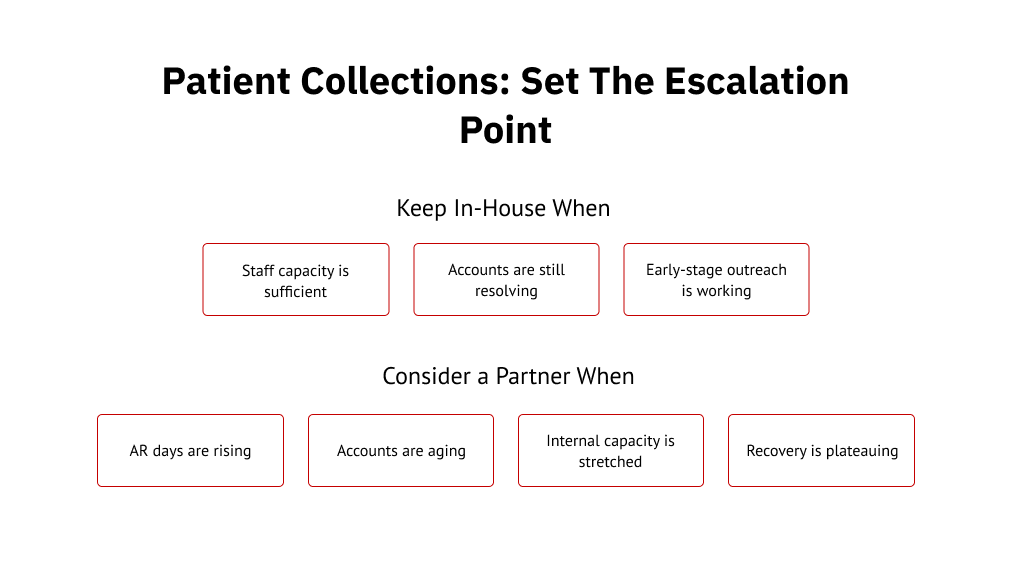
Once the checklist above is in place, the actual decision comes down to weighing three models against your own account mix.
| Aspect | In-house | First-party placement | Third-party placement |
| Cost structure | Fixed staffing and technology costs, incurred regardless of what gets recovered | Typically contingency-based, paid on recovered dollars | Typically contingency-based, often with a fee tied to account age |
| Compliance exposure | Fully owned internally, with no shared liability | Shared with the partner, though the provider’s compliance posture stays on the line | Primarily managed by the partner, governed by the FDCPA and related rules |
| Speed to escalate | Not applicable; this is the pre-escalation stage | Fast, since the brand relationship is already established | Slower to set up initially, built for aged, harder-to-recover accounts |
| Patient-facing brand | The provider’s own brand throughout | The provider’s brand, with continuity preserved even though a partner runs outreach behind the scenes | The partner’s own brand, clearly separate from the provider |
A few criteria tend to drive the decision more than the rest:
- Days in AR trending upward, a sign your internal team can’t keep pace with incoming volume.
- Staff capacity relative to account volume, measured honestly against current headcount.
- Account age distribution, or how much of your portfolio already sits past the point where in-house effort still works.
- Compliance risk tolerance, or how much regulatory exposure your organization wants to carry internally versus handing it to a partner.
Placement decisions carry a privacy dimension too. The Health Insurance Portability and Accountability Act lets a covered entity’s business associate, including a collection agency. Use protected health information to pursue payment, but that use has to stay limited to the minimum information necessary, per HHS guidance.
The No Surprises Act adds one more layer to weigh before placing an account. Providers and their collection partners have to confirm a balance is legally collectible under the Act’s protections before pursuing it. The CFPB addresses this directly in Bulletin 2022-01, which covers how the Act affects collection and credit reporting of certain medical debts.
FCS offers both first-party and third-party healthcare collection services, letting a provider use one partner across different stages of the patient collection process rather than managing separate vendor relationships for each model.
Conclusion
Patient collections work best as a defined system, not a string of account-by-account calls. Registration and the first billing cycles stay in-house. Everything after that runs through first-party or third-party placement, each carrying its own obligations under the FDCPA and HIPAA.
Track net collection rate, patient collection rate, and days in AR, and let a defined KPI threshold decide when an account moves. A partner operating within every obligation covered above, across both stages, is the standard to expect, and the basis on which to evaluate one.
Ready to see where your escalation threshold sits? Connect with FCS about how patient collections are handled at every stage.
FAQs
1. What’s the difference between first-party and third-party patient collections?
First-party collections run under the provider’s own brand for early-stage, pre-charge-off accounts, keeping outreach consistent with the practice’s existing communication. Third-party collections run under the partner’s own name once internal statements and calls are exhausted, typically on a contingency-fee basis tied to what actually gets recovered.
2. What net collection rate should a provider be targeting?
There’s no single universal benchmark, since it depends heavily on payer mix, specialty, and account volume across different provider types. The more useful practice is tracking net collection rate and patient collection rate separately, watching each one against your own organization’s trend over time rather than an outside number.
3. When should a hospital or practice place accounts with a third-party partner instead of continuing in-house efforts?
Three signals typically trigger third-party placement: internal statements and calls have been exhausted without payment, an account has crossed a defined age threshold, or staff capacity has fallen behind incoming account volume. The decision works best as a documented policy applied consistently, rather than a case-by-case judgment call.
4. How does HIPAA apply when a collection agency contacts a patient on a provider’s behalf?
A collection agency acting as a business associate may use protected health information as necessary to pursue payment on the provider’s behalf. That use has to stay limited to the minimum information necessary, and it has to run under a signed business associate agreement with the provider throughout.
5. How can providers protect the patient relationship when outsourcing collections?
First-party placement helps preserve the brand relationship, since the account is worked under the provider’s own name rather than being handed to a visibly separate agency. Providers should also evaluate a partner’s communication standards, escalation practices, reporting transparency, and compliance controls closely before making a final selection.
6. What should a provider check before selecting a healthcare-focused collection agency?
Confirm HIPAA and FDCPA compliance history, along with proven experience across both first-party and third-party work in healthcare specifically. Look for a clear, contingency-based pricing structure and documented recovery-rate performance broken out by account age, rather than a single blended number that hides where performance actually varies.