


Every unresolved claim, denial, or patient balance has a clock attached to it. The longer it stays in the queue, the harder it becomes to recover. Timely filing windows tighten, follow-up becomes less consistent, and staff capacity gets pulled toward newer work. What looked like a manageable backlog starts affecting cash flow, write-offs, and patient financial experience.
That is why healthcare revenue cycle outsourcing has moved beyond cost reduction. For many providers, it is now a way to add focused recovery capacity, protect compliance, and keep high-risk accounts from aging further.
That urgency is now reshaping outsourcing decisions. In the McKinsey RCM Buyer’s Survey 2025, 60% of provider organizations said they expect to change their outsourcing approach within two to three years. Three-quarters of that group plan to expand it.
This guide explains what to outsource, what to keep in-house, how to evaluate partners, and what a clean transition should look like.
What is healthcare revenue cycle outsourcing?
Healthcare revenue cycle outsourcing is a contracted model where a specialist partner takes on defined revenue cycle work under agreed service level agreements.
The provider still owns the accounts, payer contracts, and patient relationship. The outsourcing partner adds the staffing, technology, reporting, and process support needed to keep work moving.
That support can cover several parts of the cycle. This includes patient access, coding, charge capture, claims submission, denial management, accounts receivable follow-up, post-write-off recovery, and reporting.
However, scope needs to be defined carefully. Accounts receivable follow-up happens before write-off, while the account is still active and on the books. Post-write-off recovery comes later, after finance has moved the balance to bad debt.
The contract should clearly name that handoff point. Otherwise, teams can run into a common scoping issue: who owns the account when it reaches later-stage aging.
Why healthcare providers are outsourcing the revenue cycle now
Healthcare providers are not outsourcing because one function is difficult. They are outsourcing because staffing, payer behavior, patient responsibility, and compliance are pressuring the same system at once.
Three pressures are driving the shift.
- Billing labor is scarce: The Bureau of Labor Statistics Occupational Outlook Handbook 2025 projects 7% employment growth for medical records specialists through 2034. It also projects roughly 14,200 openings each year. Every vacant follow-up seat can turn into aged claims and slower cash.
- The cost to collect is rising: In the same McKinsey survey, 45% of respondents reported a rising cost to collect. That matters because reimbursement does not automatically rise when collection work becomes more expensive. In addition, 78% of provider organizations say payer-related causes drive at least 10% of their accounts receivable lengthening.
- Denials take more work to resolve: Payer rules, documentation expectations, coding requirements, and appeal processes keep adding complexity. Even valid claims may need correction, escalation, or payer follow-up before payment arrives.
Together, these pressures create a capability gap. A provider may approve hiring today and still wait months for trained staff. Meanwhile, accounts keep aging.
Which revenue cycle functions can you outsource?
Not every function should move at once. The right scope depends on where cash is slowing, where internal expertise is strongest, and where outside capacity can make the fastest measurable impact.
First, decide how broad the outsourcing model should be.
1. Full versus selective outsourcing
Full outsourcing moves the entire revenue cycle to one partner, including patient access, coding, claims, denials, accounts receivable, patient balances, and reporting.
Selective outsourcing moves specific work queues while the provider keeps the rest in-house. Most providers start here because it lowers transition risk and makes performance easier to measure.
For example, a provider may outsource aged accounts receivable, denial follow-up, or patient balance recovery first. If the partner performs well, scope can expand.
After scope, the next decision is where to begin outsourcing.
2. Front-end versus back-end functions
Front-end work is preventive. It includes eligibility, registration, prior authorization, coding accuracy, and clean claim submission. When done well, it prevents denials and delays before they happen.
Back-end work is recovery-focused. It includes denial management, accounts receivable follow-up, extended business office support, patient balance outreach, and post-write-off recovery.
The economics differ in the following ways:
- Front-end outsourcing reduces future denials and billing errors.
- Back-end outsourcing converts stalled balances into cash faster.
- Front-end ROI often shows over time.
- Back-end ROI is easier to measure by account age, payer, and recovery output.
For many providers, the back end is the better starting point. Denials, aged accounts, and patient balances already exist. That makes impact easier to track.
Back-end scope may include denial management and accounts receivable follow-up. It can also include first-party patient balance outreach before write-off. After write-off, it may include post-write-off recovery.
Once the back end starts aging, timing becomes the real problem.
3. The back-office tail most providers keep too long
Aged accounts, unresolved denials, and self-pay balances all lose value over time. An account at 120 days is harder to recover than the same account at 30 days.
As the account ages, timely-filing windows tighten. Contact details can become stale. Payer follow-up also gets harder because the claim has already moved further away from the original service date.
Internal teams often prioritize the newest or easiest accounts because those support monthly cash goals. That leaves the tail behind, even when those older balances still have recovery potential.
| Pro tip: Outsource the tail before it becomes invisible. A partner dedicated to aged accounts has no newer, easier queue competing for attention. |
Benefits and trade-offs of outsourcing revenue cycle management
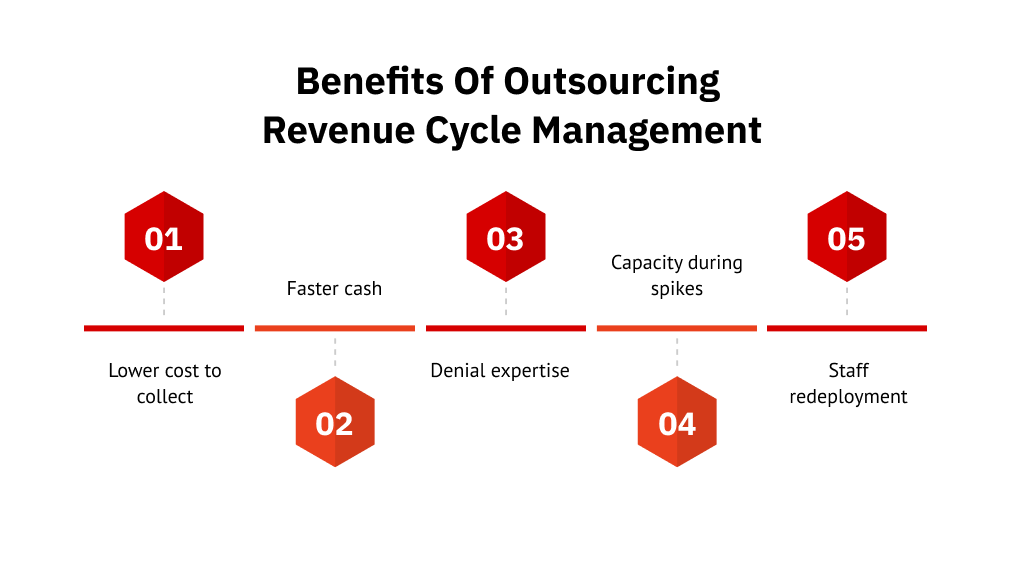
Outsourcing can improve capacity, speed, and recovery. However, every benefit has a matching risk. The key is to contract for the safeguard before the risk appears.
| Benefit you are buying | The matching risk | The safeguard to contract for |
| Lower cost to collect | Hidden fees and scope creep | Fixed fee schedule and written scope |
| Faster cash | Loss of visibility | Shared dashboards and weekly reporting |
| Denial expertise | Generic appeals | Payer playbooks and overturn-rate reporting |
| Capacity during spikes | Handoff gaps | Governance lead and escalation path |
| Staff redeployment | Data security exposure | BAA, SOC 2 Type II attestation, and audited access |
Loss of control is often a reporting problem first. When providers feel blind after outsourcing, it is usually because they agreed to monthly summaries instead of operational visibility. To avoid that gap, ask for work-queue data at the same cadence your internal team already uses.
Data security needs the same early attention. A business associate agreement is the floor under the Health Insurance Portability and Accountability Act. Beyond that, confirm who can access protected health information, where they access it from, and how each access point is logged.
In-house versus outsourced versus hybrid: a decision framework
The right model is rarely all-or-nothing. Most providers choose one of three paths.
- In-house keeps every function internal. This works when volume is stable, denial rates are low, and the billing team is fully staffed.
- Fully outsourced moves the entire cycle to one partner. This can fit providers rebuilding after a system conversion, acquisition, or operational reset.
- Hybrid keeps patient access and coding inside while moving denial management, accounts receivable follow-up, extended business office support, and post-write-off recovery outward. Many providers land here because it keeps strategic control inside while adding specialist capacity where recovery is hardest.
To make that choice more concrete, score your current position.
Score your own position
Rate each statement from 1 to 5, where 5 is clearly true today.
- Our billing team has been fully staffed for the last four quarters.
- Our denial rate is below benchmark and trending down.
- We can see aged accounts by payer, reason code, and owner in real time.
- Our patient balance outreach runs on digital channels, with phone as backup.
- We could absorb a large volume increase without adding headcount.
Once you have the total, use the score as a directional guide. A score of 20 or above supports keeping more work in-house. A score between 12 and 19 points to a hybrid model. A score below 12 makes the case for outsourcing the back end stronger.
However, score question three carefully. If your team cannot see aged accounts by owner in real time, outsourcing will not automatically fix the problem. The same visibility gap can follow the work outward.
How to choose a healthcare RCM outsourcing partner
A strong partner should bring more than labor. The right partner should improve control, reporting, compliance, recovery visibility, and patient financial experience.
Start with the essentials.
1. Non-negotiables checklist
Look for healthcare specialization, HIPAA-ready operations, SOC 2 Type II attestation, system integration, and references from similar providers. Then verify consumer contact compliance under the Fair Debt Collection Practices Act and Telephone Consumer Protection Act.
Also ask for a documented compliance program covering call auditing, training, and audit cadence.
With the basics clear, use the vetting call to test execution.
2. Questions to ask on the vetting call
Ask direct, operational questions, such as:
- Who owns each metric on your side?
- What happens if a service level is missed?
- What is your overturn rate on denials by the payer?
- Which channels do you use to reach patients?
- Where is protected health information stored and accessed?
- Are any offshore teams involved?
- How long does account repatriation take if the contract ends?
The answers should be specific. Vague answers usually become vague execution.
| Red flags Watch for no measurable service levels, no named governance lead, vague protected health information answers, one price for every function, reluctance to share sample reporting, or no clear escalation process. |
What RCM outsourcing costs: pricing models and ROI
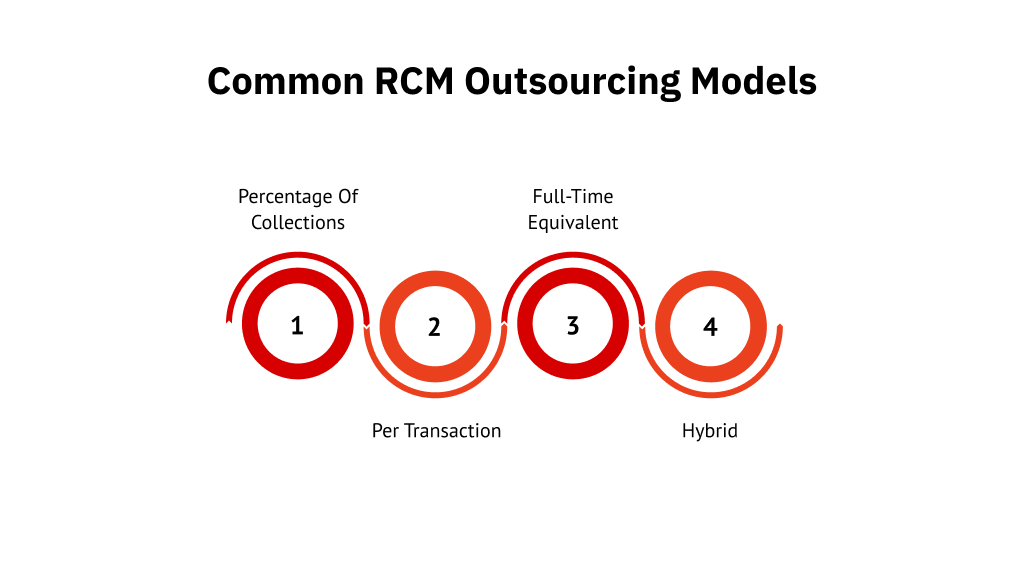
RCM outsourcing pricing depends on scope, complexity, volume, account age, and whether the work is routine or performance-based.
Common pricing structures
Pricing should match the type of work being outsourced, not just the vendor’s standard rate card. Before comparing fees, understand how each model connects cost to volume, complexity, and recovered revenue.
| Model | How it works | Fits best |
| Percentage of collections | Percentage of recovered dollars | Denials, aged AR, and patient balances |
| Per transaction | Flat fee per claim, statement, or account | High-volume repeatable work |
| Full-time equivalent | Dedicated staff at a monthly rate | Steady workloads |
| Hybrid | Base fee plus performance component | Mixed scopes |
However, the fee percentage is not the full story.
Calculating true ROI
The better question is whether outsourcing improves cash after cost.
Start with the cost to collect. This divides total revenue cycle cost by total cash collected. Include vendor fees, internal salaries, technology, clearinghouse costs, and management overhead. A partner can charge more per recovered dollar and still lower total cost if they reach balances your team would not work.
Next, track days in AR to see how long money sits before payment arrives. Break the data down by payer and aging bucket for a clearer view. Then compare outsourced queues against the queues kept in-house so that you can separate partner impact from payer behavior.
Performance-based pricing can work well for aged accounts and denials because it ties vendor revenue to recovered dollars. Flat rates can make sense for predictable, high-volume tasks.
| Pro tip: Set your baseline before go-live. Then freeze metric definitions in the contract. |
How First Credit Services handles the back-office tail
For many providers, the hardest revenue cycle work begins after internal teams are already stretched. Aged patient balances, unresolved accounts, and post-write-off placements still have recovery potential, but they need consistent follow-up, digital engagement, and strong compliance controls.
That is where First Credit Services helps in the following ways:
- Digital-first patient outreach: Patients can respond through SMS, email, portal, phone, or a self-service payment path instead of relying on phone calls alone.
- Managed service execution: FCS operates the technology and recovery workflow on the provider’s behalf, so internal teams do not need to staff or manage the platform.
- UCEP-powered engagement: Recovery runs on UCEP, FCS’s Unified Consumer Engagement Platform. It scores accounts, selects the channel and timing most likely to earn a response, and gives patients a digital path to resolve balances.
- Compliance built into the workflow: Healthcare collections involve protected health information, payment security, patient trust, and debt collection rules. FCS supports each step with documented processes and controlled outreach.
FCS scope can include extended business office support before write-off. It can also support omnichannel recovery when accounts need deeper engagement after internal efforts slow down.
This model is best suited for medium to large medical groups, health systems, and hospital networks with meaningful account volume.
What a clean transition looks like
Transition is where outsourcing programs often fail. Even a strong partner can hurt cash flow if the first 90 days are rushed.
A clean transition should follow three phases.
- Days 1 to 30 (discovery and baseline): Map work queues, document metric definitions, record baseline cost to collect and days in AR, and agree on reporting format.
- Days 31 to 60 (governance and integration): Name governance leads, set escalation paths, build the data connection, and confirm security controls.
- Days 61 to 90 (phased go-live): Start with one payer, service line, or aging bucket. Compare results against the frozen baseline before expanding scope.
Keep a lean internal team to manage the partner, review metrics, and handle exceptions. The work can move outward, but accountability stays with the provider.
Choose the right partner before revenue leaks further
Healthcare revenue cycle outsourcing works best when it is focused. Instead of moving every function at once, start where cash is already slowing. For most providers, that means denials, aged accounts, patient balances, and post-write-off recovery.
From there, the partner decision becomes more strategic. The right partner should improve more than staffing capacity. It should bring visibility, compliance discipline, digital engagement, reporting transparency, and a clear path from backlog to cash.
If patient balances and post-write-off accounts are where recovery stalls, FCS can help you find what is recoverable and where the process is breaking down.
Get in touch with us to start a revenue recovery assessment across your aged inventory.
FAQs
1. How long does it take to onboard a revenue cycle outsourcing partner?
Most back-end scopes go live within 30 to 90 days. Full-cycle transitions take longer because coding standards, payer rules, system access, and data flows need configuration.
2. Will outsourcing change how patient balances are reported to credit bureaus?
Reporting varies by partner and contract. Many healthcare recovery programs limit or exclude credit bureau reporting on medical balances. Confirm the policy before signing.
3. Can you outsource part of the revenue cycle without changing your electronic health record?
Yes. Partners can usually connect to your existing electronic health record through application programming interface, secure file transfer, or direct sync.
4. What happens to accounts if you end the outsourcing contract?
Accounts should return under the agreement’s exit terms. Ask for a repatriation window, usable data extract, and handover of open appeals or payment plans.
5. How do you keep denial appeal quality consistent across an outsourced team?
Require payer-specific appeal templates, named owners, and monthly overturn-rate reporting by denial reason. Sample completed appeals because overturn rates can hide weak documentation.
6. Is offshore delivery a compliance risk for protected health information?
Offshore delivery can be permitted under U.S. privacy rules when safeguards are in place. Require access controls, reviewed logs, restricted environments, and audit rights.