

Choosing a hospital collection agency is no longer just about who can recover the most. It is about who can recover patient balances without creating complaints, compliance gaps, or a poor handoff from the billing office.
The stakes are high because medical debt remains a sensitive collection category. According to the CFPB’s 2024 analysis of medical collections, 15 million Americans still had medical bills on their credit reports. The average reported medical balance also rose to more than $3,100.
For hospitals, that makes agency selection more than an operational decision. Newer balances may need brand-aligned outreach and flexible payment options, while older accounts may require formal bad debt recovery.
This guide compares five hospital collections services by best fit, patient experience, compliance controls, reporting depth, and practical limitations.
What hospital collection agencies actually do
Hospital collection agencies help hospitals recover unpaid patient balances after internal billing outreach has not produced resolution. Depending on the account stage, this may include early-out support, Extended Business Office coverage, first-party outreach, payment plan engagement, dispute routing, and third-party bad debt recovery.
| Stage | What it means | Patient experience priority |
| Early-out | Newer patient balances before bad debt placement. | Helpful billing support, clear payment options, and brand continuity. |
| EBO | Supplemental business office support for patient balance and AR backlogs. | Consistent follow-up without replacing the internal team. |
| Bad debt recovery | Older accounts that need a formal collection process. | Compliance, documentation, and respectful recovery. |
Early-out and EBO should still feel close to billing support because patients often recognize the hospital relationship at this stage. As accounts age, however, bad debt recovery requires a more formal process with stronger documentation, clearer escalation rules, and tighter compliance controls.
Across each stage, a strong hospital collection agency should understand HIPAA, FDCPA, Regulation F, TCPA, state collection rules, patient complaints, charity care, and 501(r) requirements for nonprofit hospitals.
How to compare hospital collection agencies
Not every agency is built for the same type of hospital account. Some are stronger in early-out and EBO, some focus on bad debt, and others operate closer to broader healthcare RCM.
Before comparing providers, define what you need the agency to handle.
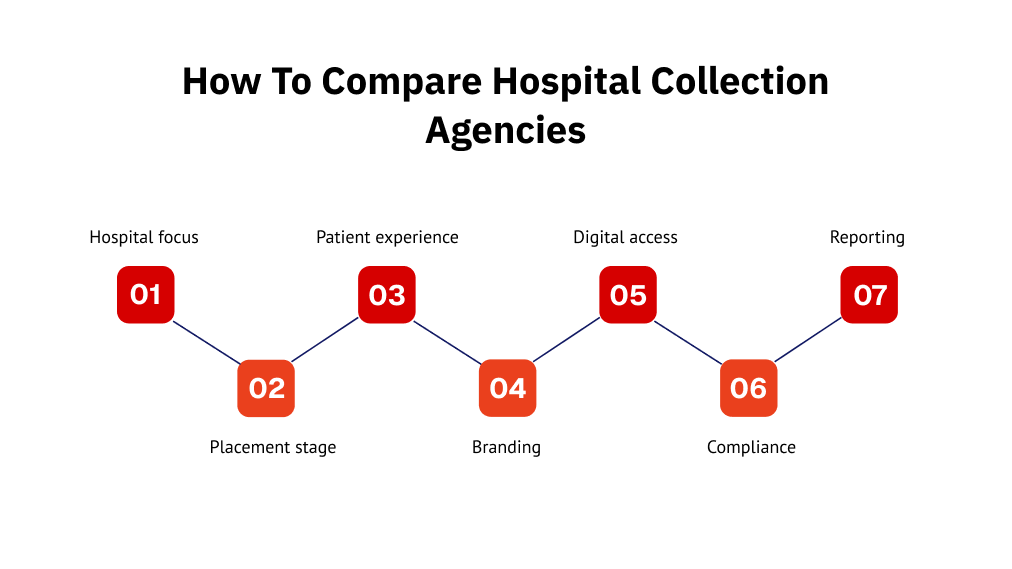
| Evaluation area | What to verify |
| Hospital focus | Does the agency work with hospitals and health systems, not only small provider offices? |
| Placement stage | Does it support early-out, EBO, bad debt, or all three? |
| Patient experience | Can it manage outreach without damaging patient trust? |
| Branding | Can early-stage outreach stay under the hospital’s brand? |
| Digital access | Does it support SMS, email, portal, chat, callbacks, and payment plans? |
| Compliance | Does it address HIPAA, FDCPA, Regulation F, TCPA, PCI, and 501(r) workflows? |
| Reporting | Can it show netback, account status, disputes, and performance by AR bucket? |
| Selection tip: Do not compare agencies only by recovery rate. Ask how they define recovery, calculate netback, and report results by account age. |
Best hospital collection agencies compared by fit
The right choice depends on account volume, patient mix, placement age, internal capacity, and how much control your hospital wants over the patient experience.
Here’s a brief comparison:
| Provider | Best fit | Standout strength |
| First Credit Services | Mid-to-large hospitals and health systems | Managed early-out, EBO, digital engagement, and bad debt recovery. |
| IC System | Hospitals wanting a long-standing healthcare collections agency. | Healthcare experience, integrations, and patient experience monitoring. |
| Revco Solutions | Hospitals with large aged bad debt portfolios. | Healthcare bad debt recovery and security credentials. |
| Wakefield | Regional hospitals and provider networks. | Healthcare collections tied to broader RCM operations. |
| Harris & Harris | Hospitals needing early-out and bad debt coverage. | First-party collections, bad debt, analytics, and patient communication. |
Now, let us compare each service provider in detail:
1. First Credit Services: Best for managed early-out, EBO, and bad debt recovery
First Credit Services is a strong fit for hospitals that want one managed partner for patient balance recovery across early-stage and aged accounts.
FCS can support early-out and EBO programs where outreach stays aligned with the hospital’s brand. When accounts move beyond internal resolution, it can also support formal third-party recovery. This helps hospitals reduce vendor handoffs while keeping communication history, reporting, and compliance controls more consistent.
Key features:
- EBO support: FCS provides extended business office support for hospitals that need added capacity for patient balance follow-up, billing questions, and AR projects.
- Brand-aligned outreach: In first-party programs, patients receive communication that reflects the hospital’s brand, which helps preserve trust during early balance resolution.
- Third-party recovery: FCS supports third-party collections for aged accounts that require a formal recovery process.
- Digital engagement: FCS uses digital collections workflows across SMS, email, chat, phone, and self-service payment paths.
- Patient self-service: Patients can view balances, make payments, choose payment plans, schedule callbacks, or start chats through a branded portal experience.
- Compliance controls: FCS supports healthcare collections with HIPAA, PCI DSS Level 1, SOC 2 Type II, FDCPA, Regulation F, TCPA, and documentation workflows.
How FCS helps hospitals manage patient accounts
FCS helps hospitals bring structure to patient balance recovery without making internal teams work every account manually. Accounts can be organized by age, balance type, response behavior, and required next step.
This gives RCM teams a clearer path for patient accounts. Newer balances can receive earlier outreach, unresolved accounts can move into focused follow-up, and aged accounts can enter recovery without losing account history.
FCS also operates as a managed-services partner. Hospitals get visibility and reporting, while FCS manages outreach execution, payment engagement, escalation, and compliance documentation.
Best for: Health systems that want early-out, EBO, digital engagement, and bad debt recovery under one managed patient balance partner.
2. IC System: Best for long-standing healthcare collections experience
IC System is a good option for hospitals that want an established healthcare collections agency with a long operating history and patient experience controls.
It is suitable for hospitals that value process maturity, healthcare-specific account handling, and documented quality monitoring across patient communication workflows.
Key features:
- Healthcare client focus: IC System works with healthcare organizations, including hospitals and provider groups.
- Multiple recovery stages: Its programs can support patient accounts across early-out and bad debt workflows.
- System connectivity: IC System references healthcare system connectivity with major billing and EHR platforms.
- Call quality monitoring: The company highlights CSAT-scored call monitoring and patient-facing quality checks.
- Channel variety: Outreach can extend beyond phone-only contact.
- Compliance orientation: IC System emphasizes ethical and compliant recovery for healthcare clients.
What to consider:
- Ask how much flexibility hospitals get in SMS, email, portal, and phone workflows.
- Confirm whether outreach can be tailored by account age, balance type, and patient segment.
- Review whether reporting can show netback by facility, payer mix, AR bucket, or placement batch.
Best for: Hospitals that want an established healthcare collections agency with patient experience monitoring.
3. Revco Solutions: Best for healthcare bad debt recovery
Revco Solutions is suited for hospitals that need more discipline around aged patient accounts. Its model is especially relevant when balances have moved beyond early outreach and need structured follow-up, segmentation, and security-focused operations.
Revco is ideal for scenarios when the portfolio is already in bad debt or close to formal recovery placement.
Key features:
- Aged account recovery: Revco supports recovery workflows for healthcare accounts that have moved into bad debt.
- Respectful patient communication: Its messaging emphasizes patient-focused outreach rather than aggressive contact.
- Security credentials: Revco lists HIPAA HITRUST r2, SOC 2 Type II, and PCI Level 1.
- Cyber liability coverage: Revco states that its security credentials are supported by $20M in cyber liability coverage.
- Account prioritization: Accounts can be segmented by recovery potential and patient profile.
- Regulatory oversight: Revco emphasizes healthcare compliance monitoring and internal controls.
What to consider:
- Hospitals needing early-out or white-labeled EBO should confirm how much first-party support is available.
- Ask whether digital outreach and patient payment options are designed for newer balances or mainly aged accounts.
- Confirm whether reporting separates early-stage placements from bad debt performance.
Best for: Hospitals with large bad debt portfolios that need healthcare-specific recovery and strong security credentials.
4. Wakefield: Best for healthcare RCM-connected collections

Wakefield may fit hospitals that want collections support connected to broader healthcare business office operations. Its positioning is especially relevant for provider organizations that prefer a partner familiar with both patient balance recovery and revenue cycle workflows.
This makes Wakefield more suitable for hospitals looking for collections support that can sit near existing RCM processes, rather than a standalone agency model.
Key features:
- Healthcare RCM alignment: Wakefield works across healthcare revenue cycle and collections workflows.
- Early-out self-pay support: The company supports early-stage patient balance activity.
- Bad debt services: Wakefield also provides later-stage healthcare collections support.
- Provider-focused operations: Its services are built around healthcare provider workflows.
- Business office support: Wakefield may help teams that want collections connected to wider administrative support.
- Healthcare market experience: Its positioning is centered on provider organizations rather than generic consumer collections.
What to consider:
- Verify EHR connectivity, digital outreach, reporting cadence, and portal capabilities during the demo.
- Confirm whether SMS-first outreach, detailed patient journey reporting, and branded payment options are available.
- Ask whether collections can be scoped separately if your hospital does not need broader RCM support.
Best for: Regional hospitals and provider networks that want collections tied to broader healthcare business office support.
5. Harris & Harris: Best for early-out and bad debt coverage
Harris & Harris is a healthcare collections option for hospitals that want patient communication support across both early-out and bad debt stages.
Its healthcare services include first-party and early-out collections, primary and secondary bad debt, complex claims, and denials management. It focuses more on patient-facing outreach, early balance engagement, aged account recovery, reporting, analytics, and digital payment access.
Key features:
- Healthcare collections focus: Harris & Harris offers services tailored to healthcare providers, patients, and communities.
- First-party outreach: The company supports early engagement through provider-aligned patient communication.
- Early-out collections: Harris & Harris can support balances before they move into deeper aging.
- Bad debt coverage: The company also supports primary and secondary bad debt workflows.
- Reporting and analytics: Harris & Harris highlights account intelligence, reporting, and performance visibility.
- Digital payment channels: Its healthcare services reference mobile payment and communication channels for patient engagement.
What to consider:
- Confirm how much outreach can be white-labeled and where the agency’s name appears.
- Ask how digital workflows are configured across early-out and bad debt placements.
- Verify whether reporting can break out performance by facility, account age, and placement batch.
Best for: Hospitals that want healthcare-focused early-out collections, patient communication support, and bad debt recovery from the same agency.
What to verify before choosing a hospital collection agency
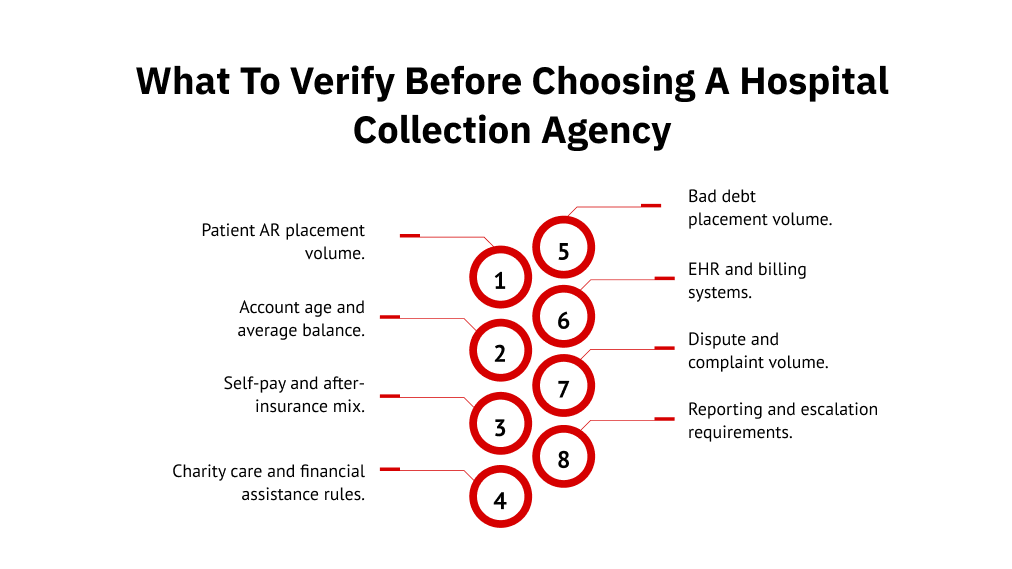
A strong shortlist starts with your own patient AR profile. Before speaking to vendors, define what you are placing and what success should look like.
Document:
- Monthly or annual patient AR placement volume.
- Account age by bucket.
- Average balance size.
- Self-pay versus after-insurance mix.
- Charity care and financial assistance rules.
- Current bad debt placement volume.
- Existing EHR and billing systems.
- Dispute and complaint volume.
- Required reporting format.
- Internal escalation policy.
Then use this framework:
| If your main issue is | Look for |
| Early balances are aging | Early-out or EBO support under your brand. |
| Bad debt keeps increasing | Healthcare bad debt recovery and clear netback reporting. |
| Patients are not responding | Digital outreach, payment links, portal access, and scheduled callbacks. |
| Internal teams are overloaded | Managed workflows, not just software access. |
| Reporting is unclear | Account-level dashboards by facility, age bucket, and placement batch. |
| Compliance risk is a concern. | HIPAA, FDCPA, Regulation F, TCPA, PCI, and 501(r) awareness. |
Questions to ask before signing
Do not stop at a demo. Ask questions that show how the program will work once real accounts are placed.
- Which account stages do you support: early-out, EBO, bad debt, or all three?
- Which patient communications stay under our hospital brand?
- How do you handle financial assistance and 501(r) requirements?
- Can you show a sample netback report from a similar hospital portfolio?
- What happens when a patient disputes a balance?
- What digital outreach happens before an agent is involved?
- What data do you need from our EHR or billing system?
- How often do dashboards or status reports update?
- How are payments, disputes, and patient notes returned to our team?
- What happens to account data when the contract ends?
Red flags in hospital collection agency proposals
A vendor may look strong on paper and still be wrong for your hospital. Hence, watch for these signs:
- They talk about gross recovery but avoid netback.
- They cannot explain how they apply your financial assistance policy.
- They treat early-out, EBO, and bad debt as the same workflow.
- They cannot confirm state licensing coverage where needed.
- They rely mostly on phone outreach without a clear digital sequence.
- They cannot show sample reporting by facility, age bucket, or placement batch.
- They treat hospital collections like generic consumer collections.
- They cannot explain how disputed accounts are paused, routed, and resolved.
- They do not define when the hospital’s brand appears and when the agency’s name appears.
- They make onboarding sound simple but cannot explain data requirements.
Choose a partner that protects recovery and patient trust
Hospital collections services should not create a harder experience for patients or a heavier workload for your internal team. The right partner should bring structure to patient balance recovery, give patients clearer ways to resolve accounts, and document each step with the compliance controls hospitals need.
The best fit depends on account volume, placement age, patient mix, internal capacity, and brand requirements. Some hospitals need early-out support, whereas others need stronger bad debt recovery. Many need both, but under a model that avoids disconnected handoffs.
FCS helps hospital and health system finance teams recover more patient AR without adding internal workload. Its contingency-based model supports early-out and bad debt recovery under your brand, with full compliance coverage built into every stage.
Talk to a Hospital Collections Specialist.
FAQs
1. How should hospitals measure a collection agency’s performance?
Hospitals should track netback, recovery by account age, payment plan completion, dispute volume, complaint trends, and patient contact outcomes. These metrics show whether the agency is improving recovery without creating avoidable patient experience or compliance issues.
2. How are hospital collections different from medical collections?
Hospital collections usually involve larger account volumes, multiple service lines, financial assistance policies, 501(r) requirements, and higher patient experience risk. A hospital-focused agency should understand these requirements before handling placements.
3. What is the difference between early-out and bad debt collections?
Early-out focuses on newer patient balances before formal bad debt placement. Bad debt collections handle older unresolved accounts that require a more structured recovery process and stronger collection documentation.
4. Should hospitals choose a first-party or third-party collection model?
It depends on account age and patient experience goals. First-party outreach keeps communication closer to the hospital’s brand, while third-party collections are more appropriate for aged accounts that need formal recovery.
5. What should hospitals ask a collection agency before signing?
Hospitals should ask about white-label outreach, 501(r) handling, financial assistance workflows, netback reporting, digital engagement, dispute routing, state licensing, data transfer, and how accounts move from early-out to bad debt.
6. What is netback in hospital collections?
Netback is the amount the hospital actually receives after fees and costs. It is more useful than gross recovery because it shows the real financial return from a collection program.