


Why does a hospital with a fully staffed billing department still write off six figures in patient balances every year?
That question often pushes providers to outsource healthcare debt collection services.
Uncollected revenue remains a challenge for providers. The Kodiak Solutions Revenue Cycle Analytics Benchmarking Analysis, 2026 found that providers lost over $48 billion in 2025, up 25% from 2024. The median bad debt rate also rose from 1.1% to 1.3%.
However, the harder question for most revenue cycle management (RCM) leaders is timing. Self-pay balances often pile up faster than billing staff can work them. As a result, recovery odds shrink every month an account sits untouched.
This guide covers when to outsource and who must sign off. It also explains which financial, operational, and reputational factors should shape the decision.
Internal sign-off: who needs to weigh in before outsourcing
Most guides on outsourced healthcare collections start at vendor evaluation. In practical terms, the harder step comes earlier: getting internal agreement that outsourcing should happen at all. That agreement usually depends on three groups, and each reads the decision through a different risk lens.
Revenue cycle or finance leadership
Finance leaders look beyond a generic cost-to-collect figure. Specifically, they want four answers:
- How much self-pay accounts receivable (AR) sits past 90 and 120 days?
- What share is written off as bad debt versus routed to charity care?
- How quickly would contingency-based recoveries appear in cash flow reporting?
- Does that timeline compare favorably with the fixed cost of current billing staff?
Once the numbers make sense, compliance usually becomes the next checkpoint.
Compliance
Compliance sets a far higher bar than a standard vendor nondisclosure agreement.
First, a collections partner needs a Business Associate Agreement (BAA) that governs protected health information (PHI). It should also assign liability if PHI is mishandled.
Beyond that, the Health Insurance Portability and Accountability Act (HIPAA) sets a minimum necessary standard. That standard limits the partner to the data needed to resolve each balance.
Alongside compliance, one more group protects your reputation.
Patient financial experience or patient advocacy
Your collection partner should align its outreach with your charity-care and financial-assistance screening processes. Ideally, accounts that qualify for assistance should be identified before they reach third-party collections. Otherwise, your organization could face reputational damage and regulatory exposure.
For nonprofit hospitals, that regulatory exposure is written into federal tax law. Under Section 501(r)(6) of the Internal Revenue Code, you must make reasonable efforts to determine assistance eligibility first. Only then can extraordinary collection actions, such as credit bureau reporting, begin. Moreover, the IRS holds the hospital accountable for these actions when a collection agency takes them on its behalf.
Even so, timing still decides whether sign-off holds.
Where sign-off usually stalls
A finance-led push to outsource often stalls for months when stakeholders join late. Typically, compliance raises BAA or PHI-access concerns, or advocacy finds the partner cannot flag charity-care-eligible accounts. Consequently, involve all three groups from the first meeting.
| Pro tip: Confirm how a prospective partner screens accounts for charity-care or financial-assistance eligibility before you shortlist them. This one question can quietly reopen a deal that already looked settled on price and recovery rate. |
With sign-off secured, the next test is whether your financial data shows you are ready to outsource.
Financial indicators that an organization is ready to outsource
Your organization is financially ready to outsource when aged patient balances keep growing. At the same time, in-house recovery falls behind what a specialized partner achieves. These signals matter most when they persist across several months.
In most cases, three financial signals appear together in your AR data:
- Balances aging past 90 to 120 days: Past this window, continued in-house follow-up often costs more in staff time than it recovers. An extended business office (EBO) can take over that follow-up earlier, before accounts reach this window.
- In-house recovery trailing partner results: Your recovery rate lags what a specialized healthcare collection agency recovers on comparable accounts. Notably, this comparison works only when you track recovery by account-age bucket. A single blended rate hides where revenue is slipping.
- Self-pay volume outpacing billing capacity: Rising patient financial responsibility steadily shifts more revenue into self-pay balances. Meanwhile, your billing team’s headcount usually stays flat, so follow-up falls further behind each month.
Before acting, separate a temporary dip from a structural problem. A slow month can follow a known cause, such as staff turnover or an electronic health record (EHR) migration. That kind of dip usually corrects itself once the cause is resolved. By contrast, aged AR that climbs month after month points to a lasting capacity gap.
Naturally, that gap also shows up in your daily operations, starting with how your billing team spends its time.
Operational indicators that an organization is ready to outsource
Your organization is operationally ready to outsource when collections work spreads into roles never built for it. These signals often surface in daily workflows long before teams decide to outsource medical collections.
In particular, watch for three patterns:
- Collections-heavy billing roles: Staff time spent on collections reduces the capacity available for claim submission and AR management. As a result, the role starts to resemble a collections position without the necessary training or compliance infrastructure.
- No recovery tracking by age: Without that view, your team cannot see where recovery slows down. On top of that, the gap suggests collections has outgrown an ad hoc process.
- Undocumented contact practices: Repeated calls about the same balance, with no consent trail or contact-frequency limit, create collections activity without collections controls. Consent rules under the Telephone Consumer Protection Act (TCPA) still apply to autodialed calls and texts.
Each pattern also carries a hidden cost for your organization. For example, an undocumented call history makes complaints and audit requests hard to answer with confidence. Similarly, the staff time lost to collections calls rarely appears as a line item anyone reviews.
| Pro tip: Split self-pay balances into 30-day aging buckets, from current through 120+ days. Then review recovery for each bucket every month. The bucket where recovery drops fastest is often where outsourcing pays off first. |
When these signals line up, the next question becomes what outsourcing returns in efficiency and revenue.
Efficiency and revenue benefits of outsourcing healthcare debt collection services
Outsourcing healthcare debt collection improves recovery on aged patient balances. It also returns billing-team hours to core revenue cycle work. Partners that specialize in medical debt collection services work these accounts daily. Stretched billing teams rarely have that level of focus. Taken together, the value shows up in three connected ways.
1. Higher recovery rates from specialized expertise
Specialized agents learn to read why each balance remains unpaid. Over time, they adjust outreach to match that reason. For instance, an account disputed over an explanation of benefits needs a different approach than one tied to financial hardship.
On the other hand, a biller handling collections alongside claims work has little time to segment accounts. Every balance tends to get the same script on the same schedule.
Better recovery also speeds up how quickly that revenue reaches your books.
2. Faster cash flow and fewer AR days
Dedicated follow-up moves aged balances toward resolution sooner. Accounts that would otherwise sit for weeks get worked on a defined cadence. In turn, resolution stops the backlog from compounding. Each closed account is one less balance aging into the next bucket while your staff handles newer AR.
Just as important, outsourcing frees up the people behind your revenue cycle.
3. More billing staff capacity for higher-value work
Outsourcing cuts the hours billing staff spend on collections calls. From there, your team can redirect that time to revenue cycle work that helps prevent bad debt, including:
- Financial counseling before and after care
- Charity care and financial assistance screening
- Insurance eligibility verification
- Clean claim submission and denial follow-up
| Did you know? The McKinsey RCM Buyer’s Survey 2025 polled revenue cycle leaders at US care delivery organizations. Among them, 76% expect self-pay bad debt and uncompensated care to rise. Likewise, 85% expect the out-of-pocket share of each bill to keep growing. |
Still, efficiency is only half the story, since compliance and outreach quality also shape the return.
Compliance and reputation benefits of outsourcing healthcare debt collection services
A specialized healthcare collection agency brings established compliance controls and consistent outreach standards from day one. Crucially, your billing team no longer has to build those processes on top of its existing workload. Two benefits stand out once accounts move to a partner.
1. Built-in compliance processes
A specialized partner arrives with compliance processes already in place. These cover HIPAA and debt collection rules, usually including:
- Minimum necessary PHI access, limited by agent role
- Documented communication procedures and audit logs
- Staff training on the Fair Debt Collection Practices Act (FDCPA), Regulation F, and TCPA
- A signed BAA before any account is placed
Along with stronger controls, outreach itself becomes more predictable.
2. More consistent account outreach
Defined outreach standards replace reactive calls made whenever a biller finds a spare moment. At a minimum, those standards cover:
- Empathy-led scripts for sensitive balances
- Contact-frequency limits and quiet-hour rules
- A consistent channel sequence for every account
- Honored opt-outs and channel preferences
First Credit Services handles debt collection for medical bills under HIPAA and SOC 2-aligned controls. Our agents also manage consent and contact preferences across calls, email, and SMS.
Ultimately, a clear, uniform message at every touchpoint protects your reputation and speeds resolution.
The financial cost of delaying an outsourcing decision
Putting off the decision to outsource medical collections carries a cost that grows every month. That cost builds up in four ways:
- Lost capacity comes first: Every hour spent chasing aged balances is an hour taken from core revenue cycle work. That opportunity cost matters more here than rebuilding a full return on investment (ROI) model.
- Recovery odds fall with age: Older balances become harder to resolve, a well-established pattern across the collections industry. Put simply, the longer an account waits, the less of it you recover.
- Fixed costs continue: All the while, staff salaries, training time, and software licenses stay on the books, recovered or not. Under contingency-based pricing, collection costs rise and fall with recovered revenue.
- Workload compounds: Each month of delay adds a new cohort of aging accounts to those already stalled. Eventually, the backlog grows faster than a fixed team can clear it.
Cost to collect and ROI calculations still shape broader healthcare revenue cycle outsourcing decisions.
| Pro tip: Calculate your own cost of delay before evaluating any partner. Start with your current aged AR balance. Next, multiply it by the percentage you realistically expect to lose to further aging over the coming quarter. |
That cost also lands harder on some provider types than others.
Organizational profiles that benefit most from outsourcing
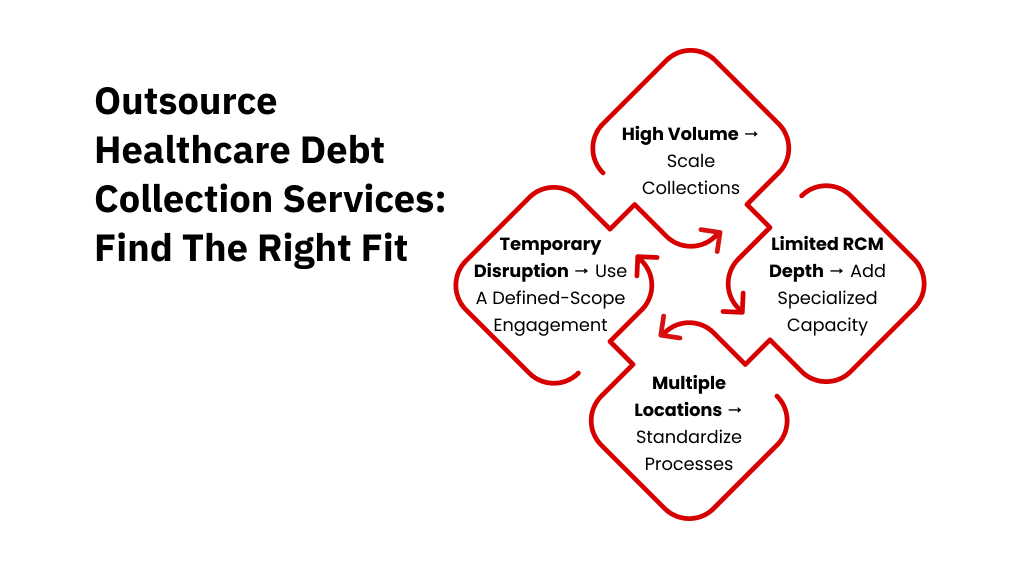
Outsourced healthcare collections deliver the most value where self-pay volume outgrows in-house capacity. They also help when a known disruption creates a temporary backlog. With that in mind, four profiles tend to benefit most.
Hospital systems
Under the Emergency Medical Treatment and Labor Act (EMTALA), hospital emergency departments must screen and stabilize patients. That duty applies regardless of ability to pay, creating a steady stream of high-value, high-risk self-pay balances. Those self-pay balances then compete for the same staff hours as payer denials. Left unchecked, the largest emergency balances often sit untouched while payer work takes priority.
Physician groups face a similar squeeze for different reasons.
Physician groups and specialty practices
Dental, fertility, and certain orthopedic and dermatology practices perform more elective or partially covered procedures. As a rule, they carry a higher self-pay share per patient than primary care. Unlike hospital systems, they rarely have dedicated revenue cycle management (RCM) depth. Instead, one overstretched team handles both billing and collections.
Multi-location and high self-pay settings
Urgent care networks and ambulatory surgery centers (ASCs) often see balance volume outgrow a single in-house process. Across sites, financial assistance screening can also vary from one location to the next. That inconsistency adds compliance exposure to an existing collections problem.
Finally, some backlogs stem from a one-time event with a known end date.
Organizations working through a transition
An electronic health record (EHR) conversion, such as an Epic or Cerner migration, can stall claims and balances. A merger or acquisition can have the same effect. In these cases, a defined-scope, time-limited engagement usually fits better than a permanent one.
FCS supports hospital networks, physician groups, and other regulated healthcare settings across both early-out and bad debt stages. That range lets each profile above start with the engagement model its backlog actually needs.
Whatever the profile, faster recovery always has to be balanced against reputational risk.
The reputation trade-off in outsourced healthcare collections
Moving accounts to a healthcare collection agency sooner improves recovery odds. Conversely, an outreach process that feels harsh carries reputational and retention risk for your organization. However, that risk depends on how each balance came about, especially whether it was ever a planned expense.
Why the trade-off shifts by care setting
- Emergency department balances: These are often unplanned and follow a high-stress visit. Early third-party outreach on these accounts carries the highest reputational risk.
- Scheduled elective-procedure balances: Under the No Surprises Act, providers must give uninsured and self-pay patients a good faith estimate for scheduled care. Follow-up is expected, so reputational risk runs lower.
Put another way, two balances of the same age can call for very different handling.
How to balance recovery and reputation
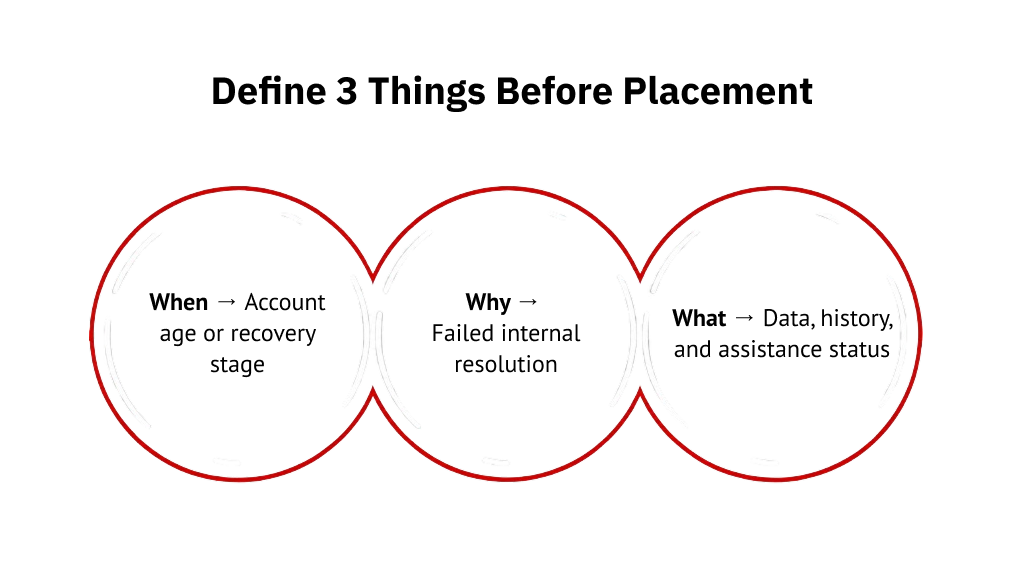
Done well, staging resolves most of that tension. Knowing when to shift from first-party to third-party collections keeps early outreach under your brand longer. Stage that phase long enough to protect your reputation, then move on before the account ages past easy recovery. To that end, define how many first-party touches each account type receives before placement.
| Pro tip: Match the outreach approach to the account type before you match it to the timeline. An emergency department balance and an elective-procedure balance carry different reputational risk, even at the same account age. |
Weighed together, every factor so far points to one final question about timing.
Is it time to outsource healthcare debt collection services?
It is time to outsource healthcare debt collection services when aged self-pay balances keep climbing month after month. The same holds when billing staff lose growing hours to collections calls, and each delay deepens the backlog. In return, the right healthcare collection agency improves recovery while protecting your compliance posture and reputation.
As a next step, compare partners on compliance controls and vendor fit. After that, map out cost models and transition planning before you place a single account.
Could your recovery efforts scale without increasing your internal workload? See how FCS can extend your collection capacity without adding to your internal team.
FAQs
1. How long does it take to see recovery results after placing accounts with a partner?
Most partners typically show measurable recovery activity within 30 to 60 days of placement. Full portfolio performance is usually assessed over a 90-day cycle. This timeline is separate from onboarding, which covers data setup and compliance review before outreach begins.
2. Does outsourcing collections affect patient satisfaction scores?
It depends on the partner’s tone and channel discipline. A partner trained in healthcare-specific communication typically affects satisfaction less than an untrained internal team making overdue calls. Before placing accounts, ask to review the partner’s call scripts and complaint-handling process.
3. Can we outsource only our oldest accounts and keep newer balances in-house?
Yes. Many providers segment by account age, sending balances past 90 or 120 days to a partner while billing staff manages early-stage follow-up. The key is a written handoff rule, so every account moves at a consistent point, and no balance gets worked twice.
4. What happens to a placed account the partner cannot recover?
Within an active placement, unrecovered accounts are typically returned to the provider or closed per the service agreement. Under contingency pricing, no fee is owed on them. What happens when the overall contract ends depends on the exit terms you negotiate upfront.
5. How do you know if your organization is large enough to outsource?
In most cases, outsourcing makes financial sense once annual self-pay placements are large enough to justify onboarding and integration work. Hospital systems and mid-size to large medical groups usually qualify. Smaller practices often gain more from tightening in-house follow-up first.
6. What information do you hand off when placing accounts with a partner?
Typically, you share each account’s balance and aging data, along with its prior contact history. Relevant insurance and dispute notes should also travel with the record, plus any financial assistance status. Under HIPAA’s minimum necessary standard, clinical details beyond what resolution requires should stay with the provider.