


Collections usually start breaking long before customers become unwilling to pay.
As account volumes rise, follow-ups slow down, communication across channels becomes inconsistent, and recovery teams struggle to keep pace. Over time, payment disputes, overdue balances, and unanswered reminders begin piling up faster than teams can resolve them. Such issues materialize into declining recovery performance, rising complaints, and damaged customer relationships.
That challenge is becoming harder to manage as consumer debt pressure rises. According to the Federal Reserve’s 2025 report, U.S. credit card debt crossed $1.2 trillion in 2024, while minimum-payment behavior reached its highest level in at least a decade.
For many businesses, that creates a difficult balancing act. Recovery teams need to move faster and manage larger account volumes. However, aggressive collections workflows can damage customer relationships, increase complaints, and create compliance risk. Scaling internal collections teams quickly isn’t always practical either.
That is why more organizations are moving toward first-party collections outsourcing models that combine white-label recovery, digital engagement, compliance oversight, and operational scalability.
This guide explains how first-party collections outsourcing works, what sets strong providers apart from generic vendors, and how businesses evaluate the right partner for long-term recovery performance.
What Is First-Party Collections Outsourcing?
First-party collections outsourcing means hiring an external partner to recover early-stage receivables under your company’s brand. The consumer never knows they are interacting with an outside team. This model is commonly used for pre-charge-off collections outsourcing, typically for accounts 0 to 120 days delinquent. The goal is to recover overdue revenue without damaging the customer relationship. Many businesses use outsourced first-party collections to scale recovery operations faster without expanding internal teams.
Let’s explore how in-house, first-party, and third-party collections differ across branding, compliance, scalability, and customer experience.
| Factor | In-House Collections | First-Party Outsourcing | Third-Party Outsourcing |
| Brand on communication | Your brand | Your brand (white-labeled) | Agency’s brand |
| Typical delinquency stage | 0–60 days | 0–120 days | 90+ days |
| FDCPA applicability | Exempt | Generally exempt | Fully subject |
| Customer relationship | Preserved | Preserved | At risk |
| Scalability | Limited by headcount | Highly scalable | Scalable |
| Cost Model | Fixed salaries and overhead | Typically contingency based | Contingency or fee-based |
*First-party exemption generally applies when the outsourced partner collects in the creditor’s name. State UDAAP and TCPA rules still apply.
If you’re already past the “should we outsource?” question and into the “how do we pick the right partner?” stage, the evaluation changes quickly. It becomes less about cost alone. Technology, compliance, scalability, and customer experience carry more weight.
Pro Tip: You can also explore FCS’s first-party collections services to see how a modern first-party collections outsourcing model combines white-label recovery, omnichannel engagement, and compliance-focused operations.
What to Look for in a First-Party Collections Outsourcing Partner
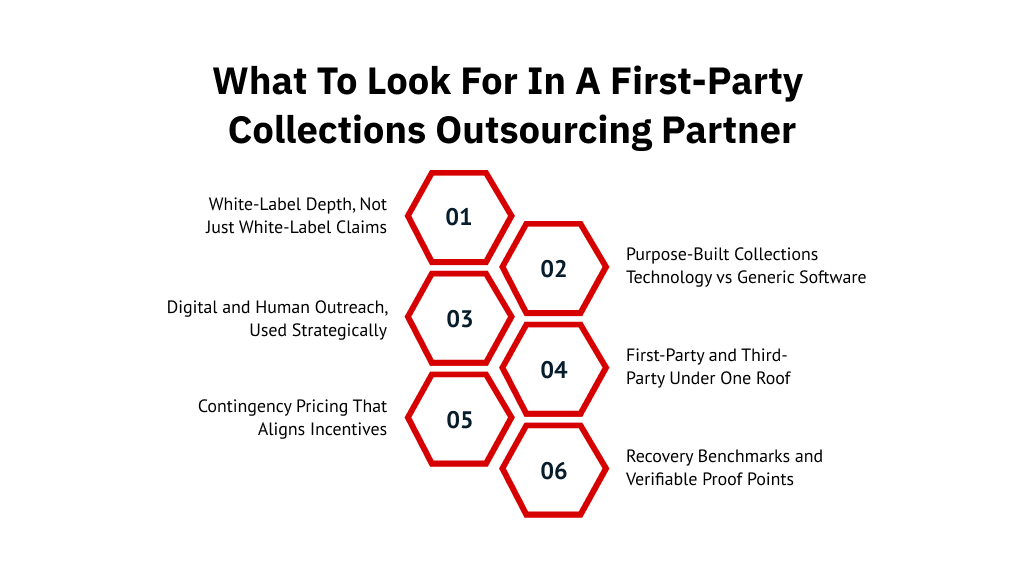
Most providers promise better recovery rates. That alone is not enough. The real difference lies in how they protect your brand, manage compliance, scale operations, and engage consumers throughout the recovery lifecycle.
If you are evaluating first-party collections outsourcing partners, here are the areas worth examining closely.
1. White-Label Depth, Not Just White-Label Claims
Many providers claim to offer white-label collections. The real question is whether the experience actually feels like an extension of your brand.
A strong partner keeps branding, messaging, and communication consistent across phone, email, SMS, payment portals, and support workflows. Scripts should reflect your brand voice, not generic collection language. Agents should also receive account-specific training before outreach begins.
A major red flag is templated communication reused across clients. Customers notice when the experience feels outsourced.
2. Purpose-Built Collections Technology vs Generic Software
There is a major difference between standard call-center software and purpose-built recovery technology.
Modern collections programs rely on AI-driven engagement, omnichannel coordination, self-service payment portals, behavioral segmentation, and real-time reporting. Therefore, SMS, email, voice, and self-service workflows should operate as a single, connected recovery sequence, not as disconnected outreach attempts.
If a provider struggles to explain how the platform works, the technology is probably not a true differentiator.
3. Digital and Human Outreach, Used Strategically
Strong recovery programs do not rely entirely on phone calls or automation. They use both strategically.
Digital outreach works well for high-volume, lower-complexity accounts, while human agents become more valuable during disputes, hardship conversations, or escalations. According to PR Newswire’s 2025 report, nearly 60% of Gen Z and Millennial consumers prefer financial providers offering text-based communication.
The key is knowing when accounts should move from automated engagement to human support.
4. First-Party and Third-Party Under One Roof
Not every first-party recovery effort succeeds. The real question is how smoothly accounts transition into later-stage recovery.
Using separate vendors for first-party and third-party collections often creates fragmented communication, operational delays, and loss of customer context during handoffs. In contrast, partners managing both under one relationship create smoother escalation paths because payment history, communication records, and engagement data move with the account. That continuity improves both recovery efficiency and customer experience.
You can also review how modern third-party collections programs support smoother recovery escalation at later stages of delinquency.
5. Contingency Pricing That Aligns Incentives
Pricing structure reveals how accountable a collections partner expects to be.
Contingency pricing creates the clearest alignment because the provider earns revenue only when recovery happens. Some providers, including certain FCS first-party recovery models, may use fixed-support or per-seat pricing for programs that require agent-driven engagement alongside digital outreach.
However, businesses should watch carefully for:
- Large upfront setup fees
- Long-term contracts without benchmarks
- Hidden operational costs
- Minimum commitments disconnected from performance
A simple question helps clarify the relationship quickly: “What do we pay if recovery performance underdelivers?”
The answer usually tells you how accountable the provider expects to be.
6. Recovery Benchmarks and Verifiable Proof Points
Every collection partner claims strong recovery performance. The more important question is whether they can prove it.
Ask for recovery benchmarks across different delinquency stages, since early-stage recovery at 30 days looks very different from performance at 90-plus days. To further validate those results, request client references in your industry and anonymized case studies that demonstrate measurable outcomes.
Good providers should be able to share examples tied to:
- Recovery rate improvement
- Roll-rate reduction
- Right-party contact performance
- Digital engagement metrics
- Reduced operational workload
- Faster payment resolution
Vague claims without supporting numbers should raise concerns immediately.
The Compliance Angle Most Companies Underestimate
Compliance is often treated like a checkbox during vendor evaluation. In reality, it becomes one of the biggest operational risks in collections outsourcing. That is especially true in first-party recovery, where businesses must balance revenue recovery with customer trust, regulatory scrutiny, and brand protection.
A strong collections partner should not just understand compliance requirements. They should build them into communication workflows, outreach policies, reporting, and agent training.
First-Party Exemption Under FDCPA: What It Actually Means
The Consumer Financial Protection Bureau enforces many of the rules that shape modern collection practices. One of the most misunderstood areas is how the Fair Debt Collection Practices Act (FDCPA) applies to first-party collections.
The FDCPA primarily governs debt collectors, not original creditors. When an outsourcing partner contacts consumers under your company’s brand name, the interaction generally falls outside the FDCPA’s strictest requirements. That is why the first-party exemption exists in the first place.
However, “generally exempt” does not mean “unregulated.” State-level UDAAP laws still apply to unfair or deceptive practices. The Telephone Consumer Protection Act (TCPA) governs automated calls and text messaging regardless of whether the outreach is first-party or third-party. The CFPB also maintains enforcement authority that extends beyond narrow FDCPA definitions.
Although Regulation F primarily targets third-party collectors, many of its communication standards now also influence first-party recovery programs. Frequency controls, disclosure practices, consent management, and communication tracking have become broader industry expectations.
That is why strong first-party collections outsourcing partners often follow FDCPA-level standards even when technically exempt. It helps reduce regulatory exposure and better protect client brands over time.
Industry-Specific Compliance Adds Another Layer
General collections compliance is only part of the evaluation process. Industry-specific regulations create additional operational complexity.
| Some industry-specific compliance requirements include:Healthcare: HIPAA governs how patient billing and delinquency communication can be handled. Collections partners should demonstrate HIPAA-compliant workflows, secure communication controls, and documented operational processes. Financial services and fintech: State lending regulations, licensing requirements, PCI DSS standards, and payment-data security controls all influence how collections workflows operate across channels. |
That is why one question matters during vendor evaluation: “Can you show us the compliance certifications relevant to our industry, and explain how those standards are maintained operationally?”
A vague answer is usually a warning sign.
You can also explore FCS compliance capabilities to understand how regulatory requirements are managed across the recovery lifecycle. In addition, check industry-wise solutions to see how compliance needs vary across different recovery environments.
How First Credit Services Approaches First-Party Collections Outsourcing
The earlier evaluation criteria become easier to understand when viewed through a real operating model. Here is how First Credit Services (FCS) approaches first-party collections outsourcing across people, technology, and compliance infrastructure.
The Service: FCS as Your Outsourced AR Team
At the operational level, FCS functions as an extension of the client’s accounts receivable team rather than as a disconnected third-party vendor. Agents are trained on the client’s business, customer base, escalation policies, and brand voice before outreach begins.
Key parts of the operational model include:
- Fully white-labeled communication across calls, emails, SMS outreach, and payment workflows.
- Real-time CRM and billing system integration to reduce reconciliation gaps and disconnected workflows.
- Contingency-based pricing for many first-party programs, with per-seat pricing available for dedicated live-agent support.
- First-party and third-party collections are managed under the same relationship for smoother escalation and lifecycle continuity.
- Compliance standards include HIPAA, PCI DSS Level 1, SOC 2 Type II, RMAI certification, ACA International membership, and BBB accreditation.
- Three global call centers with both onshore and offshore support capacity for operational flexibility and scale.
Together, these capabilities allow businesses to scale recovery operations while maintaining brand consistency, operational visibility, and compliance oversight.
The Platform: UCEP (Unified Consumer Engagement Platform)
FCS powers its digital-first recovery operations through UCEP, its proprietary consumer engagement platform. Managed internally by FCS, the platform orchestrates first-party recovery workflows on behalf of clients while maintaining a fully branded customer experience.
It supports both digital-first engagement and blended recovery programs. In practice, automated communication and live-agent outreach work together within coordinated omnichannel workflows.
Key capabilities include:
- AI-driven contact strategy: UCEP helps optimize outreach timing, channels, and messaging based on engagement behavior and account activity to improve right-party contact rates without increasing outreach volume.
- Omnichannel workflow orchestration: SMS, email, chat, and phone outreach operate within coordinated engagement sequences. The next action depends on how consumers respond, reducing communication fatigue and improving engagement quality.
- Self-service payment portal: Consumers can review balances, enroll in payment plans, or accept settlement offers via a branded, mobile-first portal available 24/7. This speeds up straightforward account resolution without requiring agent involvement.
- Behavioral analytics and AI segmentation: Accounts are prioritized based on delinquency stage, responsiveness, payment behavior, and risk indicators. Outreach resources focus on areas with the highest recovery probability.
- Full white-label experience: Every interaction reflects the client’s branding. It allows consumers to experience the engagement as a direct extension of the original brand relationship.
- System integration and reporting: UCEP connects to CRM, billing, and payment systems via APIs, CRM sync, or SFTP workflows. Reporting dashboards track recovery performance, engagement metrics, payment conversion, and outreach effectiveness in real time.
You can explore the platform further through FCS digital collections solutions.
How They Work Together in Practice
The combined model works as a coordinated recovery workflow rather than disconnected digital and agent processes.
The process typically begins with account data flowing into FCS through API integrations, CRM synchronization, or SFTP transfers. UCEP then segments accounts based on delinquency stage, behavioral signals, responsiveness, and recovery likelihood.
From there, digital outreach begins first. Consumers receive branded SMS reminders, payment emails, and access to the client’s self-service portal under the client’s name. Many early-stage accounts resolve directly through the digital payment experience without agent involvement.
When digital engagement stalls or accounts become more complex, live agents step in. FCS agents handle disputes, hardship conversations, negotiations, and escalations using workflows aligned with the client’s brand and policies.
Throughout the process, both digital and agent-driven interactions remain connected inside the same recovery environment. Activity is logged in dashboards and client systems in real time, ensuring continuous communication throughout the account lifecycle.
If first-party recovery efforts still fail, the account can transition directly into FCS’s third-party collections operation without losing communication history, behavioral data, or recovery context.
| Case study: Failed-payment recovery for a membership business A large health and fitness membership brand was struggling with 500–700 failed payments per club each month. Internal teams could not consistently manage follow-ups, leading to recurring revenue loss and preventable membership churn. FCS implemented a white-labeled first-party recovery workflow using SMS, email, phone outreach, and self-service payment options under the client’s brand. The program focused on resolving failed payments early before accounts were canceled or moved deeper into delinquency. Results included: 1. Up to 70% monthly failed-payment recovery 2. Around 400 retained members per club each month 3. Roughly $6,000 in monthly recovered revenue per club 4. Reduced operational workload for internal teams 5. Recovery programs delivering reported ROI above 600% across similar engagements. Read the full failed-payment recovery case study. |
Which Industries Benefit Most from First-Party Outsourcing
First-party collections outsourcing works especially well in industries where customer retention, compliance, and high account volume intersect. The operational challenge is usually not just recovering revenue. It is recovering revenue without damaging long-term customer relationships.
| Industry | Why First-Party Outsourcing Fits |
| Healthcare | Patient billing communication is highly sensitive and regulated under HIPAA. Therefore, healthcare recovery solutions enable providers to recover balances earlier while preserving patient trust. |
| Subscriptions and recurring revenue | Failed-payment churn is often involuntary. Customers may have expired cards or temporary payment issues rather than true cancellation intent. This is where digital recovery workflows help recover revenue before customers disengage entirely. |
| Auto finance and consumer lending | Rising delinquency pressure makes early-stage recovery increasingly important. Borrowers who have poor collection experience are less likely to return for future products. In such cases, brand-safe auto finance collections solutions help lenders protect both recovery performance and future customer value. |
| Fintech | Fast-growing fintech companies need scalable recovery operations that support digital-first customer communication without building large internal teams. Here, fintech collections solutions help balance operational scale with modern customer engagement. |
Getting Started: What the Transition Looks Like
For many businesses, the final hesitation is not whether first-party collections outsourcing works. It’s understanding what onboarding and day-to-day execution actually look like.
A typical rollout usually follows four stages:
- Data and system setup: The client shares delinquent account data, payment history, contact information, brand guidelines, escalation thresholds, and access to the CRM or billing system for integration.
- Launch preparation: The partner handles data integration, workflow setup, script alignment, compliance reviews, and agent training. A strong provider should typically be able to go live within a few weeks.
- Pilot phase: Most companies start with a specific delinquency bucket, product line, or region rather than a full rollout. Teams then track KPIs such as recovery rate, contact rate, roll-rate reduction, and customer satisfaction over a 60–90 day period.
- Ongoing optimization: First-party recovery is not a set-and-forget process. Outreach timing, messaging, and channel mix should continuously evolve based on engagement and recovery performance data.
You can explore onboarding and recovery consultation options through sales inquiries.
Build a More Scalable Recovery Operation with the Right Partner
First-party collections outsourcing now plays a larger role than recovering overdue balances. It helps businesses protect customer relationships, scale recovery operations efficiently, and maintain compliance across the collections lifecycle.
If you are evaluating whether FCS is the right fit for your recovery strategy, the fastest next step is a conversation about your accounts, your industry, and what a pilot program could look like.
Schedule a recovery strategy discussion with FCS.
FAQs
1. Do outsourced first-party collections fall under the FDCPA?
Generally, no, because the partner collects in the creditor’s name. But state UDAAP laws, TCPA, and CFPB enforcement still apply. A responsible partner follows FDCPA-level standards regardless of whether they’re technically required.
2. Will my customers know they’re talking to an outside company?
In a true white-label arrangement, no. All communication, including calls, texts, emails, and the payment portal, appears under your brand. The consumer experience looks and feels like your internal team.
3. What’s the best pricing model for first-party outsourcing?
Contingency-based pricing, where you pay a percentage of what’s collected, aligns incentives most directly. You don’t pay unless the partner delivers results. Not every provider uses this model, so it’s worth asking upfront.
4. Can I outsource just a portion of my accounts?
Yes. Most companies start with a specific segment (a delinquency bucket, a product line, or a region) and expand based on performance.
5. What happens to accounts that can’t be resolved through first-party?
They can escalate to third-party collections. Partners who handle both first- and third-party under a single relationship make this transition smooth, with no data loss and no vendor switching.
6. How long does it take to get started?
With the right partner, onboarding typically takes a few weeks. This includes data integration, brand alignment, script development, and agent training. Most companies start with a pilot before scaling.