


An account has passed another due date. Your team has sent reminders, but the latest promise to pay has also slipped. Now the question is whether another follow-up will move the account forward or simply repeat the same cycle.
Deciding when to send an account to collections requires more than an aging threshold. Customer responses and unresolved disputes also shape that decision.
According to the New York Fed’s Q4 2024 report, the annualized rate of credit card balances entering serious delinquency rose to 7.18%, from 6.36% a year earlier.
Against that backdrop, a consistent placement policy helps your team review overdue accounts without relying on individual judgment alone.
This guide covers six signals that internal recovery has stalled, how timing varies by account type, and the readiness checks to complete before placement. It also explains how to build a policy your team can follow every cycle.
When should you send an account to collections?
Send an account to collections when your written age threshold is reached, internal follow-up has stalled, and the balance is verified. Hold accounts with unresolved disputes or legal restrictions until the required review is complete.
For planning, 60 to 90 days past due can serve as a benchmark, but it is not a universal legal rule. Document your default threshold and exceptions, with finance and compliance approval.
Why there’s no single right day
Adjust timing using four factors:
- Account type: Revolving credit and medical balances follow different billing cycles and requirements
- Customer behavior: Missed promises, partial payments, and recent responses can change the next step
- Recovery economics: Compare expected net recovery with the cost of further internal work
- Industry rules: Apply product-specific restrictions before using a general benchmark
Define exhausted internal follow-up through measurable criteria: attempts across permitted channels, missed commitments, and time since the last meaningful response. Then complete the readiness checklist below before placement.
If accounts need additional outreach under your brand, early-stage collections can supplement internal capacity before third-party referral.
Why delaying a placement decision can cost more
When an account stays in follow-up without a scheduled next step, it can become harder and more expensive to work. Four costs deserve attention:
- Stale contact details: Moves, disconnected numbers, and abandoned email addresses can increase skip-tracing work
- Inconsistent follow-up: Without a firm review point, some accounts receive repeated calls while others receive none
- Missed payment arrangements: Delayed responses to missed installments leave problems unresolved and make restarting the conversation harder
- More investigation: Longer payment histories and archived records can increase the work needed to reconstruct an account
Meanwhile, staff time spent repeating unsuccessful steps is unavailable for customers who remain engaged. The question is whether another internal action has a reasonable chance of improving the outcome.
However, account age alone does not justify placement. A documented hold for a dispute, hardship review, or legal restriction may still be appropriate.
| Pro tip: Pair your age threshold with a review date. Every account that passes it should have a documented decision: place, hold, or complete a specific next step. |
6 signals an account is ready for collections
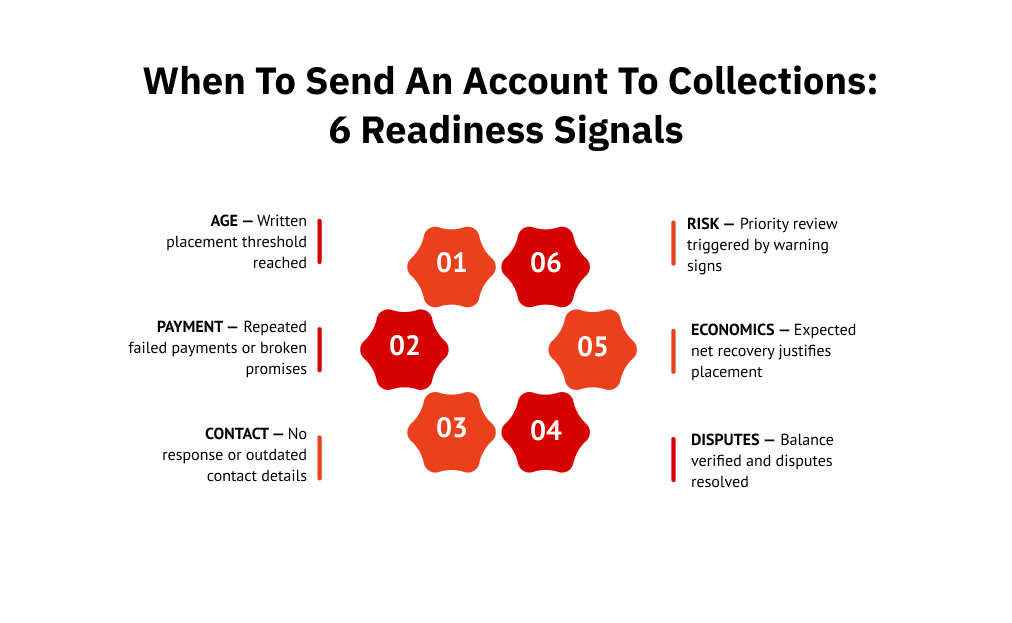
A calendar date alone does not make an account ready for placement. The account also needs to show specific behavioral and operational signals that confirm internal follow-up has run its course. Use these six signals as a checklist before any account moves to an agency.
1. The account has reached your written age threshold
Measure account age from the original due date, not the last statement or invoice date. Those two dates can be weeks apart, and measuring from the wrong one creates inconsistency across your portfolio.
Your threshold should already appear in at least one of these places:
- Your customer terms or service agreement
- Your internal financial policy
- The final notice you send before escalation
If it does not appear in any of them, the threshold is informal.
Informal thresholds shift depending on who reviews the account and how busy they are that week. Write it down, get finance and compliance to approve it, and reference the same number in every placement decision.
2. Payment attempts failed, or promises were broken
Repeated missed promises or unsuccessful retries suggest that the current approach needs review. First, check why a card or Automated Clearing House (ACH) payment failed, notify the customer, and request an updated method or arrangement.
If the customer continues missing agreed dates or does not respond, document the pattern and reassess placement. However, a partial payment is not automatically a broken arrangement; compare it with the agreed schedule before escalating.
3. The customer stopped responding or may have moved
Before placing an account for non-response, confirm that your team has attempted contact across every available channel. A customer who ignores phone calls may respond to a text, whereas the one who ignores email may respond to a letter. Counting attempts in a single channel and calling it “exhausted” leaves recovery on the table.
Define “non-responsive” in measurable terms. For example: no reply to three contact attempts across at least two channels over 14 days. Without that definition, the judgment varies by staff member and by workload.
Returned mail, disconnected numbers, and bounced emails suggest the customer may have relocated. These accounts need earlier review because contact data decays quickly once it starts going stale. Each week of delay increases the chance that the remaining contact paths also go cold.
When you do identify a skip-trace candidate, that is a signal the account has moved past what most internal teams can handle. Omnichannel recovery programs are designed for exactly this scenario: coordinated outreach across channels with updated contact data.
4. Any dispute has been reviewed and the balance reconciled
Hold placement until the dispute is reviewed, the balance is reconciled, and applicable dispute-handling requirements are met. Otherwise, the agency may need to pause recovery as soon as it receives the account.
Under the Fair Debt Collection Practices Act (FDCPA), consumers generally have 30 days after receiving validation information to dispute a debt in writing. A timely dispute generally requires the collector to pause collection of the disputed amount until it sends verification to the consumer. Thus, unresolved disputes can leave accounts idle while teams exchange documents.
Resolving the issue internally first helps avoid that delay. However, an internal finding that a dispute lacks merit does not replace the collector’s legal verification duties. Document the outcome and meet applicable requirements before placement.
| Pro tip: Resolve balance questions and prepare supporting documents before placement. This helps the agency assess readiness and respond to disputes without avoidable back-and-forth. |
5. The recovery economics still add up
Before placing, weigh three things:
- The outstanding balance
- The expected net recovery after agency fees
- Your internal cost to keep working the account (staff hours, letters, calls, payment processing)
No federal law sets a minimum balance for collections. However, very small balances may not justify placement if the expected recovery after fees is negligible. In those cases, batching small balances together for periodic placement often works better than writing them off by default.
On the other end, large balances sometimes justify extended internal effort because the potential recovery is high enough to cover the extra cost.
The decision is not about balance size alone. It is about whether the next dollar of internal effort is likely to return more than what an agency would recover on the same account.
6. Risk signals call for priority review
Certain customer behaviors should move an account to the front of your review queue. These signals do not mean the account goes straight to an agency. They mean it gets reviewed sooner rather than waiting for the next scheduled cycle.
Watch for these:
- The customer states they will not pay.
- The customer revokes the payment method on file or files a chargeback.
- Multiple accounts from the same customer become delinquent at the same time.
A chargeback requires closer review because it may stem from a billing error, a misunderstanding, or misuse of the dispute process. Regardless of the cause, the same readiness checks apply before placement. Across large portfolios, predictive models can help prioritize accounts for review based on risk signals.
How placement timing varies by account type
A single placement rule rarely works across an entire portfolio. Payment behavior, regulation, and customer expectations differ by account type. The table below separates common business practice from the legal and accounting milestones that apply in consumer-facing industries.
| Account type | Common placement practice | Rule or milestone to account for | What it controls |
| Credit cards and other revolving credit | Early-stage first-party work during delinquency; third-party placement before or after charge-off, depending on strategy | Charge-off at 180 days delinquent | Accounting and credit classification, not the placement date |
| Auto loans and personal installment loans | Early-stage first-party work during delinquency; third-party placement before or after charge-off, depending on strategy | Charge-off at 120 days delinquent | Accounting and credit classification, not the placement date |
| Fintech and buy-now-pay-later | Depends on the product’s credit structure and lending partner | The lending partner’s policies and applicable rules | Varies by product; one timeline doesn’t fit all |
| Healthcare patient balances | Referral after insurance processing and financial-assistance screening | IRS 501(r) for nonprofit hospitals | Extraordinary collection actions, not the referral itself |
| Health and fitness memberships | Placement after failed-payment retries and a short internal follow-up cycle | Membership contract terms and state law | Fees, cancellation and contact rules |
| Government and municipal (fees, fines, utility-type charges) | Placement per statute or ordinance | Local code and procurement terms | Who can collect, when, and what can be added |
Each business sets its own policy within these limits.
Healthcare: 501(r) limits certain actions, not referrals
Under Section 501(r), nonprofit hospitals must make reasonable efforts to assess financial-assistance eligibility before extraordinary collection actions. It also includes certain debt sales, credit reporting, and legal actions. These generally require waiting at least 120 days after the first post-discharge bill.
Agency referral alone is not an extraordinary action, but hospitals remain accountable for agencies acting on their behalf. Meanwhile, Medicare’s 120-day bad-debt rule governs reimbursement eligibility, not referral timing.
An extended business office can continue outreach under the provider’s brand while insurance and balance questions are resolved, reducing delays before placement.
| Did you know? In an October 2025 MGMA poll, 29% of medical group leaders said patient-balance collections had worsened compared with the prior year. |
Lending and consumer finance: charge-off is not a placement deadline
Federal banking guidance generally calls for charge-off at 180 days past due for open-end credit and 120 days for closed-end loans. However, charge-off is an accounting milestone. First- or third-party collection can occur before or after it, subject to applicable requirements. Set placement timing to give the agency enough time to work the account.
How to build a placement policy in 5 steps
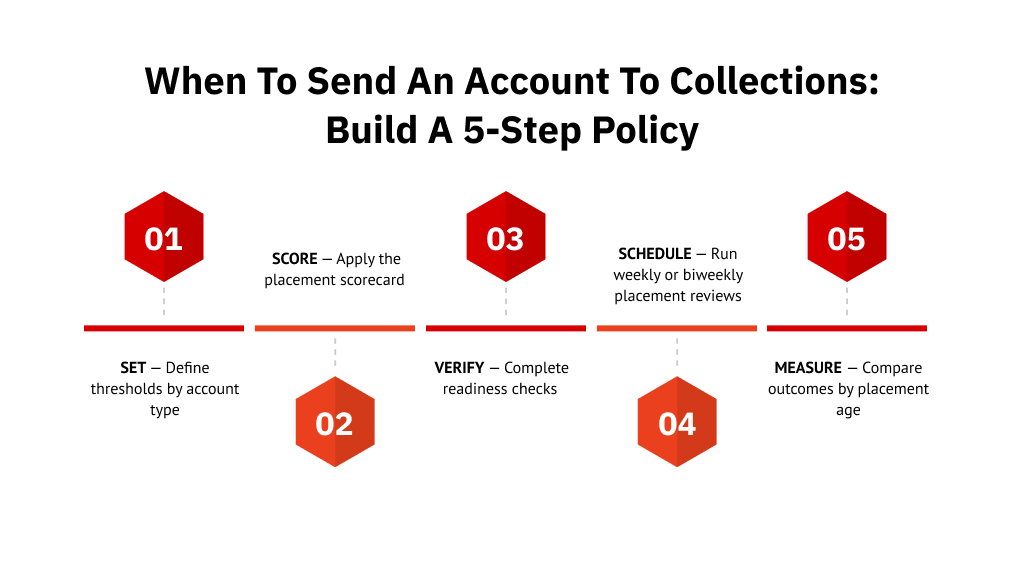
The signals and benchmarks above only work if your team applies them the same way every cycle. This section turns them into a written rule.
- Set a default threshold for each account type, approved by finance and compliance.
- Score each account with the placement scorecard.
- Run a pre-placement readiness check.
- Place accounts on a fixed cadence (weekly or biweekly sweeps).
- Measure results by placement-age group and recalibrate quarterly.
The placement scorecard
Use this scorecard to move each account into one of three categories. Any “Hold” result blocks placement. However, even with a “Place now” result, you must complete the readiness checklist below before proceeding.
| Factor | Place now | One more internal cycle | Hold |
| Account age | Written threshold reached | Threshold close, with a specific next step scheduled | Policy or regulatory condition not yet met |
| Contact status | Attempts documented, no meaningful response | A promised callback or scheduled contact remains | Contact or identity details need verification |
| Promise history | Repeated broken promises | A credible payment arrangement is active | Account status needs review |
| Dispute status | Balance verified; applicable dispute process complete | Supporting documentation being gathered | Unresolved dispute or legal restriction |
| Recovery economics | Expected net recovery justifies placement | A specific internal step has a reasonable expected return | Documentation insufficient or placement uneconomic |
Pre-placement readiness checklist
Before any account moves to an agency, confirm these items:
- Balance reconciled
- Final notice with a firm date sent
- Dispute reviewed and closed
- Bankruptcy, deceased, and other legal-status screens complete
- Customer agreement, statements, and contact log attached
For the internal steps before this point, see how to collect past-due accounts.
Worked example: what a 90-day delay can mean
The table below uses illustrative assumptions to show how placement timing affects expected recovery. Both recovery rates are hypothetical. The example excludes agency fees and internal costs, and it compares two scenarios rather than the same accounts tracked over time.
| Scenario | Customer balances placed | Assumed recovery rate | Expected recovery |
| Placed at 90 days | $100,000 | 25% | $25,000 |
| Placed at 180 days | $100,000 | 15% | $15,000 |
| Difference | $10,000 |
Compare similar account groups over the same period. Then track recovery rate, net-back, and time to first payment. If earlier placement consistently improves net returns, move that segment’s threshold earlier.
Placement timing mistakes to avoid
These five mistakes can undermine an otherwise sound placement policy:
- Placing disputed or unreconciled balances: Review disputes, reconcile balances, and prepare supporting records before placement to reduce delays.
- Waiting for “one more call”: Extend follow-up only with a clear purpose and a scheduled next step.
- Missing promised placement dates: Follow through on stated deadlines to keep future notices credible.
- Using one threshold for every account: Adjust timing for account type, customer circumstances, and applicable requirements.
- Placing accounts at random: Use a weekly or biweekly cycle to support predictable workloads and regular reviews.
Write the placement rule before you need it
When follow-up stalls, your team should already know the next step. A written placement policy provides that direction.
Start with an age benchmark, then adjust it by account type. Next, review missed promises and nonresponse while holding accounts with unresolved disputes or legal restrictions. Use your recovery results to refine the timing.
Applied consistently, these rules help your team act promptly and explain each placement decision.
Talk to our experts about placement timing that fits your portfolio.
FAQs
1. Can you send an account to collections if the customer reports identity theft?
If a consumer reporting agency provides an identity-theft notification that meets the applicable federal requirements, the law generally prohibits selling, transferring, or placing the debt for collection. If an identity-theft claim reaches you through another channel, pause the account and investigate before proceeding.
2. Can you send an active-duty service member’s account to collections?
Yes, but federal protections still apply. A service member can ask to cap interest at 6% on debts taken on before active duty. Courts also require proof of military status before granting a default judgment. Screen accounts for active-duty status before placement so the agency can apply these protections from day one.
3. Can you send a minor’s account to collections?
Contracts entered into by minors are generally voidable, subject to exceptions under applicable law. Do not assume a parent or guardian is liable solely because the customer is a minor. Verify who accepted financial responsibility under the agreement and applicable state law before placing the account.
4. Do you have to stop contacting the customer once an account is placed?
No law generally requires you to stop, but you should. Two parties contacting the same customer creates conflicting messages and payment confusion. Route all outreach and payments through the agency, and refer any customer who calls you to the agency for account details.
5. What should you do if you sent an account to collections by mistake?
Recall it immediately and ask the agency to stop all activity. If the account was reported to a credit bureau, have the reporting corrected or deleted, since furnishers must correct information they know is inaccurate. Notify the customer and fix the cause, such as a missed payment posting or a wrong balance.
6. Does sending an account to collections stop interest and late fees?
Interest and fees continue to apply only if the customer agreement and state law allow them. A third-party collector can collect only amounts the agreement or law authorizes. Give the agency an itemized balance at placement so every amount it collects is permitted.